
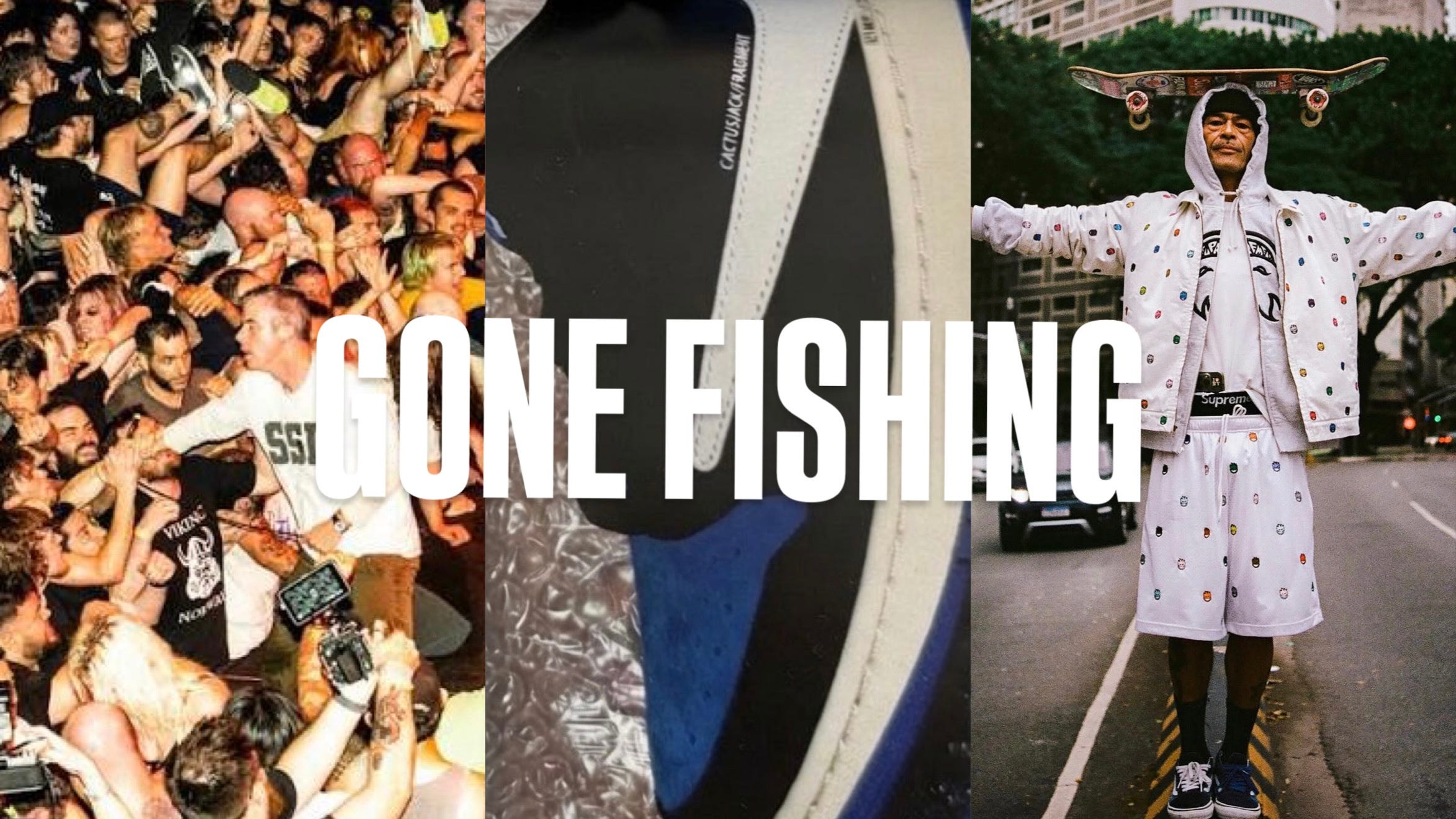
When you are reading this, I’m already on my way to Paris for PFW that starts next week. For anyone working at the intersection of culture, brands, fashion, music, sport, and community, there are few places more inspiring than Paris during these days. That's for sure! Beyond the runways, it's the streets, conversations, chance encounters, and emerging ideas that make PFW such a unique moment to understand where culture is moving next. On top, I have an event with Till Jagla and his team of footwear-brand Flowers For Society - and I’m excited and proud and proud and excited to add my name to the event-list of PFW, especially because it’s also the first event for GONE FISHING. Plus: I will release my culture essay “Why Street Culture Won” as a limited printed version on-site. 4,223 words. 18 pages. And a passion project. I will tell you a little bit more about it in the next issue, but if you’re around PFW next week, hit me up, and I’ll gift you a copy!
That being said, let’s have a look at all the news of this week, I’ve fished from the sea of information…

Source: Satisfy Running
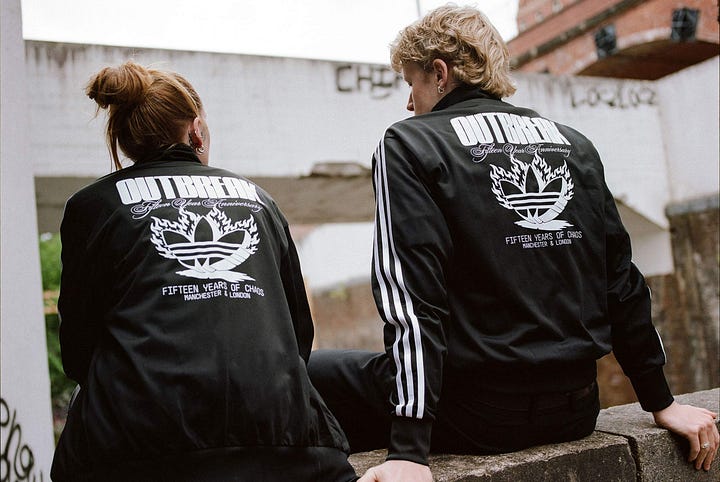
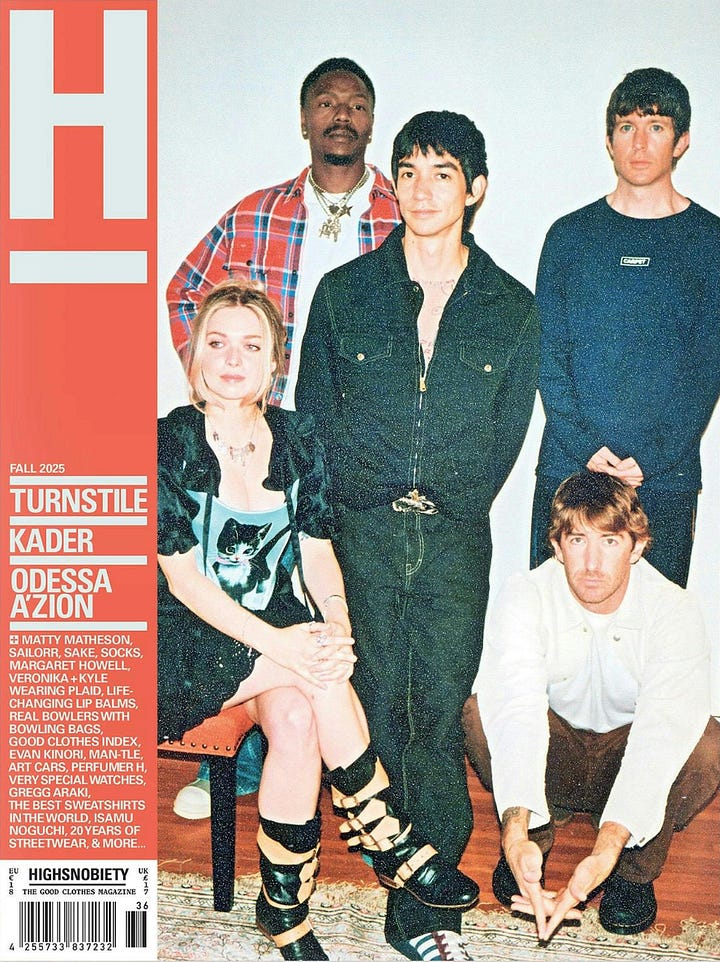
Source: Outbreak Fest / Highsnobiety
Honestly, seeing Turnstile on the cover of Highsnobiety was cool, but weird. Seeing Satisfy Running adapting the circle pit for their collaboration with adidas felt something between interesting and awkward. And now, the Outbreak festival releases a capsule-collection with adidas - What happens when Hardcore-Punk goes mainstream?
For most of its history, Hardcore-Punk existed in deliberate opposition to the systems that surrounded it.
Not necessarily because every participant rejected success, money or visibility, but because the scene was built around a different set of values. Hardcore-Piunk was never particularly interested in status. It did not reward exclusivity in the same way fashion did, nor did it celebrate wealth the way Hip-Hop often embraced it as a symbol of overcoming adversity. If Hip-Hop’s defining narrative was moving from the margins to the centre, Hardcore-Punk’s was often about building something meaningful away from the centre altogether.
That distinction matters.
Because while many subcultures eventually become attractive to brands, not all of them arrive there from the same direction.
The recent collaboration between UK-based Outbreak Fest and adidas Originals feels like a useful example. On paper, the partnership makes perfect sense. Outbreak has grown from a small DIY festival into one of the most important gatherings in contemporary Hardcore-Punk and alternative music, while adidas continues to search for communities that possess the kind of authenticity large brands struggle to manufacture themselves. The collection itself is relatively harmless: a black Stan Smith, a black track jacket, and a black t-shirt celebrating fifteen years of the festival. adidas gains cultural relevance. Outbreak gains resources, visibility, support, and money. Everybody wins. At least in theory.
The reaction from parts of the hardcore community suggests the reality is more complicated.
“Nothing screams hardcore like letting big companies capitalise on its community” (ryanfossett)
That shouldn’t be surprising. Hardcore-Punk has always carried political and ethical dimensions that extend beyond music. Conversations around veganism, animal rights, anti-consumerism, community organising, and social responsibility remain far more visible within Hardcore-Punk than in many other contemporary music scenes. Those values do not automatically disappear the moment a scene becomes successful. If anything, they become more difficult to reconcile with the realities of corporate partnerships.
At the same time, it would be dishonest to pretend Hardcore-Punk can remain frozen in time.
Bands cannot survive indefinitely on gas money, floor space, and the occasional vegan hot meal at a venue. Festivals become larger. Tours become more expensive. Audiences grow. Infrastructure becomes necessary. And why should a good message packed in good music only be available to a small crowd?
The question is no longer whether Hardcore-Punk should interact with larger brands. That conversation has already been decided by reality. The more relevant question is which bands and brands, under what conditions, and for what reasons.
That is where the Outbreak collaboration becomes interesting.
The criticism surrounding the project does not seem to stem from the existence of a partnership itself as much as the feeling that something was lost in translation. Many of the comments surrounding the release reflect a familiar concern whenever subcultures enter larger commercial spaces: the fear that brands understand the aesthetic but miss the values underneath it. It’s not a take-and-give mentality - it’s stealing and capitalizing from a culture.
Perhaps that is why Hardcore-Punk remains such a difficult space for brands to navigate. Unlike many other cultural movements, its credibility has never been built around visibility. It has been built around participation. Nobody cared what you wore if you weren’t showing up. Nobody cared how much money you had if you weren’t contributing. Authenticity was earned through involvement rather than consumption.
Yet dismissing every collaboration outright feels equally simplistic.
The energy currently surrounding Hardcore-Punk is undeniably positive. Bands like Turnstile have introduced entirely new audiences to the scene. Festivals are growing. Communities are expanding. More people are discovering a culture and a music that still offers something increasingly rare in contemporary life: genuine participation, belonging, and human connection.
The challenge is making sure those things survive the attention.
Because the real value of Hardcore-Punk was never that it remained underground. The real value was the set of ideas it carried while it was there.
And those ideas are worth protecting, regardless of who wants to collaborate next.
“I'm genuinely happy to see hardcore receiving broader recognition. But it's also worth remembering that cultural relevance doesn't begin when something reaches the mainstream.” (Lena Votteler)
Sometimes it’s not about the collection, but what it represents and stands for. The new Supreme x Spitfire collab is skateboarding par excellence.
And yes, the collection is solid - I’m digging the white workwear jacket, the blue sweater, and the green longsleeve - but the 2:28 minute long video filmed by Johnny Wilson in São Paulo, Brazil is putting everything in perspective.
I don’t want to be too LinkedIn now, but it’s so important - and still so important - for a brand to not only announce and then release a collection. Context is king, and getting people into the right mood more important than to tell them what kind of fabric has been used. The community need to dig the vibe. That’s part of the authenticity of a brand. Supreme knows how to do it. Again.
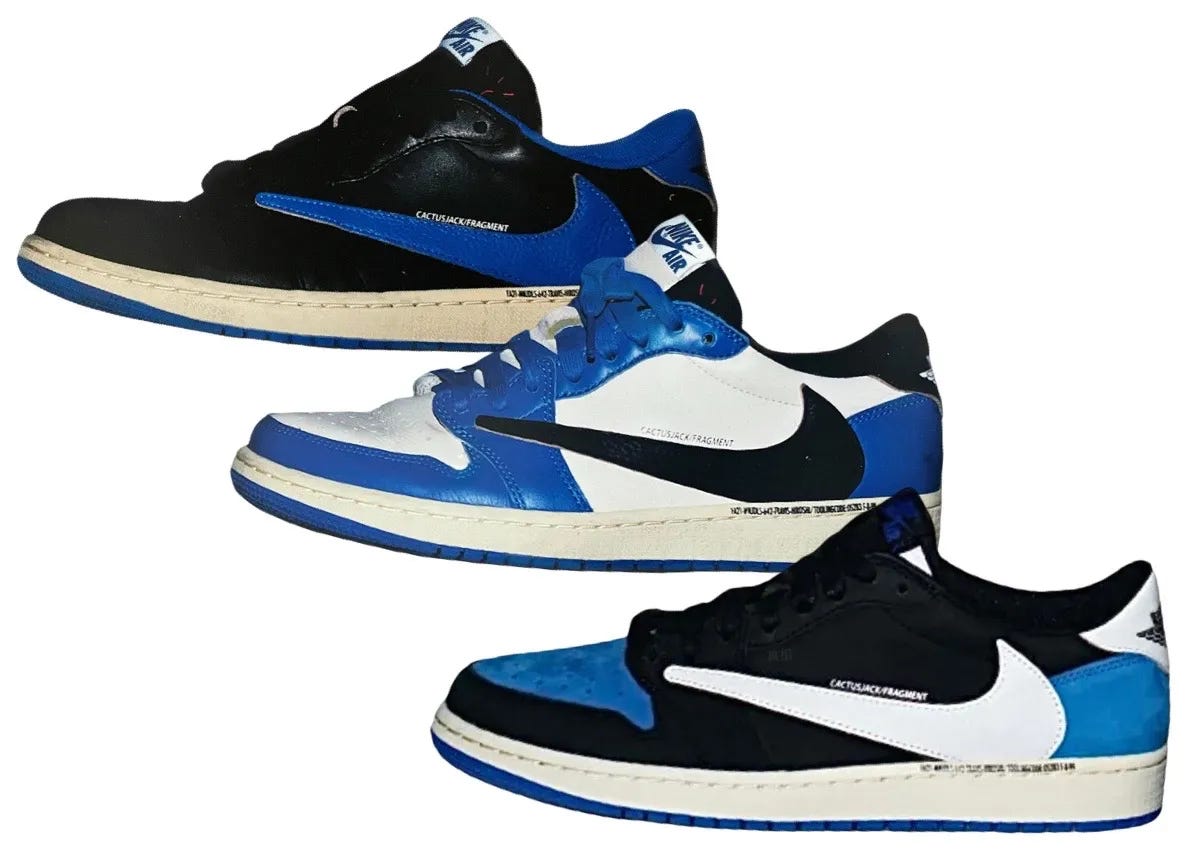
Source: SBD
Could have, should have, would have…
One of the things that continues to make sneaker culture so fascinating is its obsession with the paths not taken.
For every sneaker that reaches retail, there are dozens that never leave the design studio. Samples, prototypes, look-sees, and one-off pairs exist somewhere between history and speculation, offering a glimpse into alternative versions of stories we thought we already knew.
The latest example comes from the Travis Scott x Fragment Design x Air Jordan 1 Low. Originally released in 2021 and widely regarded as one of the defining sneaker collaborations of its era, the shoe has recently resurfaced in the form of several previously unseen sample versions. Among them is a darker interpretation featuring royal blue suede, black nubuck overlays, and contrasting white details, while additional leather-based iterations experiment with different placements of the now-iconic reverse Swoosh. None of the pairs are expected to release, although sneaker history has taught us never to rule anything out completely. And honestly, the ones that are close to the OG Royals most, would turn into a hyped one!
But what makes these discoveries interesting is not necessarily the possibility of a future release. It is the insight they provide into the creative process itself. Samples reveal that sneaker design is rarely a straight line. The shoes that eventually arrive on shelves often represent just one decision among dozens of possibilities, while the unreleased versions tell a parallel story of experimentation, revision, and exploration. Even if we talk about one of the easiest sneaker collabs in years. What Travis and team Nike and Hiroshi Fujiwara did is not that deep artistically.
Sometimes the most interesting sneaker isn’t the one that released. It’s the one that almost did. What do you think? Which one is your fav? Let me know in the comments!
➡️ Nike
Last week I wrote about this unbelievable comeback of the New York Knicks against the San Antonio Spurs. Now, one week and one game later, the Knicks have won the NBA championships and are the new kings of the game of basketball - at least in the USA. But honestly, if you love this sport, you must have loved those finals!
But besides that, I think one specific thing stood out. The answer Knicks’ newly crowned king Jalen Brunson gave just minutes after the final victory, when asked how he had managed to achieve it:
"My confidence comes from my work ethic. All I can think of is all the hours in the summer, every summer since I ever can remember making this a reality. I’d just be alone in the gym."
Something we all can write on a piece of paper and hang it at our mirror, reminding us every morning and every evening what strength really means. He’s for sure the finals MVP.
Last but not least, get your weekly dose of great music with the ever evolving HIGHFIVESANDSTAGEDIVES playlist on Spotify and make sure to click the plus or the follow button or whatsoever to stay up to date, and then tell your family and friends and all people, who deserve listening to great music, about it. Appreciate it! You can discover some more playlists I made, too, and right here (I used to be a music editor btw):
Feel free to follow my journey through culture on:
Comments
Nothing yet. Say the first thing.
Sign in to join the conversation.