
An amusing ritual of recent technology conferences is asking panelists whether they think AI is a bubble. It’s a bit like asking arms dealers if they anticipate a new era of world peace. Yet this remains a consistent topic of conversation and many outside the industry answer differently. Part of this divergence is a lack of rhetorical clarity about when we say something is a “bubble”.
Little-b bubbles and Big-B Bubbles
One interpretation is what I term a “little-b” bubble: a technology whose valuation and importance gets pumped up far beyond its actual impact. Recent examples include the Metaverse and NFTs. While the technology may yet have a big impact, the hype ran far ahead of their permeation into the broader economy.
As “little-b” bubbles deflate, there is embarrassment for their promoters and localized investment losses but no large impact on the global economy or society.
AI does not fit in this category. Real value is created by deploying AI today in fields like law, coding and customer service, and it has already far exceeded the economic impact of prior bubble technologies. The mistake that many make, myself included, is concluding that because a technology works and creates economic value, it cannot also sit within a bubble.
The dot-com era provides a good demonstration of this lesson. Clearly, the internet was not a passing fad and companies like Amazon, Microsoft, and Cisco were not mere vaporware. Yet the massive inflation and sudden popping of that bubble was a cataclysmic event for the technology industry and crashed the global economy. This would be a “big B” Bubble.
I personally believe that AI is not yet a Bubble. But it is more likely than not to become one.
What Makes a Bubble?
For this analysis I rely significantly on the work of Carlota Perez both because her “Technological Revolutions and Financial Capital” and its framework are essential contributions to the subject and because it makes me sound smart. Her core insight is that technology evolves in revolutions caused by highly visible clusters of innovation that drive development. In the first phase of these revolutions, capital floods in to build out the infrastructure of the new technology until it eventually leads to a Bubble then a crash. The crash creates a turning point prompting changes in regulatory frameworks then a “golden era”.
In this framing, the market clearly sees AI as a technology revolution on par with the internet. The $1.3T invested in AI CapEx from 2020-2024 is equal to 6.1% of 2020 GDP, very similar to the 6.2% invested in the Dot Com era from 1996-2000. This investment level is, astonishingly, expected to continue to grow.
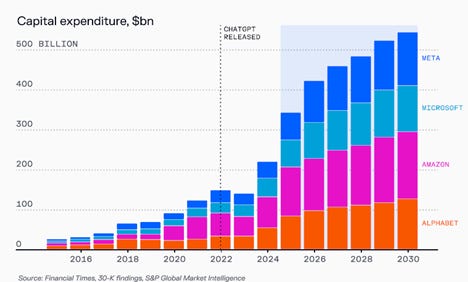
This comparison does not prove we are in a Bubble, but it does show that some important raw conditions for one are present.
Financial Frenzies
With a technology revolution underway, a Bubble forms when investor psychology becomes unmoored and the paper economy decouples from the real economy. Assessing investor psychology is an unscientific endeavor made even more so by my obvious bias as an investor myself.
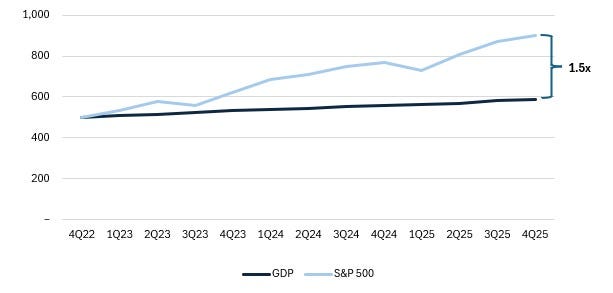
There are a few indicators that in the past have shown an investor frenzy and can be helpful to guess if we are in one today. One simple measure is how much the stock market (paper economy) has outpaced GDP (real economy). During the Dot Com Bubble, the gap between the two grew quite stark.
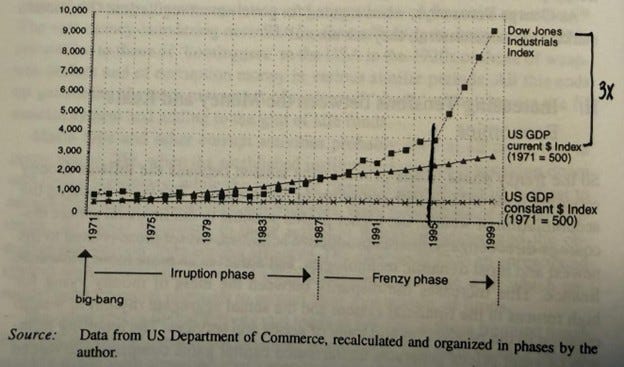
A similar analysis today shows a divergence between the two, but not to the same degree as in the Dot Com era. The present divergence is roughly analogous to 1995 in the Dot Com era chart (represented by my very poorly hand-drawn line in the above chart).
Another recurring signal is when investors pay a material premium for a box of assets relative to the underlying assets themselves. During the bull market of the 1920’s, investment trusts often traded far above the value of the underlying holdings, sometimes more than 2x. For example, the Goldman Sachs Trading Corporation issued stock at $100 in December 1928 then sold it to the public at $104/share and by February 1929 it had reached $222.50 [1]. Similarly, during the stock market bubble in Taiwan in the late 1980’s, closed end funds like that of Citizens Fund could trade at large premiums to Net Asset Value (NAV) even though investors could have bought the underlying shares directly for the cost of NAV (see below).
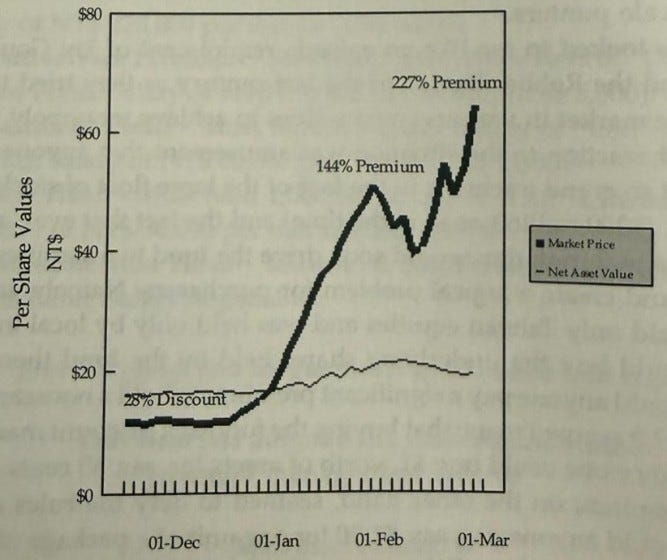
These are compelling examples because there is no quibbling about the value of the underlying assets. The NAV is known. If investors are still willing to pay 2x NAV it’s because they expect that someone else will buy it in the future at an even higher price.
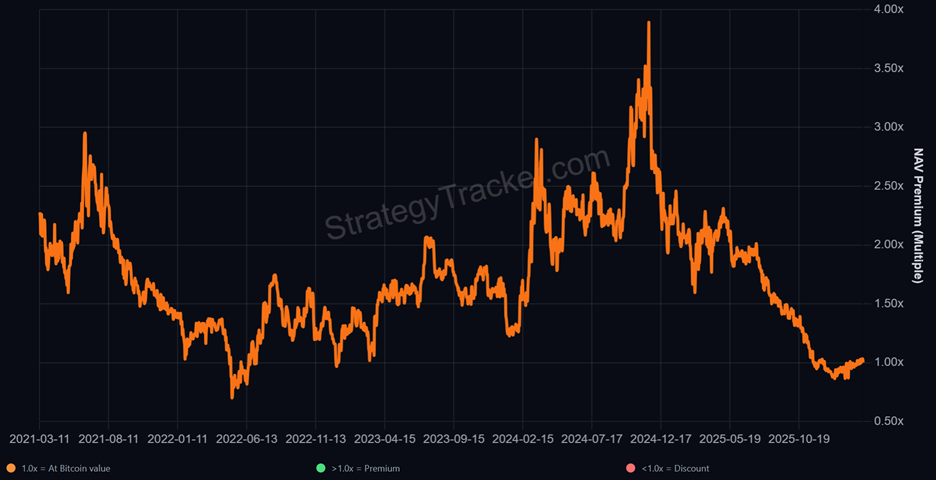
Digital Asset Trusts (DATs) briefly looked like the modern equivalent of the same phenomenon. DATs are public companies that own a pot of cryptocurrency and, for a time, would reliably trade at a premium to NAV. The most famous example Strategy (fka Microstrategy) saw its premium reach nearly 4x in late 2024 after Trump’s election (see below). Those premiums have melted away with falling cryptocurrency prices. It’s unclear whether this signals a broader cooling of speculative impulses or merely that crypto was the wrong vehicle.
What About Venture Capital?
A fair counterargument is venture capital. AI companies have received an avalanche of funding, some of which is speculative. As The Information noted about Thinking Machines after it raised $2Bn for what was then the largest ever Seed round:
“Not only has the one-year-old Thinking Machines not yet released a product, it hasn’t talked publicly about what that product will be. Even some of the company’s investors don’t have a very good idea of what it is working on.”
This is not to pick on Thinking Machines, as there have been many large seed rounds raised for companies with vague or nascent plans. You could have made similarly snarky arguments about investing in OpenAI in 2019 and you would have been spectacularly wrong.
More importantly, potential venture capital losses, while large in aggregate, are unlikely to cascade through the broader economic system the way public markets collapses do. While venture losses can amplify a Bubble, on their own, they are not enough of a factor to call this a Bubble.
What I’m Watching Now
So where are we? We are still in the early stages of a technology revolution that has not yet become a true financial frenzy. There is no single indicator that will announce we are in a Bubble, but there are signals that can show financial capital is becoming decoupled from the real economy. I am watching out for a wave of AI-related IPOs that trade at stratospheric valuations, strong markets for other forms of speculation (collectibles, watches, art), and large-scale fraud like at Enron. Most worrying is the increase in debt use, particularly novel instruments like GPU-collateralized loans, and off-balance-sheet financing that make the AI ecosystem more opaque.
Ultimately, as an investor I am betting that AI technology is real. Even if history shows that probably won’t be enough.
[1] The Great Crash 1929 by John Kenneth Galbraith
No posts
Comments
Nothing yet. Say the first thing.
Sign in to join the conversation.