
On May 18, 2026, Portugal published Lei Orgânica 1/2026, codifying a ten-year naturalization timeline for the majority of Golden Visa investors. Five years of residency before eligibility for naturalization became ten for nationals of non-CPLP, non-EU countries. For CPLP (Community of Portuguese Language Countries) and EU nationals, the timeline shifted from five to seven years. For most U.S. investors who entered the program expecting a five-year path to European citizenship, the path they were sold no longer exists.
Analysis from here divides across two questions. What can be done about the nationality timeline through Portuguese channels? And what can be done about the underlying investment and associated risks, representations, and costs through U.S. channels?
This three-part series offers a framework for identifying and distinguishing next steps.
Part I: The Portuguese Resistance covers the Portuguese-side legal and advocacy efforts already underway, who is leading them, and what those efforts can realistically achieve.
Part II: The Mirage and the Misrepresentations addresses the analytical questions investors should be asking about the investment itself, separate from how the Portuguese resistance efforts resolve.
Part III: U.S. Risks and What Remains Actionable lays out the temporal risk framework, what remains actionable on the U.S. side, and what continuing assessment looks like.
Pursuing action in one area does not commit an investor to the other, nor does the outcome in one area determine the outcome of another.
This series is not a recommendation about any specific investor’s situation and is not legal, tax, or investment advice. It is meant to be an aid for contextualizing what recourse is and is not available now.
The transitional provision in Lei Orgânica 1/2026 preserves the prior nationality law for nationality applications already submitted at entry into force. The IRN had clarified, in advance of publication and reaffirmed on its platform, that the online submission date is the operative cutoff for nationality applications. This protects a cohort of investors who managed to submit before midnight on May 18. Investors mid-investment with no nationality application yet submitted are not presently protected by that narrow IRN cutoff. Whether some of them can still be brought within transitional protection through the implementing regulations now turns on the interpretation of Article 7(2)’s reference to “pending administrative procedures,” including whether that phrase can be interpreted and operationalized to include residence applications delayed in the AIMA backlog.
The Portuguese resistance efforts are at least partially rooted in the legal opinion of Jorge Miranda, considered the father of the Portuguese constitution, and his collaborator Rui Tavares Lanceiro, both doctors of law and professors at Universidade de Lisboa. Their analysis concludes that specific provisions of the proposal that became Lei Orgânica 1/2026 are unconstitutional on multiple independent grounds, including retroactivity, equality, proportionality, and the protection of legitimate expectations. The opinion was issued in June/July 2025 in response to the government's proposal, so it analyzes the bill as proposed rather than the law as enacted. The constitutional arguments largely transfer to the enacted text.
The opinion expressly addresses the situation of foreign nationals who meet or are close to meeting the prior five-year requirement but have not yet filed a nationality application, treating their legal positions as entitled to constitutional protection.
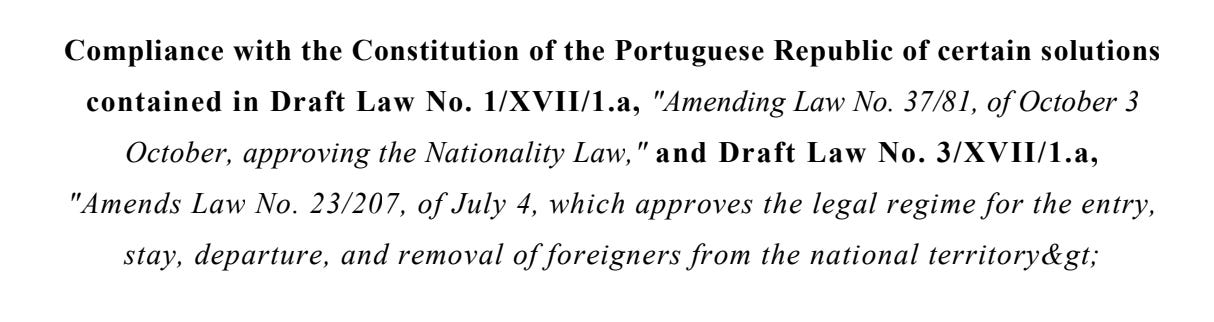
Investors who want to add their voice to the constitutional argument can file a complaint with the Portuguese Ombudsman.
The Provedoria is the constitutional ombudsman, independent of Parliament, and receives citizen complaints. It can technically request successive constitutional review of legislation (fiscalização sucessiva), though it deploys that power rarely. The more likely outcome of a complaint wave is a Provedoria report to Parliament identifying shortcomings, which Parliament can act on, partially address, or decline to address. Parliament has already rejected numerous proposed amendments that would have softened the law or added clearer transitional provisions, which limits what a Provedoria report to Parliament can realistically achieve in the short term.
Filing still serves a purpose: it documents the affected cohort, establishes a public record, and creates pressure that becomes input for the coalition’s broader institutional work. Investors can submit directly to triagem@provedor-jus.pt. A complaint template circulating in investor community channels raises concerns about insufficient transitional protection, the impact of SEF/AIMA/IRN administrative delays, legitimate expectations under the prior five-year framework, the situation of children growing up and studying in Portugal, and differential treatment between CPLP/EU and other residents. Submission in Portuguese may improve uptake.
The Portugal-side resistance and coalition work continues. The implementing regulations, due within 90 days, and the constitutional review pathway operate on different mechanics, and recognizing the difference can help to calibrate expectations.
The regulations can only densify what the statute already contains. They can specify how the new ten-year timeline is administered, how residency time is counted for investors with delayed AIMA appointments, and how applications already in process are handled procedurally. They cannot invent new categories of relief that the statute does not authorize. The live question among Portuguese counsel is how far the statute's existing language can be interpreted and operationalized to reach the mid-cycle cohort.
Portuguese counsel involved in the regulatory lobbying effort have argued that Article 7(2)'s reference to "pending administrative procedures" can be interpreted and implemented through regulation to include residence applications stuck in the AIMA backlog, not only citizenship applications already submitted to the IRN. On that reading, the statute itself authorizes transitional protection for the mid-cycle cohort, and the regulations need only operationalize it. The argument rests on the principle that applicants should not be penalized for State-caused delays, and it aligns with President Seguro's promulgation framing about preserving trust in the State. Whether the regulations adopt this reading will help determine whether constitutional review becomes the primary route for relief or a backstop to an incomplete regulatory solution.
Constitutional review is the channel where remedy for the unconstitutional provisions could be ordered. The Miranda/Tavares Lanceiro analysis identifies several distinct constitutional defects: the cutoff date for the prior regime, the retroactive rule on counting residence time, the absence of a transitional regime for residents who relied on the prior framework, and the limitation on urgent judicial protection in family reunification matters. A successful constitutional challenge could invalidate any or all of these provisions and could require the legislature to enact a transitional regime calibrated to different cohorts of affected residents. That is a separate and slower process than the regulations, and its outcome is not certain.
Collective efforts continue on both fronts and are supported by several coordinated groups. Investors who want to support or participate in these efforts can find them here:
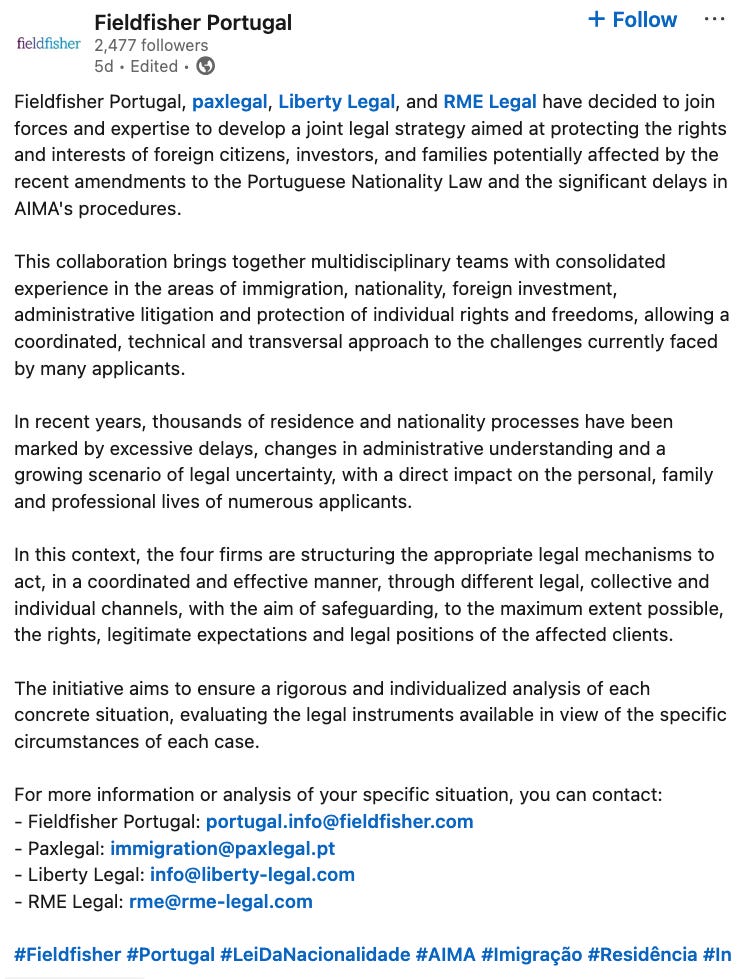
Fieldfisher Portugal, paxlegal, Liberty Legal and RME Legal have joined forces to develop a coordinated legal strategy aimed at protecting the rights and legitimate expectations of those potentially affected by Portugal’s new nationality law. The four firms are currently assessing the most appropriate legal mechanisms, both individual and collective, to respond to situations involving excessive delays, legal uncertainty, and administrative changes impacting residence and nationality procedures. Interested parties should contact the firm of their choice for more information.
The consortium hosted a webinar, Coordinated Legal Response to the Portuguese Nationality Reform, on Tuesday, May 19. They ask investors to fill out a survey to inform their efforts. Link to survey.
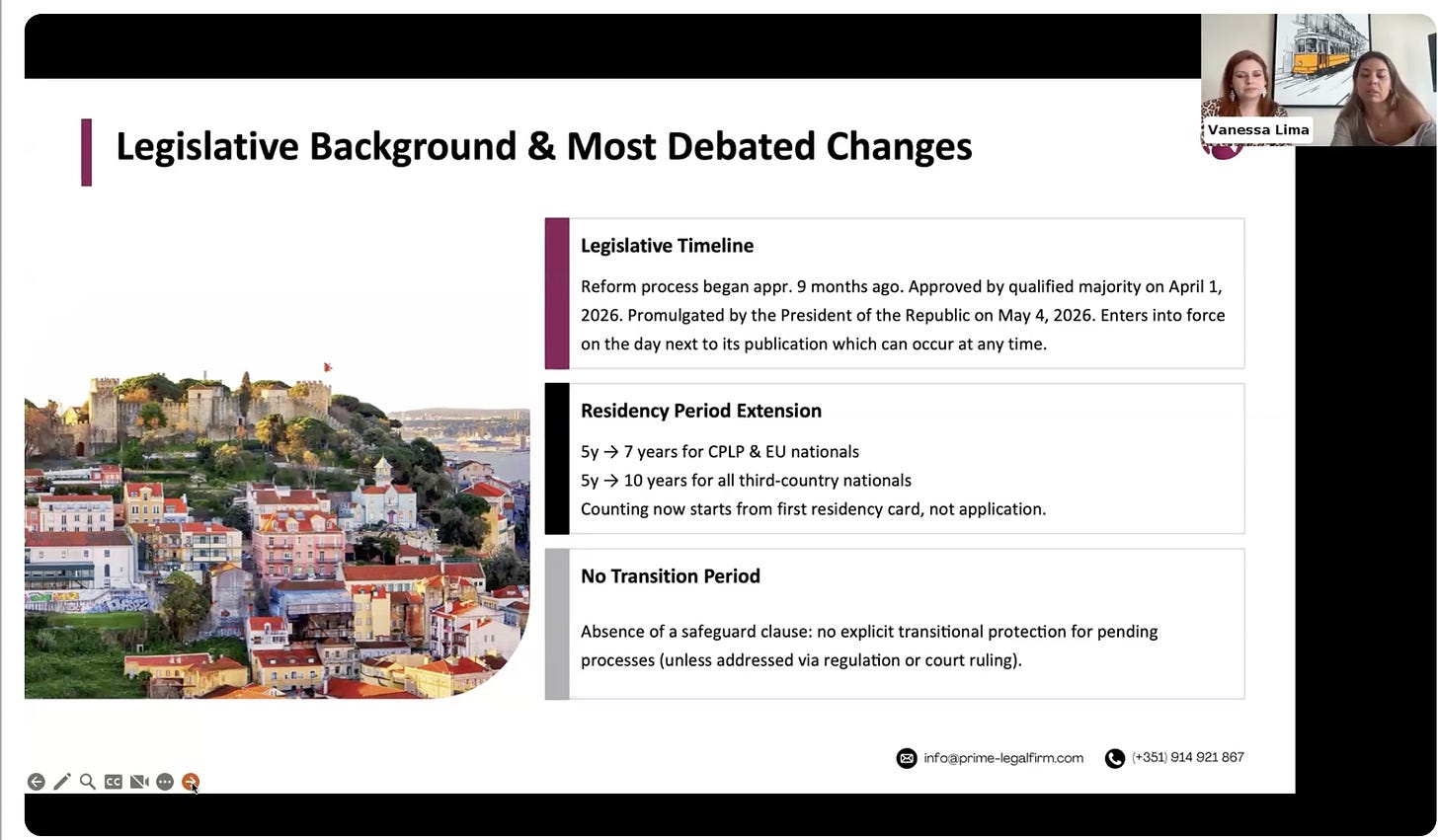
PAIIR (paiir.pt) is a longstanding advocate for immigrant investors and a leading voice in preserving the Golden Visa program in Portugal. It is anchored by Sara Sousa Rebolo and Vanessa Rodrigues Lima of Prime Legal. Prime Legal’s recent webinar on the nationality law changes is free to watch.
SJC (sjc.pt) is a community association dedicated to protecting legal certainty, institutional fairness, and meaningful participation for residents who have committed their lives, capital, and futures to Portugal. They are working to strengthen legal certainty and public trust in Portugal through institutional advocacy and engagement with parliamentary stakeholders. They seek donations to fund their work.
ATP (Telegram link) is a community for Portuguese ARI investors, D visa holders, lawyers, and industry professionals supporting them, as well as foreign residents generally. The community recently expanded to include D visa holders and operates as a series of messaging subgroups that recently moved from WhatsApp to Telegram. A Legal Action working group within ATP is evaluating litigation strategies anchored in investment and contract law.

The Portuguese coalition efforts are serious and substantively grounded. Investors who are watching them unfold should also understand the undercurrent those efforts must navigate, as it shapes what outcomes are realistically achievable through which channels.
Comparative sociological research has often characterized Portugal as a society where trust is organized more strongly through family, community, and established networks than through generalized trust toward abstract out-groups. Reciprocal obligations and protective empathy tend to be reserved for inner circles rather than extended as universal moral commitments to strangers, reflecting how trust operates in a society shaped by its particular history.1
Two implications follow for foreign investors seeking redress.
First, public-sympathy strategies face headwinds that have nothing to do with the merits of investor claims. Appeals to the Portuguese populace for empathy toward Golden Visa investors operate against a sociological backdrop in which (a) the investors are an out-group, (b) the investors hold significant capital relative to most Portuguese citizens, and (c) Portuguese citizens are navigating their own housing affordability and economic pressures. Recent political-psychology research on Portuguese attitudes toward immigration suggests that tolerance for outsiders weakens when outsiders are perceived as competing for material resources.23 Wealthy investors are particularly difficult to frame as sympathetic victims in this environment.
Second, courts, regulators, and parliamentary processes operate on different mechanics than public sentiment. The Miranda/Tavares Lanceiro constitutional analysis carries significant weight here.
The CMVM has also made clear, in statements to Portuguese press (see their comment in a recent Expresso article in Portuguese or in English), that judicial remedies for confirmed information failures by fund managers include contract annulment, compensation, financial penalties, and the return of commissions. This is a Portuguese regulator confirming that misleading representations to investors about the five-year citizenship timeline are not just a political grievance. They are the basis for actionable claims against the fund managers, developers, agents, or promoters who made them. The institutional ground for investor recovery is concrete both in the U.S. and in Portugal, as detailed in Part II.
The work being done by the legal consortium, PAIIR, SJC, and ATP does not depend on public sympathy materializing.
The historical precedent reinforces the point. Portuguese retail investors defrauded by Banco Espírito Santo a decade ago, who were Portuguese citizens rather than foreigners, struggled for years to generate sustained public pressure for accountability. If domestic victims of domestic institutional fraud could not move public sentiment to action, foreign investors are unlikely to.
What this means practically: investors who participate in or support the Portuguese coalition efforts would do well to calibrate expectations. The institutional channels may produce meaningful transitional protections, carve-outs, or compensation. The public-sentiment channel is unlikely to deliver the same. Resources directed toward institutional channels can compound. Resources directed toward public-sympathy campaigns may dissipate.
Will the Portuguese efforts have measurable success? Will they be able to preserve or restore citizenship timelines or transitional regimes for investors already in process through action in the courts? Will they also, in some scenarios, be able to force AIMA to clear backlogs or produce compensation for administrative bad faith? I hope they can, and I hope they do.
Portuguese legal action cannot make a fund compliant with U.S. securities or tax law, however. Portuguese litigation is unlikely to retroactively produce properly computed PFIC Annual Information Statements that support a valid and defensible QEF election for U.S. tax reporting, nor reclaim the resulting overpaid U.S. taxes that could grow to over six figures and be lost to the statute of limitations for refund claims. Portuguese courts cannot undo CFC exposure and mitigate related IRS penalties for missed filings, file or complete FBARs and defend against findings of willfulness, reverse an IRA prohibited transaction, restore lost retirement-account tax advantages, or address U.S. securities registration failures that may have occurred when the Portuguese funds courted and accepted American capital without proper registration or exemption.
The Portuguese resistance focuses on investor protection and addresses the Portuguese administrative and legal problems. The U.S. exposures sit elsewhere: with issuers, promoters, managers, auditors, and gatekeepers whose deficient disclosures, unauthorized marketing to American citizens, and inadequate U.S. tax documentation pushed downstream tax harm onto investors. Those harms may create serious civil liability under U.S. securities laws.
Portuguese litigation may address the nationality-law injury. It cannot cure the U.S. investment, tax, securities, PFIC, CFC, FBAR, or IRA exposure embedded in how many of these investments were marketed, structured, documented, and reported. Those U.S. exposures may give investors a separate financial path: capital recovery, damages, or transaction rescission through the American judicial system. Those claims do not necessarily depend on how the Portuguese administrative and constitutional efforts turn out. They create a separate legal track outside the Portuguese administrative and constitutional process. This U.S. exposure is the subject of Parts II and III.
Part II examines the investment itself: the misrepresentations embedded in how Portuguese Golden Visa funds were sold to U.S. investors, the analytical question investors would do well to ask themselves now, and the reasons the package they bought has substantially less value than what was presented.
Originally published at https://www.pfichelp.com/blog/recourse-part-I
Amy Short is the Principal of Golden Visa Direct and PFIC Help, a forensic tax exposure diagnostic practice serving U.S. investors in Portuguese Golden Visa funds.
This material has been prepared for information and educational purposes only. It is not intended to provide, nor should it be relied upon for, tax, legal, or investment advice. Each investor should consult appropriate tax, legal, and financial professionals regarding individual circumstances.
Pinto, I. R., Carvalho, C. L., Dias, C., Lopes, P., Alves, S., de Carvalho, C., & Marques, J. M. (2020). A path toward inclusive social cohesion: The role of European and national identity on contesting vs. accepting European migration policies in Portugal. Frontiers in Psychology, 11, e01875.
Comments
Nothing yet. Say the first thing.
Sign in to join the conversation.