
An edited version of the following essay originally appeared in Washington Monthly on March 31, 2026. The subject and argument dovetail nicely with last week’s post, entitled “My American Heritage.”
What makes someone a citizen of the United States? We might be tempted to say, a little hopefully, that a citizen is someone who obeys the laws and acts in accordance with them, treats other citizens with respect and participates fully and equally with them in governance, and enjoys the protection of the United States. But those are definitions of good citizenship. What makes one a citizen as a legal fact was never actually spelled out when the Constitution was written in 1787. It was not until the ratification of the 14th Amendment in 1868 that the Constitution was made to state precisely what made someone a citizen, and it did so in one terse sentence at the beginning of the Amendment: “All persons born or naturalized in the United States, and subject to the jurisdiction thereof, are citizens of the United States and of the State wherein they reside.” If you are born in the United States, you are considered, ipso facto, an American citizen, and with only minor exceptions.
Simple as this seems, that sentence has become the trigger for a major constitutional dispute. Conservative jurists and politicians, fearful that illegal immigration poses a threat to the stability of American society, have criticized the idea that the simple fact of birth on American soil can make someone a citizen, since having a child on American soil – an “anchor baby,” so to speak – almost guarantees that the parents, including those who broke the law by entering this country illegally, are going to have to be granted some form of right to stay as well.
Although there is no sure data on the actual number of such births, they have been energetically denounced as a strategy to justify illegal immigration and prevent deportations. The Trump administration has directly questioned the conventional meaning of “birthright citizenship” with one of President Trump’s first executive orders (EO 14160), which insists that illegal migrants cannot be considered, in most cases, to be “subject to the jurisdiction” of the United States. Hence, their children cannot be considered citizens, either, even if born on American soil. If, for instance, a child is born in Mississippi, but the mother entered the country illegally and the father was not a U.S. citizen at the time, then (according to EO 14160) the child should not enjoy the status of U.S. citizen.1
But that makes a great deal hang on what is meant by the phrase, “subject to the jurisdiction,” and it is not at all clear that the creators of the 14th Amendment intended for the jurisdiction clause to become the tail wagging the citizenship dog. No surprise, then, that EO 14160 has been met with a flurry of lawsuits. In July, U.S. District Judge Joseph Laplante issued a preliminary injunction against EO 14160 in Barbara v. Trump, which was upheld by the Ninth Circuit Court of Appeals. But in December, the U.S. Supreme Court granted review to the Trump administration, with oral argument likely to take place this spring and a decision in the summer.2
There are, in the most general sense, two ways of making someone a citizen. The first is known as the jus sanguinis – the law of blood, or hereditary descent. It is this which St. Paul pleaded in Acts 22:28, when he successfully defied the authority of a Roman officer by claiming to be a Roman citizen “by birth.” By the jus sanguinis, only if your parents were citizens, are you automatically a citizen. The alternative is the jus solis – the law of the soil, where birth on a national territory makes you a citizen. It was this version of citizenship which the 14th Amendment made part of the Constitution.3
In the long view, it is the jus solis which has been the dominant model for citizenship in English, and then American, law. As early as 1608, the fabled English jurist Edward Coke wrote in Calvin’s Case that “every one born within the dominions of the King of England” is “entitled to enjoy all the rights and liberties of an Englishman.”4 And Coke was followed by the equally fabled jurist William Blackstone, who wrote in his famous Commentaries in the 1760s that “natural-born subjects are such as are born within the dominions of the crown of England.”5 And though the Constitution never spelled out jus soli, American jurists and judges picked up the theme in American practice. The Revolution, argued the legendary Justice Joseph Story, “did not involve in it … an abolition of the common law” inherited from England. Hence, in 1806, in Gardner v. Ward, a Massachusetts court ruled that even a Loyalist who had returned home after exile during the Revolution “is a citizen of the country wherein he was born” and was entitled to vote.6 In Lynch v. Clarke, an 1844 case in New York, the court ruled that Julia Lynch, a woman born in America but who was brought up in British-ruled Ireland by her Irish parents, was an American citizen simply by the fact of her birth-place. “The general understanding of the legal profession, and the universal impression of the public mind,” wrote Judge Lewis Standford, “is that birth in this country does of itself constitute citizenship.”7
What derailed this comparatively straightforward principle was race. The Constitution had spoken in five places of citizenship, but it spoke of both national citizenship and state citizenship, without stopping to define the relationship of the two. That oversight gave an opportunity to Southern courts, acting in the interests of white supremacy, to insist that free blacks were not regarded as citizens of their states, and therefore could not be understood to enjoy national citizenship either. “It seems very manifest,” announced Attorney General William Wirt in 1821, “that no person is included in the description of citizen of the United States who has not the full rights of a citizen in the State of his residence.” (After all, wrote Wirt, the jus soli seemed to open the possibility that “free Negroes and mulattoes,” by virtue of birth on American soil, should be considered American citizens, and thus eligible to all the “high offices” described in the Constitution, and “command the purse and sword of the nation.”)8 In the absence of an incorporation doctrine in the 19th century, there was nothing to prevent Southern states from erasing any notion of black state citizenship, and then using that erasure to deny black national citizenship.
It remained only for Chief Justice Roger Taney, in the infamous decision he wrote for Dred Scott v. Sanford in 1857, to take the erasure one step further and blot out the jus soli on the national level as well. This time, Taney proposed to reverse William Wirt’s logic: African Americans were racially incapable of being citizens of the United States, and therefore had no claim to the rights of citizenship in the western territories (and, if Taney had dared to take it one more logical step, in any state, either). Dred Scott, the plaintiff in the case, could not be “a citizen of the United States” because “he is a negro of African descent; his ancestors were of pure African blood, and were brought into this country and sold as negro slaves.” Scott, and every other African American, “were at that time considered as a subordinate and inferior class of beings, who had been subjugated by the dominant race, and … had no rights or privileges but such as those who held the power and the government might choose to grant them.”9 In other words, Scott simply had the wrong ancestors, and that ancestry put Scott beyond all hope of citizenship. The jus sanguinis had disposed of the jus soli.
But only for the moment. Abraham Lincoln understood that Dred Scott was a political, not a legal decision, and when he was elected president in 1860, he set his administration on the path to reversing Dred Scott. In his inaugural address, with Taney sitting behind him on the east portico of the Capitol, Lincoln dared to suggest that re-captured fugitive slaves deserved at least due process – a privilege which not even Taney could have missed as a component of citizenship.10 The outbreak of the Civil War in April 1861 complicated that movement, since any gesture Lincoln made toward resurrecting the jus soli was bound to set off yelps of fear that Lincoln planned not only to emancipate slaves, but to make emancipated slaves citizens. In 1862, Edward Bates, Lincoln’s attorney-general, gingerly raised the question in an opinion which asked “Who is a citizen? What constitutes a citizen of the United States?” Bates hemmed-and-hawed a good deal, but at last put his foot down: “every person born in the country is, at the moment of birth, prima facie a citizen … and the country he is born in is, prima facie, his country.”11
The need for restoring the jus soli became even more acute in 1865 with the end of the war, since Lincoln’s Republicans now needed to raise up a Republican Party in the defeated Confederacy to carry forward a postwar reconstruction. The most obvious new constituency was the newly-emancipated slaves. But they would never be able to carry the political weight of reconstruction so long as they lacked the vote, and they would fall well short of the vote if they could not be considered citizens. In December, 1865, Republicans put forward a Civil Rights Bill that would recognize black citizenship, and with it, the vote. But acts of one Congress can be overturned by acts of another, and to guarantee black voting rights permanently, Congress turned to passing a 14th Amendment, with a definition of citizenship unapologetically based on the jus soli.
There remained, however, that peculiar exception to the jus soli captured in the amendment’s phrase and subject to the jurisdiction thereof. It had long been understood in common law that the families of foreign diplomats and the soldiers of occupying armies were not immune from producing children on some other country’s soil. Yet, no one with any practical sense would deem those children citizens of that country. The famous 19th-century American jurist, James Kent, made three exceptions to the jus soli: the offspring of foreign diplomatic personnel, soldiers of foreign armies, and members of Indian tribes “who are not born in obedience to us” (because American law then recognized the tribes as “national communities” of their own).12 When the Civil Rights Bill was debated in Congress in 1866, its proponents were very clear that “every person born within the limits of the United States … is by virtue of natural law and national law a citizen of the United States,” and the jurisdiction exclusion applied only to “foreigners, aliens, who belong to the families of ambassadors or foreign ministers accredited to the government of the United States” and to members of the tribes who have “always … been in our legislation and jurisprudence” regarded “as being quasi foreign nations.” Otherwise, “it will include every other class of persons.”13 But with the new waves of immigrant labor which piled onto American shores after the Civil War, there began to be some question as to whether many of the immigrants really considered themselves subject to American law, so that any of their children born in the United States might also be subject to the jurisdiction exceptions.
This question came to a point in 1898 in the case of U.S. v. Wong Kim Ark. Wong Kim Ark was born to Chinese immigrant parents in California in 1870. His parents owned a small business in San Francisco, but they did not seek U.S. citizenship, and returned to China later in the 1870s. Wong Kim Ark, however, came back to the U.S. to find work, and settled as a cook in a mining camp. He made several trips to China to visit his parents, but in 1895 he was almost barred from re-entry to California by a customs official who insisted that Wong Kim Ark was not only not a citizen, but was prevented from entering the country by the 1882 Chinese Exclusion Act.14 He filed suit, and in 1897, his case was heard before the Supreme Court. The Court’s conclusion in March, 1898, was a resounding 6-to-2 decision in favor of the strongest version of the jus soli. Even if his parents were “subjects of the Emperor of China” and with no intention of becoming American citizens, Wong Kim Ark nevertheless became “at the time of his birth a citizen of the United States, by virtue of the first clause of the Fourteenth Amendment of the Constitution.”15
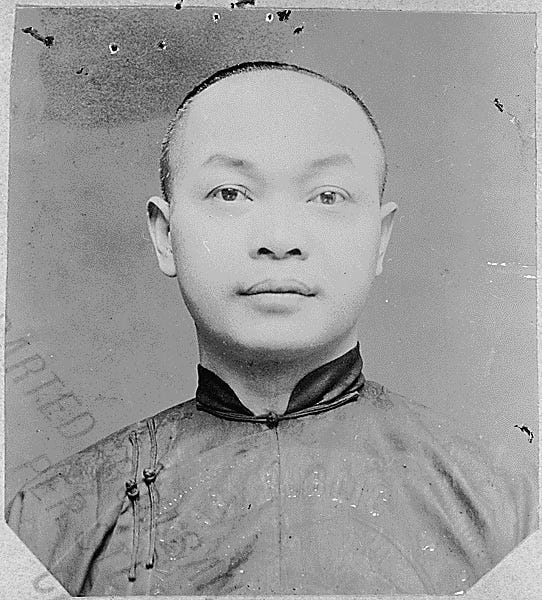
The Trump administration’s challenge to birthright citizenship re-opens the definition of jurisdiction, and the administration’s advisers have argued that non-citizen parents who entered the United States illegally have done so in deliberate violation of the immigration statutes. Although “the parents are not enemies in the sense of an invading army,” still “they did not come in amity” to the United States. They are, in other words, not “completely subject” to American law; hence, any children born to them on American territory cannot enjoy the benefit of jus soli. This, of course, is in direct contradiction of the finding in Wong Kim Ark’s case; but some commentators have freely responded that Ark may have been decided in error.16
There are serious problems with these challenges. No one denies the difficulties posed by the waves of mass migration which have become problematic, not just for the United States, but for nations throughout the developed world which have been ill-prepared for large-scale migration over the last twenty years. But a number of the solutions which have been proposed only promise to create more difficulties, and so it is with the dispute over birthright citizenship and the meaning of jurisdiction. In the most basic sense, it is difficult to arrive at a clear legal understanding of a concept as subjective as “amity,” or even “completely subject.” Whenever jurists like Coke and Blackstone talked about an absence of amity, they meant declarations of war, not an inability to sing the National Anthem. There are also situations which simply defy any attempt to determine “amity.” To illustrate this, Keith Whittington asks us to imagine a foundling left on the doorstep of an orphanage or a police station with no parent available to be examined for “amity.” Are we ready to deny that newborn the status jus soli would otherwise give, while we search for the parents? And what if we never find them?17
There is also the stumbling-block offered in the form of a ‘jurisdiction’ case which was filed in Nebraska only twelve years after the ratification of the 14th Amendment. In April 1880, a native tribesman (possibly a Winnebago , or Ho-Chunk, although the court documents are not particularly clear) named John Elk filed suit in federal court after an elections registrar in Omaha named Charles Wilkins refused to accept his vote in the Omaha city council election. Elk v. Wilkins was casually dismissed by the district court in January of 1881, but an appeal went to the U.S. Supreme Court, and in November, 1884, the Court turned down the appeal. Elk had been born on a reservation, and had never filed any documents attesting to a change of allegiance, and so was not eligible under the existing federal treaties with the tribes to be considered “subject to the jurisdiction” of the United States. Much as this could be read today as a hostile dismissal of native rights, in 1880 it was understood as an affirmation of the autonomy of tribal nationhood. Hence, the decision against Elk was not based on whether he was in “amity” with the laws of the United States, but on the absence of a formal legal repudiation of his tribal birth-allegiance, which we might call his original jus soli. However, the implication – and this is the key consideration in the current “birthright citizenship cases” – was that if Elk had been born anywhere off the reservation, he would then have been considered “subject to the jurisdiction” and allowed to vote. And in fact, by 1887, Congress had passed a Major Crimes Act and then a General Allotment Act (known as the Dawes Act) which effectively citizen-ized tribal members like Elk who lived elsewhere than a reservation.18
Finally, there is a technical question: how willing are we to overturn more than a century-and-a-quarter of settled jurisprudence from the highest court in the land? The principle of stare decisis – letting a judgment stand – has never been absolute. However, one hundred and twenty-eight years of consistent application of U.S. v. Wong Kim Ark’s understanding of the jus soli – in Supreme Court cases like Immigration and Naturalization Service v. Rios-Pineda (1985), where the Court unanimously held that a child born to an undocumented immigrant “was a citizen of this country,” and even Hamdi v. Rumsfeld (2004), which conceded citizenship status based on birth on U.S. soil to a recruit to the Taliban – should not be lightly waved away.19
But still larger in my mind is the cloud this throws over the 14th Amendment itself. The Amendment was a necessity which grew out of a great injustice, which was American slavery and the legal mechanism by which Dred Scott made slavery nearly unmovable, “alike lawful” (as Lincoln put it) “in all the States, old as well as new – North as well as South.” The Civil War overturned Dred Scott and slavery in one enormously costly smash. But even with the abolition of slavery, the United States government had to face the terrible residual hostility of the old slave-owning class to their former chattels, and their determination to keep political equality forever from their hands by denying (like Chief Justice Tamey) that African Americans could ever be citizens. The 14th Amendment changed that for good and all: no matter what one’s status had been before 1868, birth on American soil made anyone and everyone there a citizen, and a citizen alike. To lay a finger on the 14th Amendment – however narrowly, through the jurisdiction phrase, however plausibly, through the possibility of abuse – is to cast a shadow over the conflict and the injustice that the 14th Amendment helped to end.
Ironically, I don’t actually have a dog in this race. I was born in Yokohama, Japan, the son of a U.S. Army officer stationed there and a natural-born American citizen mother; my birth certificate was issued, not by a hospital or county official, but by the State Department. So, my claim to U.S. citizenship has, technically, nothing to do with the jus soli (except, perhaps, in the sense that I was born in a civilian building which had been temporarily converted to an Army hospital). I am, instead, covered by a series of statutes, beginning with the Naturalization Act of 1790 and running up through the current Immigration and Nationality Act (which was passed by Congress the year before I was born). Yet, I defend birthright citizenship as both the actual intention of the 14th Amendment, and as the fairest means of determining the citizenship of others.
I am conscious that critics of birthright citizenship have decried the jus soli as “feudal.” But to chip away at the jus soli, as some do, by quibbles over the meaning of jurisdiction will not make it any less feudal, if it is at all. Moreover: what would be the alternative? The jus sanguinis is, if anything, even more feudal. No law is ever perfect; no law is ever airtight. And this is as true concerning the 14th Amendment as any provision in the Code of Hammurabi. But perfection is not the goal of law; it is, instead, the closest approximation to truth and justice which humanity can claim. Birthright citizenship is one of the better, more generous, examples of those approximations.
Joe Walsh, “Federal judge issues fourth block of Trump’s birthright citizenship order since Supreme Court ruling,” CBS News (August 7, 2025); Amy Howe, “Trump urges Supreme Court to decide whether to end birthright citizenship,” César Cuauhtémoc García Hernández, “A way out remains for birthright citizenship decision,” SCOTUS blog (September 26, 2025 and December 22, 2025).
There is, of course, a third possibility, and that is the administration of a test to everyone at a certain age, rather like a college admissions test like the SAT. A national citizenship test has the superficial attraction of ensuring that everyone who aspires to citizenship earns it through a real knowledge of citizenship. But there are so many accompanying problems with a citizenship test – at what age, and what is the status of those before they are eligible to take the test? What happens to those who flunk? Can it be taken over and over again? What should be on the test? – that it has never been seriously considered.
Carol Nackenoff & Julie Novkov, American by Birth: Wong Kim Ark and the Battle for Citizenship (Lawrence, KS, 2021), 7.
Blackstone, “Of the People, Whether Aliens, Denizens, or Natives,” in Commentaries on the Laws of England (London, 1826), 1:366.
Story, “Terrett and Others v. Taylor and Others” (1815), in Reports of Cases Argued and Decided in the Supreme Court of the United States (New York, 1882), 3:49; Gardner v. Ward, in The Founders’ Constitution, ed. P.B. Kurland & R. Lerner (Chicago, 1987), 4:491.
Lynch v. Clarke and Lynch, in Reports of Cases Argued and Determined in the Court of Chancery of the State of New York, Before the Hon. Lewis H. Standford (New York: 1846), 1:668.
Wirt, “Rights of Free Virginia Negroes” (November 7, 1821), in Official Opinions of the Attorneys General of the United States, ed. B.F. Hall (Washington, DC, 1859), 1:507.
“The Dred Scott Case” (1857), in S.F. Miller, Reports of Decisions in the Supreme Court of the United States (Washington, DC, 1875), 2:8.
Lincoln, “First Inaugural Address – Final Text” (March 4, 1861), in Collected Works of Abraham Lincoln, ed. R.P. Basler (New Brunswick, NJ, 1953), 4:264.
Opinion of Attorney General Bates on Citizenship (Washington, DC, 1863), 13; Harold M. Hyman, The Reconstruction Justice of Salmon P. Chase: In Re Turner and Texas v. White (Lawrence, KS, 1997), 87-88.
Kent, “On the Rights of Persons,” Commentaries on American Law, ed. O.W. Holmes (Boston,1884), 2:52, 55, and Goodell v. Jackson (1823), in Reports of Cases Argued and Determined in the Supreme Court of Judicature … in the State of New York, ed. W. Johnson (New York, 1873), 711; John Yoo & Robert Delahanty, “The Originalist Case for Birthright Citizenship,” National Affairs 66 (Winter 2026), 11.
Jacob Howard, “Reconstruction,” Congressional Globe, Thirty-ninth Congress, 1st session (May 30, 1866), 2890.
Amanda Frost, “’By Accident of Birth’: The Battle over Birthright Citizenship After United States v. Wong Kim Ark,” Yale Journal of Law and the Humanities (2021), 40, 43-45, 47.
United States v. Wong Kim Ark, in The Columbia Documentary History of the Asian American Experience, ed. F. Odo (New York, 2002), 113.
John Eastman, “The Significance of ‘Domicile’ in Wong Kim Ark,” Chapman Law Review 22 (2019), 303; Randy Barnett & Ilan Wurman, “Trump Might Have a Case on Birthright Citizenship,” New York Times (February 15, 2025); Keith Whittington, “By Birth Alone: The Original Meaning of Birthright Citizenship and Subject to the Jurisdiction of the United States” (August 1, 2025), SSRN, 7-8.
Whittington, “By Birth Alone,” 53.
Bethany R. Berger, “Birthright Citizenship on Trial: Elk v. Wilkins and United States v. Wong Kim Ark,” Cardozo Law Review 37 (April 2016), 1197-8, 1215-1216; Stephen D. Bodayla, “’Can An Indian Vote?” Elk v. Wilkins, A Setback for Indian Citizenship,” Nebraska History 67 (Winter 1986), 375, 378.
James C. Ho, “Defining ‘American’: Birthright Citizenship and the Original Understanding of the Fourteenth Amendment,” The Green Bag 9 (Summer 2006), 376.
Comments
Nothing yet. Say the first thing.
Sign in to join the conversation.