
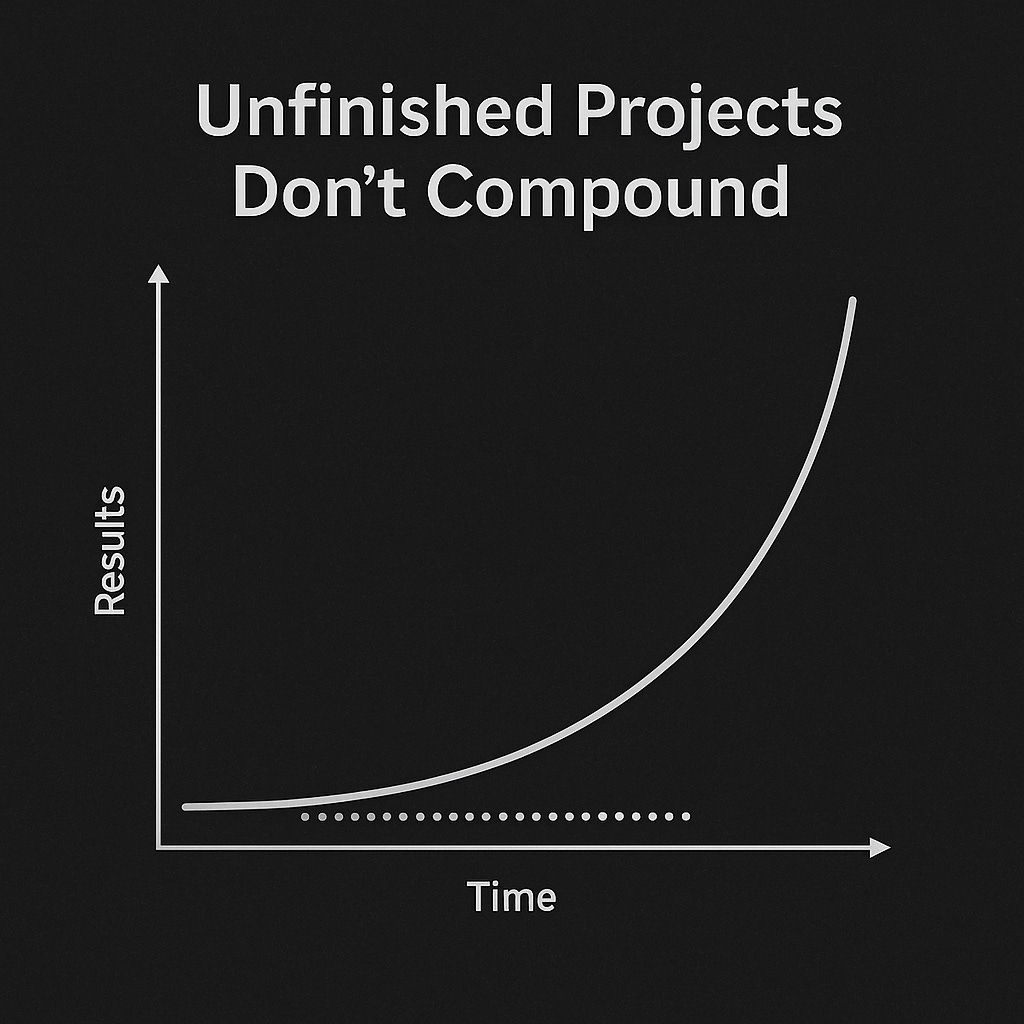
You have to finish what you start. You must close the loop to get feedback.
That’s the goal: to receive feedback and learn from it—so you can return to the starting point with new knowledge that has been tested in the real world.
This is how you improve.
By running a simple cycle:
build → test → learn → repeat.
Eventually, you’ll find a way that works.
The faster you close the loop, the faster you get the feedback.
This is exactly how tech giants improve their products so quickly.
They move at lightning speed to release something, just to get feedback fast.
They understand that real knowledge only comes from testing things in reality.
You’ll only know if your idea is good when it’s been tested in real conditions.
So, finish whatever you’re doing as fast as possible—so you can discover what works and what doesn’t.
If it doesn’t work, delete it.
If it works, repeat the cycle.
Don’t spend years planning only to smash your face into a wall.
Plan just enough to execute now.
That’s how evolution works: through trial and error.
Viruses don’t even have a brain—and yet, we’re still trying to figure out how to stop them. Every time we find a solution, they’ve already adapted.
How? Just trial and error.
They repeat the cycle until something works.
So if you feel stuck in life—if things aren’t going your way—remember: viruses survive and thrive without a brain.
You don’t need to overthink.
You just need to act on what works and stop acting on what doesn’t.
Here is a Simple Action Plan:
Make just two-column list:
Column 1: Everything that works for you
Column 2: Everything that doesn’t work
Now you know exactly what to keep doing—and what to stop immediately.
And trust yourself. You best future is waiting for you.
Exploration means trying new things: traveling, learning new skills, starting a side hustle, watching new movies, or entering new relationships.
Exploitation, on the other hand, means sticking to what you know works—like maintaining your current job, following daily routines, staying close with your existing friends, or rereading your favorite books.
Going into full exploration mode—changing your job, relationships, lifestyle, and environment all at once—can be overwhelming. The brain consumes a lot of energy when processing unfamiliar stimuli. The more novel the input, the higher the energy demand.
At home, your brain operates efficiently because the environment is familiar. It doesn’t need to process new inputs constantly. But when you’re in an unfamiliar setting, your brain becomes more alert. This is manageable as long as some aspects of your life—like your job, family, friends, or finances—remain stable and familiar.
However, if you go into full exploration mode, you might feel like you're in Inception—the movie where each layer of reality is a dream within a dream. Everything becomes unfamiliar: new job, new relationships, new home, new city, new everything. This creates cognitive overload.
That’s why nature seeks balance. All animals, including humans, require equilibrium to function properly.
A healthy ratio is 80% exploitation, 20% exploration. That means you:
Stick with your job for income but explore a side hustle.
Keep your core friendships but occasionally meet new people.
Follow a routine but try something different from time to time.
Warren Buffett says he stays within his circle of competence. He exploits what he knows works. If an investment feels too complex, he simply walks away and returns to what he understands well.
In the Netflix documentary Jiro Dreams of Sushi, Jiro represents an extreme case of exploitation. He has spent his entire life mastering the art of sushi-making. Every day, he refines the same process. Yet even Jiro explored in small ways. In other areas of life—relationships, lifestyle, or trends—he remained static.
Full exploitation is also risky. The world changes without your permission. Jiro was lucky—sushi never went out of fashion. But horse sellers weren’t so fortunate when cars replaced horses. Had they spent 20% of their time exploring, they might have adapted to new consumer trends and survived the shift.
The same could be said for Blockbuster.
Ultimately, life is a constant dance between the known and the unknown. If you cling too tightly to what’s familiar, you risk stagnation. If you chase novelty endlessly, you risk burnout.
Choose your constants wisely. Then, with intention, open doors to the new.
Act fast—with total commitment.
Act like failure is impossible.
Act like you've already done it a million times.
Because doubt feeds fear.
And fear multiplies doubt.
Soon, you're caught in a loop—hard to escape, especially in the short term.
Confidence isn’t something you “do.”
It’s simply the absence of doubt.
Think of James Bond.
He acts like he already knows the outcome. He expects to win.
But a man full of doubt?
He expects to lose.
You doubt yourself because you've been conditioned by past disappointments.
It's like life—society, setbacks, and hesitation—left their mark on you.
When you were a kid, things were simple.
You wanted something? You moved. You acted. No overthinking.
Now?
You think deeply before doing anything.
You kill the moment.
You kill the magic.
Overthinking destroys your reality.
You worry about problems that may never exist.
You're calculating every move like a chess player.
But life is no chessboard.
In chess, there's one opponent.
Life? It’s far more complex.
It’s infinite. Unpredictable. Your thinking alone isn’t enough.
You have to move. You have to trust. You have to let life happen.
And you must believe—truly believe—that your next action will work.
That it’s the right move.
The best move.
Then take it.
Own it.
And move on.
No posts
Comments
Nothing yet. Say the first thing.
Sign in to join the conversation.