
I’ve known Dina Gilio-Whitaker for many years, and I’ve been reading and admiring her work even longer. Her new book, Who Gets to Be an Indian: Ethnic Fraud and Other Difficult Conversations About Native American Identity couldn’t have come at a more important time.
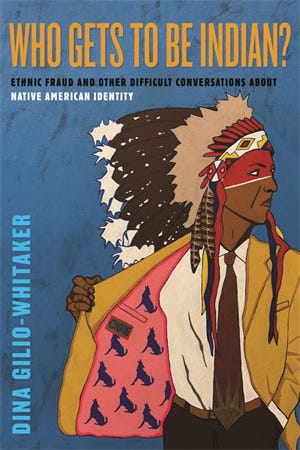
As high-profile figures—including Buffy Sainte-Marie and Sacheen Littlefeather—have been found to have falsely claimed Native identity, it feels like more and more people are pretending to be Native. At the same time, Native communities continue to grapple with identities shaped by adoption, blood quantum, disenrollment, and tribal histories that have left some communities without federal recognition.
As many of you know, I’ve written about people who falsely claim Native identity before (looking at you, Elizabeth Warren), because I believe ethnic fraud is a serious threat to tribal sovereignty. It’s a difficult topic to wade through–made worse by the pressures of colonization. But these are conversations we have to have for the health and future of Indian Country.
I sat down with Dina to discuss her new book and the challenging questions it raises. The following interview has been edited for length, flow, and clarity.
RN: And so the first question I have for you is kind of big, but, why do you think Native identity is so fraught?
DGW: It has to do everything with our history of being colonized and the US government’s impulse to eliminate us, right? So there’s a zillion reasons why in this effort to eliminate our existence as Indian people not just physically, but discursively led to confusion about what being Native is. And ultimately I would say it’s because of the historical push to racialize us–to understand Indian people as a separate racial category–as opposed to the separate societies and nations that we were before the arrival of Europeans.
RN: When I talk about it with non-Native people, for a lot of them, that’s a new concept: The idea that being Native isn’t just a racial category. It’s a political category. That I am a citizen of my tribe and my tribe has a treaty relationship with the US federal government. And that’s a specific designation that’s different than just “I’m Native.”
DGW: Right, because there’s no comparison. There’s no other group in the United States that is a reality for.
RN: One of the reasons that I think Native identity is so fraught is because I think that (this is gonna sound really academic) part of the settler colonial project of the United States is to be able to turn a switch on and off of who is Native and who is not.
I feel like the United States government has a long project of being able to control our identity. I think the most obvious example of this is blood quantum, especially during the termination era. But you can see that even in the 19th century with these weird laws of saying, okay, you’re Native if you live on the reservation, but if you leave the reservation you forfeit being Native.
DGW: Either way it always comes down to the need to erase our existence.
RN: For people who maybe haven’t ever heard of it, what is a pretendian? And how did this phenomenon get started?
DGW: Pretendian is of course a portmanteau [a word created by blending two words together] of the words pretend and Indian. So bringing those two words together to denote somebody who’s pretending to be an Indian. Right?
I make the argument that “Pretendianism” as we know it today corresponds to the rise of the film industry, and how that intersects with the late 19th century Wild West shows. The commodification of Nativeness in the film industry opens this door where people want to become Indian.
RN: I feel like our awareness as Native people of how much of a problem pretendians are has changed in recent years. The most I’ve been involved in this issue was around Elizabeth Warren and her false claims of being Cherokee. And I feel like I got a lot of pushback from Native people.
DGW: There was that whole narrative too, about we have bigger fish to fry. We have bigger problems than to have this fight.
RN: Yes, exactly.
DGW: Which is a stupid argument.
RN: Tell me why are pretendians a threat to tribal sovereignty?
DGW: We’ve had two incidents now where tribal sovereignty has been challenged in the Supreme Court through the Indian Child Welfare Act. And so these right wing groups are trying to undermine or eliminate tribal sovereignty based on the argument that Native people have special rights based on being a racial group. Of course, the counter argument to that is, no, these rights are granted not based on race, but on political status.
RN: I think the other reason that pretendians are a threat to tribal sovereignty is the extent to which pretendians are trying to infiltrate Native communities and take what actually belongs to Native people. I don’t think people realize how aggressive pretendians can be.
You see it in academia where people are writing and publishing on issues. There are places where land back efforts are going to fake Native groups instead of tribes that are actually Native.
DGW: I’m also in the environmental world, and we’re increasingly seeing the appropriation of Nativeness being deployed for grants around conservation and climate change.
So often the impulse for pretendians is tied to the desire for material gain, right? To get something out of it. But it doesn’t answer the question about why people keep claiming it despite all evidence to the contrary.
RN: I have a theory. Because there are regions where these stories are really popular. They’re really popular in the American South and they’re really popular in Oklahoma. And in Oklahoma it wasn’t that long ago (the early 1900s) that white people were illegally squatting on our land and we were overrun by white settlers. And often those settlers were violent and deeply racist. And so instead of families telling the story that they were part of this wave of violent white settlement, they can tell the story of oh, we have high cheekbones and we’re part Cherokee.
It’s not wanting to tell the story of being a settler. I think it’s wanting to tell the story of being Indigenous
DGW: Right. As somebody who was born and raised in Los Angeles, I was literally born in Hollywood. So the 1960s and the 1970s were an era where things really started to shift and pretendianism really started to take on these new valences. It’s the point at which being Indian became cool. I’m old enough to remember when it wasn’t cool to be Indian.
And growing up in a family with my mother’s stories about being Indian–my mother being from a reservation community in Washington, at least for part of her childhood. And her mother was a boarding school survivor. So we have a story in our family that’s a true lived Native experience, and the trauma from that. And I grew up with that.
RN: We have people who are falsely claiming to be Native. But then on the other side are people who are genuinely Native that are cut off from that identity–whether it’s through disenrollment or blood quantum or adoption. How do we embrace those people while at the same time showing pretendians the door?
DGW: I actually propose a model in the book that talks about American Indianness or Nativeness as a spectrum. On one end of that spectrum you are enrolled in a federally recognized tribe. On the other end of the spectrum is ethnic fraud–you are somebody who has knowingly lied about being Native. But in the middle of that spectrum is this huge gray area.
I want people to talk about it publicly. What makes you think that you’re Native? What is that based on? And let’s put you somewhere on that spectrum.
RN: Where do you think Indian country goes from here? If you could chart a path forward, what would that path be?
DGW: I think the path forward is to develop processes for accountability. This is what this is all about. It’s about accountability to tribal communities and transparency about who you say you are. We have to demand both things. And that means that in these spaces where we see the most egregious Native claiming–academia, Hollywood, publishing, government contracting, the conservation world, environmental spaces, competing for grants, philanthropy, all of those–we have to demand that kind of accountability.
If you’re entering academic spaces or applying for scholarships or fellowships or things that are tied to material benefits, then you’ve gotta be able to answer questions and not be offended by it. You don’t get to claim to be a veteran without receipts. So people have to be willing to show paperwork. And if you can’t, if you are in that gray area category where you can’t show who you are, tell us why. Just explain yourself and let the people in charge make those determinations.
So we’re trying to do that right now on our campus down at Cal State San Marcos. We’re forming a Native faculty and staff association. And we have created a process that lays out exactly what I just said: Asking people to tell us who they are and if you’re enrolled in a federally recognized tribe, great. If you’re enrolled in a non-recognized tribe, then what tribe, right?
RN: I think most Indigenous people aren’t offended by that question. Among Cherokee people, when you’re introducing yourself, people ask: Who are your parents? Who are your grandparents? Because they wanna place you within the broader community.
DGW: In my tribal community, the Colvilles, that’s what you do. That’s protocol. When you are in community, you introduce yourself by who you’re related to. That is literally how you make those relations and establish that accountability. And why can’t we institute something like that in our non-Native public spaces?
RN: I think it goes back to that tension we’ve been talking about this whole time where it’s not a racial category. It’s political, but it’s also kin, right? It’s not just a box that you check. It’s who you are, who your family is, where you come from, and that’s how Indigenous people understand it, right? It’s trying to assert that understanding into non-Native spaces where people have a hard time.
DGW: Exactly.
No posts
Comments
Nothing yet. Say the first thing.
Sign in to join the conversation.