
Over nearly two years, I have been conducting the Scaling in Human Societies Living Literature Review. Today, I would like to apply that work to the question of how artificial intelligence might remake cities. In contrast to recent historical trends, there is good reason to believe that AI will lead to dispersal in cities, rather than concentration, as it takes over the most important knowledge spillover functions that cities carry out.
As usual, this work is supported by Coefficient Giving’s Living Literature Review grant, but all conclusions are my own and do not reflect the views of CG.
My prediction challenges much of our intuition with cities, and before we discuss the specific characteristics of AI, let us first review recent trends.
The idea that technology will make cities obsolete is not a new one. Morus (2000) recounts how Victorian-era thinkers marveled at the “annihilation of space and time” that would be wrought by the then-new railroads and telegraphs, thereby making cities obsolete. More recent is Cairncross’ (1997) The Death of Distance, which predicted that emerging telecommunications technology would allow individuals to do much more, including perform their jobs, from home and thereby make cities less important.
This idea is currently out of fashion in urban economics, and the dominant view is that advancing technology has generally had a concentrating effect rather than a dispersive effect. Gyourko, Mayer, and Sinai (2006) popularized the term “superstar cities” to refer to those metropolitan areas, such as the New York City area and the San Francisco Bay Area that offer high wages with extraordinarily high housing costs. Le Galès and Pierson (2019) write of the returning allure of superstar cities in the 21st century and their role in driving inequality. Bertholdo and de Castro Marins (2025), drawing upon such ideas as Richard Florida’s (2002, updated 2019) creative class, emphasize the importance of human proximity as a driver of entrepreneurship, which is increasingly the driver of wealth creation in the 21st century.
Early in this project, I highlighted some results in urban scaling. The basic principle is that socioeconomic quantities, such as average wages, increase by some amount (typical values found are around 5-10%) for every doubling of a city size. An indicator of urban concentration might be that scaling becomes steeper, which means that being a large city becomes more important over time for its economic prosperity. Shutters and Applegate (2022) find that from 1984 to 2020, the wage premium in micropolitan statistical areas in the United States has been decreasing, while the premium in metropolitan statistical areas has been increasing. This result is consistent with urban concentration.
In the last post, I looked at three papers that offer simple, theoretical models that show how falling transportation costs generally lead to urban concentration. As transportation costs decline, such as with the development of steamships, railroads, and highways, manufacturing plants are incentivized to concentrate into a smaller number of larger facilities, as the benefits of economies of scale of such an arrangement outweigh the costs of having to transport goods further.
Tranos and Ioannides (2021) find higher rates of Internet adoption in a country lead to greater urban concentration across countries. They furthermore find that increased Internet usage increases a city’s ranking in the national hierarchy. However, the same authors (Tranos and Ioannides 2020) in another study find that information and telecommunications technology led to greater urban dispersion, as measured by several metrics of concentration. Tranos and Ioannides (2021) argue that the difference stems from different methodologies for determining city boundaries between the two papers.
A modern, casual reading of economic geography suggests that the world is moving to a “winner takes all” kind of urban concentration, where economic activity is disproportionately located in superstar cities. However, the literature tells a more nuanced story.
Last May, I discussed some of the weaknesses in the scaling literature more broadly. The most compelling weakness, in my view, is the causation problem. Even if we know that larger cities tend to offer higher wages, it is not obvious that higher wages are a result of the fact that the city is larger, as opposed to that large cities offer higher wages for other reasons, thereby attracting more residents. Other problems include that it is not obvious how to delineate cities for the purposes of analysis, and the results can be very sensitive to how cities are defined; the statistical methods that are used for analysis are contested, and results may be highly sensitive to the methods; results might be improperly extrapolated to very large or very small cities; and authors often conflate cross-sectional (several cities at a single point in time) data with temporal (a single city over a period of time) data. When accounting for these complications, the observed scaling laws are often greatly diminished or disappear entirely.
To add to those issues, and for those readers who understand some statistics, Gomez-Lievano, Vysotsky, and Lobo (2018) demonstrate how scaling can emerge artificially from lognormal incomes distributions if incomes are assessed from small samples.
One of the most striking results that should temper our understanding of how the wage premium evolves over time comes from Butts, Jaworski, and Kitchens (2023). Making corrections for unobserved characteristics, such as people with greater earnings potential moving to cities with higher costs of living, they find that the urban wage premium in the United States decreased from 16.2% in 1950 to around 5% in 2010. Without any such correction, Boustan, Bunten, and Hearey (2013) find that the wage premium was 35% in 1940, 20-25% in 1980, and above 35% by 2010. Butts, Jaworski, and Kitchens (2023) furthermore find that the wage premium was significantly higher for college-educated workers than non-college-educated workers. They argue that making a naive comparison, without accounting for sorting and differences in worker characteristics that are independent of city size, greatly overstates the wage premium. Note that Butts, Jaworski, and Kitchens (2023) estimate strictly an urban wage premium over rural areas, which is somewhat different from the continuously rising wages relative to city size that we have usually analyzed.
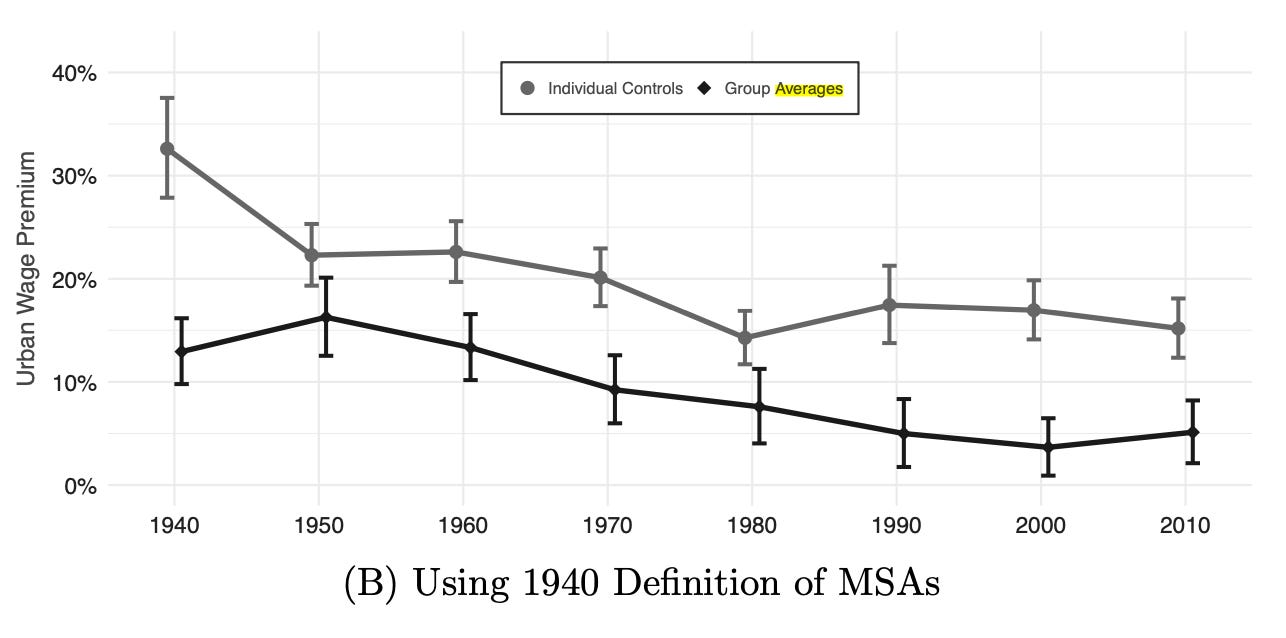
Autor (2019) also shows that the wage premium for large cities is significantly higher for workers with college degrees, and for non-college workers, fell by two-thirds from 1990 to 2015.
Ganong and Shoag (2017) ask why regional convergence is slowing. They argue that high housing prices in high-income cities have deterred low-income workers from moving to high-income cities, or they have driven lower income workers away. With such an explanation, regional divergence is fully consistent with weakening agglomeration economies. According to Hermann and Whitney (2022), the ratio between the median house price and median income in the United States has increased from just above 3.0 in 1990 to 5.5 in 2022.. In the San Francisco Bay Area, that ratio now exceeds 10.01. If the large city wage premium is driven primarily by sorting, rather than agglomeration, then we fully reconcile the rising metropolitan wage premium in Shutters and Applegate (2022) with the corrected declining wage premium in Butts, Jaworski, and Kitchens (2023).
Now we will turn our attention to AI specifically. We have shown so far that agglomeration effects are weaker than is commonly supposed, and the balance of evidence suggests they are getting weaker, not stronger. Hence our task is not to show that AI will break existing agglomeration trends, but rather that it will accelerate de-agglomeration trends that are already in progress.
There are two classes of technology that have been especially relevant for economic geography: transportation (of goods and people), such as the steamships, railroad, automobile, highways, and airplanes; and communication, such as the telegraph, telephone, radio, television, and the Internet. Communication can be regarded as a form of transportation as well: transportation of data. What distinguishes artificial intelligence does past communication technologies is that in enables the acquisition of knowledge without another person at the other end.
Most relevantly for agglomeration economies, AI subverts one of the foundational pillars of urban scaling. In his textbook Principles of Economics, Marshall (1890) posits that knowledge spillovers are a central agglomeration mechanism. These refer to the way in which people in close proximity, who might but don’t necessarily work for the same firms, share knowledge with each other. AI, however, provides access to knowledge and a wealth of experience in a nonlocal manner, and in a way that is without precedent.
At present, there is not much research available on the impact of AI on knowledge spillovers. Brynjolfsson, Li, and Raymond (2023) study the rollout of a conversational AI tool on the productivity of about 5000 customer support agents. The study finds a 14% improvement in productivity overall, with a 34% improvement for novice agents and virtually no improvement for experienced agents. They suggest that the main mechanism by which AI systems operate is by imitating the behavior of experienced agents, and so Brynjolfsson, Li, and Raymond (2023) identify the AI system as functioning as a close analog to a system of knowledge spillovers from experienced to novice agents.
Even with deep diffusion of AI in the economy, it is doubtful that knowledge spillovers will disappear entirely. Lin, Frey, and Wu (2023), examining a data set of 20 million research articles and 4 million patent applications, find that remote teams are consistently less likely to achieve breakthroughs than in-person teams. While the call center analysis above focuses on the diffusion of knowledge, the patent analysis of Lin, Frey, and Wu (2023) focuses on the recombination of ideas to create new knowledge. Although a small fraction of the population works directly in research and development, even in San Francisco, this may be one area where urban agglomeration survives widespread AI diffusion.
There is a test that I think an economist could do now with publicly available data, and to my knowledge no one has done this. It is generally established that the city-wage premium is stronger for younger workers; see for example Wheeler (2006), who suggests that matching, an important agglomeration mechanism, is stronger for younger workers. Peri (2002) squarely attributes the stronger premium for young workers to the knowledge spillovers that they gain from large cities. The question that I would be interested in is as follows: in industries with greater AI exposure, is the wage premium for larger cities and for younger workers in particular less? If so, then that would be evidence that AI is eroding economies of agglomeration.
For the sake of having something tangible, I predict that by 2035, the allometric exponent of GDP per capita, with respect to city size, will have decreased by at least one percentage point from the 2025 value. Recall that under urban scaling theory, we can express socioeconomic quantities, such as GDP per capita, as a power of the population: Y = N^β, where the exponent β is the allometric exponent. Under the theoretical model of Bettencourt (2013), β = 1/6 = 0.1666…, while empirical results typically place β between 0.05 and 0.10.
Given how sensitive our measurements of β are to things such as city boundaries, controls for causality, and other factors, it is necessary to settle this debate with a consistent methodology that assesses the scaling exponent in 2025 and 2035. Even if the methodology is debatable, it should capture a trend of weakening agglomeration economies if it is consistent.
There are three ways in which I could be wrong. First, it may be that after the great excitement and investment of the last few years, AI will fizzle out and fail to make a lasting impact on the economy by 2035. I don’t think this is likely, but it is possible. Second, I might be right about AI, but there might be countervailing factors that cause the GDP-size elasticity not to fall like I think it will. Third, I may be wrong about the nature of AI, and it might in fact have a concentrating effect rather than a dispersive effect. It is this third scenario that would most go against my argument.
Conversely, it is possible that my prediction will be right, but for reasons that have nothing to do with AI.
In this post, I have argued that artificial intelligence will weaken agglomeration economies, thereby reducing the advantages of concentration of the workforce in large cities. I have also argued that, in light of more recent research developments, agglomeration economies are weaker than previously supposed and are perhaps getting weaker over time, and so my claim about AI is not as radical as it might first appear to be.
Over the last few posts, starting with “Urban Scaling Reconsidered” in May, I have reviewed quite a few papers that have challenged the idea of urban scaling, suggesting that the phenomenon is not as strong as I had previously thought. As a result, I have revised my views on the topic, a process that is by no means complete. I don’t consider the revisionist research to be any more airtight than the research it challenges, but it is important in building a complete picture of the scaling situation.
Still, although I have never articulated it, I have long had a suspicion that urban agglomeration economics are based on intangible phenomena, such as knowledge spillovers and serendipitous contact, and consequently the numbers we observe are not very reliable. Furthermore, when a phenomenon is intangible, it tends to be contingent on particular circumstances rather than a universal description of reality, and that is indeed what the revisionist literature is showing us.
Despite the greater skepticism that I am now bringing to the concept, the evidence is nonetheless overwhelming that agglomeration economies are a thing, and I do not expect them to disappear entirely under any plausible AI scenario in the foreseeable future2.
I am discounting the possibility of rapid development of artificial superintelligence, which supersedes human labor for all economically relevant tasks, for the sake of bounding the analysis. However, what agglomeration economies would look like in such a scenario would be an interesting thought experiment.
No posts
Comments
Nothing yet. Say the first thing.
Sign in to join the conversation.