
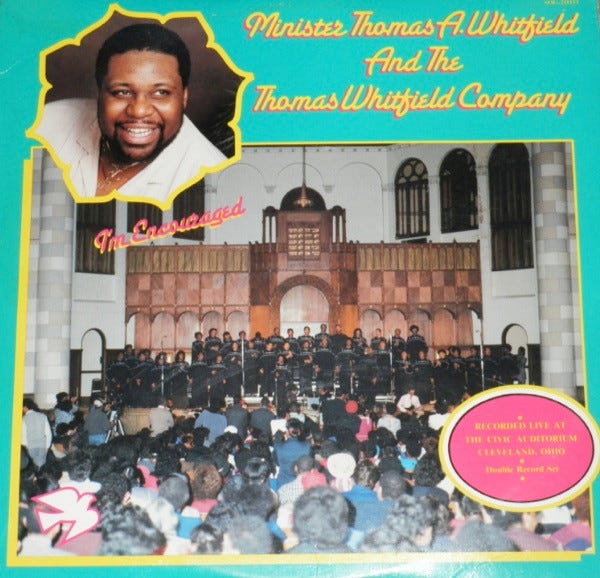
As a teenager, I knew Thomas Whitfield’s hits. It was pretty hard not to hear his music in those days. Gospel hits could maintain a presence on radio for years after their release, so it was not unusual for customers to come into the Christian bookstore where I worked part-time asking for the “new” song by so-and-so that wasn’t quite so new. One day, a customer engaged me in conversation about Thomas Whitfield and asked if I’d heard his 1983 release Hold Me. I answered that I had not and checked our catalogs to see if it was still in print. It was not.
Long story short, it was reissued on cassette around that time, and it helped me hear Thomas Whitfield’s artistry in an entirely different way. Hold Me was the kind of album that felt like you were sitting in the living room of a friend who had recently been through some things, happened to write songs about those experiences, and invited you over to listen. It was a visionary approach to gospel—one with stronger jazz and funk influences—but it never lost the gospel feel. Whitfield’s presence in gospel had always been distinctive, though. Close listeners first noticed his compositional and instrumental style back in 1974 on “Make Me Over Again” from James Cleveland & The Voices of Tabernacle’s God Has Smiled On Me and on Hulah Gene Hurley’s 1977 recording with her daughter Carolyne, God Has Done So Much.
For whatever reason, Hold Me didn't achieve the success of Vanessa Bell Armstrong's Peace Be Still (which Whitfield produced half of), despite their similarities. Whitfield did, however, score a massive hit that same year with the live recording Hallelujah Anyhow!, which produced standards like the title track, "Soon as I Get Home," and "I'm Saved." The difference between Hold Me and Hallelujah Anyhow! was simple: Whitfield muted his more direct jazz leanings and channeled those influences into a more conventionally gospel mold.
1986's I'm Encouraged, also recorded live, was bolder still. The album feels more connected to Hold Me, invoking the same sense of intimacy and the deep personal connection that made it seem as though Whitfield was carrying—and sharing—the listener's lived experience. The title track would dominate airwaves for years to come, but deep cuts like "When I'm Weak, I'm Strong" and John Askew's "Wrapped Up, Tied Up, Tangled Up" became enduring favorites. The popularity of "Wrapped Up, Tied Up, Tangled Up" was evident several years later when songwriter John Askew performed it at the Bobby Jones Gospel Explosion, a moment that demonstrated just how deeply the song had resonated with gospel audiences.
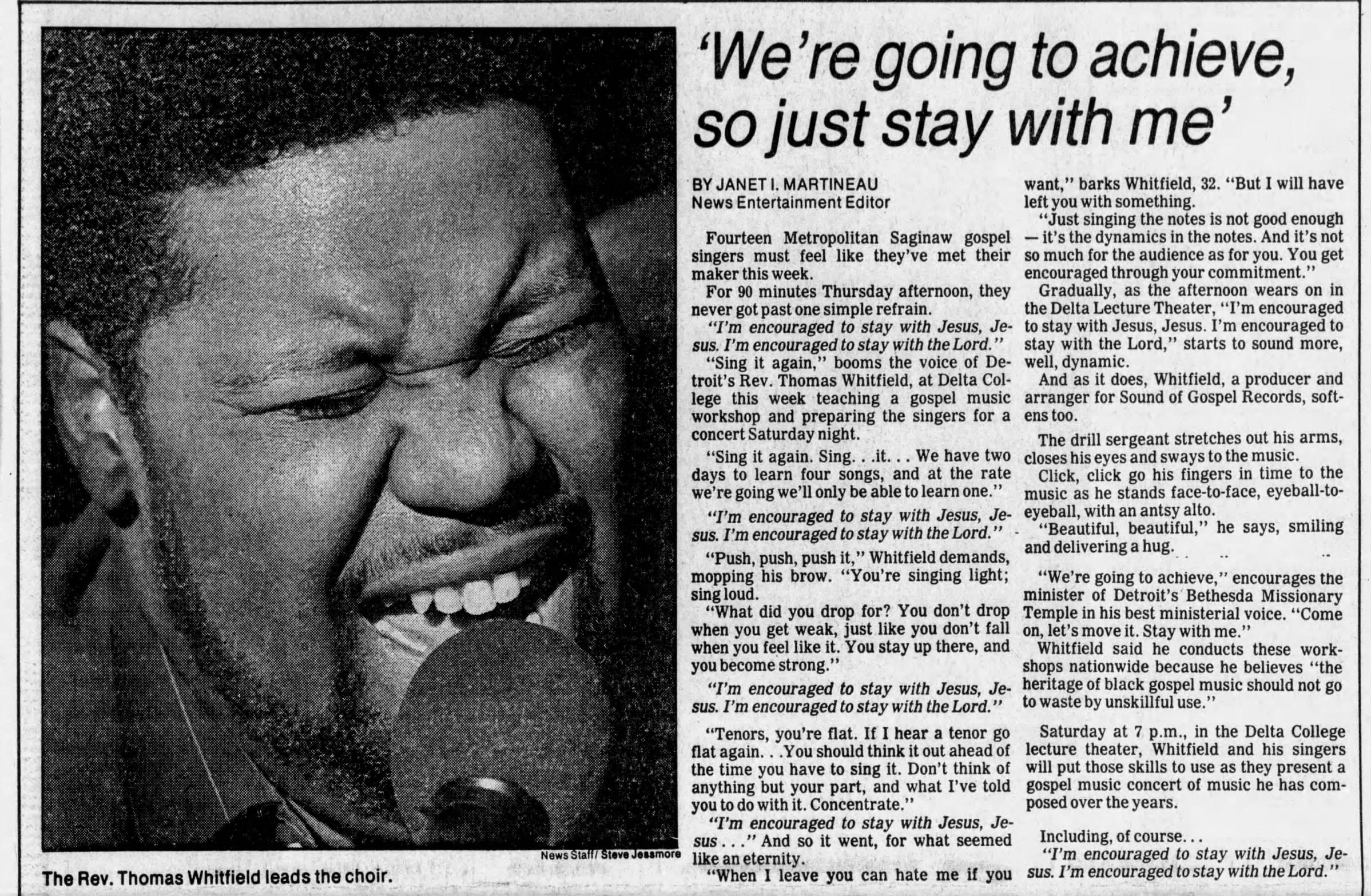
Whitfield also reimagined gospel mainstays with “Never Alone,” “By and By,” and “It’s In the Air” (a reimagining of “Just Above My Head”), taking care to maintain a connection between the past and the present rather than attempting to separate gospel music from its roots despite his diverse musical influences. In an interview with Joyce Walker-Tyson of the Detroit Free Press, Whitfield listed Burt Bacharach, Dionne Warwick, Sergio Mendes, Gino Vannelli, and Quincy Jones among his favorite artists. Rather than imitate them, Whitfield synthesized those influences into a sound that was unmistakably his own.
In interviews, Whitfield also signaled broader ambitions, particularly an interest in scoring films. “I sit there [at the movies] and watch the screen and block out all the background music,” he told Walker-Tyson in 1981. “Then I score it in my head. I’d love to do a movie score. To just sit down and watch a theme, then make music to fit every mood and feeling—that would be a great challenge to me. I think that would be fantastic.”
In the years that followed Hallelujah Anyhow!, he did indeed broaden his sound further, recording the delightfully highbrow And They Sang a Hymn (which earned a Grammy nomination) and The Annual Christmas Service. He signed with The Benson Company in 1990, resulting in the final works of his career: My Faith (which also earned a Grammy nomination and produced the standard “We Need a Word from the Lord”) and Alive and Satisfied, the latter released just before his untimely death from heart disease in 1992.
“He wanted to be modern, yet traditional,” said Rev. Charles Craig III, then pastor of Craig Memorial Tabernacle Church, where Whitfield began his career. “He was a genius because he could combine it all.”
1976: The Productions of Shannon Williams at Nashboro Records
·
Mar 27
Go deeper into the stories, songs, and artists that shaped gospel music—each issue is a carefully researched, richly told exploration you won’t find anywhere else. Become a subscriber to God’s Music Is My Life and get every essay, every week.
The New York Community Choir: "Dance, children, dance..."
·
June 8, 2021

Writer’s Note: Last week, I focused on Amy Grant’s Unguarded (1985), an album that caused a massive controversy in the largely white evangelical world. I’d planned on focusing, this week, on Tramaine Hawkins’ The Search Is Over, released in 1986. I realized, however, that I needed to go a little further back in time to set the stage for that story. Sinc…
Thanks for reading God's Music Is My Life! This post is public so feel free to share it.
Comments
Nothing yet. Say the first thing.
Sign in to join the conversation.