
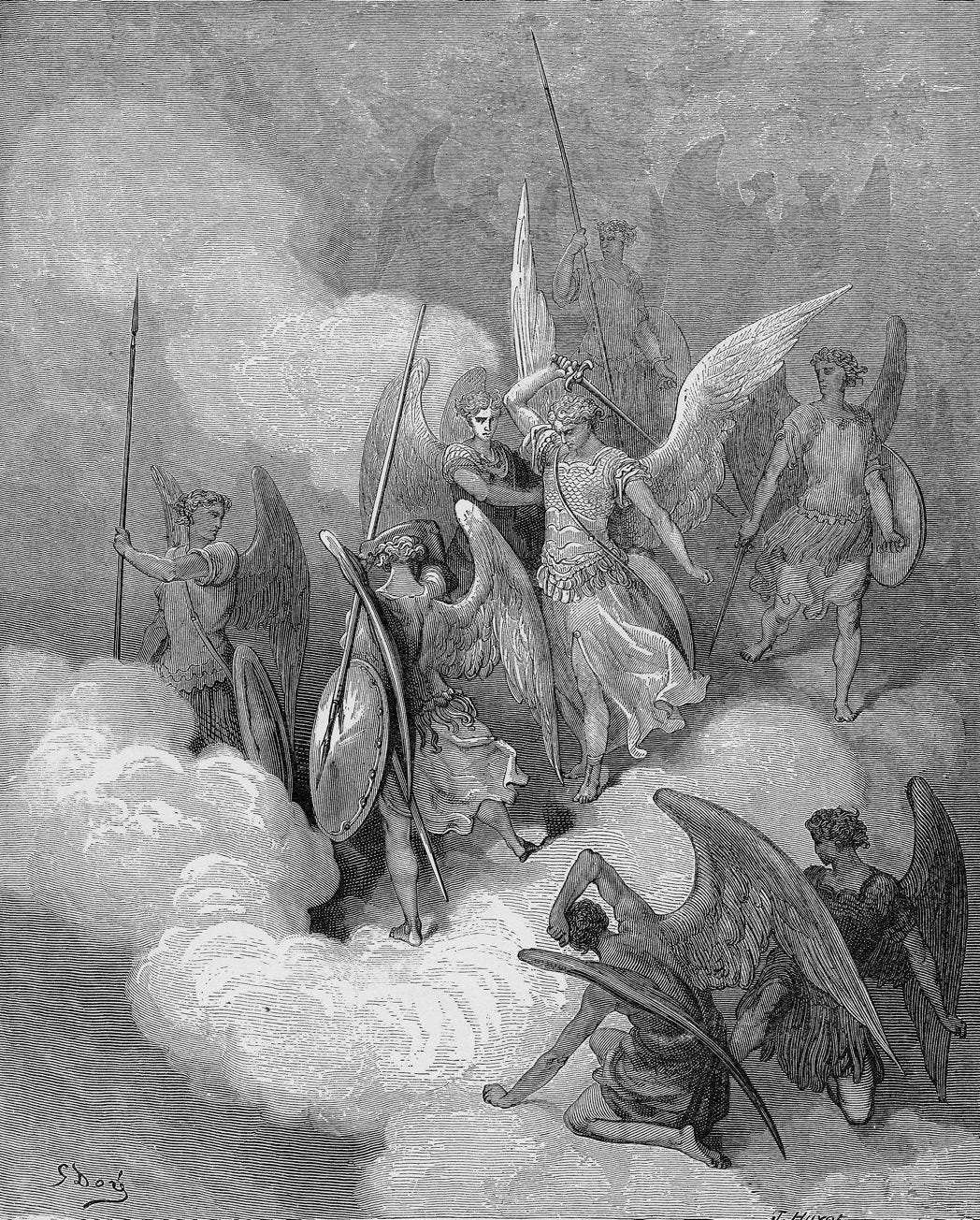
When the armies of Heaven gather on the field of battle in Book 6 of Paradise Lost, Raphael says that it “seemed strange at first, that angel should with angel war” (6.91-2). They are used to harmony, to unanimity, to a frictionless collective adoration of God. But it doesn’t take long for the rush of battle to replace discomfort with rage:
Now storming fury rose,
And clamour such as heard in Heav’n till now
Was never: arms on armour clashing brayed
Horrible discord, and the madding wheels
Of brazen chariots raged: dire was the noise
Of conflict; overhead the dismal hiss
Of fiery darts in flaming volleys flew,
And flying vaulted either host with fire.
So under fiery cope together rushed
Both battles main, with ruinous assault
And inextinguishable rage…
(6.207-217)
For most of Book 6, we watch as millions of angels vent all their unimaginable strength, skill in combat, and rage upon each other. They will wound each other, but being unable to die and able to heal themselves, will be able to push forward in a constant cycle of pain and recovery, retreat and attack. The rebel angels will plunder the ground for minerals and the loyal angels will rip up entire hills to hurl them at their enemies, both sides disfiguring the landscape of Heaven. Smoke and fire will cloud the skies, and the “horrible discord” of battle will fill the air. And, we are told, if God did not send the Son in to intervene, it would have gone on like this forever.
Brothers turned against each other in battle, destruction and pain, the feeling that this violence might continue without end…these are presented in epic terms in Book 6 of Paradise Lost, but are also recognizable as all too-real experiences of civil war.
As I discussed in this month’s intro post, England was embroiled in a protracted series of civil wars that began in 1642 and resulted in the execution of King Charles I in 1649. And as you may remember from one of the first articles I published as part of this slow read, John Milton wrote extensively – and controversially – about his objection to monarchy even through the restoration in 1660. He defended the decision to execute Charles in The Tenure of Kings and Magistrates and again in Eikonoklastes, both published in 1649; he doubled down on this position still further for an international audience in his Defensio pro Populo Anglicano (1651) and Defensio Secunda (1654); and even when it was becoming clear that the Republic was failing, he wrote treatises in 1659 and 1660 insisting that a future without an English monarch was possible.1
Paradise Lost was published 7 years after the Indemnity and Oblivion Act, also referred to as the “Act of Oblivion,” a 1660 generalized pardon from the newly restored King Charles II for any crimes committed during the period of civil war and interregnum. The act asserts Charles’ intention to move on from the events of the wars, “And to bury all Seeds of future Discords and remembrance of the former as well in His own Breast as in the Breasts of His Subjects one towards another.” But “oblivion” is not so easily achieved, and remembrance of the civil wars would have remained fresh for early readers of Paradise Lost, just as it was for our author.
In this article, I want to grapple with the civil war in Heaven - the “intestine war,”2 as Raphael calls it - and the difficulty posed by holding this fictional epic conflict up next to the civil wars in England. This is going to be as much a lit review as it is a discussion of the book, as I’ll be walking through some of the scholarship I’ve been reading on this subject that’s currently informing my perspective. My own guiding questions / points of curiosity over the past weeks of research have been:
How might the memory of the recent civil wars have informed early readers’ responses to Paradise Lost?
To what extent can early modern political context be illuminating in analyzing Book 6? And to what extent might focusing on the question of political allegory distract from the story?
If I see God’s chronic unpleasantness as a feature rather than a bug in Paradise Lost, what might that mean about the story as a whole?
If you have any reading questions or general points of curiosity or confusion about the War in Heaven and/or its connection to the Civil Wars in England, I’d be interested to hear in the comments! For now, let’s get into our article, starting with an examination of God the King.
Comments
Nothing yet. Say the first thing.
Sign in to join the conversation.