
TL;DR: Researchers surveyed 58 caregivers who had started a GLP-1 (mostly tirzepatide) within the past six months and lived with at least one kid. Since starting, 46.6% said they were offering their children healthier foods and 50% said they were more focused on managing their kids’ nutrition and activity. About a quarter noticed their kids actually eating healthier or moving more, though most saw no change in the kids yet. The effect was strongest when a pediatrician had already flagged the child’s weight. It’s small and self-reported, but it points to a “ripple effect” nobody has been measuring: treat the parent, and the family’s whole food environment can shift.
We talk about these drugs as an individual thing, one person, one dose, one waistline. This study asked a smarter question: what happens to everyone else in the house?
There’s real logic to it. Decades of research show a parent’s weight and habits shape a child’s obesity risk, and that when parents go through weight programs or bariatric surgery, their kids’ behaviors often improve too. So the researchers borrowed a framework called the Family Ecological Model, which is a fancy way of saying the home environment is a system. The parent isn’t just a person in the house. The parent is more like the thermostat, they set the conditions everyone else lives in. Change what the parent stocks, cooks, and models, and you’ve changed the climate for the kids without ever handing the kids a thing.
Here’s the mechanism, and it starts inside the parent. GLP-1 is a gut hormone that, among other things, quiets what people call “food noise”, the constant background hum of cravings and thoughts about eating. When a parent’s cravings drop and their eating gets more structured, their relationship to the grocery cart changes. They stop buying the stuff that used to call to them. They cook with less chaos. Adults on these drugs consistently report exactly this: fewer cravings, more dietary structure, a calmer food environment.
Kids don’t have the drug in their system. What they have is a parent whose behavior around food shifted, and children learn food the way they learn language, by absorbing what’s around them. So the drug acts on the parent’s brain, and the household is the delivery system to the kids.
The survey covered 58 caregivers, mostly women, mostly on tirzepatide, who’d been on their medication an average of just over two months. Since starting:
46.6% said they were offering their children healthier foods. Not a single caregiver reported offering less healthy food.
50% said they’d become more focused on managing their kids’ nutrition and physical activity.
27.6% noticed their children actually eating healthier, and 24.1% noticed their kids being more physically active.
Notice the split there. Half of parents changed what they controlled, the food they bought and offered. Only a quarter saw the kids’ own behavior change. That’s not a disappointment, it’s how family change usually works: the environment shifts first, and the kids’ habits catch up later, with time and reinforcement.
One finding stood out. When a pediatrician had previously raised concern about a child’s weight, 79% of those parents started offering healthier food after going on a GLP-1, compared to just 38% of parents who hadn’t heard that concern. A single earlier conversation from a doctor primed parents to act on the moment.
Keep this in proportion. It’s 58 people, a small and fairly homogeneous group, mostly white, well-educated, married women. It’s all self-reported, which invites the bias of people wanting to describe themselves as good parents. There are no actual measurements of the kids’ weight or diet, just caregiver perception, and it’s a single snapshot in time. So this shows a promising signal and a hypothesis, not proof that these kids end up healthier. The authors are clear that longer studies with real measurements are needed.
I find this one genuinely exciting, and a little tender, because it flips the frame from “is this drug vain?” to “what if treating one person quietly lifts a whole family?” We spend so much energy debating whether adults should be on these drugs, and here’s a hint that the benefit might not stop at the adult, it might spill into the next generation’s kitchen.
What thrills me about research like this is how many angles it opens: pediatricians using a parent’s treatment as a natural moment to talk about the whole family, the possibility of interrupting the cycle where a parent’s obesity becomes a child’s, and a reminder that food environments are shared, not individual.
For people using these every day who are also parents, I think the honest takeaway is empowering: the way you shop and cook while you’re on this is quietly teaching your kids, so lean into it on purpose. The caveat, that most kids hadn’t visibly changed yet, isn’t bad news to me. It’s a nudge that the home environment is the first domino, and it’s the one you actually control. I’ll be watching whether bigger, longer studies show these ripples turning into real, lasting change for the children, because if they do, that reframes what these drugs are worth entirely.
Follow Tirzepatide Tales on YouTube and Instagram, and Rising Health Report on TikTok. As always, I’m unaffiliated, so I appreciate support in any way possible, likes, shares, and comments on all my socials, so I can stay unaffiliated and never let money skew my opinion.
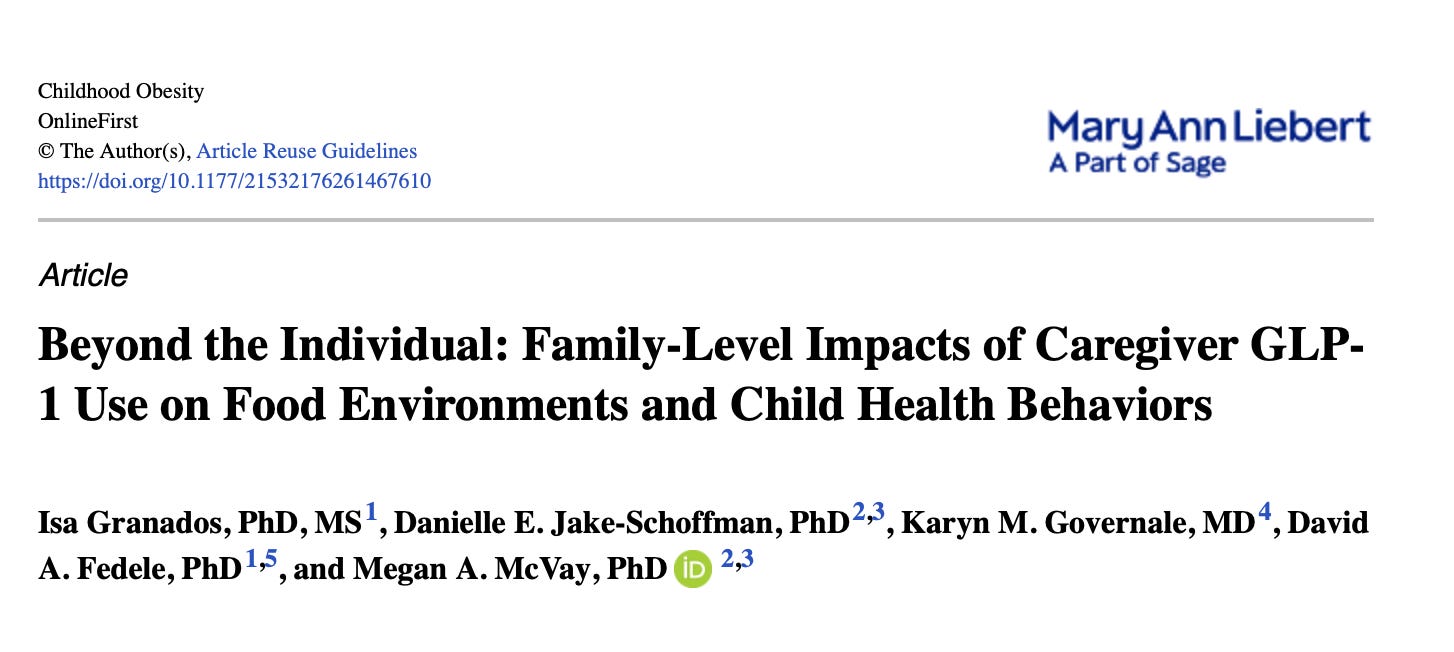
Source: Granados, I., Jake-Schoffman, D. E., Governale, K. M., Fedele, D. A., & McVay, M. A. (2026). Beyond the individual: Family-level impacts of caregiver GLP-1 use on food environments and child health behaviors. Childhood Obesity. Advance online publication. https://doi.org/10.1177/21532176261467610
No posts
Comments
Nothing yet. Say the first thing.
Sign in to join the conversation.