
TL;DR: A study in Diabetes, Obesity & Metabolism found that estimated drug exposure, not prescribed dose, best predicts nausea and GI side effects on oral semaglutide. Absorption of the pill varies wildly between people based on weight, sex, and gut conditions. So if you feel terrible on a “normal” dose, you may simply be absorbing more than average. The catch: there is no easy at-home test for this yet.
If you and a friend take the same oral semaglutide dose, you might be absorbing very different amounts of the drug. That is not a defect in you or the medication. It is what happens when you swallow a pill instead of injecting it.
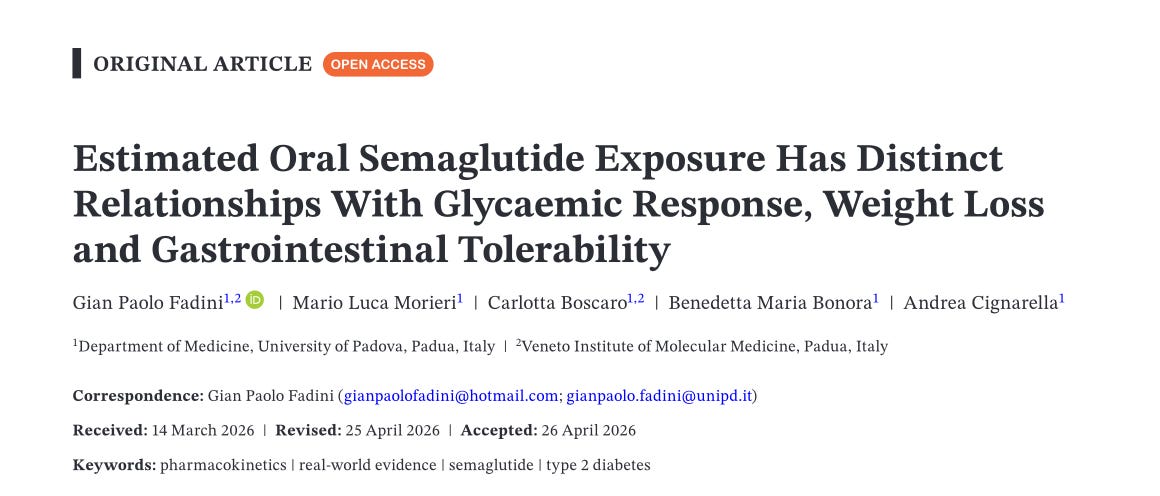
A study in Diabetes, Obesity & Metabolism explains why the dose on the label only tells part of the story.
They looked at real-world type 2 diabetes patients starting oral semaglutide. Instead of just logging the prescribed dose, they used a validated pharmacokinetic model to estimate each person’s actual drug exposure at every visit. The model accounted for dose, body weight, sex, ethnicity, and GI disorders, all things that change how a pill gets absorbed.
The finding: estimated exposure predicted GI side effects better than the prescribed dose did.
Knowing what someone was prescribed did not reliably tell you whether they would be miserable with nausea. Estimating what their body actually absorbed did.
That flips a common assumption. When a patient reports awful nausea, the easy read is “this drug is not for them.” The better read might be that they are absorbing more of the same dose than average, so they are effectively running a heavier exposure than intended.
When you inject semaglutide, a known amount goes into tissue and absorbs predictably. A pill has to survive stomach acid, cross the intestinal lining, and get picked up by a system that varies hugely person to person.
The variables stack up:
Gastric emptying speed, which can vary roughly threefold between people
Stomach pH, which affects how the drug dissolves
Food, meal type, and timing
Bile acid transporters, which differ by genetics and gut health
Any underlying GI condition, diagnosed or not
So a person with slow gastric emptying might absorb the drug gradually and hit a lower peak. Someone with inflammatory bowel disease might absorb less overall. Someone with fast emptying and a healthy gut might absorb a 14 mg dose more completely than the “average” patient the trials were built around. Same prescription, very different real exposure, and exposure is what drives the nausea.
This is not a quirk of one drug, either. A Physiological Reviews paper on gastric emptying notes that this variation is fundamental human biology. Emptying shows “substantial inter-individual variation” even in healthy people and gets disrupted by disease, medication, and age. The study team included GI disorders in their model precisely because any digestive condition will push your absorption off the population average.
If you are struggling with severe nausea, the problem may not be that you cannot tolerate the drug. It may be that you are a high absorber and your dose needs adjusting. The flip side is real too: if you are not getting the expected weight loss or glucose control on a dose that should work, you might be a low absorber.
Ideally a doctor would account for this. During titration, the right questions go beyond “do you feel nauseous” to how severe, when it peaks, how long it lasts. If someone is in real distress early, that argues for adjusting the dose sooner rather than telling them to tough it out.
The catch is honest. This research does not hand you an at-home absorption test. The model needs clinical data and expertise to run, so in practice doctors are still doing trial and error. What the study changes is the framing: oral dosing is messier than injection dosing, and that complexity deserves to be taken seriously.
This is good news wrapped around a problem. If you are fighting nausea on oral semaglutide, knowing absorption might be the culprit beats labeling yourself a bad responder. It is an argument for your doctor to adjust aggressively when you are genuinely suffering. And it is a reminder that potent drugs in pill form behave less predictably than the shot, and our dosing should reflect that.
Whether follow-up work shows that dosing by estimated absorption actually improves outcomes, whether anyone develops a practical way to spot high versus low absorbers early, and whether the same absorption-variability question gets asked of the injectable, which almost certainly has its own version of this.
APA Citation: Authors. (2026). Estimated oral semaglutide exposure has distinct relationships with glycaemic response, weight loss and gastrointestinal tolerability. Diabetes, Obesity & Metabolism. https://doi.org/10.1111/dom.70840
No posts
Comments
Nothing yet. Say the first thing.
Sign in to join the conversation.