
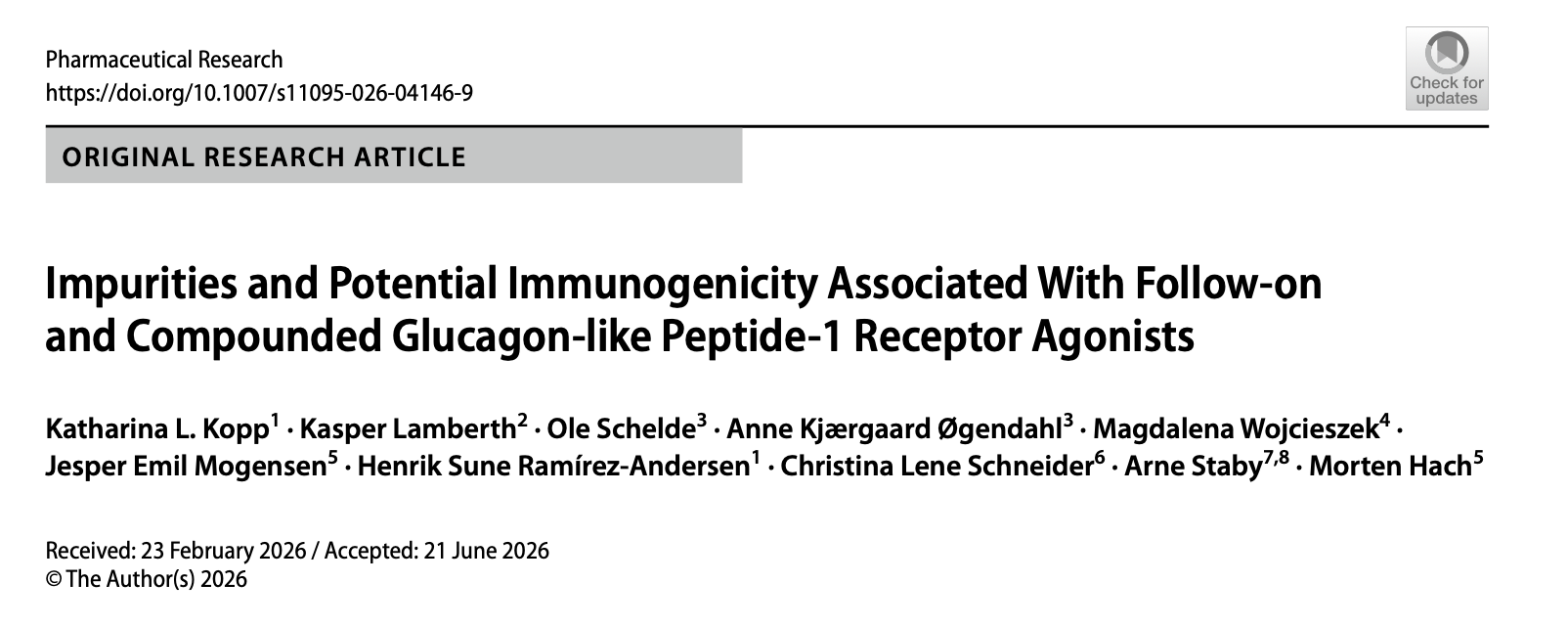
TL;DR: A new paper in Pharmaceutical Research reports that compounded and “follow-on” versions of semaglutide carry different impurities than the brand-name drug, and that some could, in a lab dish, provoke an immune response. The chemistry is real and the assays are standard. The problem lives everywhere the methods can’t protect you: the study was funded by Novo Nordisk, all ten authors are Novo employees or shareholders, the products were sourced in a way the paper never explains, the scariest results ride on tiny subsets, and the whole thing is timed to petitions asking the FDA to ban Novo’s cheap competition. This isn’t a story about bad science. It’s a story about how good science gets pointed like a weapon, and how to read industry research so it can’t fool you.
To read this paper clearly, you need two pieces of context, one about the drug and one about the money.
The drug part: compounding pharmacies make custom versions of medicines, and US law lets them produce a brand-name drug when it’s in official shortage. When semaglutide demand exploded and Novo couldn’t keep up, the FDA declared a shortage in late 2022, and compounded semaglutide poured in, usually at a fraction of Ozempic and Wegovy’s price. For millions of people, the compounded version was the only one they could afford. The immune concern the study raises is real in principle: these drugs are peptides, delicate chains of amino acids, and if impurities or clumping creep in, your body can theoretically build antibodies against the drug, which in the worst case cause reactions or blunt how well it works. Worth studying. Nobody should pretend all compounded product is automatically pristine.
The money part: the shortage ended in early 2025, and normally that means compounders stand down. Except the price gap is enormous and demand is bottomless, so the compounded market didn’t disappear. That leaves Novo, like Lilly before it, staring at a nearly identical drug sold for far less that millions already use, a problem no marketing campaign solves. There’s an FDA mechanism for this, the “demonstrable difficulties in compounding” list. Land a drug on it and compounding that molecule becomes off-limits, even in future shortages. In November 2024 a citizen petition asked the FDA to put semaglutide on that list. In August 2025 a second petition asked the FDA to force compounders to warn doctors about immunogenicity. This paper cites those petitions directly. It knows what fight it’s in. (I mapped the full pharma strategy for strangling compounding in if you can kill a competitor with a paper cut, why use a bazooka?.)
Here’s the trap. When people hear “industry-funded study,” they picture fraud, faked numbers, a chemist cooking data in a basement. That almost never happens, because it’s illegal, career-ending, and unnecessary. The real bias is quieter and completely legal, and it lives in the space the scientific method doesn’t reach.
Think of a study like a courtroom. The procedure can be flawless, sworn witnesses, real evidence, proper cross-examination, and the verdict can still be rigged if one side gets to pick which witnesses show up, write the questions, choose the courtroom, and pay the judge. The methods section of a paper is the courtroom procedure. It tells you the assays were run correctly. It tells you almost nothing about the choices made before and around those assays, and those choices are where a funder’s interest quietly steers the outcome. This paper is a clean example, so let me walk the choices one at a time.
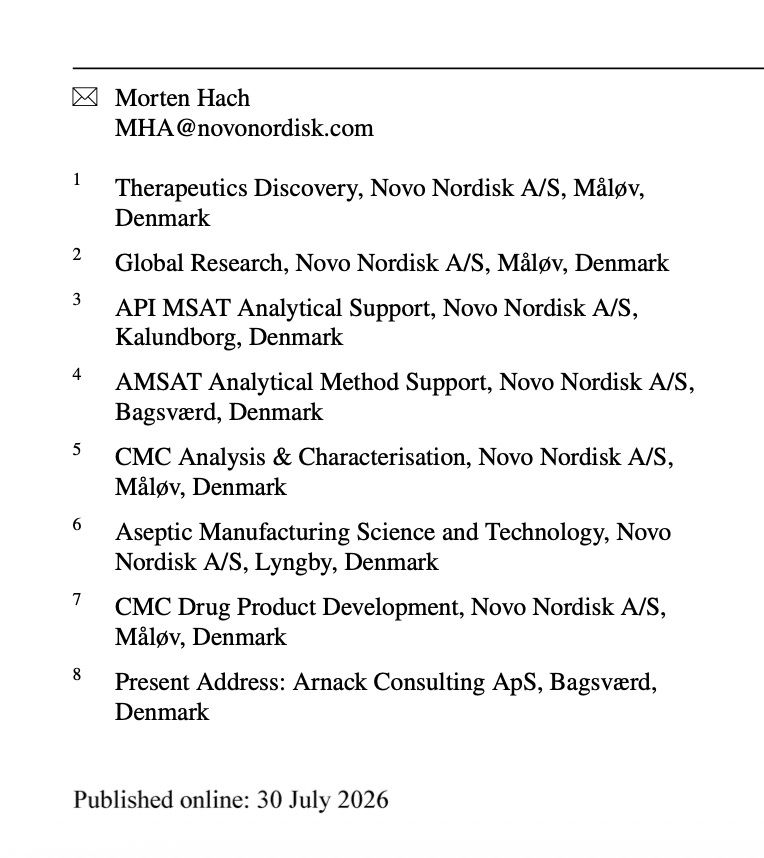
The study was funded by Novo Nordisk. All ten authors are current Novo employees and shareholders, or were during the work. The company selling the expensive drug paid its own staff to test the cheap competition, then published while petitioning to ban that competition on these exact grounds. That is not a neutral safety audit, it’s a litigant submitting evidence in its own case. It doesn’t make the data false. It means every soft judgment call in the study has a direction it’s quietly pulled toward, and there are more of those calls than most readers realize.
This is the one that should bother you most, because sourcing is where the whole thing turns. The paper tested 37 semaglutide products and 4 liraglutide products bought from 36 commercial suppliers across four continents. On breadth, fine, that’s a real spread, and I’ll credit it. But there are hundreds of compounders and copycat makers out there, and the paper never explains how these particular suppliers were chosen from that ocean. It just calls it “a sampling.” When the funder profits from a bad result, an unexplained selection process is the whole ballgame, because a sample nobody can audit is a sample that can be steered toward the worst actors while the good ones are quietly left out. There’s also no blinding described, meaning Novo’s scientists knew which vial was the competitor and which was their own product while they judged the results, when the honest way to run this is to hide that from the analysts.
They could have only sampled known lower quality suppliers over suppliers that are more widely known and tested.
Semaglutide is sensitive to light and heat. These products were purchased commercially and shipped to Novo’s labs in Denmark, and the paper repeatedly pins the impurities on “degradation during storage.” Notice the sleight of hand: degradation during storage could just as easily have happened in transit to Novo as at the compounding pharmacy, yet the blame points outward. The study leans hard on a variable it never controlled, in the direction that flatters the funder. On top of that, the most alarming numbers ride on tiny slivers of the sample. The scary light-degradation result was measured on just two of the compounded injectables. The immune signal appeared in only 4 of 15 donors. A wide sample is not the same as an unbiased one, and letting thin subsets carry the headline is how a modest finding gets dressed up as an alarm.
The paper opens with a gut-punch statistic, 961 adverse-event reports for compounded semaglutide, including 21 deaths. Sounds damning. Here’s what that number is: raw, unverified reports to the FDA’s FAERS database, which anyone can file and which establish exactly zero about whether the drug caused anything. There’s no denominator, no comparison against how many millions used the product, and no verification that the drug was at fault. A real safety signal needs all three. Presenting the raw count alone, up front, is a rhetorical choice, not a scientific one. (The impurity question genuinely is worth understanding on its own terms, which I dug into in the real reason there’s B12 in your compounded GLP-1.)
Let me be fair, because the point isn’t to flip the propaganda around. Compounded drugs really do have looser oversight than FDA-approved ones. Sourcing of the active ingredient can be murky, light-sensitive peptides in clear vials really can degrade, and those are legitimate reasons to be careful about where you get a compounded product. The immune concern is a real scientific question, not a fiction. What I’m challenging is not whether the topic matters. It’s whether a manufacturer-funded, manufacturer-authored study, with opaque sourcing, no blinding, an uncontrolled storage confound, and headline numbers with no denominator, timed to a petition that would erase the funder’s competition, should be treated as the settled truth. It shouldn’t. It should be treated as one interested party’s evidence, awaiting the same tests from a lab with no stake in the answer.
I keep coming back to this paper because it’s such a perfect teaching tool, and I want the people using these drugs to walk away with something more durable than a verdict on one study. The lesson is this: the most misleading research is almost never fake, it’s real methods wrapped around biased choices, and the bias hides in the parts of the paper nobody screenshots, the funding line, the sourcing, the confounders, the denominator that isn’t there.
Once you can see those, you can read industry science like an adult instead of being frightened or reassured on command.
What frustrates me is how well this works precisely because the chemistry is good, the word “immunogenicity” is scary, and most people will never scroll to the disclosure that every author draws a Novo paycheck.
What I want for anyone who compounds because it’s the only version they can afford is the full picture instead of half: yes, be smart about sourcing, ask your pharmacy about where the active ingredient comes from, whether the product is light-protected, whether it’s third-party tested, and no, do not let a drugmaker’s in-house study stampede you into believing your only safe option is the one that costs ten times more.
Follow Tirzepatide Tales on YouTube and Instagram, and Rising Health Report on TikTok. As always, I’m unaffiliated, so I appreciate support in any way possible, likes, shares, and comments on all my socials, so I can stay unaffiliated and never let money skew my opinion.
Source: Kopp, K. L., Lamberth, K., Schelde, O., Øgendahl, A. K., Wojcieszek, M., Mogensen, J. E., Ramírez-Andersen, H. S., Schneider, C. L., Staby, A., & Hach, M. (2026). Impurities and potential immunogenicity associated with follow-on and compounded glucagon-like peptide-1 receptor agonists. Pharmaceutical Research. https://doi.org/10.1007/s11095-026-04146-9 (funded by Novo Nordisk A/S; all authors are Novo Nordisk employees/shareholders).
No posts
Comments
Nothing yet. Say the first thing.
Sign in to join the conversation.