
By David Albertson and Jason Blakely
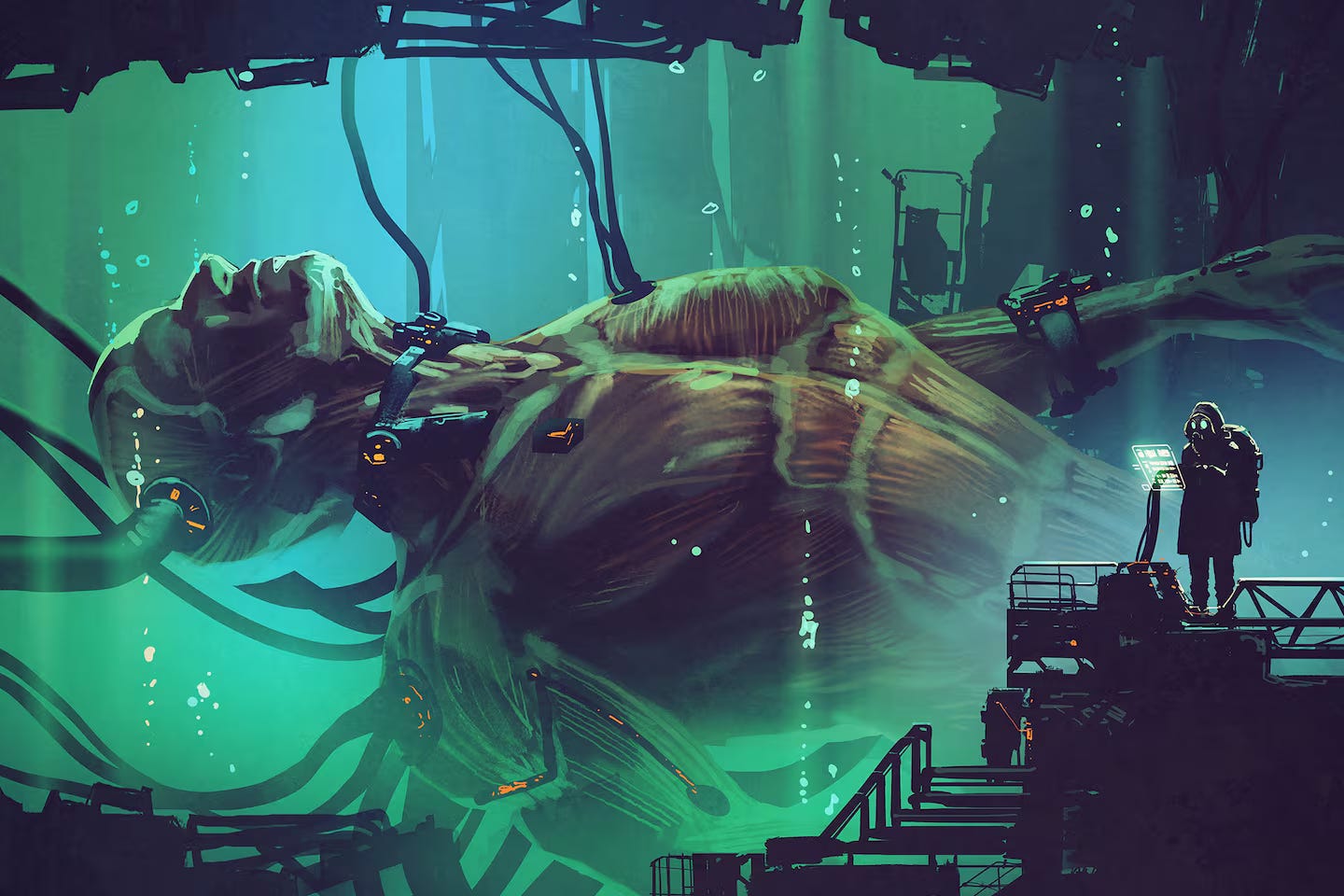
One rarely finds reactionary tech billionaires, revolutionary Marxists, and liberal progressives all joined in one chorus. Yet when it comes to hopes for the American future, many of them have started singing the same song.
They sing of a technocratic future, a utopia pulled straight out of science fiction. That should worry us. Notoriously, the most extravagant sci-fi utopians today are also the richest men on the planet. Peter Thiel, the billionaire cofounder of PayPal and Palantir, prophesied to The New York Times’s Ross Douthat that the human race will only survive through “transhumanism,” a concept describing the “natural body” getting “transformed into an immortal body” with the help of advanced biotech. The same fantasy is shared by Sam Altman, the CEO of OpenAI, who dreams of the “year humans and machines will merge” (perhaps 2075, he suggests) in a “co-evolution” to breed “superhuman AI.” Meanwhile Elon Musk yearns for the day humanity colonizes Mars and spares us the ignominy of being a “single-planet species.” On the day he became the world’s first trillionaire, Musk vowed to “take the fiction out of science fiction.”

But it was not the Tech Right who pioneered sci-fi futurism, it was the neo-Marxists. The eminent Marxist and academic literary theorist Fredric Jameson turned not to religion, not to poetry, but to contemporary American science fiction to stimulate his political imagination.
His justly celebrated 2005 tome “Archaeologies of the Future” analyzes the works of the sci-fi canon — Isaac Asimov, Frank Herbert, Philip K. Dick, and Ursula K. Le Guin, among others — to measure the height and depth of our common hopes for a just and prosperous tomorrow. Aaron Bastani wrote a bestselling book in 2019 entitled “Fully Automated Luxury Communism,” arguing that robotics and computer automation would make possible a postcapitalist abundant future. The systemic scarcities that plagued the Soviet Communism of yesteryear could be overcome, as advances in asteroid mining, gene editing, and synthetic meat would “provide for the needs of everyone in style.” Tech would usher in a future of universal material luxury. Musk, Thiel, and Altman couldn’t hope for more.
It is not only the billionaires and Marxists who dream of sci-fi abundance. A few years ago, wonkish center-left commentators were thrilled by the modest technologized utopianism of Kim Stanley Robinson. Robinson’s best-selling 2020 novel “The Ministry of the Future” was wildly popular with liberal opinion makers, from Bill Gates to Barack Obama. After projecting the sci-fi fates of New York, California, and Mars in other books, Robinson turned his novel into a literary sandbox for concrete solutions to the global climate crisis. No spaceships, no aliens, just smart monetary policy interventions by the International Monetary Fund and some heroic geoengineering. This mundane utopianism stays entirely this-worldly but banks on the promise of future innovation to fortify present political hopes — as if looking to the machines to give us permission to dream.
More recently, the liberal thinkers Ezra Klein and Derek Thompson in their influential 2025 book “Abundance” argued that progressives can regain momentum by offering a vision of society beyond scarcity, as artificial intelligence does the dishes and biotech extends our lifespans. They ask readers to dream “the year is 2050” and look forward to taking “star pills” to save “millions of lives and billions of healthy years.”
This is not to question the indispensable human need to hope for radically better futures. On the contrary: In the face of mounting and compounding global crises, it is crucial that we take the time to sketch out what the utopian scholar Gregory Claeys calls a “map or guidebook” to the future. Utopia, Claeys reminds us, allows humans to suspend immediate worries about political and economic exigency. It fortifies the imagination to reach toward a grander vision and describe in colorful detail the ideals guiding our collective projects. Utopianism lifts the hard limits of “realistic” planning and even suspends boundaries of time and space. Nothing sharpens the eye for critique of the present like a journey elsewhere and elsewhen.
The recent enthusiasm for sci-fi utopianism, even from Musk and the rest, tells us something important. It is high time to dispense with outdated nostrums that assume utopianism is either silly or dangerous. Utopianism ought to be considered a plausible politics, alongside progressivism, libertarianism, and neoliberal realism. On the other hand, our contemporary menu of futuristic imaginings offers rather limited and bizarre fare.
To be sure, technology has a vital role to play in any vision of human flourishing, whether in agriculture or health care or transportation. We desperately need new tools to fight diseases, reduce energy use, and distribute the advantages of developed economies to the rest of the world. As Pope Leo XIV himself noted in this year’s encyclical on AI, technology per se is not a “force antagonistic to humanity,” although it is “never neutral, because it takes on the characteristics of those who devise, finance, regulate, or use it.”
But unless our utopian dreaming expands beyond the marvels of techno-wizardry and reckons with the full reality of human possibilities, we will only multiply our current problems on a greater and more dangerous scale. The moral curve must advance at least as quickly as the technological curve. There are no pills or devices for living in peaceful communities and quelling violence. Citizens incapable of compassion for their neighbors will not be prepared to wield awesome technological power in humane ways.
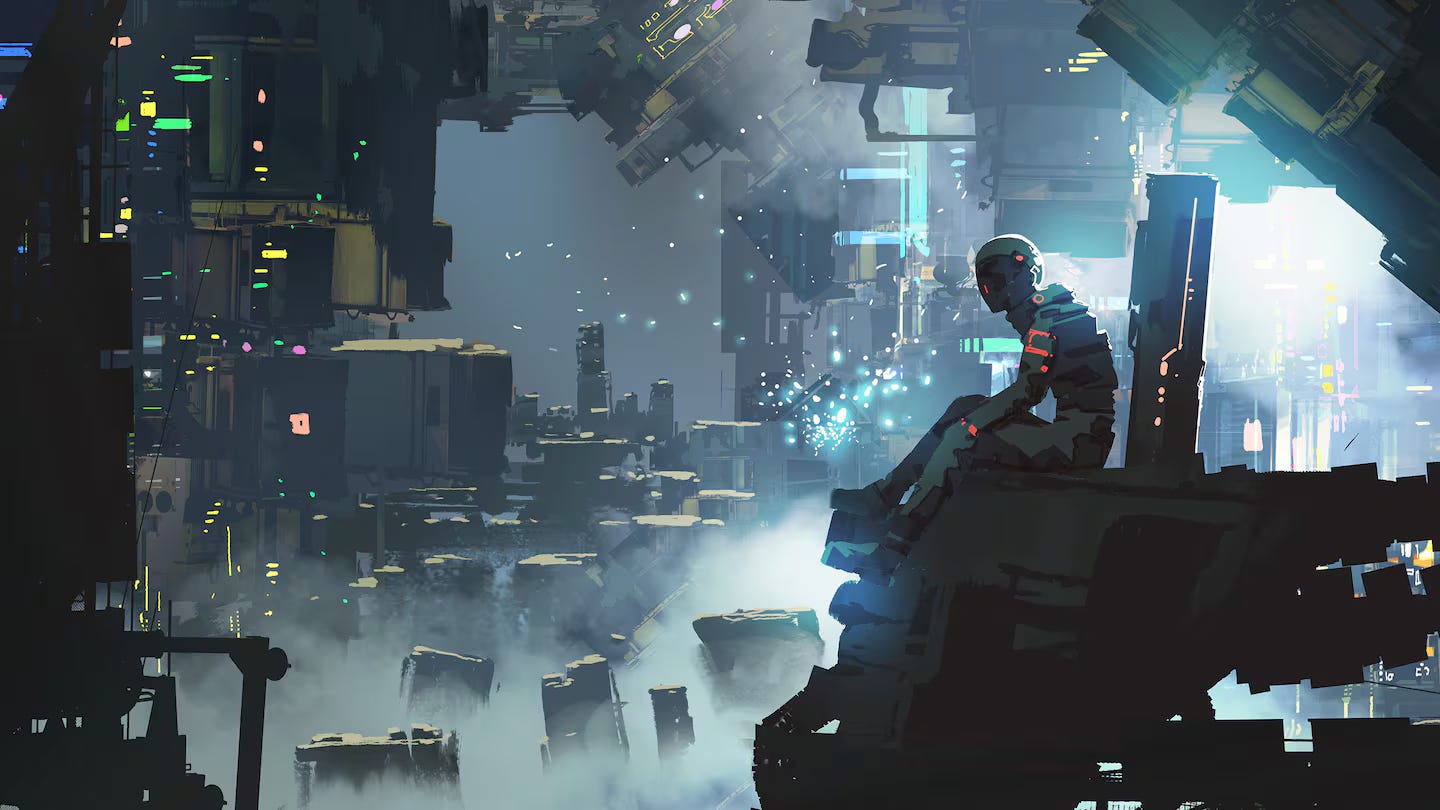
Too often the dreams of sudden technological progress for the few end up shutting down difficult conversations about the common good. But what are our greatest aspirations for our shared future? Some turn to science fiction as a deus ex machina to skip to the end of the story without explaining the mechanism for a social transformation. But what kind of human beings will be morally capable of a better world? Techno-utopians of all stripes fail to dream beyond creature comforts, restricting the radical imagination.
If we are to avoid these compromises, we need a politics of utopia that is universal, deep, truly ambitious, and tenaciously focused on holistic human betterment.
To this end we have a lot to learn from the wisdom and diversity of utopias from the past. The first modern utopian — and the inventor of this form of politics — is the Renaissance humanist, lawyer, and canonized saint Sir Thomas More. More’s witty novella “Utopia” (1516) dreams of a society that takes the dignity and preciousness of every human life with utter seriousness and seeks universal growth and self-expression. Every man, woman, and child has food, housing, fulfilling work, friendship, and the ability to play, learn, and create. More’s Utopians do not accomplish this through technological virtuosity but by making hard choices to prioritize the commons, to share resources, and to learn to love the intrinsic goods of human fellowship more than luxuries. Indeed, they understand that excessive abundance makes utopia impossible. They dress simply, prefer meaningful pleasures like stargazing and singing, and are so cured of greed that they all relieve themselves in golden pots.
More’s “Utopia” accomplishes its miracle by cultivating virtue in individuals and equipping them for actual flourishing. Human education is both a means and its end. While shallow sci-fi utopians of every stripe forget this central lever of any political future, deep utopianism confronts the challenge of reshaping harmful desires and forming communities around mutual care and interdependency.
Authentic utopian dreaming has always been easily hijacked by shortsighted, weaker visions. Even More’s original utopianism was immediately taken over by Francis Bacon, the godfather of Silicon Valley technocrats. His 1627 novella “New Atlantis” placed scientific power, not humanistic virtue, at the center of the story. In Bacon’s science fiction, shipwrecked sailors wash up on the shores of Bensalem, a private island where a powerful government runs a secretive scientific institute. If More celebrated egalitarian human flourishing, Bacon was tantalized by technological control.
Today, utopian politics has a reputation for being dangerous, because authoritarians in the last century like Stalin and Mao, gripped by the Baconian techno-fallacy, sought to force structural change violently without regard for the dignity and freedom of human beings. Here we can begin to appreciate the strange convergence of Marxist utopianism and sci-fi dreams, which both chase rapid material development while neglecting spiritual and ethical transformation in favor of technological control. For his own part, Marx himself was a fierce critic of ethical utopianism and put his faith instead in scientific power.
Other American utopians can inspire and guide our imaginations better than the AI barons. Edward Bellamy’s 1888 “Looking Backward: 2000–1887” critiqued the capitalism of his day from the perspective of a robust socialist future. In the 1930s and ’40s, Dorothy Day founded Catholic Worker communities in New York City that offered immediate food and housing for anyone who needed it.
Martin Luther King Jr. — a devoted reader of Bellamy — understood that maximalist dreaming poses a very real threat to concentrations of wealth and power. King’s “I Have a Dream” speech lifts every limit on what we can hope for together. It remains the most potent expression of American utopianism to date, conjuring forth a postracial vision that overwhelmed the false realism of Jim Crow and beckoned the country toward a still unrealized future. King’s martyrdom put the seal of seriousness on his radical Christian utopianism.

Today in Los Angeles, where we write from, the spiritual legacy of Day and King is still active in Father Greg Boyle and his Homeboy Industries. Boyle’s community has gained national attention for rehabilitating gang members and breaking down class divides through a highly successful network of microenterprises. The social theorist Erik Olin Wright calls such postcapitalist initiatives “real utopias” here and now — like travelers from the future.
As Oscar Wilde famously quipped, “A map of the world that does not include Utopia is not worth even glancing at, for it leaves out the one country at which Humanity is always landing.” Whatever ideological tradition or political party we hail from, Americans all face a polycrisis of climate, economy, democracy, belonging, and human identity. But it takes far more invention, far greater daring, and far stronger hope to imagine a future without hungry children, gun deaths, uninsured families, and genocidal wars than simply to cheer on the AI singularity. As we navigate this difficult century, the only utopia worth building is one centered on the most spectacular of all marvels: the full realization of the human person.
David Albertson is a professor of religion and philosophy at the University of Southern California. Jason Blakely is a professor of philosophy at Loyola Marymount University. They are the authors of “Utopia for Our Century: A Manifesto of Hope.”
This article originally appeared on BostonGlobe.com on August 11, 2026.
Comments
Nothing yet. Say the first thing.
Sign in to join the conversation.