
Research: Garth von Buchholz ▪️Global Island AI
Infographic design: Gemini Notebook
Behavior only has meaning when it is analyzed in context, such as the environment, the group behavior, the situation/circumstances, and the perspective/worldview of someone.
Intelligent people-readers see not just the individual, but the network.
Balance – no player type is better or worse than another and a group needs all types, but proportions may vary.
Flow – No one is limited to one role and can switch roles, and the way they switch is the flow.
Stuck – Notice where group dynamics get “stuck” so that instead of trying to identify problems in individuals or topics, look at the bottlenecks and dysfunctional flows.
Actions – the actions are vocal actions and the function of the actions is more pertinent than the content of what is said; watch where the attention flows (King, 2026).
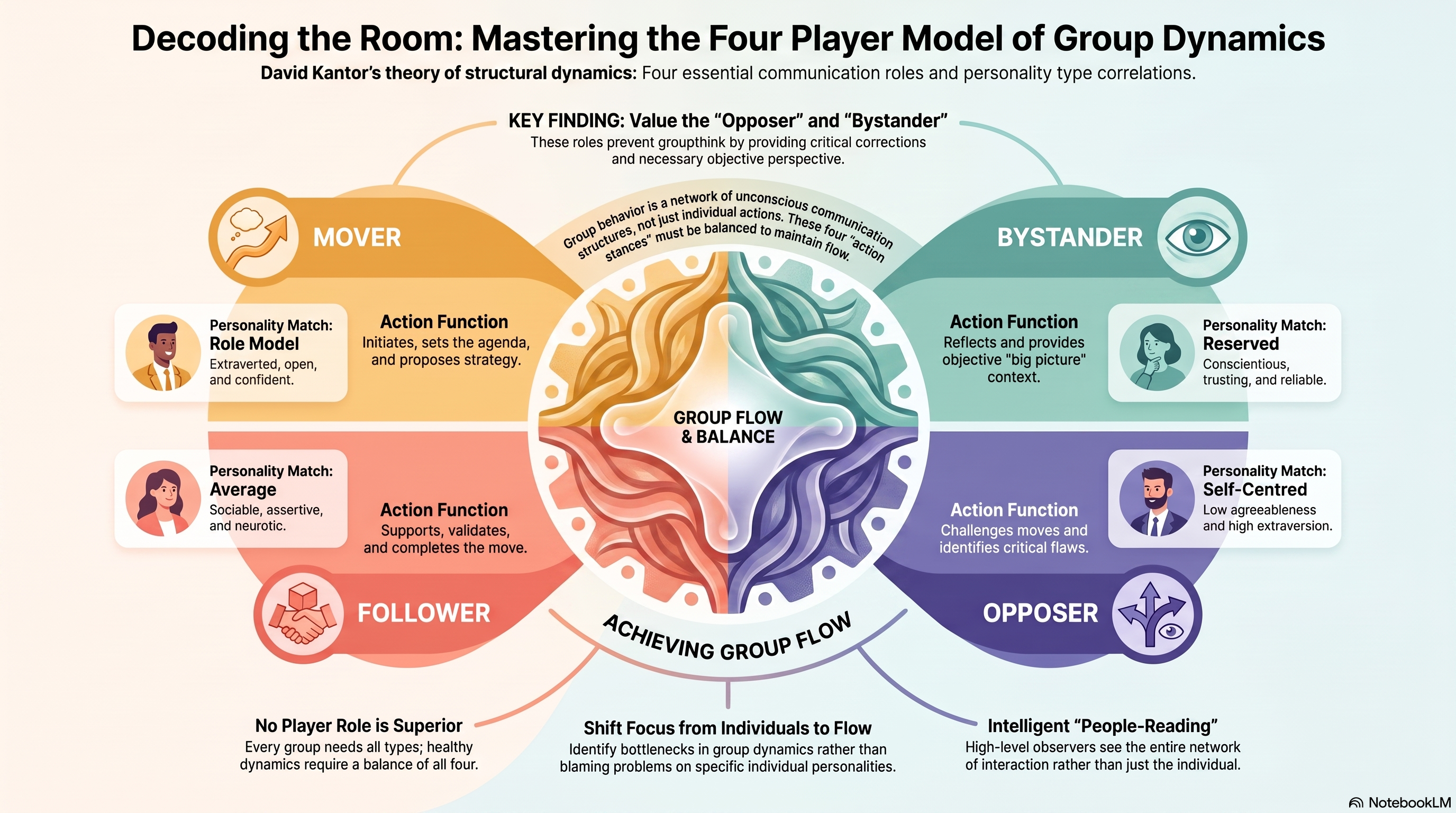
David Kantor’s Theory of Structural Dynamics identifies an underlying, largely unconscious structure of human communication. His Four Player Model has four distinct “player roles” or “action stances” in any group situation:
1. Mover – Initiates, pushes conversation forward, creates change, starts things off, makes a plan, proposes a strategy, sets the agenda, act as directors to organize and motivate a group, but can come across as domineering (corresponds to Role Models type).
2. Follower – Supports the Mover’s initiation, validates it, builds on it, follows through, completes, uses collaboration and teamwork, but may come across as pliable, reticent, passive aggressive (corresponds to Average type).
3. Opposer – Challenges the move by the Mover and the support by the Follower, identifies flaws, suggests corrections, asks pointed questions, but may over-analyze, get stuck in arguments, or comes across as overly critical and negative (corresponds to Self-Centred type).
4. Bystander – Observes and reflects, provides meta-observation of the group interactions, brings context and the “bigger picture”, provides valuable objectivity and perspective, but may come across as detached and aloof or judgmental (corresponds to Reserved type) (King, 2026).
According to a peer reviewed study in 2018 with data from more than 1.5 million people using the “OCEAN – Big 5” personality traits, four basic but distinct personality types were identified (Gerlach et al, 2018):
Average – Neurotic, extraverted, sociable, and assertive, but not especially open (corresponds to Follower player role).
Reserved – Agreeable, conscientious, trusting, likeable, and reliable, and lower in neuroticism, extraversion, and openness (corresponds to Bystander player role).
Role Models – Extraverted, open, agreeable, confident, and conscientious, plus low on neuroticism (corresponds to Mover player role).
Self-Centred – Low agreeableness, low openness, and low conscientiousness, disinclined to agree and harmonize but may have high extraversion (corresponds to Opposer player role) (King, 2026).
Gerlach, M., Farb, B., Revelle, W., & Amaral, L. A. N. (2018). A robust data-driven approach identifies four personality types across four large data sets. Nature Human Behaviour, 2(10), 735–742.
Kantor, D. (2012). Reading the room: Group dynamics for coaches and leaders. Jossey-Bass.
King, P. (2026). Behavioral tells: Read the hidden signals behind every action: What people reveal without saying a word. PKCS Media.
/gvb
Comments
Nothing yet. Say the first thing.
Sign in to join the conversation.