
Introduction
During the height of the global response to the COVID-19 pandemic, the Global Health Project team were asked to conduct a comprehensive study conducted in June 2021 aimed to explore the potential effects of mRNA vaccines among the U.S. population.
At the time, public discussion around vaccine side effects faced significant restrictions, and the publication of this research was blocked by influence from pharmaceutical companies among some of the research suppliers used for the study.
Despite these challenges, the findings were shared privately among health practitioners and scientists, offering critical insights into vaccine safety and efficacy.
Now, with the lifting of these constraints and a broader acknowledgment of the spectrum of reactions associated with mRNA vaccines, we are able to publicly release these pivotal results. This blog post provides a thorough examination of the study, its methodology, key findings, and comparisons to other research, offering readers a comprehensive resource to understand this previously unseen data.
Background
The study, titled "Understanding the Potential Effects of COVID-19 Vaccines Among the General U.S. Population," was conducted between June 18 and June 28, 2021. It surveyed 5,007 U.S. adults, selected through a commercial market research panel, with demographics approximately aligned to the 2020 U.S. Census for age, gender, and region. The purpose was to examine a wide range of self-reported symptoms—both mild and serious—experienced by participants in the months before and after receiving a COVID-19 vaccine, as well as by unvaccinated individuals, including those in close proximity to vaccinated individuals.
It is important to note that this study relied on self-reported data and did not confirm clinical diagnoses or include detailed medical histories. As such, it captures associations rather than causation, providing a snapshot of experiences during a specific period in the early rollout of mRNA vaccines.
You can download the report by clicking here:
In this post, we’ll summarize the key findings and explore the implications, especially since this important study was censored and serves as a case-study to ensure this type of research suppression never occurs again.
Study Overview
Methodology
Sample Size and Composition: The study included 5,007 participants, with 76% reporting at least one dose of a COVID-19 vaccine and 24% remaining unvaccinated at the time of the survey.
Data Collection: Conducted via an online survey, the instrument was designed to be adaptive to various browsers and screen sizes to minimize mode effects. Questions covered:
COVID-19 infection history and severity.
Presence of "long haul" symptoms post-infection.
Detailed timelines of various self-reported symptoms in the past year, before and after vaccination.
Vaccination status, timing, and location of vaccine administration.
Proximity of unvaccinated individuals to vaccinated individuals and any subsequent symptoms.
Demographic Alignment: The sample was compared to the 2020 U.S. Census, showing slight variances but general representativeness across age, gender, ethnicity, income, and geographic distribution.
Key Groups Analyzed
Vaccinated Individuals: Symptoms were analyzed, particularly among those without pre-existing conditions or prior COVID-19 infections, to isolate potential vaccine-related effects.
Unvaccinated Individuals: Special attention was given to those reporting symptoms after close contact with vaccinated individuals, exploring potential indirect effects.
Key Findings
1. COVID-19 Infection and Severity
Prevalence: Approximately 19% of participants reported a previous COVID-19 diagnosis.
Severity Distribution:
Asymptomatic: 41%
Mild (cold-like, no treatment): 32%
Moderate (flu-like, at-home treatment): 20%
Severe (required hospitalization): 7%
Long Haul Symptoms: Among those diagnosed, 51% reported experiencing lingering or "long haul" symptoms, with the most common including:
Fatigue: 34%
Loss of taste/smell: 31%
Headache: 28%
Depression/anxiety: 25%
2. Vaccination Status and Reported Effects
Vaccination Coverage: 76% of participants were vaccinated, surpassing the national average at the time, with most vaccinations occurring between November 2020 and April 2021.
Vaccination Locations:
Retail pharmacies (e.g., CVS, Walgreens): 31%
Hospital/urgent care clinics: 25%
Personal physicians: 26%
Drive-up vaccination sites: 10%
Other: 8%
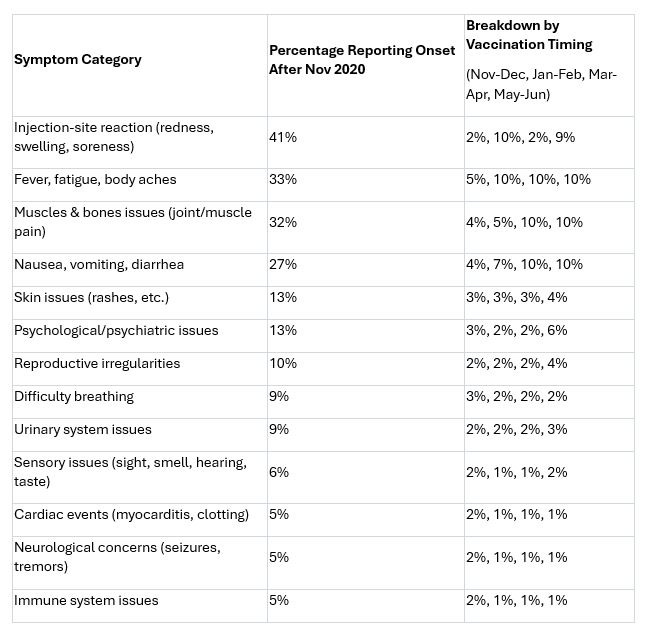
Post-Vaccination Symptoms Among Vaccinated Individuals (Without Pre-existing Conditions or Prior COVID-19): The following table details the percentage of vaccinated participants reporting symptom onset after November 2020, coinciding with the early vaccine rollout. Importantly, this subset of respondents reported no pre-existing conditions and no previous COVId-19 infection.
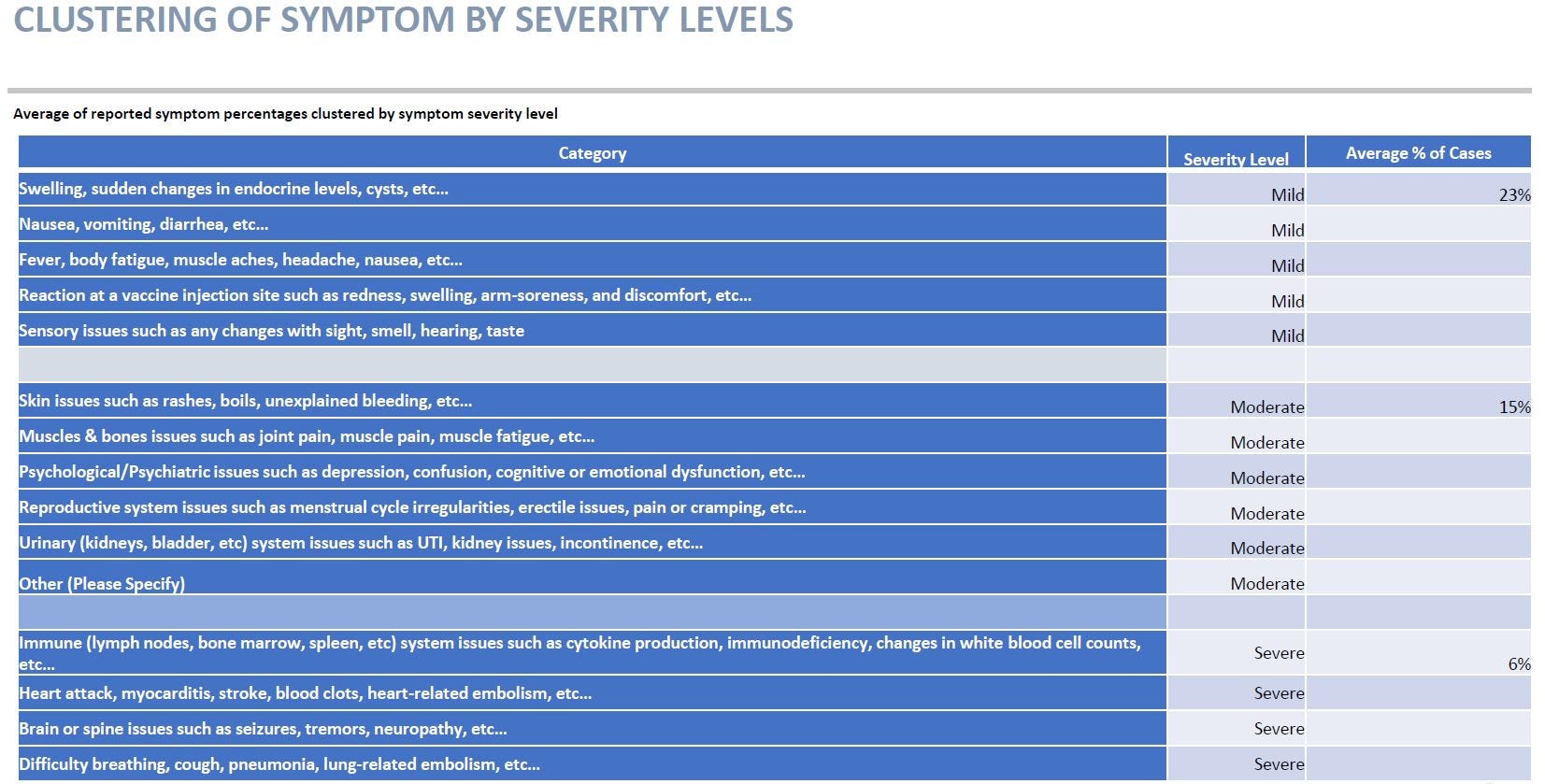
Severity Distribution of Symptoms: Among vaccinated participants reporting symptoms, the severity was categorized as:
Mild: 23%
Moderate: 15%
Severe: 6%
3. Unvaccinated Participants and Proximity Effects
Proximity to Vaccinated Individuals: Among unvaccinated participants, 11% reported experiencing new symptoms after being in close proximity to vaccinated individuals.
Timing of Symptom Onset Post-Proximity:
Same Day: 31%
Within 3 Days: 29%
4-6 Days: 17%
7-14 Days: 9%
More than 2 Weeks: 14%
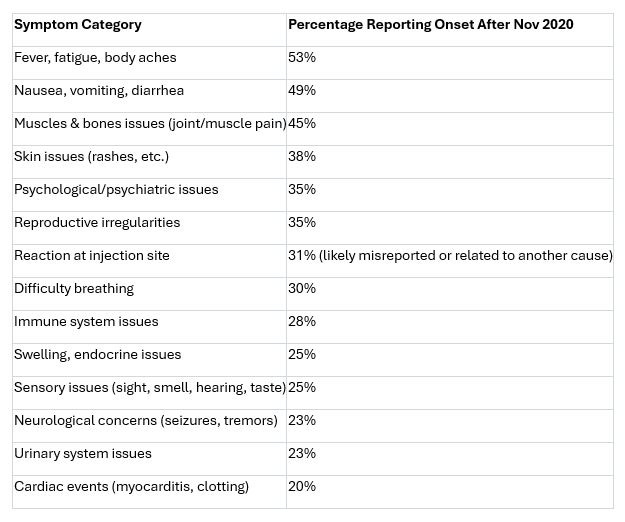
Symptoms Reported by Unvaccinated Individuals Post-Proximity (No Pre-existing Conditions, No Prior COVID-19): The following table details the percentage of unvaccinated participants reporting symptom onset after November 2020, following proximity to vaccinated individuals:
Comparison to Other Studies
To contextualize these findings, it is useful to compare them to other research on mRNA vaccine adverse events:
Cardiovascular Issues:
This Study: Reported a 5% incidence of cardiac events such as myocarditis or clotting among vaccinated individuals.
Other Studies: Research from the Global Vaccine Data Network and CDC/FDA safety monitoring through VAERS and VSD has identified an increased risk of myocarditis and pericarditis, particularly after mRNA vaccines like Pfizer-BioNTech and Moderna, especially in younger males. These studies confirm myocarditis as a notable side effect, aligning with the findings here.
Other studies that show a link between Covid-19 vaccines and cardiovascular issues include: https://www.nature.com/articles/s41598-022-10928-z, https://www.ncbi.nlm.nih.gov/pmc/articles/PMC8340602/, https://www.mdpi.com/2076-393X/10/4/505, https://news.yale.edu/2023/05/05/yale-study-reveals-insights-post-vaccine-heart-inflammation-cases, https://www.cdc.gov/mmwr/volumes/71/wr/mm7114e1.htm
Injection Site Reactions:
This Study: Found 41% of vaccinated participants experienced reactions at the injection site.
Other Studies: Local reactions such as redness, swelling, and pain are commonly reported across multiple studies and clinical trials of mRNA vaccines, consistent with this study's data.
General Symptoms:
This Study: Noted high percentages for symptoms like fever, fatigue, and muscle aches (33%).
Other Studies: These systemic reactions are frequently reported in large-scale analyses and clinical trials, with similar prevalence, reinforcing the consistency of these findings.
Proximity-Related Symptoms in Unvaccinated:
This Study: Observed that 11% of unvaccinated individuals reported new symptoms after proximity to vaccinated individuals, with a range of onset times.
Other Studies: This phenomenon is less commonly discussed in peer-reviewed research, though some anecdotal reports have surfaced. This aspect requires further scientific scrutiny to validate or dismiss potential mechanisms such as vaccine shedding or other indirect effects.
One significant study on this topic can be found at www.MyCycleStory.com. Other studies of interest include: https://www.oaepublish.com/idr/article/view/5756 and https://jpands.org/vol29no3/helwig.pdf
Reproductive and Endocrine System Issues:
This Study: Found 10% of vaccinated individuals reported reproductive system issues without pre-existing conditions.
Other Studies: Some studies have investigated menstrual changes post-vaccination, but the link to vaccination remains under investigation with mixed results. Broader endocrine system effects are less documented, suggesting this may be an area for further research.
Other studies of interest include: https://onlinelibrary.wiley.com/doi/10.1111/andr.13209, https://www.ncbi.nlm.nih.gov/pmc/articles/PMC9428332/, https://www.ajog.org/article/S0002-9378(23)00189-7/fulltext, https://jpands.org/vol28no1/thorp.pdf
Psychological and Psychiatric Effects:
This Study: Reported 13% of vaccinated individuals experiencing psychological or psychiatric issues post-vaccination.
Other Studies: Psychological effects are less frequently discussed in major studies, though there are mentions of increased stress or anxiety related to the vaccination process or health concerns, indicating a potential gap in research.
Other studies of interest include: https://www.nature.com/articles/s41380-023-02406-8, https://www.cureus.com/articles/202749-behavioral-and-health-outcomes-of-mrna-covid-19-vaccination-a-case-control-study-in-japanese-small-and-medium-sized-enterprises, https://www.cureus.com/articles/202749-development-of-anxiety-symptoms-after-receiving-the-pfizer-biontech-bnt162b2-covid-19-vaccine-a-case-series, https://www.cureus.com/articles/202749-psychiatric-complications-including-psychosis-in-a-middle-aged-man-after-covid-19-vaccination-a-case-report, https://www.ncbi.nlm.nih.gov/pmc/articles/PMC10905007/
Immune System Effects:
This Study: Noted 5% of vaccinated individuals potentially experiencing immune system disruptions.
Other Studies: There is less direct correlation in other studies to general immune system effects post-mRNA vaccination, although some research discusses changes in immune response, particularly in relation to autoimmunity or immune-mediated conditions.
Other studies of interest include: https://www.nature.com/articles/s41467-024-50656-7, https://www.ncbi.nlm.nih.gov/pmc/articles/PMC10832335/, https://www.frontiersin.org/journals/immunology/articles/10.3389/fimmu.2023.1126906/full, https://jpands.org/vol28no1/thorp.pdf, https://www.journal-of-hepatology.eu/article/S0168-8278(21)00238-3/fulltext
Implications
The findings from this study suggest a range of reactions to mRNA vaccines, from mild and common to rare but severe, underscoring several key points:
Ongoing Monitoring: Continuous surveillance for adverse events post-vaccination is essential, particularly for conditions like myocarditis which can be serious. The data highlights the need for robust systems to track and analyze vaccine effects over time.
Medical Education: Health professionals should be well-informed to recognize and respond to a wide spectrum of symptoms, ensuring patient safety and providing appropriate care. This includes understanding both common and rare reactions to better support patients.
Further Research: There is a clear need for more in-depth studies to establish causality, especially concerning symptoms reported by unvaccinated individuals in proximity to vaccinated ones. This could involve exploring potential mechanisms such as vaccine shedding or other indirect effects, as well as confirming the prevalence and nature of less commonly reported symptoms.
Transparency in Research: The release of this previously censored study emphasizes the value of open information-sharing. By reviewing and discussing a wider range of self-reported outcomes, future research can better assess incidence rates, potential risk factors, and timelines for recovery, contributing to a more comprehensive understanding of vaccine safety profiles.
Limitations
It is crucial to understand the limitations of this research:
Self-Reported Data: The study relies on self-reported symptoms without clinical verification, which may lead to over- or under-reporting of certain conditions.
Lack of Medical Histories: The absence of detailed medical histories limits the ability to distinguish between vaccine-related effects and symptoms caused by other factors.
Snapshot in Time: The data represents a specific period in 2021, and further research is needed to understand long-term implications and changes in vaccine effects over time.
Sample Size Considerations: While the sample size of 5,007 provides a reasonable snapshot, it may not capture all nuances seen in larger, more diverse cohorts like those from VAERS or international databases.
Conclusion
The release of this previously restricted study marks a significant moment in vaccine research transparency. It adds valuable data to the public discourse on mRNA vaccine effects, contributing to our growing understanding of their safety profile. While most individuals who experienced effects reported mild to moderate symptoms, a smaller percentage encountered more severe reactions, highlighting areas for continued investigation.
However, when viewed in total, the constellation of symptoms when viewed in aggregate point to a potentially significant collective problem. The “smoke signal” intent of this early study in 2021 has been validated since with other studies looking at various specific system issues, although few since have endeavored to view the potential universe of adverse events in total. For perspective. here is a possible projection of the extent of the impact from the report in 2021:
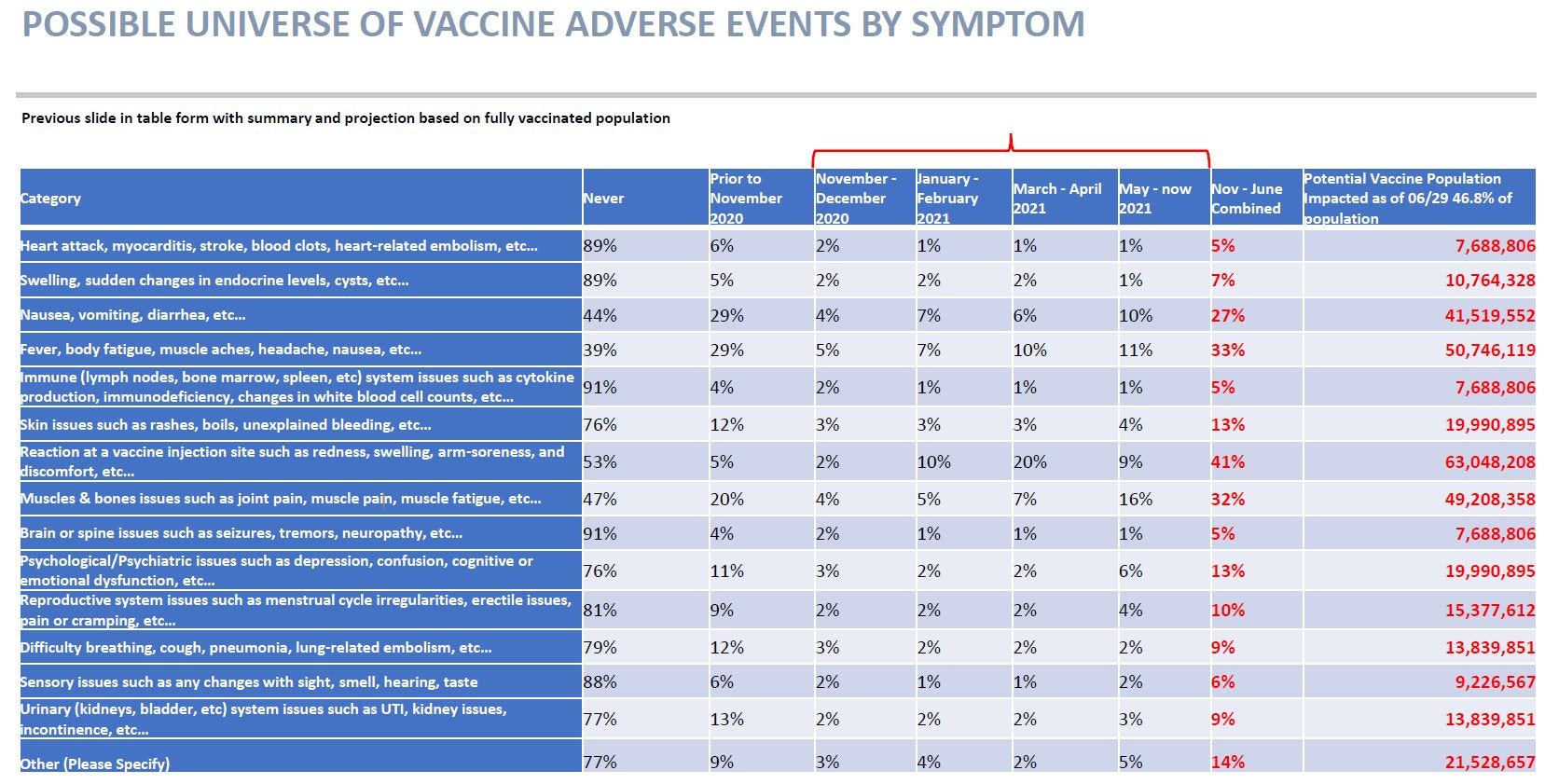
The findings also raise intriguing questions about potential indirect effects, such as symptoms reported by unvaccinated individuals after proximity to vaccinated ones, which merit further scientific scrutiny. Members of the GHP team have been involved in that research as well and we encourage you to follow Dr. Pierre Kory and A Midwestern Doctor for more expansive discussions on that issue.
As new studies and surveillance efforts emerge, a more nuanced analysis will clarify both the frequency and severity of observed side effects. These findings should be considered alongside the extensive body of research supporting vaccine safety and efficacy, including long-term monitoring data from various global health organizations. By sharing this research publicly, we aim to empower individuals with knowledge, provide clarity to health professionals, and contribute to informed medical decision-making and public health policy.
We appreciate the patience and diligence of those who conducted this research under challenging circumstances and are now proud to share their findings with the world. Let this be a step towards more open, honest, and informed health practices. Readers are encouraged to review additional evidence and official guidance when making health decisions.
No posts
Comments
Nothing yet. Say the first thing.
Sign in to join the conversation.