
At Global Health Project, we’ve always believed that lasting public health progress begins by listening—by seeking the truth in lived experience and connecting data to real people. In our latest calls and collaborations one message echoes: to heal, we must first understand what has happened, how it was engineered, and why a new campaign—of equal magnitude and sophistication—is necessary to restore trust and sanity in American health and public dialogue.
In our previous post, "Rebuilding Trust in American Healthcare," we unveiled insights from our national survey of 2,006 U.S. adults, revealing a profound "trust paradox" in public perceptions of the U.S. Department of Health and Human Services (HHS). While 93% of Americans expressed deep concerns over issues like vaccine safety, chronic disease epidemics, and regulatory conflicts of interest, there remains strong support for genuine reforms—provided they prioritize transparency, accountability, and lived experiences over top-down mandates. Building on this foundation, recent discussions, including a Twitter Space on September 4, 2025 that we participated in, and RFK Jr.'s Senate hearing testimony the same day, underscore the urgent need to address the lingering effects of COVID-era behavioral interventions. These interventions, rooted in applied behavioral science, reshaped societal norms and individual behaviors on a global scale. Today, we explore how they were deployed, the machinery behind them, and—crucially—how our research on personas, psychographics, and media habits can guide new campaigns to reverse these effects, fostering healing and autonomy. This is not just analysis; it's a blueprint for action, calling on HHS to invest in undoing the damage with the same rigor and scale used to inflict it.
Applied behavioral science, often through "nudges"—subtle alterations to choice architecture designed to influence behavior without overt coercion—was systematically employed during the COVID-19 crisis to promote compliance with public health policies. Governments and organizations drew on principles from psychology and economics to instill cognitive and emotional shifts, making actions like masking, social distancing, lockdowns, and vaccination feel intuitive, socially normative, or urgent. These efforts were not isolated; they involved coordinated global campaigns that integrated research, marketing, and technology to scale impact.
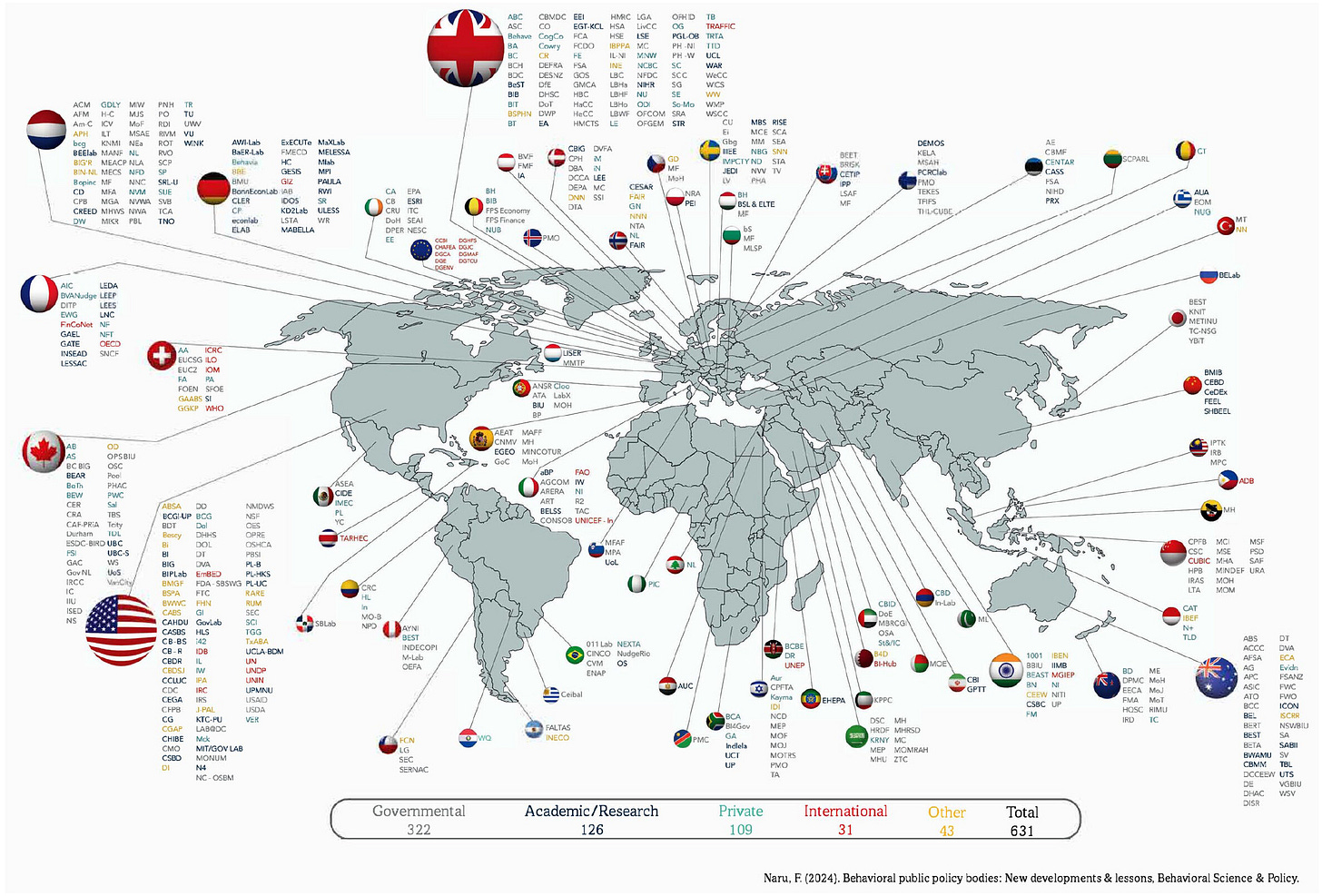
As this paper explains in depth “The field of behavioral public policy (BPP) has grown rapidly in the past 10 years, as is indicated by the rising numbers of BPP bodies that routinely apply insights and methods from behavioral science to improving the effectiveness and efficiency of public policy. This article reports on a count showing that between 2018 and 2024, the number of BPP bodies grew worldwide from 201 to 631 and increased on all continents.”. So-called “Nudge units” are deeply integrated into both public and commercial enterprises and continue to grow because they worked so well during the Covid era to prove they could be deployed at scale to change behavior (never mind pesky things like consent and autonomy!).
Covid-19 saw the broad deployment of applied behavioral science as a tool for shaping the actions, emotions, and beliefs of entire populations. Nudging as a concept isn’t inherently nefarious; it describes efforts to guide decisions in predictable ways, often by reframing choices or harnessing social influence. But what was unprecedented was scale, intensity, and complexity: governments in coordination with PR firms, media giants, technology platforms, and global institutions consolidated their messaging, directing not just information—but psychology—toward behavioral compliance.
Nudges leveraged emotional appeals, social norms, and low-friction interventions to drive behavior change. For instance, messaging often framed compliance as a prosocial act, such as the UK's "Stay Home, Protect the NHS, Save Lives," which evoked collective responsibility and guilt to encourage lockdown adherence. In the US, text-based reminders used ownership language like "Claim your dose today" to boost vaccination appointments by up to 6%, drawing on scarcity and endowment effects. Other strategies included peer information nudges, where messages highlighted others' vaccination rates to exploit conformity, and incentives like lotteries (e.g., Ohio's Vax-a-Million) to make uptake rewarding. Globally, campaigns incorporated disgust priming (e.g., emphasizing germ transfer for hand-washing) and simplified cues (e.g., singing "Happy Birthday" twice for timing). These were tested iteratively via A/B experiments and surveys to refine effectiveness, often prioritizing short-term compliance over long-term trust.
Governments collaborated with private sector partners to operationalize these nudges at scale. In the US, HHS partnered with marketing firm Fors Marsh Group for the "We Can Do This" campaign, which integrated behavioral insights into multimedia ads targeting hesitant groups. PR giant Edelman conducted global studies on brand trust during the pandemic, advising on communication strategies that aligned corporate and government messaging. Research firms provided data via surveys and experiments, while advertising agencies handled creative development for TV, radio, and digital ads. Technology providers enabled targeted delivery, such as SMS platforms for reminders, and social media giants like Facebook and Twitter (now X) amplified content through algorithms favoring official narratives. Globally, entities like the UK's Behavioural Insights Team (BIT) advised on policy framing, working with media outlets for consistent rollout across channels. This ecosystem ensured campaigns were scalable, with real-time adjustments based on engagement metrics.
Key players included federal agencies like HHS, CDC, and FDA; global NGOs and governance bodies like WHO and GAVI; PR and marketing conglomerates (Fors Marsh Group, Edelman, VMLY&R); major media and advertising partnerships (iHeartMedia, WPP); and social media platforms (Facebook, Twitter, TikTok, Google).
Their operational playbook:
Data-driven segmentation sourced from national surveys and health profiles.
Media blitzes simultaneously deployed across broadcast, digital, outdoor, sports, and entertainment.
Social norm interventions: Emotional appeals (protect grandma!), loss aversion (don’t let Covid take your freedom), and visual cues (mask banners, icons on social feeds).
Technology leverage: Push alerts, algorithmic boosting and throttling of content, targeted behavioral ad campaigns.
Suppressing dissent: Coordinated requests—sometimes explicit, sometimes implicit—to social media and mainstream media to censor, de-prioritize, or even ban content deemed “misinformation”—even when that content included legitimate scientific dissent or personal injury testimony.
Governments and partners used:
Choice architecture (presenting options or consequences in ways that steer decisions)
Fear appeals (highlighting risk, suffering, and loss)
Peer pressure (showing what “everyone else” is doing)
Emotional stories (victim testimonials, heroic healthcare narratives)
Media saturation—drowning out alternative voices with authoritative repetition.
Concurrently, efforts to promote compliance included mechanisms to suppress alternative views. Governments pressured social media platforms to censor content deemed misinformation; for example, Meta CEO Mark Zuckerberg acknowledged White House requests to remove COVID-related posts, including those questioning vaccine efficacy or origins. Tactics involved derogatory labeling (e.g., "anti-vaxxer"), algorithmic demotion, content removal, and partnerships with fact-checkers to flag dissenting data. In China, censorship circumvention spiked as users sought blocked information, while in democratic nations, platforms like YouTube and Facebook enforced policies that buried heterodox opinions, often at the behest of officials. These measures created echo chambers, marginalizing scientists and citizens who raised concerns about policy harms or data inconsistencies.
The result: public cognitive and emotional shifts so deep that much of the population became locked into binary attitudes—compliance or suspicion, fear or denial—with meaningful dialogue and healing crowded out by conflict and fatigue.
Public data reveals substantial funding. In the US, HHS allocated $911 million for COVID-19 propaganda efforts, primarily through Fors Marsh Group, which received task orders for the "We Can Do This" campaign using COVID relief funds of at least $250 million for a single year. A benefit-cost analysis estimated the campaign delivered $90 in “societal benefits” per $1 spent, though this focused on vaccination uptake. The UK's BIT secured contracts worth over £100,000 for behavioral advice on COVID responses, including net-zero nudges post-pandemic. NGOs and international bodies, such as the World Economic Forum, contributed through reports and partnerships, though exact figures are less transparent. These investments underscore the scale: billions globally for coordinated behavioral shifts.
The cognitive, emotional, and behavioral conflicts from these interventions—manifesting as distrust, fatigue, and unresolved doubts—require targeted reversal. Our work on "#TheOath" campaign and the HHS Perception studies provides a foundation, identifying key drivers like validation of lived experiences and psychographics such as empowerment-seeking. By leveraging personas, media habits, and tested frameworks, we can design campaigns that help the populace reconcile truths, heal, and reclaim autonomy.
The "#TheOath" research (2022, n=1,000+ U.S. adults) pinpointed the "Moveable Middle" (MM, 76% of respondents)—a diverse, vaccinated but hesitant group open to dialogue if messages validate doubts without blame. Using quantitative surveys with nonconscious measurement tools, EEG, and in-person interviews, we found high engagement (82% positive valence) from credible messengers like physicians admitting errors, driving actions like information-seeking (63%). Our HHS survey expanded this, revealing four personas: Grounded Realists (31%, practical and experience-driven), Progressive Pragmatists (12%, systemic-focused), System-Conscious Seekers (51%, digitally engaged and solution-oriented), and Institutional Skeptics (7%, distrustful of overreach). Key drivers include addressing "pain points" like vaccine injuries (93% concern rate), with media habits favoring Facebook (72% MM usage) and TikTok for younger segments.
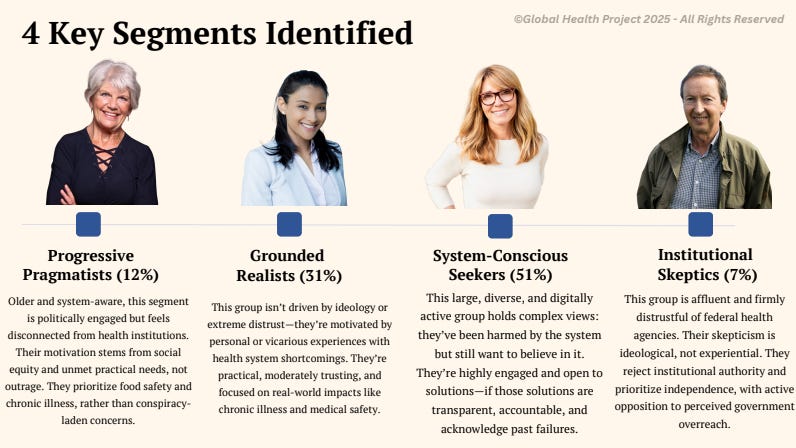
To deprogram, frameworks must reframe narratives around healing and truth. For the majority of the population that means deploying campaigns based on empathetic storytelling: "Your doubts are valid—let's uncover the facts together," countering original guilt-based nudges with autonomy. Position as empowerment tools, e.g., interactive quizzes on policy trade-offs (lockdown harms vs. claimed benefits) via apps. For Institutional Skeptics, grassroots channels like X emphasize independence: "Reclaim your health from overreach—evidence on censored data." Tailor psychographics: inspiration for Pragmatists via systemic reform stories; practical data for Realists on chronic disease spikes. Multichannel delivery—social media for broad reach, radio for skeptics—ensures scale, with A/B testing for resonance as in "#TheOath."And in all cases, these campaigns have to include paid promotions on mainstream channels and major social media platforms; paid placement is the ONLY way to break through the entrenched censorship echo chambers.
Grassroots efforts alone can't counter global-scale nudges; it requires HHS investment in multichannel, targeted campaigns mirroring past ones but focused on transparency, truth, and healing. With RFK Jr.'s revelations amplifying censored info, now is the moment.
We urge all partners, policymakers, and Americans: join us in calling for real investment in psychological and informational recovery. Support funding for nationwide, multi-platform campaigns that honor lived experience, encourage genuine accountability, and invite all to step out of the shadow of engineered compliance into the light of honest, autonomous health decision-making.
This is more than communications—this is about restoring sanity, dignity, and trust in the wake of extraordinary manipulation. The path forward is clear. With the right strategy and resources, it is achievable.
Join us in this vital work. Download our full studies, share your insights, and contact Jeanne Sheffield at JeanneSheffield@GlobalHealthProject.org to collaborate.
Let’s nudge America back to sanity—with data, empathy, and the courage to confront what was done so we can heal, together.
No posts
Comments
Nothing yet. Say the first thing.
Sign in to join the conversation.