
Dear Readers - welcome to the Global Corridor newsletter. The world is experiencing massive restructuring of its economy, territory and technologies through new global infrastructure projects. Many of the investments in new railways, data-centres, real estate developments, port expansions, special/extractive zones, highways, and more are proceeding through transnational, multi-modal corridors. We are seeing the making of a new global geography at an unprecedented pace and scale. I’ll be providing a round up of some of the most interesting news, stories, data, opinion + academic work that can help us make better sense of this transforming world, including news from my own project.
Recently I joined the Urban Radar podcast with Zhengli Huang and Linda Westman to discuss the Global Infrastructure Race recorded live as part of the Urban Institute’s 10 year anniversary celebrations. Drawing on insights emerging from the GlobalCORRIDOR and Pluralize projects to share our interpretation of the surge of finance into global infrastructure projects, its urban impacts and how we can centre and decentre the role of China.
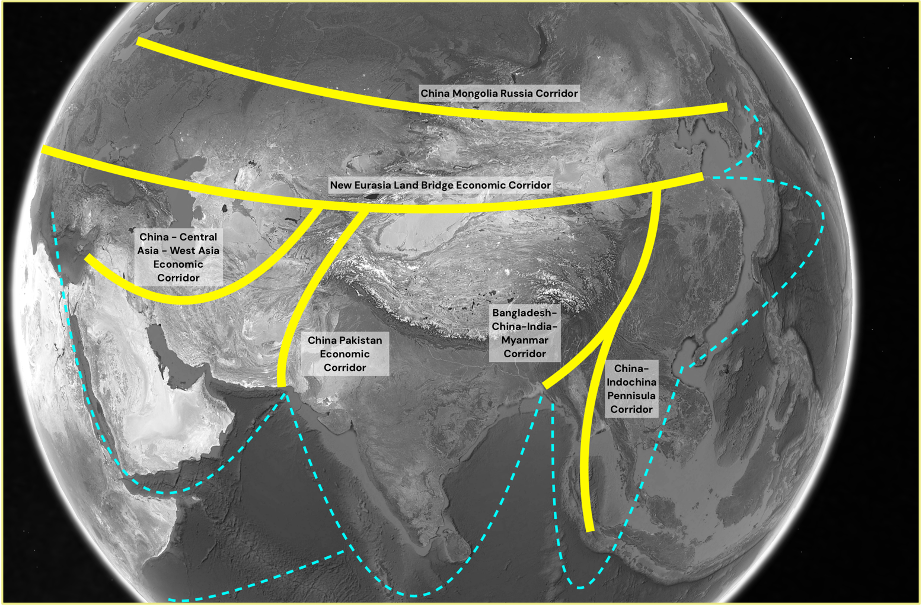
Discussion included addressing:
What is the Global Infrastructure Race and how can we understand its diverse geopolitical and economic manifestations?
How can historical and contemporary analysis help unpack the role of China and Chinese investments?
What are the impacts on cities and urban inequalities of these activities in and beyond China?
If you like Urban Radar there is now a whole host of podcasts by Beth Perry and Tom Goodfellow to enjoy listening to here
A round up of some of the biggest news on global infrastructure projects and emerging implications:
BlackRock’s Global Infrastructure Partners nears $38bn takeover of utility AES and $40bn purchase Macquarie-owned Aligned Data Centers
BlackRock’s Global Infrastructure Partners (GIP) is reportedly nearing two massive acquisitions, a roughly $38 billion takeover of the US utility AES and a $40 billion purchase of Macquarie-owned Aligned Data Centers. While framed as simply more investment into the infrastructure sector, the dual acquisition move reveals a deeper restructuring of how power (both electrical and political) is being reorganised through global finance actors. Thinking about it through an extractivism logic highlights how these deals exemplify the ways energy and data are becoming mutually constitutive terrains of accumulation (and you can learn more about that from Patrick Bresnihan and Patrick Brodie here).
GIP’s pursuit of AES is especially telling. AES is not merely a conventional power utility with its portfolio encompassing renewables, battery storage, and long-term power-purchase agreements that anchor the electricity needs of industrial and more recently, digital sectors. Acquiring this utility gives BlackRock influence in shaping the future of energy generation in the digital age, which sector(s) receive preferential access, and how decarbonisation is likely paced or stalled. The utility grid is now being increasingly built, managed and owned by financial actors with deep and tied investments in the (unsustainable?) data centre boom.
The simultaneous bid for Aligned Data Centers, one of the fastest-growing ‘hyperscale’ operators demonstrates the second half of this data+power equation. Data centres are the physical machinery of the AI economy, consuming vast, concentrated loads of electricity and requiring unprecedented cooling, water, and land. Their expansion is remaking peri-urban and rural landscapes, at pace substituting agricultural or residential uses with fortified (low job) digital enclaves. By acquiring Aligned, GIP is securing not only data centre real estate but a critical node in the global computational supply chain.
Taken together, the two deals amount to a form of vertical integration of the digital-energy complex. BlackRock will control major segments of generation and major segments of consumption. This is extractivism updated not in the narrow sense of mineral removal, but as the extraction of value through infrastructures that reorganise territory for the flows of global capital. Electricity becomes an input to data; data becomes an engine for further financialisation.
Logistical corridor in place for Africa’s largest mining project
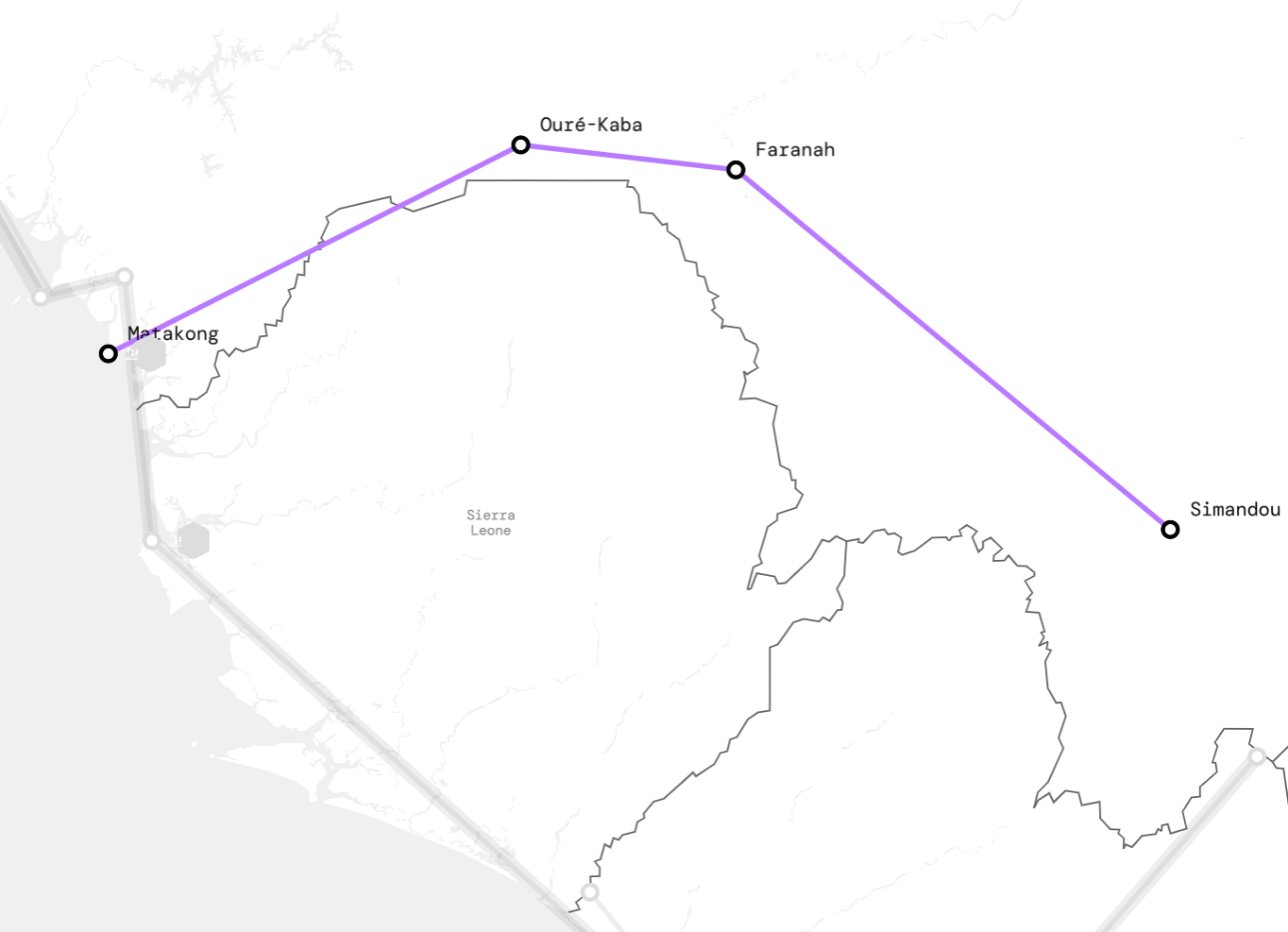
After decades of delay, Simandou, long proclaimed as Africa’s largest untapped iron-ore reserve has begun exporting its resources. The railway is laid and operational, the port terminal facing out toward the Atlantic Ocean now ready, mining activities are underway.

The map of Simandou’s logistics shows a new infrastructural era for Guinea as part of the $23 billion project. The trans-Guinean heavy-haul railway spans hundreds of kilometres, cutting across protected areas, farming villages and fragile ecologies on its way from the southeastern massif to the coast. Designed as a multi-user corridor, the line aims to ferry tens of millions of tonnes of high-grade ore annually for the next several decades. The port facilities, employing offshore loading and transshipment systems rather than deep-water dredging, form the coastal node of this corridor. Collectively, alongside the mine these installations create a single, continuous extractive artery.
Dutch government takes control of Chinese-owned chipmaker Nexperia
The Dutch government has made a dramatic intervention in Europe’s semiconductor supply chain, taking effective control of Nexperia, the Nijmegen-based chip manufacturer owned by China’s Wingtech Technology. On 30 September 2025, The Hague invoked a rarely used national security law, the Goods Availability Act, to restrict Wingtech’s decision-making rights. The government insists this is not a full nationalisation, rather, it now has the power to reverse or block corporate decisions that threaten Europe’s access to critical chips.
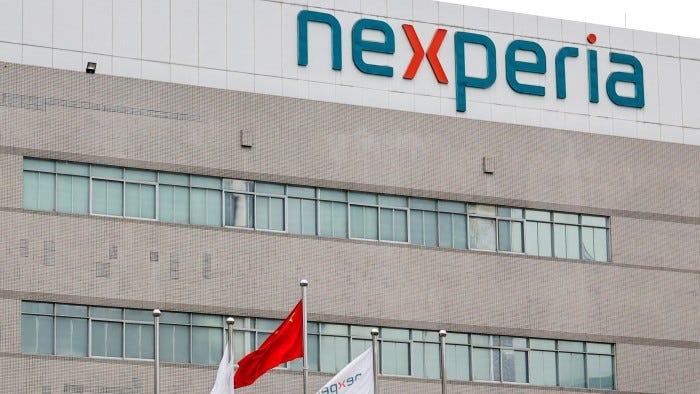
According to Dutch officials, the move was spurred by “serious governance shortcomings” within Nexperia. They argue that these shortcomings create a real risk to European technological sovereignty, especially given Nexperia’s role as a supplier of semiconductors used in autos and consumer electronics.
Unsurprisingly, Beijing has reacted strongly. Wingtech decried the decision as geopolitical, accusing The Netherlands of “politicisation” rather than objective risk management. The response from China’s government was equally sharp: it claims the move threatens global semiconductor supply chains. It’s clear that tech sovereignty is becoming inseparable from geopolitics!

A docker is led away by police during the docks strike in Manchester in August 1972 (Trinity Mirror / Mirrorpix). The 1972 Manchester docks strike was a significant labor dispute that reflected wider industrial unrest in the UK during the early 1970s. Dockworkers at Manchester, part of the national network of port labor, walked out over pay, working conditions, and the casualized employment system, demanding better wages and job security. The strike caused major disruptions to trade and shipping, affecting imports and exports and highlighting the critical role of dock labor in the economy. But it also signalled a shifting global economy of shipping brought on by containerisation.
Which Way Home is a 2009 documentary film directed by Rebecca Cammisa. The film follows several children who are attempting to get from Mexico and Central America to the United States, on top of a freight train that crosses Mexico known as “La Bestia” (The Beast). Cammisa received a Fulbright Scholar Grant to make the documentary in 2006. The film premiered on HBO on August 24, 2009.
Featuring a selection of new academic papers covering various types of scholarship on global infrastructure:
The flammable city: Infrastructure, temporalities, and social struggles in Dock Sud, Buenos Aires by Simone Vegliò in Urban Studies
This article explores the impacts of large-scale infrastructure operations in Buenos Aires. Focussing on neo-extractive and logistical infrastructures in the southern area of Dock Sud, it investigates how these infrastructures urbanise – namely, how they integrate into urban spaces and the socio-spatial and material dynamics they generate. It does so by investigating the relationships between materiality and temporality, highlighting their complex and multifaceted interplay. While adopting a view from below – that is, by analysing the social conflicts experienced by those living in the spaces surrounding these infrastructures – the discussion sheds light on how Dock Sud’s urban materiality is contested through the creation of distinct and often conflicting temporalities. Specifically, the article delves into the socio-material situation of Villa Inflamable shantytown by scrutinising what it terms the politics of ‘mientras tanto’ [meanwhile], showing how residents reversed the state’s and municipality’s promotion of a prolonged condition of waiting to confront their extremely precarious and hazardous urban conditions. It contends that the mientras tanto reveals the fragmented ‘time – space’ of infrastructure, shedding light on its profoundly uneven socio-material dynamics and the related disputes that play out at the level of temporalities. The article argues that Dock Sud can be understood as the manifestation of a flammable city – specifically, the combination of the tireless political action conducted by the residents on the one hand, and the severe environmental conditions that the area suffers on the other.
Special economic zone urbanism in Africa: capital, territory, and contested industrialization by Han Gao and Xingping Wang in Geoforum
This study introduces the concept of Special Economic Zone Urbanism (SEZ Urbanism) to examine how SEZs operate as institutional tools for capital accumulation and territorial restructuring within multi-scalar networks, shaping Africa’s urbanization frontiers. African SEZs are shifting from traditional export-processing zones to integrated city–industry complexes that integrate infrastructure, real estate, manufacturing industries, and services. SEZ Urbanism is conceptualized as an ideal-type analytical framework, viewing urbanization as an institutional process rather than a fixed model. It rests on three key features: (1) policy coupling that links land governance, capital accumulation, and regulatory experimentation through multi-functional development; (2) cross-sectoral, multi-scalar governance embedding SEZs into national urban and regional strategies with unified planning and financialized investment; and (3) an urban-oriented logic where zones actively produce and reorganize urban space regardless of proximity to existing cities. Using a function–spatial embeddedness continuum, the study situates SEZ Urbanism within global infrastructure-led development and the spatialization of industrial policy
Time, temporality, and the dialectic of infrastructure-led urbanization–urbanism by Jean-Paul D. Addie in Dialogues in Human Geography
Vegliò et al.’s innovative intervention offers a valuable analytical reframing, illuminating the situated complexities and lived realities of global infrastructure. Building on their multifaceted argument, this response foregrounds the dialectic between urbanization and urbanism to develop a temporal reading of global ‘infrastructure-led urbanization’. I contend that examining the temporal co-constitution of infrastructure and the urban can deepen our understanding of the changing landscapes of global infrastructure, offering new ways to conceptualize progress, endure crisis, and navigate the dynamic infrastructuring of urban futures.
No posts
Comments
Nothing yet. Say the first thing.
Sign in to join the conversation.