
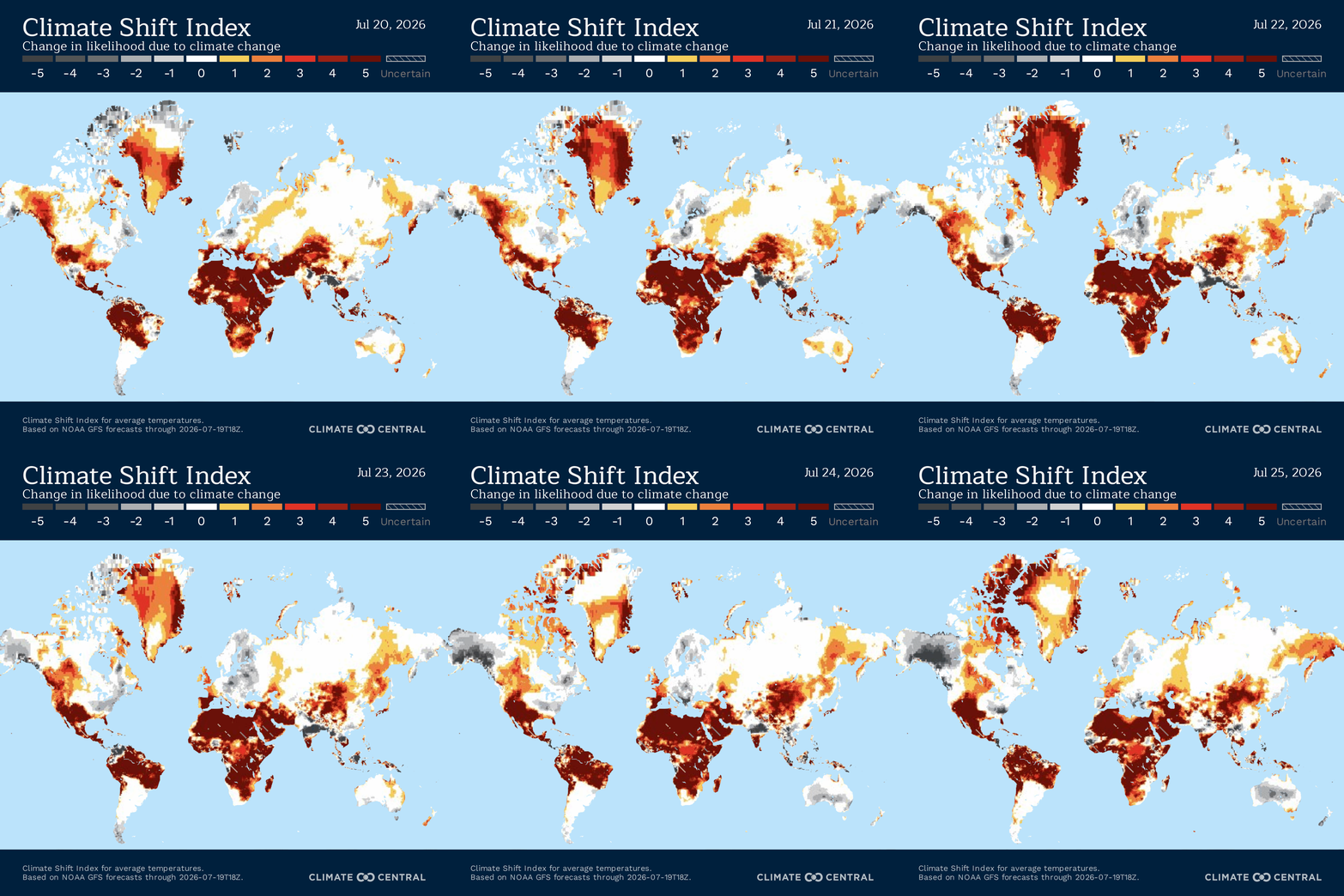
Ecuador’s banana exporters, Guyana’s coastal health system, Brazil’s cattle sector, and drought-affected communities in Yemen, Ethiopia, Afghanistan, and Pakistan are the focus of this week’s climate impacts roundup. A possible strong El Niño could complicate banana production and shipments in Ecuador, while rising heat and humidity are projected to make cattle welfare harder to manage in Brazil. Flooding, drought, heat, unsafe water, smog, and food insecurity are also shaping health risks and daily life in Guyana, Yemen, Ethiopia, Afghanistan, and Pakistan, especially for communities facing social exclusion, disability, gender inequality, or limited access to basic services.1
Need to read this in a language other than English? Try OpenL (up to 1,500 characters) or Google Translate—both offer free translations into 100+ languages.
Ecuador’s banana exporters are bracing for El Niño on top of a warmer climate — Ecuador’s banana sector is heading into a difficult period as growers and exporters face a possible strong El Niño, along with container shortages, disrupted shipping routes, deteriorating roads, port insecurity, and labor shortages. Exports were still higher through April than during the same period last year, but growth slowed each month, and the industry reported an “operational paradox” of high fruit availability in the fields and limited capacity to move that fruit to overseas markets. Refrigerated container shortages, cargo delays, shifting shipping routes, and disruption along key trade corridors made exports harder to move, while damaged roads and insecurity around highways and ports created problems inside the country. Between weeks 18 and 21, temperatures also ran up to 1°C above 2025 levels, and production indicators suggested more fruit was likely to come through the system even as shipping capacity remained limited. El Niño is a natural climate pattern, but it can raise global temperatures and increase the risk of extreme weather. It now occurs in a climate already warmed by human-caused greenhouse gas emissions, which means its heat, rainfall, and flooding risks can unfold from a hotter baseline. Ecuador's banana industry faces added risk because strong past El Niño events have brought major flooding, damaged infrastructure, and agricultural losses. The government declared a yellow alert in 17 of Ecuador’s 24 provinces, including areas with a high concentration of banana plantations. Another strong El Niño could worsen field conditions, reduce fruit quality, damage roads, delay harvest and transport, and make it harder to keep shipments moving through a system already facing shipping constraints.
Ecuador has a more favorable long-term outlook than some other major banana exporters in a recent regional suitability study, but banana production across Latin America and the Caribbean faces growing climate risks. Researchers found that, without urgent climate action and adaptation, rising temperatures could reduce the area suitable for export banana production in the region by 60% by 2080. Bananas are concentrated in warm, low-altitude areas with stable temperatures, slightly acidic soils, nearby ports, roads, workers, and export infrastructure. That geography is useful for today’s export system, but it makes adaptation harder. Production cannot just shift to cooler areas if those places lack irrigation, packing facilities, transport networks, labor, or access to ports. Some banana-growing regions are already close to the heat limits for commercial farming. In Bahia, Brazil, one grower said a 2023 heat wave cut the following year’s harvest by 15%, and that banana plants can stop functioning when temperatures reach around 40°C with very low humidity, even when irrigation is available. Farmers and researchers are testing ways to reduce losses, including more frequent irrigation, banana varieties that need less water, heat-tolerance research, and protective sprays that reduce damage to leaves and fruit. But those measures have limits if water becomes less reliable, heat becomes more extreme, and future suitable growing areas are farther from the infrastructure that makes export production possible. Bananas are also tied to trade, jobs, and food security, serving as a major source of export revenue for many low- and middle-income countries, supporting hundreds of thousands of jobs in places such as Colombia, and remaining an important food crop in many countries.
Climate change is adding pressure to Guyana’s health system — Guyana is highly exposed to climate-related health risks because much of the country’s population and infrastructure is concentrated along the coast. A 2026 study notes that about 90% of Guyana’s population, along with most of its urban centers, is located along the coastal belt, where sea-level rise, flooding, drainage problems, and coastal erosion can affect homes, roads, health facilities, and access to care. The country’s climate is shaped by seasonal rainfall patterns, with northern Guyana experiencing two wet and dry seasons and southern Guyana having one main wet season. As temperatures rise and rainfall patterns become less predictable, both coastal and inland communities face health risks from floods, droughts, heat, and disruptions to water and sanitation systems. Severe flooding can contaminate water supplies, damage clinics, interrupt transportation, and make it harder for people to reach care. Drought can reduce water availability, affect agriculture, and worsen food and nutrition risks. Higher temperatures can increase heat stress, especially for outdoor workers, older adults, children, and people with existing health conditions. Climate-related health concerns in Guyana include heat stress, infectious and vector-borne diseases such as malaria and dengue, water-borne illnesses such as gastroenteritis, and added strain on people already living with noncommunicable diseases.
Guyana has public-sector workers who are concerned about climate change and willing to act, but major knowledge and practice gaps remain. In a survey of 176 public-sector workers, including health professionals, most respondents — 69.5% — recognized that climate change affects health. Fewer than one in five, however, could correctly define what climate change is. Respondents were more likely to recognize direct health effects such as air-quality problems, heat-related illness, and water-borne disease, while mental health and nutrition impacts were less often identified. Climate-health work depends not only on hospitals responding after floods, heat, or outbreaks, but also on workers anticipating risks, communicating with communities, coordinating across agencies, and protecting services during emergencies. Guyana has policy frameworks and post-COVID response systems that can support climate-health planning, but the study also identified outdated legislation, limited training, fragmented coordination among agencies, and workforce attrition as weaknesses. Strengthening climate-health training, interagency planning, and capacity building would help turn concern into practical readiness as climate risks place more stress on Guyana’s coastal communities and health system.
Rising heat is making beef cattle welfare a growing challenge for Brazil — Brazil has the world’s largest commercial cattle herd and is one of the most important beef exporters, with much of its production based on cattle raised outdoors on pasture. A 2026 study modeled how climate change could change heat stress for beef cattle across Brazil using the Temperature-Humidity Index, which combines air temperature and humidity to estimate how stressful conditions are for animals. The researchers focused on extreme heat stress, when the index rises above 94, a level associated with serious animal welfare risks. When cattle are exposed to heat and humidity outside their comfort range, they use more energy trying to regulate body temperature, which can reduce feed intake, reproductive efficiency, immune function, meat quality, and survival. Historically, Brazil’s North and Mid-West regions had the highest heat-stress exposure, especially from September through December, when dry-season heat already pushes animals closer to dangerous thresholds. Future projections show that the risk could become longer and more intense as climate change raises temperatures and changes humidity patterns. By 2041 to 2060, parts of the North and Mid-West are projected to see much larger increases in extreme heat-stress days, with some areas approaching nearly every day of the month under extreme conditions during critical periods. By 2061 to 2080, under a high-emissions scenario, extreme heat stress is projected to spread across much of Brazil and persist through more of the year. Acre, Amazonas, Goiás, Mato Grosso, Pará, and Rondônia are projected to face 28 to 31 days per month of extreme heat stress during the September to December peak. Heat would become a recurring production and welfare challenge, affecting animal health, ranch management, worker demands, water needs, and the long-term reliability of Brazil’s pasture-based beef system.
The adaptation challenge is tied to land use as well as animal care. Expanding cattle production into hotter Amazonian regions may become less viable over time because those same areas are projected to face some of the most severe increases in extreme heat stress. Clearing more forest for ranching would also worsen greenhouse gas emissions, biodiversity loss, and disruption to the water and climate regulation that forests provide. The study points toward adaptation strategies that improve cattle welfare and productivity without expanding degraded land. Those include more shade, better pasture management, integrated crop-livestock systems, genetic selection for more heat-tolerant cattle, improved drinking-water access, cooling systems such as sprinklers, and precision livestock tools that monitor animals and environmental conditions in real time. Some of these options have tradeoffs. Sprinklers can reduce heat stress, but they also require water and electricity. Integrated crop-livestock systems can improve soil organic matter, water retention, and local microclimates, but the crops and forage used in those systems are also exposed to heat and water stress. Restoring degraded pastures could help Brazil maintain production without pushing ranching into new forest areas, but that depends on technical support, financing, and access to practices that smaller and rural producers can actually use.
Yemen’s Muhammasheen face climate hazards with few basic protections — The Muhammasheen, whose name means “the marginalized,” are among the Yemeni communities least protected from floods, drought, unsafe water, and disease. Yemen is already dealing with years of war, economic collapse, damaged infrastructure, and severe water scarcity, while rising temperatures, erratic rainfall, flash floods, tropical cyclones, drought, and sea-level rise add new risks to daily life. Short, intense downpours are damaging homes, roads, farmland, and infrastructure, and torrential rains in mid-August 2025 affected more than 100,000 people. Drought and groundwater depletion are creating a different threat. Illegal drilling, overused aquifers, reduced freshwater recharge, sea-level rise, and unsustainable agricultural water use are contributing to salt intrusion in coastal basins, making groundwater less suitable for drinking and irrigation. For the Muhammasheen, these hazards are intensified by social exclusion. Many families live in informal settlements around cities such as Sanaa, Ta’iz, Aden, Hudaydah, and Saada, often on slopes, flood plains, dry riverbeds, or near waste sites. Many lack formal land rights, property ownership, or identity documents, leaving their homes more precarious and their access to public programs more limited. Heavy rains can wash sewage and uncollected waste into settlements, destroy fragile housing, and leave families stranded in mud. When drought shrinks or dries up nearby water sources, families without piped connections may have to rely on tanker deliveries at high cost, or walk to distant communal points to collect water. In neighborhoods without reliable sanitation or waste collection, open sewage, polluted water, burning trash, and contaminated groundwater increase the risks of diarrhea, cholera, and respiratory illness.
Climate protection for Muhammasheen communities starts with documents, water, sanitation, and health access. Basic services are limited, with only 9% of Muhammasheen households connected to piped water, compared with 30% nationally, and only 42% having an in-home latrine. Many adults lack national identity documents, which can block access to cash transfers, ration cards, health care, education, and other public services. Clinics and vaccination campaigns may bypass Muhammasheen neighborhoods, while children face barriers to school because of documentation gaps, fees, distance, and discrimination. Floods, drought, water contamination, and disease outbreaks become more dangerous when families cannot easily receive aid, access clinics, move to safer housing, or demand repairs. Practical climate-health protection would include identity-document programs, safer housing, drainage, clean water, sanitation, waste services, mobile clinics, vaccination outreach, legal aid, and stronger safeguards against discrimination or aid diversion. Without those steps, climate hazards will keep falling hardest on families already pushed outside Yemen’s systems of protection.
Disability and drought are linked to deeper poverty in rural Ethiopia — A 2026 working paper on rural Ethiopia links household survey data from 2018/2019 and 2021/2022 with local rainfall records to examine how disability, drought, and extreme poverty overlap. The researchers measured disability at the household level using questions on difficulty seeing, hearing, walking, remembering or concentrating, self-care, and communication, with the main analysis focused on households where at least one member reported a lot of difficulty or could not do one of those activities at all. Under that stricter disability measure, about 10.3% of rural sample households had at least one member with a moderate or severe functioning difficulty. After adjusting for the extra costs associated with disability, households with disabled members had much higher poverty rates than households without disabled members. In the pooled sample, 58.3% of households with disabled members were poor, compared with 41.2% of households without disabled members. The poverty gap was also larger, meaning poor households with disabled members were farther below the poverty line. The estimated extra cost of disability was about 18.5% of real per-adult-equivalent consumption expenditure, reflecting expenses such as assistive devices, medical care, transportation, and other needs that can reduce what a household has available for food, housing, education, and other basic costs.
Drought was also associated with worse poverty outcomes. After controlling for household and community characteristics, drought increased the probability of being poor by nearly 9 percentage points, while having a disabled household member increased that probability by nearly 13 percentage points. Both disability and drought were associated with lower household consumption. A drought in rain-fed rural economies can reduce crop production, income, food access, and the ability to absorb expenses, and those losses can be harder for households already spending more to meet disability-related needs.
The combined disability-and-drought result was more complicated than expected. The researchers did not find a statistically significant combined effect of disability and drought on the poverty measures, even though disability and drought were each separately associated with worse poverty outcomes. For household consumption, the interaction between disability and drought was positive. The authors suggested that households with disabled members may have been more likely to receive support during drought, including from government or development partners. Ethiopia’s Productive Safety Net Programme can provide unconditional support to households or individuals unable to contribute labor to public works, and the paper reports that a larger share of households with disabled members received PSNP support than households without disabled members. That does not mean drought helped households with disabilities. It means the relationship between climate shocks and poverty can depend on whether support systems reach households with higher needs. For climate and poverty policy, disability-inclusive support that accounts for extra living costs, reaches rural households before drought deepens hardship, and treats disability data as part of climate-risk planning rather than a separate social-service issue would better reflect the needs of households facing both disability and climate risk.
Drought and degraded rangelands are putting Afghanistan’s food security at risk — Afghanistan is facing recurring drought, water scarcity, desertification, and land degradation in a country where many rural families depend on farming, livestock, and seasonal water supplies. Much of the country has an arid or semi-arid climate, with limited rainfall and water systems that depend heavily on snowmelt from the Hindu Kush. Rising temperatures, glacier loss, shifting seasons, and poor water management can make water less reliable for crops, livestock, and drinking. Heavy rains and floods can bring temporary relief after dry years, but they can also destroy homes, roads, farmland, and irrigation systems, leaving communities with damaged infrastructure and continued water insecurity. Rangelands are especially important because they support pastoral communities, livestock production, and ecosystems, but many have been degraded. Declining grasslands, shrublands, forests, and wetlands leave families who depend on animals and small-scale agriculture more exposed to food shortages, income losses, clean-water problems, and displacement. Afghanistan contributes only a very small share of global greenhouse gas emissions (0.1%), but it is highly vulnerable to climate impacts, while investment in water management, environmental restoration, and sustainable agriculture remains limited.
Snowpack and seasonal water timing shape Afghanistan’s drought risk. Snow in the Hindu Kush acts like a seasonal water reserve, feeding rivers, irrigation systems, and local water supplies as temperatures rise in spring and summer. Low snow levels, earlier melt, or less predictable melt can leave farmers and herders short of water during the months when crops and animals need it most. Better drought planning, local water management, rangeland restoration, and support for rural communities could help protect livelihoods before families are pushed further into food insecurity or displacement.
Drought and water scarcity also deepen gender inequality in Afghanistan. Many rural families lack reliable water systems and must collect water from kariz systems or distant sources. Household water collection, cooking, washing, and caregiving are largely treated as women’s and girls’ responsibilities, so dry periods can add hours of unpaid labor and increase exposure to unsafe water, poor sanitation, and waterborne disease. Nearby sources may shrink or fail during drought, forcing families to travel farther or rely on less reliable water. Women are also largely excluded from water management, policymaking, and technical education under Taliban rule, even though they are often the people managing household water every day. Afghanistan’s water crisis affects women’s health, time, safety, education, and ability to participate in decisions about the resources their families depend on.
Climate change is making Pakistan’s existing health burdens harder to manage — Pakistan’s health risks are closely tied to water. Much of the country’s supply comes from snow and glacier melt in the northern mountains, while agriculture and irrigation remain central to livelihoods, food production, and the economy. Glacier loss, water scarcity, and poor water management can affect drinking water, crop production, hydropower, and household income at the same time. Flooding creates a different set of health risks. Seasonal floods can kill people directly, destroy livestock and crops, damage sanitation systems, contaminate freshwater supplies, and displace families. Floodwater can also leave behind stagnant pools where mosquitoes and other disease vectors breed, increasing the risk of illnesses such as dengue and malaria. Water- and food-borne diseases, including cholera, diarrhea, hepatitis A, and typhoid, are more likely after rainy and flooding seasons, especially when clean water and sanitation systems are damaged. Heat adds another danger, particularly in Sindh and Punjab, where extreme temperatures can cause dehydration, kidney stones, heatstroke, and death. During Karachi’s 2015 heat wave, extreme heat overlapped with dense urban conditions and strained health services, contributing to a deadly public health emergency.
Air pollution and food insecurity add to Pakistan’s climate-health burden. Transport emissions, industrial pollution, and crop burning in central Punjab contribute to recurring smog, with poor air quality linked to asthma, hay fever, allergies, eye disease, chronic obstructive pulmonary disease, cardiovascular disease, and other long-term conditions. Food insecurity also connects climate hazards to child health. Drought, erratic weather, crop losses, and high food prices can worsen malnutrition in a country where child stunting and underweight remain serious concerns. Children who are malnourished are more vulnerable to infections and may face lasting effects on growth, immunity, and development.
Have you noticed the impacts of climate change in your community? Whether it’s unusual weather patterns or disruptions in local ecosystems, we’d love to hear your thoughts. Share your experiences or observations in the comments below and join the conversation!
At Global Climate Dispatch, we strive to provide accurate and equitable coverage of climate change and its impacts. If you come across anything that seems inaccurate or concerning, please don’t hesitate to let us know. Your insights help us ensure that the information we share remains truthful, balanced, and relevant to all.
Locations featured are chosen based on data from Climate Central’s Climate Shift Index map. Some graphics used may also come from Climate Central’s Climate Shift Index map. Any original analyses contained in this blog or any views expressed in this blog, unless otherwise noted, are solely the expression of its authors and are unaffiliated with Climate Central or any other entity or person referenced within.
Comments
Nothing yet. Say the first thing.
Sign in to join the conversation.