
How can localization be recognized as a genuine driver of business value? It’s a deceptively complicated question that intersects with a company’s growth ambition, risk tolerance and cultural openness.
In an ideal world, increased investment in localization leads to a correlated increase in user acquisition, conversion or revenue. But, for most teams, the reality is not so straight forward.
The problem is attribution. Customers in France will use the French website regardless - is localization driving growth or just table stakes? A new enterprise customer signs in Japan - was that the local sales team’s work, or was the localized product experience pivotal?
The answer, unsurprisingly, is messy. Business outcomes have multiple variables. This is well established for Brand, R&D and Customer Success teams. Localization should be no different.
In this scenario, where a clean ROI is hard to calculate, many localization teams default to proving value through efficiency metrics: faster turnaround, lower cost per word, higher throughput. This is a fundamental mistake. It reinforces the notion of localization as a cost center when you need to demonstrate strategic impact.
The efficiency trap exists when localization teams continue to act and communicate as cost centers, when they need to demonstrate growth driver value.
Operation efficiency matters, to a point. Keeping a lid on localization costs, enabling greater scale and ensuring high quality is the minimum expectation for any localization team. Associated metrics are a way of simply proving that localization is being done faster, cheaper, better than before.
When this becomes the sole pursuit of the team, they risk hitting the point of diminishing returns, when incremental investment in efficiency delivers negative returns. More critically, these metrics are invisible - and generally uninteresting - to business leadership, and ultimately invite commodification.
There’s no need to invent a new metric to prove localization value (e.g. “localization-attributed revenue”). The business metrics that matter are those that C-team leaders obsess over each month and Board members scrutinize each quarter. Business impact for localization means enabling the outcomes the business already cares about.
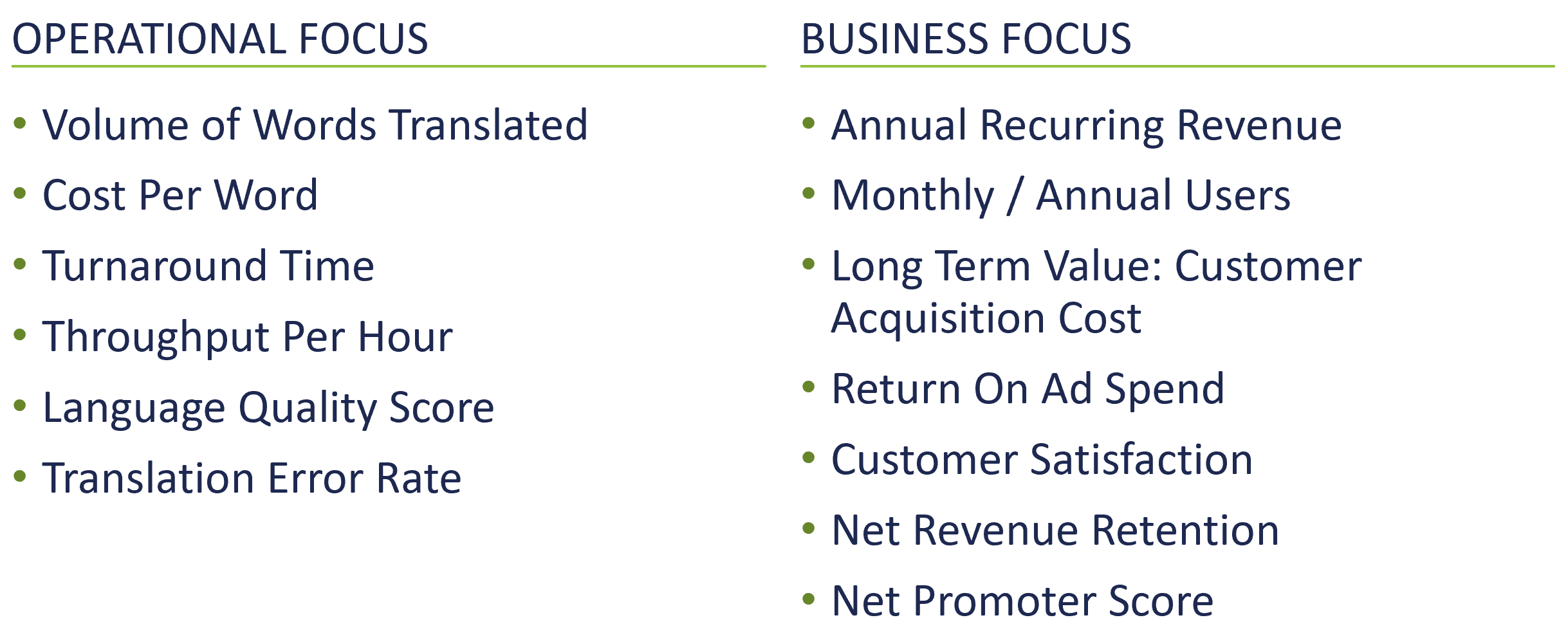
If there is no clear line that links operational metrics to business metrics, it’s not possible for localization to assert strategic relevance and take a seat at the senior leadership table.
The path forward starts by telling the story of localization in a language that matters to the business. Stop leading with operational metrics (track them internally for process improvement) and switch your external narrative exclusively to business impact.
Instead of reporting “we localized 50K words across 5 languages in 3 weeks”, reframe to “we partnered with Marketing to drive 25% quarter-over-quarter increase in qualified leads in France, Germany and Spain”.
But how do you make this shift when you can’t directly link localization to business impact? There are three approaches to help this situation.
When Product teams seek to influence a North Star metric such as “Monthly Activated Teams”, they start by identifying a set of proxy metrics that indicate activity and behaviours that are likely to drive growth in the overall North Star.
Localization can adopt a similar approach: look for metrics that signal localization quality without directly impacting revenue. These metrics are best found where international customers experience friction in their journey. Friction means lost revenue - even if you cannot quantify exactly how much.
Start here:
Customer support volume by language
High ticket volume in certain languages implies poor UX, translation issues or feature incompatibility problems. If German users submit 2x support tickets per user compared to English users, there’s a stark indicator of a hidden localization problem.
Track: Tickets per user by language, average resolution time, repeat contact rate for the same issue.
Churn and retention by market
Early user churn (within 30/60/90 days) often signals onboarding friction. Compare churn rates by language and market - significant variance indicates unresolved localization issues. Look at subscription renewal rates - low renewal per market can reveal international experience gaps (such as payment method problems or billing errors).
Track: Churn rate by language (both voluntary and involuntary) and verbatim feedback provided in cancellation flows.
Time-to-value by language
How long does it take for users to complete their first meaningful activity (first workflow executed, first project created, first invite sent)? Where the time-to-value is longer for certain languages, there’s likely friction in the on-boarding experience. Track product activation and adoption rates by language to spot differences - particularly when new features ship.
Track: days to first meaningful action, completion rate of onboarding flows, feature adoption by language.
Example: B2B accounting software
Consider a B2B accounting software product sold largely through in-market partnerships. It may be challenging to prove localization as an outright driver of revenue, but you can measure:
Support costs by language
Customer churn in first 90 days per market
Regulatory compliance incidents
Time-to-value per language
Position localization as an essential driver of the international experience, reducing friction and mitigating risk. Frame it as a reduction of operational costs and customer friction that otherwise erode lifetime value.
Proxy metrics highlight where localization is creating or reducing friction. The next step is to understand why this is happening and how to prioritize.
While it’s not always possible to calculate the absolute value of localization, you can identify the relative value through comparative analysis.
Build a source of truth for international performance
Traditional region-based sales metrics (EMEA/AMER/APAC) are too diffuse to be useful. Instead, start tracking comprehensive data points across languages and markets. If you’re unsure of what to track, simply follow the customer journey:
Acquisition metrics
Engagement metrics
Conversion rates
Revenue per user
Churn rates
Customer Satisfaction / Net Promoter Score
When you amass market-by-market data, you can conduct benchmarking and start asking diagnostic questions: “Why are lead conversions on the German site 8%, but only 3% for French?. What’s different about the experience?”
Very quickly, this approach will reveal where your localization strategy needs attention.
Example: Japan B2B marketing site
I worked with an international growth team seeking to improve marketing qualified leads across priority markets. We invested in various hyper-localization approaches that yielded strong improvements in Germany and France, but had limited impact in Japan, where website bounce rates remained stubbornly high.
Instead of increasing ad spend or translating more content, we hired a local market strategist to redesign the landing page for Japanese customers. The result: bounce rates dropped 35% and qualified leads increased 50%.
This success stemmed from careful analysis of the comparative performance across markets, then deploying localization insights and expertise to close the gap.
Leverage competitive intelligence
How do the category leaders in your priority markets handle localization? Are they spending more on a high-quality, localized experience with local content creation and market-specific features? If you are not matching them, that’s competitive disadvantage.
Map the cost of customer acquisition per market against the localized experience. If the experience is provably worse than your competitors, you risk wasting that money.
Comparative analysis helps reveal the why behind the data. It’s useful in identifying where localization is under-performing and where investment will have the biggest impact. It de-risks any conversation around future investment by explaining where and why a performance gap can be addressed.
Tracking proxy metrics and conducting comparative analysis alone won’t shift perceptions. To win the hearts and minds of stakeholders, strategic storytelling is needed.
Stories give life and colour to datapoints. They build empathy and make the invisible visible. Business leaders naturally lean on stories to explain their vision and rally employees, board members and investors to their cause. Stories cut through noise and provoke decision making.
Localization teams have a secret weapon: the ability to build empathy for the international customer. A vivid example of a localization improvement that helped connect with Japanese customers will have far greater impact than a dashboard.
Use a storytelling framework
Context: Set the stage - what was the situation?
Challenge: Create tension - what problem existed?
Choice: Demonstrate strategic thinking - what options did you consider?
Resolution: Deliver the outcome - what results did you achieve?
Lesson: Make it memorable - what is the key insight?
Example: the Japan story using the framework:
Context: Japan market was significantly underperforming Germany and France, despite similar marketing investment and tactics.
Challenge: high bounce rate, low engagement rate and under-performing qualified leads on the localized site. Poor localization quality was the assumed problem.
Choice: we evaluated three options:
Increase search ad spend. Rejected: we had a conversion problem, not an acquisition problem
Switch localization provider. Rejected: we validated the quality was already high.
Hire local market strategist who understood requirements and expectations of target customer in Japanese market to redesign landing page. Option chosen.
Resolution: 35% drop in bounce rates, 50% increase in qualified leads
Lesson: Authenticity and hyper-localization drive conversion beyond high quality localization. Understanding local user requirements and preferences is essential to winning local business
Constructing your stories
Stories are most impactful when they show how localization materially changed a business outcome. You don’t need to find a story in every localization project: look for key highlights where business impact was more apparent. Use the 5-part framework above to construct a simple, memorable story that connects on both a human and business level.
Stories like this do a lot of heavy lifting. They highlight glaring friction points for international customers, demonstrate your strategic insight and creativity, and reinforce the essential role that localization plays in delivering business value.
Find opportunities to use these stories:
Stakeholder updates or quarterly business reviews
Budget and business case presentations
When on-boarding new executives or cross-functional partners
Sending celebration announcements the team
If you don’t have routine executive reviews, use these stories as a way to initiate sharing your new localization strategy. Lead with impact and conviction.
When paired with proxy metrics and comparative analysis, strategic storytelling paints a compelling picture of localization as a growth driver - in many cases, the most under-utilized asset in the company.
Proving the value of localization is a matter of framing, not finding the perfect attribution. Instead of searching for irrefutable “proof” of revenue or customer growth, focus on building a narrative that elegantly connects the work of localization to the business outcomes that matter.
Once you stop reporting on efficiency, conversations immediately shift to a more strategic level. Localization leaders who confidently link their team’s work to business impact will be asked for their input at critical planning junctures. Instead of fulfilling requests from stakeholders, the question becomes “what’s the right approach for this market?”.
This pivot can appear stark, but it’s not necessary to change everything at once. Choose just one approach above and commit to it for 90 days. Change your mode, style and substance of communication with one stakeholder. Find a single example of business value where you can use the storytelling framework.
A small win will set the scene for further changes.
No more than any other critical business function should localization teams have to justify their existence. Rather, it’s their responsibility to proactively shift perceptions by adapting their approach, decision-making and communication to where it belongs: the strategic level.
The goal for localization should never be perfect attribution - nothing is so straight-forward. A playbook built on clear data analysis and strong business-led narratives is how strategic value leads to success.
Thanks for reading Unlocking Global Growth! This post is public so feel free to share it.
No posts
Comments
Nothing yet. Say the first thing.
Sign in to join the conversation.