
Love, Money + Real Estate is a newsletter written by award-winning columnist and book author Ilyce Glink. To support her work, please subscribe and consider upgrading to a paid subscription.
A lot of the housing news crossing my desk this month made me ask the same uncomfortable question: where, exactly, is the money supposed to come from?
Minimum-wage workers can’t cover rent in a single big city. Insurance is quietly eating a bigger slice of the monthly nut. And the housing shortage, while no longer getting worse, is still deep enough to keep prices stubborn. Here’s what caught my eye — plus a fun look back, as America turns 250, at what a single dollar could buy the year each state joined the Union.
New research from Clever Real Estate found that none of the 50 most populous U.S. metros are truly affordable for a minimum-wage worker renting a one-bedroom apartment, if you use the standard rule that housing should cost no more than 30% of your income.
It’s worse than “unaffordable” in a lot of places. In 14 cities, the rent on a one-bedroom actually costs more than an entire month’s minimum-wage paycheck.
Atlanta is the toughest of all. A minimum-wage worker there would spend 143% of gross monthly income on rent — bringing home about $1,160 a month while owing roughly $1,660 in rent. That’s a $500 hole before you’ve bought a single grocery.
The most affordable cities are both in Missouri. In No. 1 St. Louis, minimum-wage workers earn $15 an hour and pay about $995 for a one-bedroom — which still eats up 41% of gross income. “Most affordable” and “actually affordable” are not the same thing.
Worth remembering: the federal minimum wage hasn’t budged since 2009. A full-time worker at $7.25 an hour earns below the federal poverty line. To match the buying power that wage had 17 years ago, it would need to be about $11.43 an hour today — and that just gets you back to 2009.
Read it here: Minimum-Wage Workers Can’t Afford Rent in Any of America’s Largest Cities
Contract signings cooled off. Pending home sales fell 5.4% in June from May, and were down 0.3% from a year earlier, according to the National Association of REALTORS®.
Pending sales are a leading indicator — they track deals under contract but not yet closed — so a dip here often shows up as softer closings a month or two down the road. With rates still elevated, plenty of would-be buyers are staying on the sidelines.
Finally, some encouraging news about the housing industry: America’s housing deficit held essentially flat in 2024, at about 4.7 million homes — growing by just 43,000 units, according to new Zillow research.
To put that in perspective, the gap widened by 257,000 units in 2022 and 159,000 in 2023. So we went from the shortage ballooning to barely moving. Builders delivered roughly 1.4 million units in 2024, with newly finished multifamily buildings hitting a 50-year high.
As Zillow senior economist Orphe Divounguy put it, “The country is not yet building its way out of the hole, but we stopped digging.”
The catch: the number of homes actually available to rent or buy kept shrinking, and more than 8 million families are still “doubling up” — sharing housing with people they’d rather not — when they’d prefer a place of their own.
To be clear: Stopping the bleeding is progress. It isn’t a cure.
Homeowners insurance used to be a rounding error in the homebuying math. Not anymore. A new LendingTree study found that insurance now makes up 8.5% of the typical monthly housing bill for homeowners with a mortgage — about $200 out of an estimated $2,354 a month, nationally.
In 20 states, it’s 10% or more. The heaviest burdens land in states with serious weather risk: Nebraska (19.4%), Oklahoma (17.6%), and Texas (14.4%), where hail, thunderstorms, and tornadoes drive up claims. Colorado homeowners pay the highest premium in the country — $463 a month, or $5,553 a year — thanks to hail and wildfire risk.
Here’s a crazy stat: in 15 states, homeowners now pay more for insurance than they do in property taxes. In Tennessee, the typical insurance bill (about $284/month) is nearly double the property tax bill.
On the lighter end, insurance is the smallest share of housing costs in Hawaii (2.1%), California (3.8%), and much of the Northeast. If you’re shopping for a home, price the coverage before you fall in love with the house — in many markets it now swings your real buying power.
Where do you live and how much are you paying for homeowners insurance?
On July 11, the 21st Century ROAD to Housing Act became law, barring large institutional investors from buying more single-family homes. But new Cotality data shows the market moved before the law did.
Mega investors — those owning 1,000 or more properties — pulled back almost the instant Washington signaled its intent. Cotality found the sharpest declines in markets like San Jose, Huntsville, San Diego, Seattle, and Riverside. The notable holdout: Atlanta, the one major metro where institutional investors top 10% of all purchases. It hasn’t budged.
“Rather than influencing the market writ-large, this sudden dropoff in institutional investment is a signal to first-time homebuyers that there’s an opening,” said Cotality principal economist Thom Malone. “The perks large investors enjoy with sellers aren’t generally available to smaller investors, which puts homebuyers on a more level playing field.”
Why did Wall Street want these houses in the first place? Renting is big business — it now consumes about 39% of the average American’s budget, roughly 8 points more than homeowners spend on housing. And nearly half of all investor purchases sit in the $150,000–$300,000 starter-home band — exactly the homes first-timers are fighting for. Fewer investors bidding could mean a little more breathing room for real buyers.
Let’s hope.
First-time buyers made up just 21% of the market last year, versus a historical average of 40%. So where does a first home still pencil out? WalletHub compared 300 cities across 22 measures of affordability, market health, and quality of life.
The Sun Belt swept the top of the list — Arizona, Florida, and Tennessee dominate, powered by new construction, plentiful listings, and rising home values. The worst cities were almost entirely in coastal California, where sky-high prices sink affordability no matter how nice the weather.
Top 5 best cities for first-time buyers:
Palm Bay, FL
Surprise, AZ
Gilbert, AZ
Tampa, FL
Yuma, AZ
Bottom 5 (toughest for first-time buyers):
Berkeley, CA (No. 300)
Santa Monica, CA
Santa Barbara, CA
Oakland, CA
Anchorage, AK
Palm Bay took the top spot on the strength of active listings, new building permits, a low property-crime rate, and homes that were worth 107% more in 2024 than in 2018.
Are first-time buyers able to buy in your neck of the woods?
July marks America’s 250th birthday, so I loved this data that popped into my inbox earlier this month.
It’s a little perspective on how much a dollar used to buy. Bring $1 to the grocery store today and you’ll walk out with a few bananas — it won’t even cover a single item at Dollar Tree, where prices now start at $1.25.
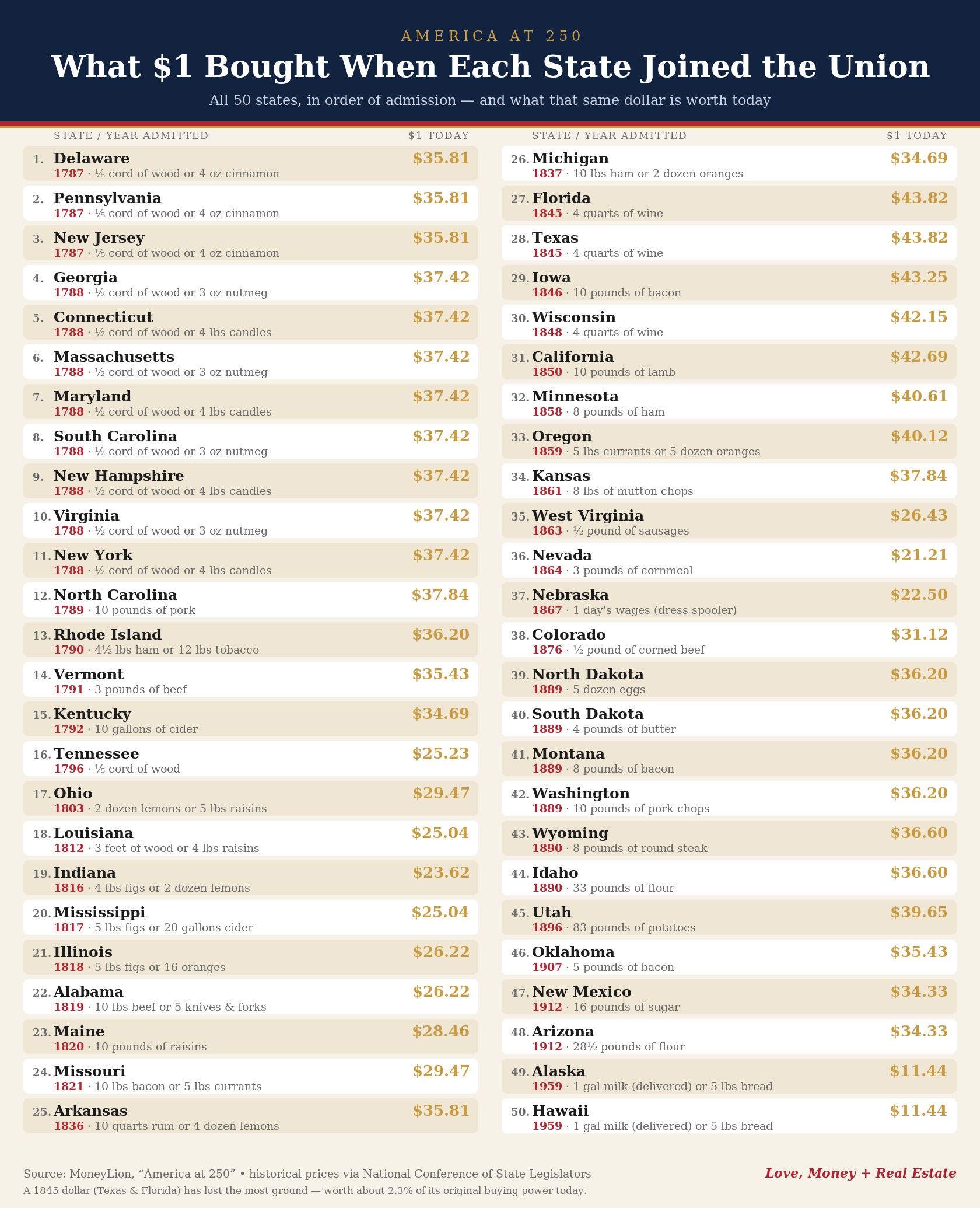
A new MoneyLion study looked at what $1 could buy the year each state joined the Union:
Delaware (1787): a dollar bought a fifth of a cord of firewood — or 4 ounces of cinnamon.
Texas & Florida (1845): four full quarts of wine. These two states have also seen the steepest inflation — a 1845 dollar is worth about $43.82 today, meaning your buck now buys roughly 2.3% of what it once did.
California (1850): 10 pounds of lamb.
North & South Dakota (1889): five dozen eggs (North) or 4 pounds of butter (South).
Alaska & Hawaii (1959): a gallon of milk — delivered — or 5 pounds of bread. Today a gallon of milk runs $6 to $8 in those states, and nobody’s bringing it to your door.
The graphic below tells the story at a glance. It’s a fun reminder that “the dollar doesn’t go as far as it used to” isn’t nostalgia — it’s arithmetic. And it’s the same arithmetic squeezing renters, buyers, and homeowners in every story above.
What’s stretching your dollar the thinnest right now — rent, insurance, or just the grocery run? Hit reply or leave a comment using the comment button and tell me. I read every note.
— Ilyce
Comments
Nothing yet. Say the first thing.
Sign in to join the conversation.