
Love, Money + Real Estate is a publication produced by award-winning financial journalist Ilyce Glink. You can support this publication by sharing these posts, subscribing or upgrading your subscription.
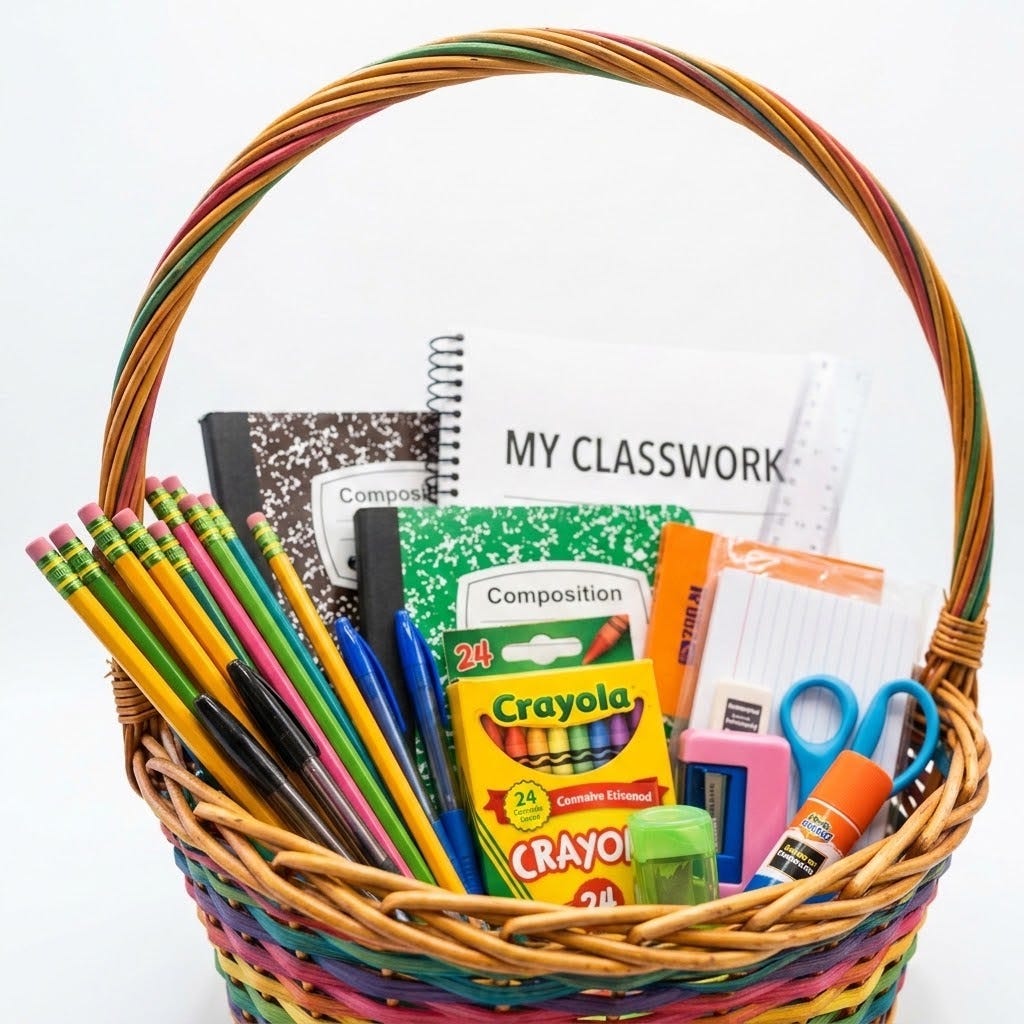
A basket of standard school supplies costs nearly 8% more than it did last August. Lunch boxes are up 26.8%. Notebooks, 23%.
Meanwhile, the average family with K-12 kids plans to spend $863.86 this season, according to the National Retail Federation. Last year it was $858.07.
That’s the $5.79. The problem is, it won’t be nearly enough.
For the past few years, surveys have found that parents want to spend less on back-to-school supplies. But, it rarely works out that way.
While some surveys say parents plan to spend $5.79 less on school supplies, Deloitte puts the number even lower. Its 2026 Back-to-School Survey has parents planning to spend $557 per child, down $13 from last year. Adjusted for inflation, that’s 6% less. It’s the fourth straight year the figure has fallen.
And yet, something’s gotta give, and it isn’t the price tag. Parents end up shelling out because nobody’s negotiating a discount at, say, Target. They’re just putting fewer things in the cart.
One more data point on the mood: 57% of parents told Deloitte they expect the economy to get worse over the next six months, the highest reading in that survey since 2020. That isn’t a good sign and may well be a self-fulfilling prophecy.
A joint analysis from Groundwork Collaborative and The Century Foundation found that a typical supply basket costs 7.7% more than a year ago, and typical school lunch items cost 10.9% more. The price data comes from actual school supply lists.
Those averages hide some tough numbers. Year over year:
Lunch boxes: up 26.8%
One-subject notebooks: up 23%
Index cards: up 22.2%
Notebook paper: up 20%
Tissues: up 20%
Sandwich bread: up 21.8%, to $4.36 a loaf
Blueberries: up 48% (bad growing conditions plus fuel costs)
Add the packed lunches to the supplies and the researchers estimate the school year runs close to $4,000 per child, 10.7% more than last year.
If you have a kid who insists on a new lunch box every August, this is the year to make the case for the old one. In fact, how about switching to a paper bag? At Target, 100 count paper lunch bags cost $2.39.
When it comes to paper and plastic items, there are two economic forces stacking on top of each other, pushing prices a lot higher.
Tariffs. The average effective U.S. tariff rate has gone from 2.3% in January 2025 to an estimated 6.6% for 2026, the highest since 1969, per the Tax Foundation’s tariff tracker. It estimates the tariffs announced and imposed work out to roughly $900 per household this year, on top of about $1,000 last year. Almost nothing on a school supply list is made here, so those costs land directly on the shelf. Newell Brands (Sharpie, Paper Mate, Elmer’s) raised prices repeatedly against a nine-figure tariff bill. ACCO Brands (Mead, Five Star, Trapper Keeper) did the same. Logitech told investors flatly that it took a sizable U.S. price increase.
Energy. The national average for regular gas hit $4.09 a gallon on July 23 and stayed there through July 30. As I write this, the price has ticket up a penny to $4.10 a gallon. That’s nearly a dollar higher than this time last year, with crude in the $80s and the Strait of Hormuz still unsettled. The June dip was real, but it tracked a pause in the Iran conflict that didn’t hold. Fuel doesn’t just show up at the pump. It shows up in freight, in fertilizer, and in the wholesale price of plastic, which is up about 20% since February. Every highlighter barrel and shrink-wrapped notebook pack carries a piece of that.
This isn’t a Target problem or a Walmart problem. It’s an input-cost problem, and switching stores won’t get you around it.
Apparel is the one category that hasn’t spiked the way paper and plastic have. Children’s footwear is up 4.7% over the past year. That’s the fastest pace in nearly four years, but nowhere near 26%. Carter’s, Vans, and Gap have all raised prices, and brands are clearly working to absorb the higher prices through their profit margin rather than shock shoppers.
NRF has families budgeting $293.11 for electronics, $250.29 for clothing and accessories, $174.01 for shoes, and $146.45 for actual school supplies. Supplies are the smallest line and the fastest-rising one, which is exactly why it slips past most families. Nobody comparison-shops a pack of index cards.
Deloitte identifies a group it calls “hyper-value seekers,” the 31% of parents using four or more cost-cutting tactics. They spend about $610 per child, 14% more than everyone else. Value-seeking, it turns out, isn’t the same as spending less. It’s being deliberate about where the money goes. Half of all parents surveyed said they’re cutting back on dining out and entertainment to fund the school list.
Others are financing it. Intuit Credit Karma found that 45% of parents plan to take on debt for back-to-school shopping, up from 34% in 2024, and 57% are heading into the season already carrying credit card balances. A third are asking their kids to chip in their own money.
And some are simply saying no. NerdWallet’s annual survey found 37% of parents say their child will likely miss at least one school activity this year because of cost. Tariff policy is abstract right up until it’s a kid not doing band.
My kids are long past the years where we shopped their back-to-school supplies list. But, here’s what we did do to save money each year, and they’re still my best recommendations:
Shop online, list in hand. This is my number one. Wait for the teacher’s actual supply list, then buy it from Amazon, Target, or Walmart without setting foot in a store. You buy what’s on the list and nothing else. No endcap displays, no “while we’re here.” You can compare sale prices across all three in about four minutes, and shipping is free at most order sizes. At $4.10 a gallon, skipping two trips across town is real money before you’ve bought a single pencil.
Reuse the durable stuff. Backpacks, lunch boxes, and binders are where the biggest percentage increases are hiding. A backpack that survived one year will survive two, unless your kid has torn the shoulder staps off.
Budget a September or October line item. More than half of parents told Credit Karma they spent over $250 on school-related requests after school started, and 29% spent more than $500. That’s not an emergency. That’s a predictable expense showing up in the wrong month.
Take the price-freeze bundles seriously. Walmart is promoting a 14-item supply kit with a backpack for $16. Target held 2024 prices on a 20-item set under $20. When retailers eat the tariff to win your traffic, let them.
What is your best money-saving tip when it comes to back-to-school expenses? Hit the comment button below and share.
When prices climb 8% and the money doesn’t, one of two things happens in every household: you spend more, or your kid gets less. Most families are quietly splitting the difference. The ones who plan the September spend now will feel it least.
What’s stretching your dollar the thinnest right now? I’d love to know and will include responses in a future note.
— Ilyce
Golden Handcuffs, Silver Lining
You Can Do 99 Things Right and Still Sink the Ship
We Earn $100k and Live Paycheck to Paycheck. How Do We Buy a New Car?
My Sister And I Each Inherited Over $1 Million. Now Her Recent Request Has Thrown Me for a Loop.
Comments
Nothing yet. Say the first thing.
Sign in to join the conversation.