
Hi! We are hosting an AI Salon discussion at 6:30 PM on July 29th — join us if you are in London! Spots are almost full ✨ Inspired by a piece from the Digital Frontier Echoes issue, “Mapping the Machine Condition,” this month’s conversation probes the question of machine creativity: Can AI generated work, through a machine condition—data, architecture, energy, context, etc.—much like the human condition, concoct deeper meaning?
Making quick sketches is my most intuitive way of thinking on paper or presenting information to someone else. I distill concepts down to keywords and abstract shapes — circles for ideas that feel complete, jagged boxes for problems still being worked out. Lines are for connecting. Arrows indicate direction. But there was something that bothered me about these sketches: once I drew a connection, it was permanent. If I discovered a new relationship between ideas, I'd have to redraw the whole thing, or end up with a web of crossed-out lines.
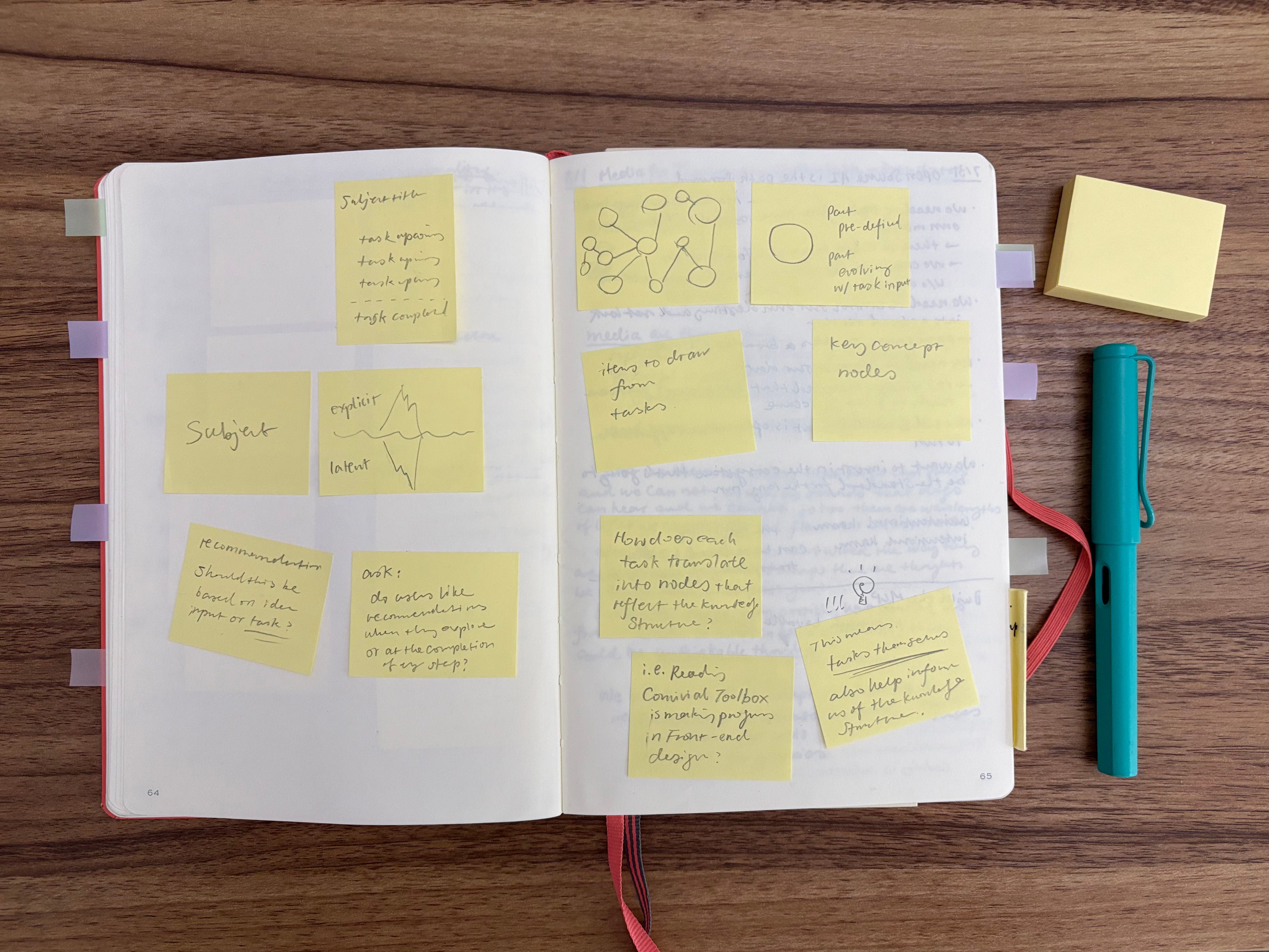
To make information more fluid, I started carrying tiny post-its everywhere, on which my scribbles become movable. Suddenly, thinking became more like arranging furniture. I could cluster related concepts, then pull one idea out and place it somewhere completely different.
We create knowledge by processing information and integrating it into our existing structure of how we make sense of the world. Because our knowledge structures and understanding pools are unique, new information maps out differently for us.
Think about the different ways we process information: note-taking in plain text, plucking highlights from streams of information. Then there's talking — sense-making in that more ephemeral way where we vocalize ideas and hear them echo back, somehow clearer than when they existed only in our heads, fresh from the hearth of conversation.
After processing, we fine-tune the useful bits by turning our knowledge into a form that is transmittable to others (and ourselves) — in writing, presentations, videos, podcasts, graphics, etc. It seems that it is only when we can make knowledge transmittable that we can truly make sense of it by our standards.
Visualization is a powerful route through which this transmission takes place, aiding us in sense-making. The ephemerality of thinking occupies most of our working memory, which we can free up by offloading thoughts onto more concrete forms of representation.
Among its many possibilities, graphic knowledge visualization is one of the most effective ways to grasp knowledge because it engages both hemispheres of the brain — the visual and verbal outlets working in concert.
Once upon time, I was obsessed with beautiful bullet journals: color-coded, waterfalling content, neat organization where everything falls into place… But I never looked at them again except during bouts of nostalgic browsing. These static, inert visualizations became mausoleums of information — potentially beautiful, but offering nothing new beyond the information itself filed away in decorative boxes.
Static isn't necessarily bad. In archiving, we want to preserve history, make things last and remain in a constant state. But when it comes to growing knowledge for a thinking human being, what's alive is by default more engaging and inspiring.
So I began to wonder: what would dynamic knowledge visualization look like? The kind that goes beyond storing and organizing ideas based on predictable taxonomies — where ideas actually find each other. I wanted a dynamic visualization system that generates creative moments of two kinds:
Solution-oriented. Solve existing questions or problems via connecting the dots, lighting up a pathway of solutions. Think of it as the answer lies within you all along.
Inspiration-oriented. Suggest relevant unknowns outside the user’s current thinking that can spark new explorations, like peripheral vision for the mind.
To explore this, I built a prototype where meaningful connections are automatically spotted as users populate their cosmos with ideas.
You can try it out here.
There may come a day when knowledge sharing looks like star-gazing in each other's night skies, each filled with constellations of connected insights. Your glowing cluster around jazz improvisation might suddenly echo my scattered thoughts on ad-hoc UI design — both about real-time change, both about finding harmony in the unexpected. We'd gather not just to share what we know, but to wonder together about the vastness of what we don't yet understand. Isn't it romantic?
And while we’re at it with any kind of design, make it fun and alive. Because what's alive is by default more engaging and inspiring.
x,
Erica
Further reading:
Knowledge Visualization by Robert Meyer
Wonder Notes is my weekly reflection on building Glia, an AI learning engine that personalizes knowledge journeys. Glia beta 2.0 will be available on July 31st. 🐾
No posts
Comments
Nothing yet. Say the first thing.
Sign in to join the conversation.