
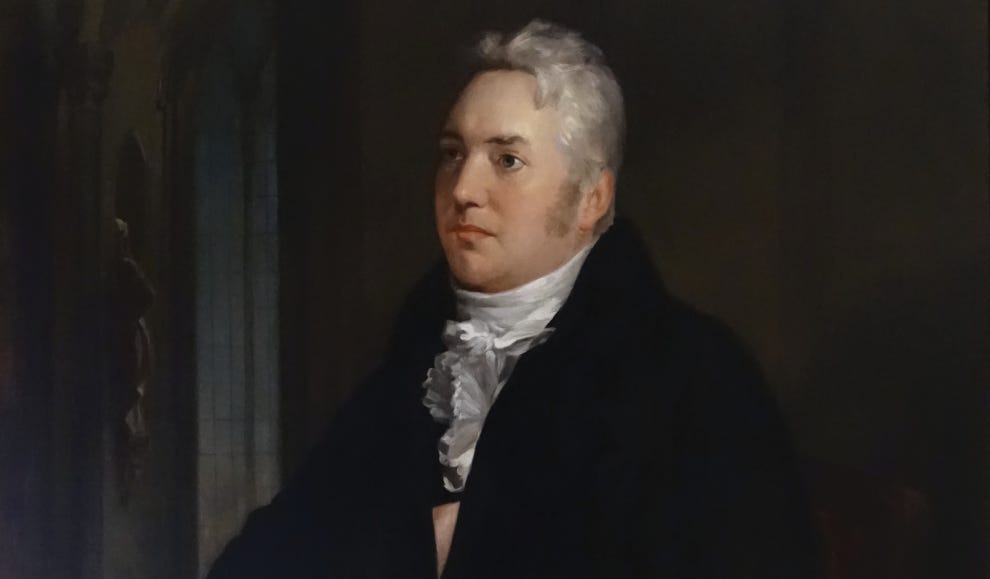
Recovering the Christian imagination is a critical area for re-enchantment. I plan to explore some aspects of this in upcoming articles. Here, I begin by asking the questions what is the imagination, and how does it connect to truth. Our guide here will be Samuel Taylor Coleridge, but to get there, we’ll start with C.S. Lewis.
One of my favorite quotes by C.S. Lewis concerns the importance of the imagination. He says that for him as a rationalist, reason is the natural organ of truth, that is, reason enables us to ascertain facts, which as a rationalist Lewis takes as truth. But, he adds, imagination is the natural organ of meaning.
There’s a lot we could explore in that quotation in terms of its relevance for Lewis’s conversion and his apologetics, but for this article I want to focus on what he said next. He said that even reason depends on imagination, since at its base, all reason is built upon metaphors supplied by the imagination. Thus, imagination is necessary for finding truth even though that is the primary responsibility of reason.
Why is reason built on metaphor? Perhaps the simplest way of seeing this is to consider how words work. All language about concrete objects consists of metaphors—the word “apple” is not itself an apple but a symbol or metaphor that we use to point to the apple. Since all our reasoning, and indeed all our thinking, depends on words, reason is based on metaphor.
Most of us probably don’t think of the imagination this way. For us, imagination is either false, as in “it’s just your imagination,” or connected with make believe or the creation of stories or art. Yet Lewis doesn’t use it that way. He sees imagination as operating at two levels, providing both a basis for reasoning via its creation of metaphors and revealing the meaning of facts.
Lewis’s understanding of imagination was heavily influenced by Samuel Taylor Coleridge, whose works he studied and heavily annotated. Coleridge’s ideas on the imagination are sophisticated and complex and shed light on Lewis’s ideas. They are thus worth exploring in some detail.
We should start with the classic definition of the imagination. The imagination is the faculty that enables us to create images in our mind. This may sound simple and relatively unimportant, but it is anything but. When we look at a tree, for example, what is in our mind is not the tree itself but an image of the tree. The imagination is thus central to our ability to perceive the world.
Coleridge develops this idea further. He distinguishes between the primary and secondary imagination. The primary imagination is involved in perceiving the world, but for Coleridge, that involves much more than meets the eye.
The primary imagination is the living Power and prime Agent in perception. In other words, it doesn’t just passively receive input from the senses and construct images from them. Rather, it actively uses our senses, reaching out through them to perceive the world.
Today, we would probably think of this more as attention than imagination. We notice what we pay attention to and miss much of what we don’t, though sometimes unexpected things catch our attention. Coleridge saw all of this as our imagination taking hold of our sense perceptions, filtering out those things that it is uninterested in, and using the rest to build our image of the world.
But perception involves more than just our senses; as Sherlock Holmes said to Watson, “you see but you do not perceive.” Perception involves understanding the meaning of what we see. For Coleridge, this is more than a cognitive assessment (“that tree is a white pine”). It connects with something far more profound, the language of God Himself.
Coleridge believed that God spoke the universe into existence as taught by Genesis 1 and John 1. But he went further: since the Logos, the Word of God, “upholds everything by His word of power” (Hebrews 1:3), he argued that the world is continually being created since God is continuing to speak the world into existence. He described this as the eternal act of creation in the infinite I AM.
But since God is continually speaking the world into being the world itself is a kind of language, a set of symbols or metaphors for divine realities. We see this in his poem “Frost at Midnight” where he speaks of his hope for his son (emphasis added):
Text within this block will maintain its original spacing when published
But thou, my babe! shalt wander like a breeze
By lakes and sandy shores, beneath the crags
Of ancient mountain, and beneath the clouds,
Which image in their bulk both lakes and shores
And mountain crags: so shalt thou see and hear
The lovely shapes and sounds intelligible
Of that eternal language, which thy God
Utters, who from eternity doth teach
Himself in all, and all things in himself.
Great universal Teacher! he shall mould
Thy spirit, and by giving make it ask.
The world is sacramental: it points beyond itself to divine realities and to God Himself. In this way, God speaks through nature, and the primary imagination enables us to perceive what God is saying through the world.
Of course, most of us today even more than in Coleridge’s day don’t understand this language. Coleridge himself identified the problem in the introduction to Lyrical Ballads as the lethargy of custom and the film of familiarity and selfish solicitude—the last of these meaning “that we solicit or demand from the world all its goods and resources for our own selfish ends, without considering its own intrinsic being or purpose.”[1]
The solution to this problem is found in the secondary imagination. Coleridge described this as an echo of the primary imagination, doing the same kinds of things but at a lower level and in different ways. Unlike the primary imagination, which operates subconsciously and intuitively, the secondary imagination co-exists with the conscious will. Rather than perceiving the world directly, the secondary imagination takes materials from the primary imagination—perceptions of both the world and its meaning—and synthesizes them to create (or, as Coleridge said, re-create) a work of art that expresses the truth in a new, fresh way. In this way, artistic expression can awaken us from the lethargy of custom and strip away the film of familiarity and selfish solicitude that blind our primary imagination to the deep truths that shine through the world.
The secondary imagination, often today called the poetic imagination, is what most of us probably think of as creativity or perhaps simply the imagination.
Coleridge distinguishes the secondary imagination from fancy, which he defines as no other than Memory emancipated from the order of time and space. In other words, fancy takes existing elements from our memory and rearranges them without fundamentally changing them. In contrast, the secondary imagination dissolves, diffuses, and dissipates the elements drawn from the primary imagination, digesting and synthesizing them into the artistic creation; it doesn’t simply rearrange them. Both have their place, but the secondary imagination is clearly the superior faculty.
The essential point here is that imagination is a vehicle for truth, understood more broadly than in Lewis’s definition of it as a rationalist. The primary imagination is the foundation of all knowledge as suggested by Lewis as well as being “the organ of meaning.” The secondary imagination expresses the truths and meaning from the primary imagination in ways that cut through our habitual ways of seeing the world to reveal its deeper significance.
With the rationalism that accompanies modernity, we have devalued the imagination, thinking it only deals with imaginary things. But this distorted and diminished understanding of the imagination has led us straight to the crisis of meaning in our society today. Recovering a full-orbed appreciation of the centrality of imagination is thus critical for our society’s mental health, and an apologetic of the imagination will be an important tool for reaching with the gospel those lost in the meaninglessness of modernity.
[1] Malcolm Guite, Lifting the Veil: Imagination and the Kingdom of God (Square Halo Books, 2021), 12.
No posts
Comments
Nothing yet. Say the first thing.
Sign in to join the conversation.