

I don’t usually write about sudden news events. I prefer to step back to look at the big picture and take a long term view. After Charlie Kirk was assassinated on September 10th, I wasn’t sure if I wanted to say anything. So, I took some time to read what some other people had written, instead.
Now, a week later, I’ve gained a bit more perspective.
I want to be clear that I don’t condone violence for any reason. This is a strong spiritual conviction of mine, above all. And, on a practical level, violence typically just begets more violence, which almost always makes things worse in the long run. I am specifically against assassinations because they easily lead to catastrophic results.1
I strongly disagree with people who have implied that Mr. Kirk got what he deserved. Advocating the killing of someone with whom we might disagree, brings us down to an even lower level of contempt than the one who was killed.
The other thing is, violence almost never solves the problems that we wish it would solve. Sure, the allies defeated the Nazis in World War II, for example, a decisive military victory. However, racial and cultural hatred were certainly not eliminated. There is still plenty of evidence that they persist today, 80 years later.
There are two foundations of violence, access to weapons and an environment of extreme animosity between people.
Our efforts to prevent access to even the worst of weapons, such as automatic rifles or home made bombs has continued to fail, as a consensus on how to accomplish this remains out of reach, at least on the government level.
Likewise, there are many reasons for a high level of animosity these days. For one, fomenting animosity has become more and more of a tool of political parties to amass power. The latest efforts to increase partisan gerrymandering here in the United States is just one example of what I’ll call a “race to the bottom” in today’s hyper partisan political environment.
So, as I see it, the assassination of Charlie Kirk, along with other political violence in recent years are, to me, a sign of increasing rage and desperation nation wide.2
If anything, Charlie Kirk may have contributed to this polarization with his rhetoric. But his death has not lead to the end of his talking points. On the contrary, there seems to be a renewed effort on behalf of his supporters to push some of the issues he expounded upon.
Back some months ago, I stumbled across a video where Charlie was debating with students on whether or not college is a scam.3 At the time, I didn’t even know who he was and I was not aware of his positions on other issues. I thought his debating style was rather aggressive and confrontational, but I could see merit to some of his points.
But I didn’t hate him, and I certainly didn’t wish him dead!
Now that I know more about his other positions on current issues, I realize that, although I strongly differed with him on most things, I was more sympathetic in two specific areas: The plight of young men, and problems with the education establishment. These are both complex topics, so I’ll choose the one I feel is more relevant here, about young men, and write about education later, in another post.
As far as I’m concerned, both of the two major political parties stand at the threshold of complete collapse. The Republicans are split between one side which is committed to a traditional bipartisan approach, versus the other side, which seems to have followed a course of extreme disparagement of all other opinions.
Meanwhile, the Democrats lost the election in November of 2024 because their party leaders failed to understand and connect with young men (as well as people who live in rural areas). Other commentators have remarked on this failure, and some have even enumerated ways in which the Democrats can win in the future, but here I want to dig deeper into the root causes of their failure instead.4
As I see it, their failure to understand these populations stems from a misunderstanding of the nature of “intersectionality,” while hanging on to the basic oppression model from what I call the “old left.” This concept stems from power imbalances that date back to the mid 1800s, once the industrial revolution was in full swing.
This older model casts populations into two opposing groups: the oppressors and the oppressed. The oppressors are seen as the “bad people” and the oppressed are the “good” ones. The problem is, that as soon as the oppressed gain sufficient power to tip the balance, then they become the new oppressors! This back and forth never really gets to the heart of the matter, focusing on fighting and struggle rather than reconciliation and cooperation.
To me, this is a false binary, because it is not the people who are “bad” or “wrong,” but the cultural memes, such as patriarchy, that are the problem. There are many ways this plays out, but one of the most damaging in current times is confusing men with patriarchy. Men in positions of great power are often cited as examples of the tyranny granted by patriarchy, while the fact is, most men live further down in those same hierarchies, often trapped in jobs with few options, or left unemployed.
The problems of sexism and racism are not zero sum games! We do not have to oppress one group in order to bring respect and opportunity to another. Instead, I recommend that we focus on the problem at its source: The incorrect assumptions we have about each other.
Classically, intersectionality is one way to describe how a person may face obstacles in life from occupying multiple demographic groups, including race, gender, and class, among others. The word was coined in a paper about how black women face two kinds of oppression that must be considered together to fully understand their plight in society.5
But patriarchy, specifically, offers both harm and advantage to both men and women.6 Traditionally, women were restricted from respect and decision making power in government, business, and even in their own households. And yet they were spared from many of the risks and sacrifices expected of men.
As society and technology have evolved over the last 60 years or so, we have paid great attention to the groups traditionally seen as oppressed, particularly women or racial minorities. This attention has been so great that we have largely forgotten (or perhaps haven’t even considered) how these same cultural traditions have oppressed men as well, although in different ways.
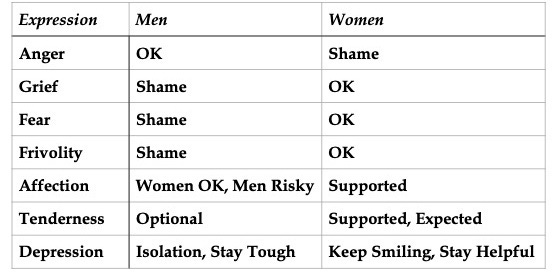
Men have been expected to suppress all emotions except anger whereas for women anger is the main emotion deemed shameful.
Men have been taught to settle differences or respond to shaming with physical violence. Men have been told their very value as a man comes from being physically and emotionally “tough.” Participation in military combat has been encouraged or even enforced, implying that men are the “disposable” sex; the phrase “women and children first” implies that men’s very lives are less valuable.
When war is over, the veterans are either dead, or wounded physically or psychologically. When those who survive malfunction under the strain, and perhaps lash out at others, they are often labeled dangerous or criminals and reviled.
Even mutual tenderness and deep emotional support among men is fraught with the risk of homophobia. Asking for help is considered a sign of weakness, and thus shameful. These and other factors cause many men to sit alone with their inner pain.
I could go into more detail, but there are whole books devoted to the plight of men.7 Recently, the On Point Radio program ran a five part series, “Falling Behind,” which describes how the education industry is failing to understand and serve the needs of boys and young men today.8
It is human nature to seek to blame something tangible or some person or group when we experience harm of some kind. Human evolution has left us with the basic emotion of anger because we have needed it to react quickly in the face of danger. In primitive times, if a snake enters your cave and approaches your baby, there is only time to react immediately: Grab an available rock and kill the snake.
But it’s much harder to know what to do with our anger when the thing that’s causing harm is a meme, a tradition, or a point of view held by a large number of other people. How can you smash a meme with a rock? Well, we’ve tried, I guess. That’s called war. Although wars are often believed to be politically, ideologically, or religiously motivated, war is actualy more often about economics, and thus survival itself. By economics, I mean access to the basics, such as water, food, shelter, mobility, and rest.
Thus it’s tempting to blame men for patriarchy because men are tangible, not ethereal. Further, the benefits of patriarchy for men are often seen as external, in the form of control of institutions, wealth, and physical power. Thus, women have struggled openly to oppose this power to attain power in these same areas for themselves.
I have no problem with women having done this. My point is rather that where men have been oppressed has remained much less visible. The reasoning goes, that, as men supposedly have the reigns on power in society, then any complaint they have is disingenuous or merely manipulative. I have seen numerous arguments that men should just go “fix themselves” and leave women out of it.
But the tragedy is that patriarchy is a society wide social tradition that has been carried forward by both men and women. We are all responsible to right the wrongs it represents. Isolating men to solve their problems alone just makes matters worse, for isolation is one of the main damaging effects patriarchy has on men in the first place.
So, along came people like Charlie Kirk. As a young white man, he inherently understood the pain that young men feel from being trapped in a society that seems to blame and vilify them for their problems. It was relatively straightforward for him to appeal to them with promises of love, respect, and better control over the forces that have oppressed them in the last few decades. And why not?
However, some of his message was to advocate for a return to a society where the benefits of patriarchy for men were more pronounced and women were more heavily subjugated by denying them political and economic power.
To me, that is backwards compared to what I strongly believe we must do instead. I don’t care if the Democratic Party learns this or not. The lesson here is not to win elections and continue the bitter bickering that our two party system has stooped to.
Our work now is to recognize men, women, and people of all gender identities as human beings with more in common that the old patriarchal model represents. Everyone has a heart and the potential to experience the full range of human emotions, more or less. We must let people of all genders define their own roles in society, as much as possible.
If anything, we must break down the taboos on emotional expression and growth that have persisted for centuries. Here is my chart that summarizes a few:
Patriarchy has also dictated our status and value in various situations or when engaging in various behaviors:
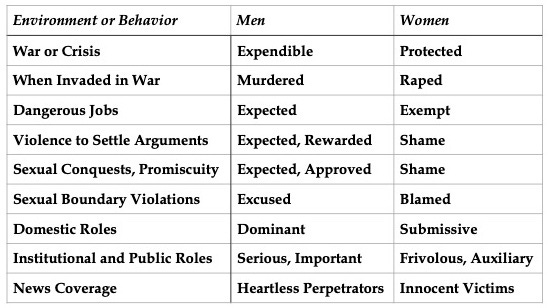
When I look at these (admittedly incomplete) lists, it seems clear that it has been rough going for both men and women, in different ways. I also realize something else: We are already well on our way to move away from these old “gender binary” standards, and, of course, we still have much more work to do.
I do not mean to imply that all genders are the same, far from it. But the variations between one individual and the next is often greater than the generalizations we have made in the past, based solely on sex or gender. If anything our job is to give every individual the power and support to be truly who they want to be, as much as possible, regardless of any categories to which we might assign them.
To me, trying to go back to reinvigorate patriarchy is not only hurtful to everyone, it is ultimately unsustainable. If young men are feeling forgotten or worse, then we must find new ways to support and love not only them, but everyone, as much as we can.
Sadly, our two political parties are still trying to impose their inherently binary framework on everyone in hopes to gain and maintain power. Each party is in fear that they will lose out, so the leaders of both work harder and harder to defeat the other.
I have news for you. Both parties are about to lose out, anyway, because we no longer want the awful state of hyper partisanship we now have as a result of all this fighting.
It is time to cease fire (literally!), climb out of our trenches, and bring about a new culture where we recognize diversity as an asset, manage ourselves in smaller and more decentralized groups, and share information and experiences through networks, rather than in hierarchies. Our mission is to use love as our fundamental means to relate with one another.
For example, an assassination is believed to be the triggering factor to the start of World War I. See: https://en.wikipedia.org/wiki/Assassination_of_Archduke_Franz_Ferdinand
Paul Pelosi, Melissa and Mark Hortman, John and Yvette Hoffman, and Donald Trump, for a few examples
See:
See, for example: “What Democrats Can Learn From Charlie Kirk,” by John Della Volpe, 17 September 2025, The New York Times, Opinion section.
See: https://en.wikipedia.org/wiki/Intersectionality
For simplicity, I am referring only to men and women here. I’m aware that I’m omitting the intersex and trans communities, among others, but my point has to do with an oversimplified hierarchy from a time when gender binary was assumed and other variations were hidden.
Examples: “Stiffed” by Susan Faludi, “The Myth of Male Power” by Warren Farrell, or “Violence: Our Deadly Epidemic and Its Causes” by James Gilligan, one of the most important books I have ever read.
See: https://www.wbur.org/onpoint/2025/04/07/falling-behind-miseducation-americas-boys
No posts
Comments
Nothing yet. Say the first thing.
Sign in to join the conversation.