
Hi everyone!
Are you watching the unrest in Iran? Well, I am, for sure. Given the ongoing turmoil inside Iran, I thought it would be of interest as part of my Eyes on Eurasia series to conduct a brief interview with the author of a forthcoming book on Iran to explore his insights into the current situation and the role of the Iranian military and security forces. In particular, I wanted to focus on what went wrong for the Shah in 1979 and the key lessons that period may hold for understanding the ongoing unrest in Iran today.
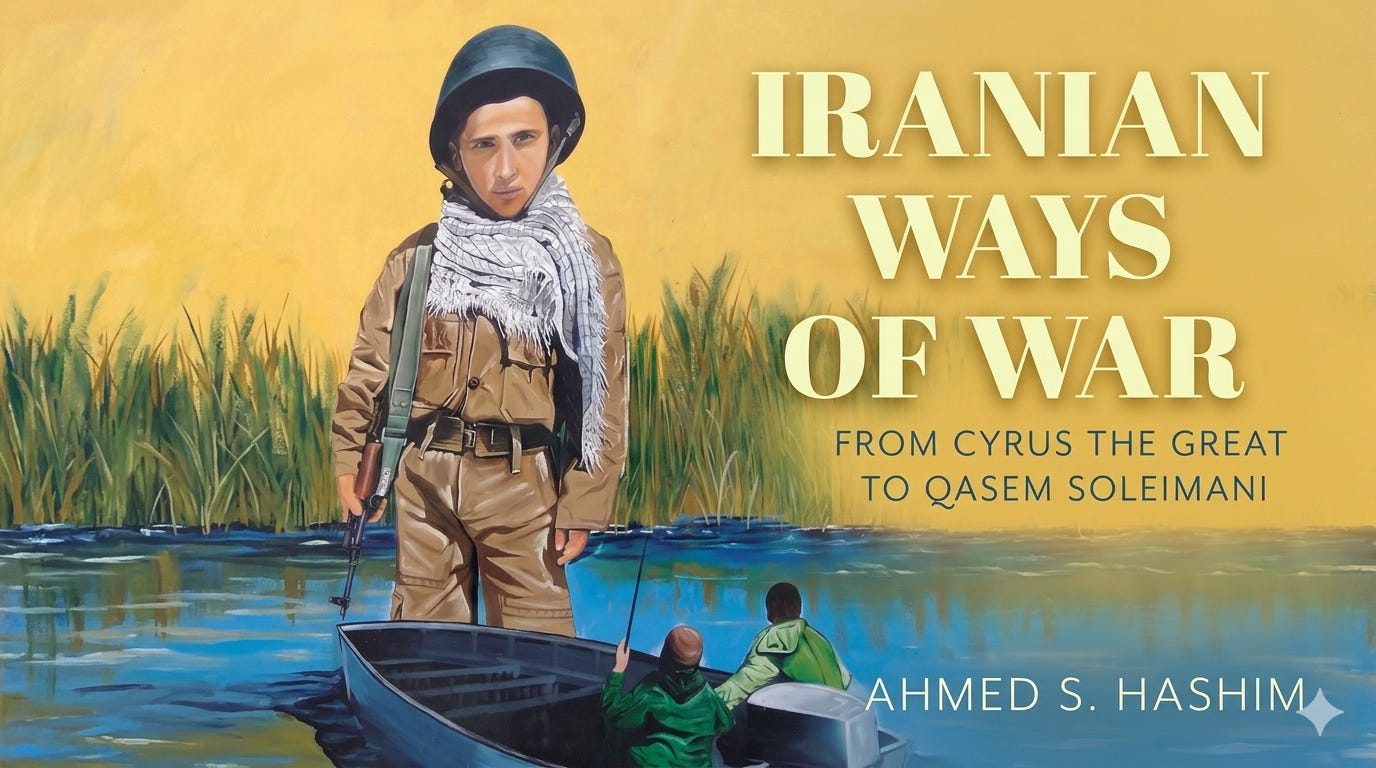
My guest is Ahmed Hashim, Professor of War Studies at Deakin University in Australia, who has written extensively on Iran, Iraq, and the broader Middle East. He has maintained a long-standing scholarly interest in Iranian military history and strategy, and his forthcoming book Iranian Ways of War: From Cyrus the Great to Qasem Soleimani, draws on that expertise as he offers a sobering historical lens through which to assess today’s turmoil.
Enjoy!
Glen
*Please note Professor Hashim’s comments below are his own and do not represent the views of Deakin University.
Eyes on Eurasia:
Background: Armies, Revolutions, and the Question of Choice
Q: You have written extensively about the role of armies and security forces during periods of domestic unrest and revolution. Why are their actions—or inactions—so decisive in revolutionary outcomes, particularly in the case of the ongoing unrest in Iran today?
Ahmed Hashim: Armies and security forces play a critical role in domestic unrest and revolutions, not simply by what they do, but by what they choose not to do. Scholars such as Katherine Chorley, Jonathan Adelman, James Ellis, and, more recently, Zoltan Barany have demonstrated through comparative case studies—ranging from the French and Russian Revolutions to Iran and the Arab Spring of 2011—that military behavior often determines whether regimes survive or collapse. My forthcoming book, Iranian Ways of War: From Cyrus the Great to Qasem Soleimani, examines the political responses and social cleavages within the Imperial Iranian Armed Forces as the Pahlavi dynasty unraveled in 1978–1979. Based on extensive primary and secondary sources. I think it offers sobering lessons for the current Iranian regime, whose options are narrowing amid deep domestic and external pressures. What the armed forces choose to do—or not do—as regime legitimacy erodes will again be decisive.
The Shah and the Failure of Leadership in 1978–1979
Q: How did the Shah’s regime perceive the crisis in its early stages, and what went wrong at the level of leadership?
A: Structural defects and unfolding events cannot be separated from the personalities and institutions that constituted Imperial Iran. In early 1978, the Shah projected confidence. In March, just before mass urban violence erupted, he declared: “Nobody can overthrow me. I have the support of 700,000 troops, all the workers, and most of the people. I have the power.” Events quickly proved him wrong, exposing chronic flaws in his personality and leadership style.
As instability deepened—through strikes, work stoppages, and widespread arson—the Shah vacillated between bravado, despair, and rhetorical denunciations of the opposition. He failed to implement a coherent strategy to defuse the crisis. Crucially, he did not attempt early political compromise to divide moderates from extremists; when he finally tried to do so, it was already too late. Ultimately, the Shah proved incapable of acting ruthlessly or decisively at a moment when such decisiveness might still have mattered.
Misreading the Crisis: Intelligence and Elite Failure
Q: How did the senior officer corps and intelligence services misinterpret the nature of the Iranian Revolution?
A: Most senior officers initially failed to grasp the true nature of the crisis confronting the monarchy. Many were convinced that communists and leftists, aided by foreign powers, were behind the unrest. SAVAK (the Shah’s secret policy and intelligence service) and Iranian military intelligence focused overwhelmingly on leftist organizations, terrorist networks, and guerrilla groups, thereby missing the broader social, religious, and political dynamics driving the revolutionary movement.
One notable exception was General Nasser Moghadam. In early 1978, he bypassed normal bureaucratic channels to warn the Shah directly that revolution was inevitable unless genuine and dramatic reforms were undertaken. The Shah was sufficiently impressed to appoint Moghadam head of SAVAK—an appointment that ultimately proved fatal to him once the regime collapsed.
Coup-Proofing and Paralysis at the Top
Q: You have noted that the observations of American General Robert Huyser, who was serving in Iran at the time of the Iranian Revolution, are especially revealing when viewed alongside present-day events. What did he see, and why does it matter?
A: Huyser witnessed firsthand the paralysis of Iran’s senior officer corps and offered a devastating indictment of the Shah’s system of control. The Shah centralized decision-making to an extreme degree, involving himself in even trivial matters that would normally be handled by mid-level officers. Loyalty to the monarch was rewarded more than professional competence, and officers were frequently rotated to prevent them from building independent bases of support.
Inter-service communication was deliberately restricted: air force officers were discouraged from interacting with ground force officers, and senior commanders could not meet without the Shah’s explicit permission. Although a Supreme Military Council existed in theory, it was largely powerless and rarely convened without the Shah present.
These coup-proofing measures succeeded in preventing a military takeover—but at an enormous cost. The senior officer corps became psychologically and institutionally dependent on the Shah. When he proved unable to act, they could not or would not act either. When senior officers finally met without him during the crisis, they lacked the habits of interaction, trust, and cohesion required to respond collectively to the unfolding revolution.
Factionalism and the “Iron Fist” Debate
Q: Was there consensus within the Iranian military on how to respond to the revolution?
A: There was no consensus at all. Deep personal animosities, institutional rivalries, and the Shah’s deliberate cultivation of jealousies undermined cohesion. Two broad currents emerged. Hardliners such as Generals Gholam Ali Oveisi and Amir Hossein Rabii favored an “iron-fist” approach, including the massive use of force during key moments such as the Moharram demonstrations. Rabii even warned the Shah that without a hardline strategy, he could not guarantee the loyalty of the air force.
Others—particularly within the Azhari government—believed that repression would only exacerbate the crisis and were increasingly pessimistic about the loyalty of the rank and file. Yet even the hardliners were psychologically incapable of acting without the Shah’s explicit authorization. Their dependence on him rendered unilateral action impossible. Once the Shah left Iran, these divisions became irrelevant as senior officers either sought accommodations with the opposition or fled the country.
Social Cleavages Inside the Imperial Armed Forces (The Artesh)
Q: Beyond leadership failures, how did social divisions within the Imperial Iranian Armed Forces—particularly in the Iranian Army (Artesh)—contribute to its collapse?
A: The Imperial Iranian Armed Forces were hollowed out by profound internal social cleavages. The senior officer corps was materially loyal to the Shah. Generals earned the equivalent of roughly $70,000 annually, enjoyed extensive fringe benefits, and lived affluent lives that they were loath to see disrupted. This materialism, combined with their psychological dependence on the monarch, reinforced their loyalty.
Middle-ranking and junior officers lived very different lives. While they benefited from housing and subsidized stores, they came overwhelmingly from the politically disgruntled middle and lower-middle classes. Unlike the senior officers, whom the Shah kept socially isolated from civilians, these officers interacted daily with Iranian society and absorbed the same frustrations felt by their civilian peers.
Junior officers, in particular, were highly politicized. Many had university educations and had been exposed in the early 1970s to a wide range of anti-Shah political ideologies prevalent in Iranian higher education. By 1979, the gulf between the senior officer corps and junior officers could scarcely have been wider—a gap that American observers had already noted in the Iranian military as early as the 1960s.
The Rank and File: Loyalty, Defection, and Collapse
Q: How did enlisted soldiers and conscripts behave as the Iranian Revolution intensified?
A: The enlisted ranks were deeply divided. Long-term regular soldiers and NCOs—largely drawn from rural areas—were generally loyal. Military service provided them with a steady income, literacy, discipline, and social mobility unavailable in their villages. It is quite possible that these forces, along with many middle-ranking and junior officers, might have remained loyal had the Shah and senior command demonstrated resolve.
However, technical specialists—particularly air force warrant officers known as homafaran—and conscripts were a different matter entirely. The homafaran were essentially well-trained civilians in uniform: engineers, communications specialists, and technicians enlisted for long terms to maintain Iran’s sophisticated military infrastructure. When their contracts expired in 1977–78, many were forced to re-enlist despite knowing they could earn more in civilian life. Literate and politically aware, they were deeply disgruntled and ultimately went over en masse to the opposition. On February 9, 1979, they openly sided with revolutionaries and clashed with elite units.
Conscripts were the weakest link. Often mistreated, poorly paid (about $30 per month), and used as personal servants by officers, they developed little loyalty to the monarchy. Although they comprised only about 30 percent of the armed forces, they formed the bulk of the infantry units deployed into cities.
Revolutionaries exploited this vulnerability systematically. They approached soldiers with ideological appeals, religious exhortations, and very practical inducements—offering 200 tumans (about $30 at the time), civilian clothes, and travel money, urging them to return home to families suffering economically. Unsurprisingly, desertions and AWOL rates soared.
Religion and Revolutionary Strategy
Q: What role did religion play in undermining military cohesion?
A: Religion was central to revolutionary success. Clerics leveraged their prestige to delegitimize the monarchy and encourage soldiers not to fire on fellow Muslims. Mullahs from provincial towns were deliberately assigned to troops from the same regions and spoke to them in familiar dialects.
Revolutionary tactics emphasized persuasion rather than coercion. Female students placed flowers in rifle barrels. Demonstrators chanted: “Brother soldier, why do you kill your brother?” The government became so concerned about the effectiveness of this propaganda that many units were confined to barracks rather than deployed.
A: Conventional Army Against a Mass Revolution
Q: Why was the Shah’s powerful military ultimately prove to be ineffective?
A: A powerful conventional military is a blunt instrument against a mass revolutionary movement. Military force can coerce but cannot manufacture legitimacy or suppress passive resistance, strikes, sabotage, and societal withdrawal. Compounding this problem, Iran’s military had shifted after 1963 away from internal security toward external defense, leaving it untrained and ill-equipped for riot control or large-scale civil unrest.
Coup-proofing mechanisms designed to prevent military takeover do not prevent paralysis or defection during legitimacy crises. Once unrest spread nationwide, exhaustion, fraternization, and recognition of impending collapse set in.
Collapse, Neutrality, and Aftermath
Q: How did the Iranian armed forces finally respond in February 1979?
A: As senior officers quietly negotiated with revolutionary leaders, the military began to disintegrate. On February 11, 1979, two dozen senior officers met in Tehran and instructed the chief of staff that the armed forces should withdraw from the conflict. Deputy Chief of Staff General Houshang Hatam issued an order proclaiming military neutrality. With that decision, the monarchy collapsed.
Looking Ahead: Lessons for Iran Today
Q: Looking ahead, how do you expect the Iranian armed forces and law enforcement agencies to behave in the coming days and weeks amid the ongoing unrest? Based on these historical lessons, how might Iran’s armed forces behave amid today’s unrest?
A: To address this question, it is useful to briefly revisit how militaries behave during revolutionary crises, drawing in part on Zoltan Barany’s framework derived from more than twenty comparative case studies. One of the most difficult variables to assess is internal cohesion, especially in Iran’s case, where there are effectively two militaries: the regular army (the Artesh) and the Islamic Revolutionary Guard Corps (Sepah or IRGC).
At first glance, one might expect the regular army—which, notably, has not yet been fully deployed—to side with the population, while the IRGC and law enforcement forces remain loyal to the regime. However, the reality is far more complex. The entire population is suffering economically, and this includes members of the armed forces, regardless of whether they serve in the Artesh, the IRGC, or the police. There will, of course, be die-hards, but material hardship cuts across institutional and ideological lines.
It is also important to note that Iranian conscripts in 2026 are not the conscripts of 1979. Today’s conscripts are more educated, more exposed to the outside world, and increasingly disillusioned. They come from both urban and rural backgrounds that are far less insulated by traditional or religious authority than in the past. At the core of their grievances lies economic deprivation. Military service for conscripts remains abysmal—as it does in much of the Middle East. They are poorly trained, underpaid, frequently misused, and daily witness open corruption, which in the case of the Islamic Republic is glaring and systemic.
At the senior command level, one has to assume there is growing concern about whether the legitimacy of the nezam—the ruling system—has been irreparably damaged and whether Iran is now on a downward spiral. Importantly, I do not believe that the decisions of senior commanders will hinge on the emergence of a cohesive domestic opposition. There was no such unified opposition in 1979 either. What existed then was an unwieldy coalition united by a single objective: removing the Shah.
Another critical factor is the poor performance of Iran’s intelligence and internal security services in recent years. They have failed both in preventing domestic penetration and in conducting effective external operations. Notably, a series of articles examining dysfunction within Iran’s sprawling intelligence and domestic security apparatus appeared briefly and were then mysteriously removed following the twelve-day war between Iran and Israel in June 2025. At this stage, effective oversight of either the armed forces or the IRGC seems unlikely.
Should we begin to see defections by senior officers—whether from the Artesh or the IRGC—that would represent one of the clearest indicators of regime vulnerability. Another would be a refusal by regular forces to continue firing on protesters, even if violence were still carried out by elements of the Basij. There is already significant ill-will between the Artesh and the IRGC, which has periodically surfaced in public disputes over recent years, despite the regular army’s continued claim to political neutrality.
At the same time, it would be a mistake to underestimate IRGC officers. They are neither uneducated nor unaware of the broader political and intellectual currents shaping Iran. I recall an IRGC officer in Tehran who once approached me eager to discuss Karl Popper’s The Open Society and Its Enemies. During that conversation, he disparaged Basij members he had previously helped train, referring to them bluntly as kharehya—donkeys. Social cleavages, of course, exist in all militaries, and every institution has its share of kharehya. What distinguishes Iran today is that literacy, economic pain, and anger have spread across all classes, with public rage further inflamed by unmistakable corruption.
Finally, the prospect of foreign intervention could paradoxically push elements of the military to abandon the regime, not to save it. A decision to jettison the Islamic Republic might be seen by some officers as a way to prevent external involvement that could damage Iran’s sovereignty and the military’s institutional prestige.
Those who cynically seek to exploit the Iranian people’s anger—and they know who they are—are wrong to believe that Iran would simply exchange an oppressive theocratic system for an oppressive puppet regime. As with the ruling system that preceded it, the Islamic Republic has now been weighed in the balance—and found wanting.
No posts
Comments
Nothing yet. Say the first thing.
Sign in to join the conversation.