
This short essay is an example of a "seeing session,” a service I offer to collectors and fellow artists. Together, we step away from the analytical mind and approach a piece of art from a contemplative posture. My role is to accompany you in direct encounter with the work and support you in the work of finding sufficient words that mirror your experience. Through our time together, the artwork becomes a window into wisdom that you can return to again and again.
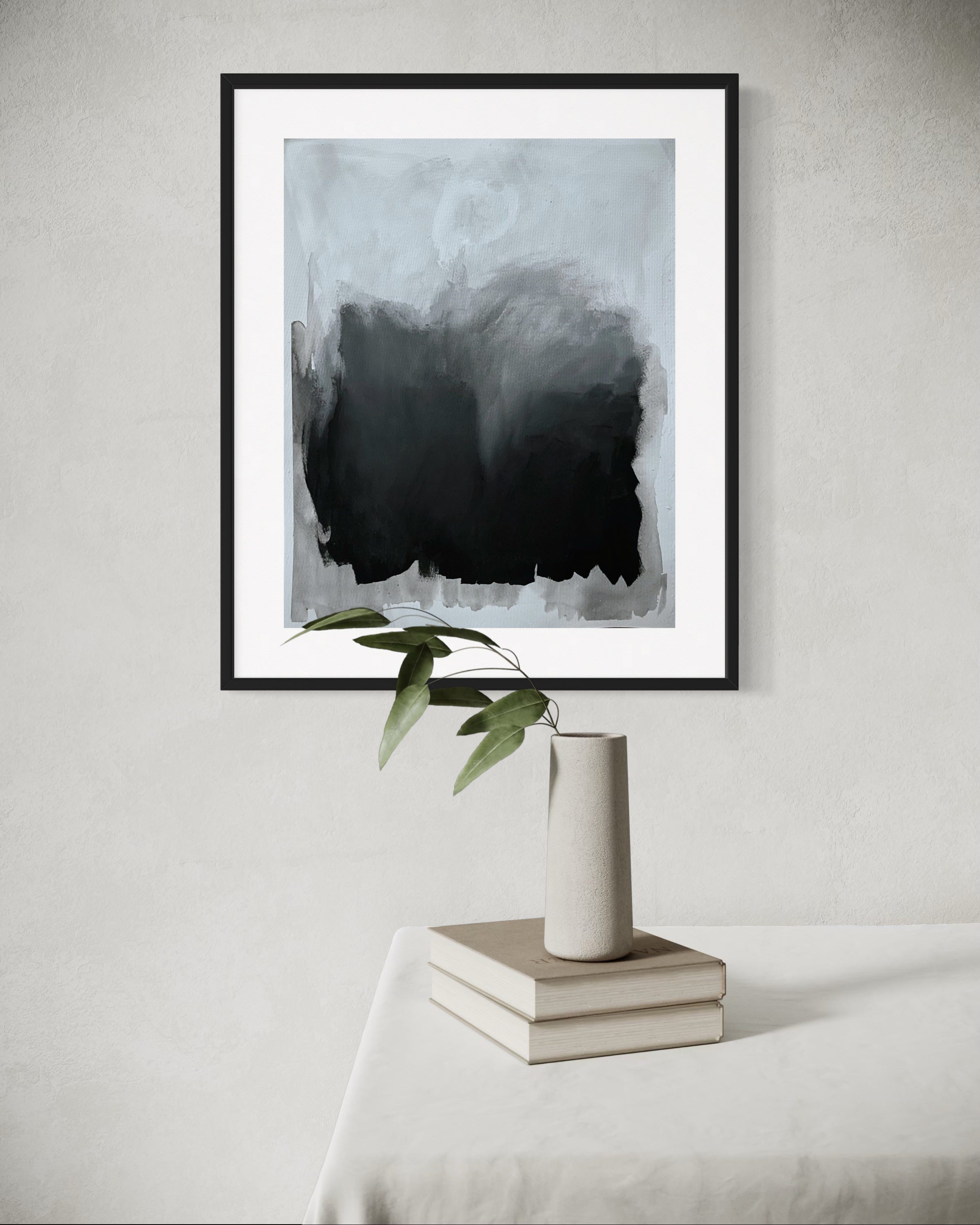
Unlike most pieces, this painting began with a very clear, deliberate image in my imagination. I wanted to create a variegated painting of values—a slow progression moving from white to gray to black, exploring imperceptible shifts in value.
But as I began the slow work of editing the transitions, the painting did what it always does. It began to articulate its own form, shapes emerging organically like hidden symbols from the subconscious. I noticed a subtle, flower-like form developing near the top of the painting. Instead of building up a strong value contrast to pull it forward, I chose to call it out with a soft, delicate white. I wanted that shape to feel as though it were rising out of the energetic silence of the background, keeping the same quiet subtlety it possessed when I first found it.
When I stepped back, the whole effect of the painting revealed itself as a paradox. There is a taut tension between the hard, contrasting boundaries in the lower section and the useful, light, dissolving brushstrokes at the top where the values collapse into one another.
I named this piece Lotus Position.
The title belongs to the painting because the process felt exactly like the architecture of meditation. When you first settle into the practice, you feel the stark, heavy outlines between yourself and the rest of the world. The boundary lines of your inner and outer experiences feel rigid and sharp, and you can see all the jagged shapes of your thoughts. But the longer you breathe, relax, and settle, the less distinct those boundaries become.
The rigid separation begins to feel more like a wash. The definitions collapse. In my own experience of this state, the distinction blurs into a subtle, barely perceptible difference, a feeling of beginning to merge with what is outside of myself. Or not merge, exactly. Grow aware of a fundamental unity.
The abstract, circular floral shape at the top serves as a reminder of that unity. White is, after all, the color from which all other colors spring. Right in the center of that floral image is an empty space, with some faint, barely visible text beneath it that I forgot long ago. That spacious center does not feel like an absence; it feels like a container for fullness, holding even the things we thought we lost to time.
It is still, but it is deeply energetic. For a long time, I have been interested in trying to paint what energetic stillness actually looks like. I want to capture the absolute potential of a gesture—a movement that is completely at rest but simultaneously in motion.
That poise is the heart of meditation. Stillness is never a passive activity; it is the fully charged state of all potential energy. It is a form ready for action from within the very calm that holds it. It is a reminder that this way of being in the world is always available to us. We do not have to earn this state. It is the natural condition of being a human—to be an aware creature intrinsically unified with all other beings.
In that sense, this image is cataphatic rather than apophatic. While some of my previous work focused on erasure and subtraction, this painting claims, in stark simplicity, the absolute fullness of being. It declares that what looks simple is actually whole. What appears empty, calm, or immovable is actually the container for all potential movement.
The heavy black at the bottom is not a negation. It is a solid, grounded reality, and it exists in perfect harmony with the airy, fragile white flower at the top. The solid dark and the empty white are indicating the exact same reality through different symbols. Neither is empty. The black is not an erasure, and the outline of the white flower is not an incompletion. Both are stable, and their strength comes precisely from their capacity to hold everything within.
If you look closely, you might even see a human figure here. It is a body in a meditative state, deeply rooted and connected downward into the earth, while remaining completely open and available upward to the sky. Those are not two different states of being. They are the single, connected reality of what it means to be alive—to be anchored to the ground while belonging to everything at once.
No posts
Comments
Nothing yet. Say the first thing.
Sign in to join the conversation.