
Ever wished you could chat with your favourite book? Ask it questions, get summaries on the fly, or even challenge its ideas. I know I have.

We stumbled upon this idea while reading Tyler Cowen's book "GOAT: Who is the Greatest Economist of all Time and Why Does it Matter? "
Halfway through, we thought it would be cool to learn how to make a generative book and that’s how this workshop came to be. Let me tell you more about how it works and what we're going to be building 🦾
R.A.G or Retrieval Generated Augmentation is a technique that allows LLMs (Large Language Models, such as ChatGPT) to accurately retrieve information from a data source (such as a PDF).
It’s important to note that our source of knowledge, being queried is stored in a vector database. RAG operates in two steps: first, it Retrieves relevant information to answer the query from the vector database.
Then, it uses an LLM to Generate a response based on the retrieved data. This approach ensures that the answers are both current and contextually relevant.
We will build a simple chatbot that will help you talk to a book of your choice through natural language. You can ask it to summarize a chapter as a haiku, transform key events into flashcards, or explain the symbolism in a pivotal scene. Curious about the author's style? The chatbot can analyze their use of metaphors.
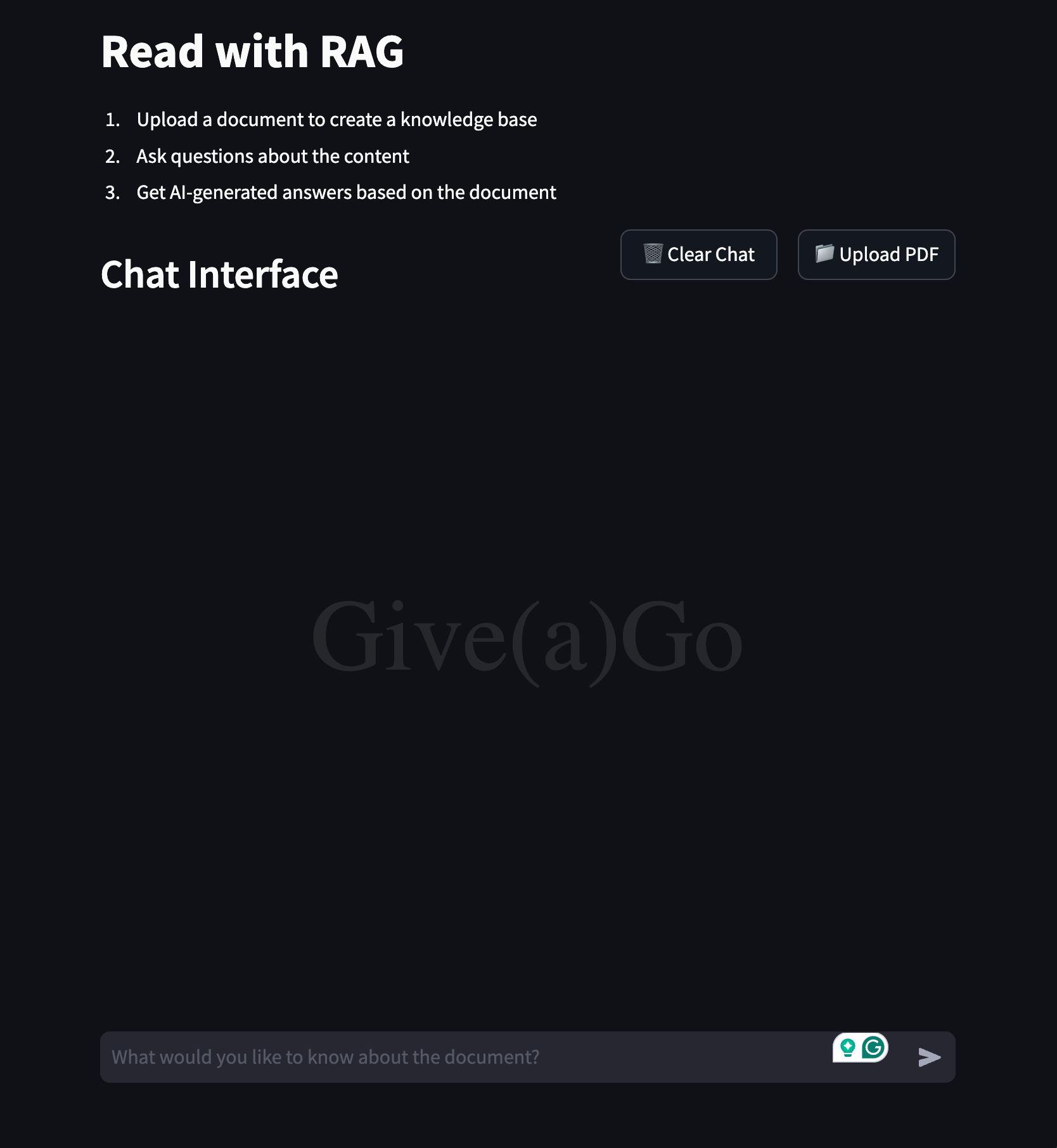
All of this sounds incredible. However, it’s important to note that while RAG is powerful, it is not infallible. It can sometimes make mistakes or misunderstand your question. Numerous techniques can be used to improve the quality of responses from your RAG pipeline.
We'll guide you through the process of:
1. Setting up a vector database to store book content
2. Implementing a simple RAG pipeline to retrieve relevant information
3. Integrating an LLM to generate responses based on the retrieved data
4. Creating a user interface for interacting with the book chatbot
Don’t worry about the technical details and tools. We will help you get setup with all of these as fast as possible. Our next walkthrough will dive into the technical details.
In an ideal world, you would be able to throw your company/project’s code base into a vector database and use RAG to pull out answers. That would be like magic. We are still far away from there. However, there are some really cool use cases.
Imagine customer service reps finding answers in seconds, or students creating study guides from textbooks with ease. Lawyers could quickly uncover important legal cases, while researchers might spot unexpected connections between different fields.
At its core, RAG helps us find and use information in smarter ways. It's like having a super-smart assistant that can read through tons of information and give you exactly what you need.
So, are you ready to make your first RAG application? Let's dive in and see where this takes us! Ready to Give It a Go?
No posts
Comments
Nothing yet. Say the first thing.
Sign in to join the conversation.