
Let's address the elephant in the room, or rather, the banana? Yes, Google’s latest AI image editing tool is called “Nano Banana”. But don’t let its goofy name fool you. This tool is taking AI communities, Reddit threads, and Discord servers by storm.
Developed by Google, Nano Banana is part of Gemini’s 2.5 Flash Image lineup and marks a major leap forward in the realm of real-time image editing. This platform lets developer’s vibe-code their ideas directly into visuals, while allowing them to blend multiple references of their choosing to create whatever they can imagine, all without touching a single line of code!
At its core, the model makes image editing as simple as typing. You give Gemini an image, describe the changes you want, and it delivers edits with surprising accuracy. However, what exactly is the magic behind it? The answer: diffusion models.
If that term sounds complicated, picture it like this: Imagine starting with a foggy, blurry picture. Step by Step, the AI would wipe away the fog, sharpen the details until the final image we wanted appears. The model can do this because it’s been trained with millions and millions of examples learning lighting, texture, shapes, and styles, so when we give it even the most basic prompt, say “put a Ferrari in front of my house”, it knows how to paint that scene to perfection.
This right here is Nano Banana’s real strength. Google has designed Gemini to follow these prompts step by step, layering edits without breaking consistency. You can stack multiple changes, and it all will feel natural, as if it were always meant to be there.
For our more curious readers, here is a great technical blog that goes into a deeper analysis of Nano Banana under the hood
Rather than just talking about what Gemini can do, I wanted to see it in action using one of my own photos, so I picked a snapshot from the last Give(a)Go event, simple, ordinary and the perfect canvas for me to experiment on.

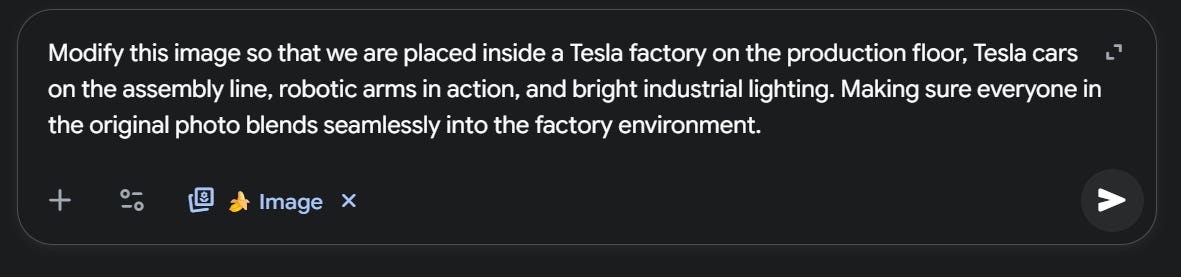
Instead of having us in the usual office backdrop, I asked Gemini to drop us in the heart of Tesla’s production floor. So I tested it with the following prompt:
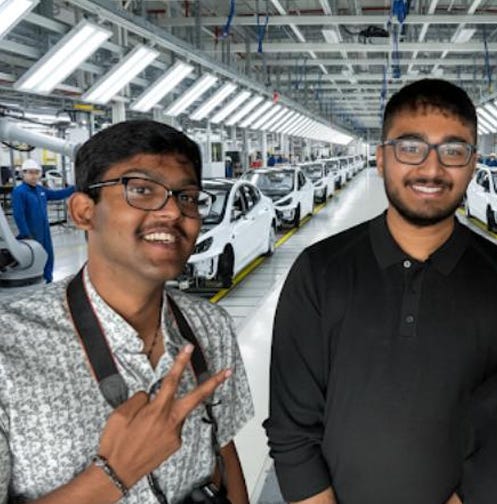
Almost instantly, Gemini processed the prompt and generated the image exactly as envisioned.
Our ordinary backdrop transformed into Tesla’s production floor, complete with machinery, astonishing symmetry and factory lighting, all blending seamlessly as if we had truly been there. And the best part, it all happened from a single prompt
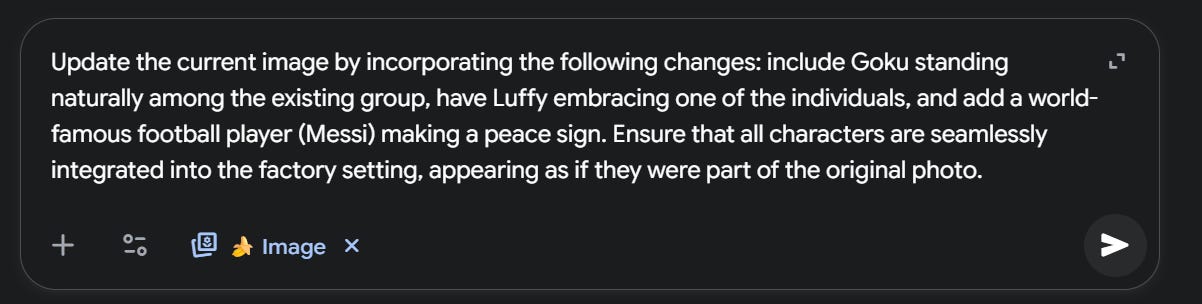
But why stop there? With the background sorted, let’s bring in a few familiar faces — both fictional and real. So, I gave Gemini the next prompt:
In seconds, Gemini populated the scene with some iconic companions like instantly recognisable anime heroes who were now side by side with us, along with a world-famous football player making a special appearance. All of them casually joined the selfie, as if they had been present all along!
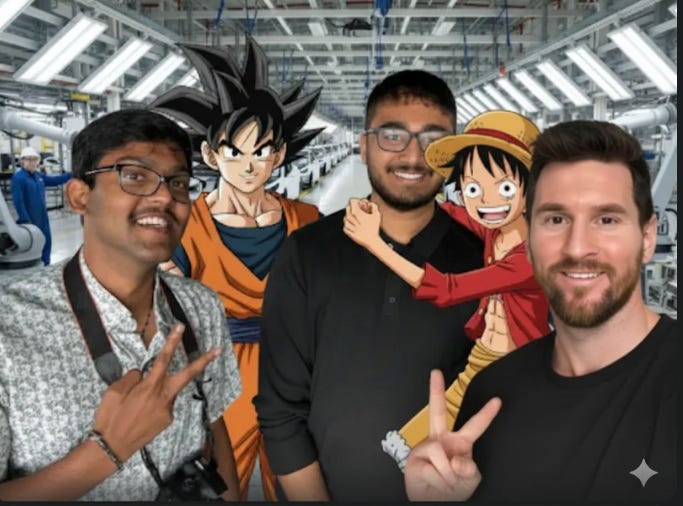
This is the magic of Nano Banana. The details blended so perfectly that it’s hard to tell an Image Model did it. Turning these simple photos into entirely new experiences.
Of course, my experiments aren’t the only use case of this tool. Creators all across social media have been posting surreal Nano Banana edits:
A cosy living room suddenly opens into a neon-lit cyberpunk cityscape.
A dog casually photoshopped into the driver’s seat of a Formula 1 car.
A wedding photo reimagined as if it were painted by Van Gogh
But this goes beyond fun edits. When combined with motion tools like Higgsfield or Kling AI, Nano Banana outputs can evolve into videos, gifs, or even cinematic sequences
For this article, I made a simple GIF from one of my own prompts, but that’s just scratching the surface. Here are some really cool use cases trending on twitter:
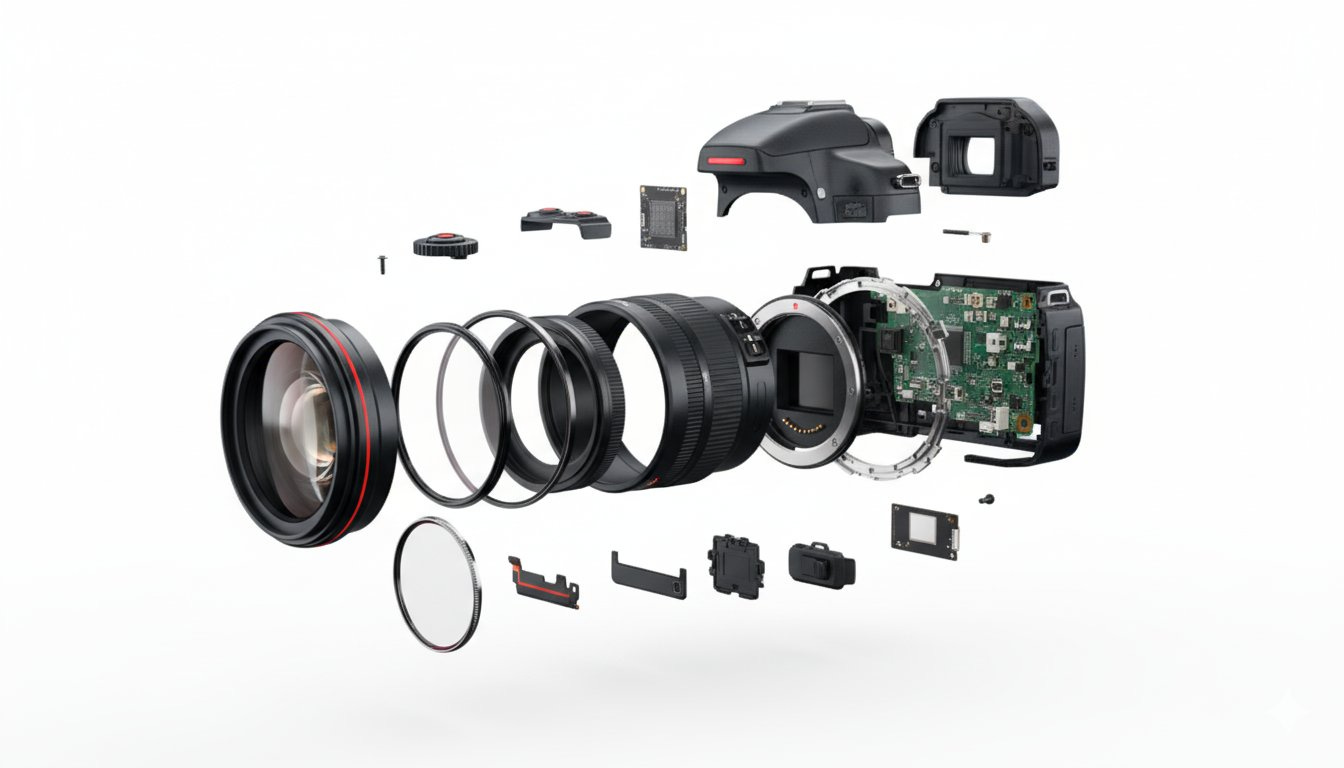
Hardware Exploded View by @AIimagined
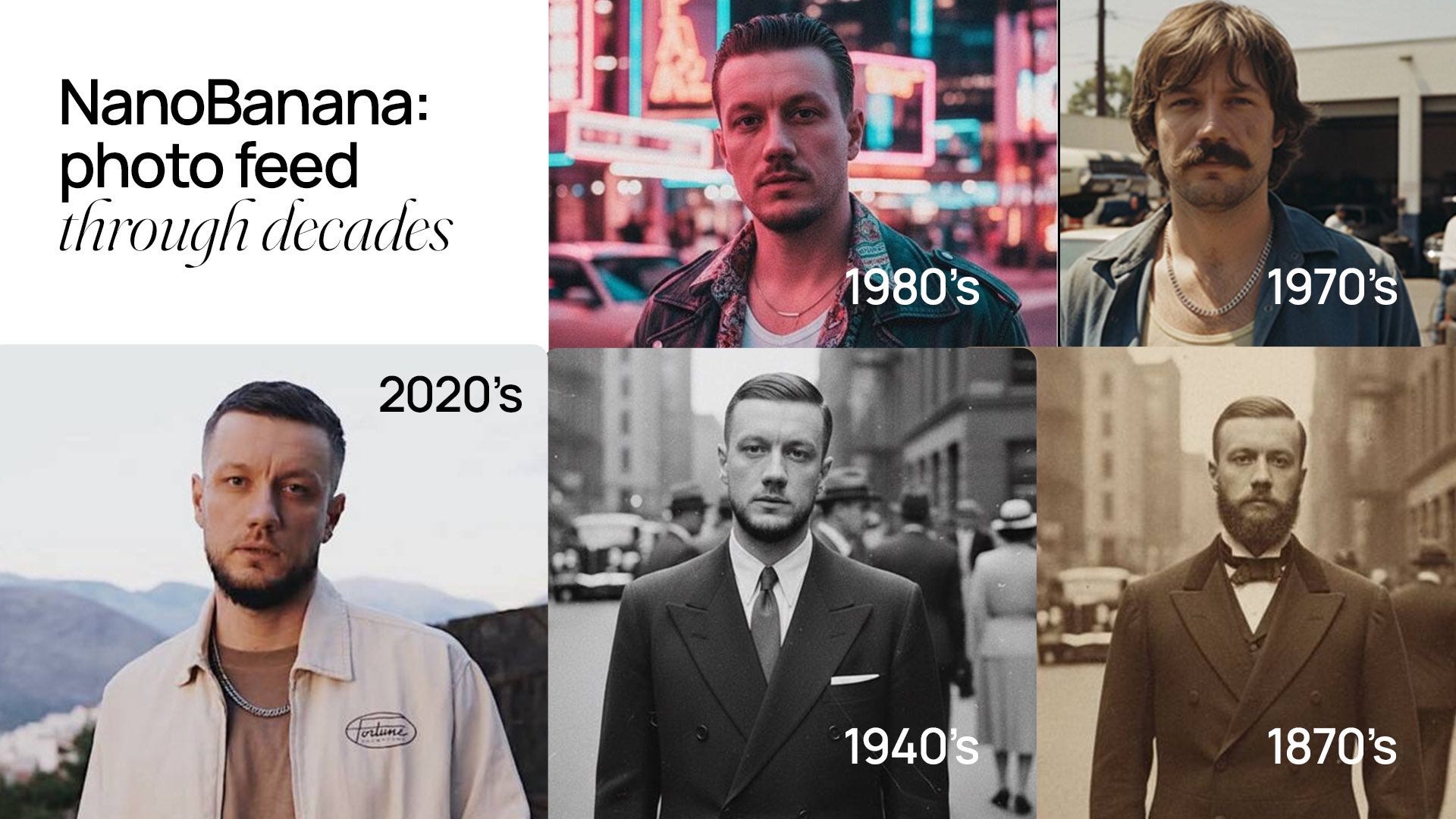
Photos of Yourself in Different Eras by @AmirMushich
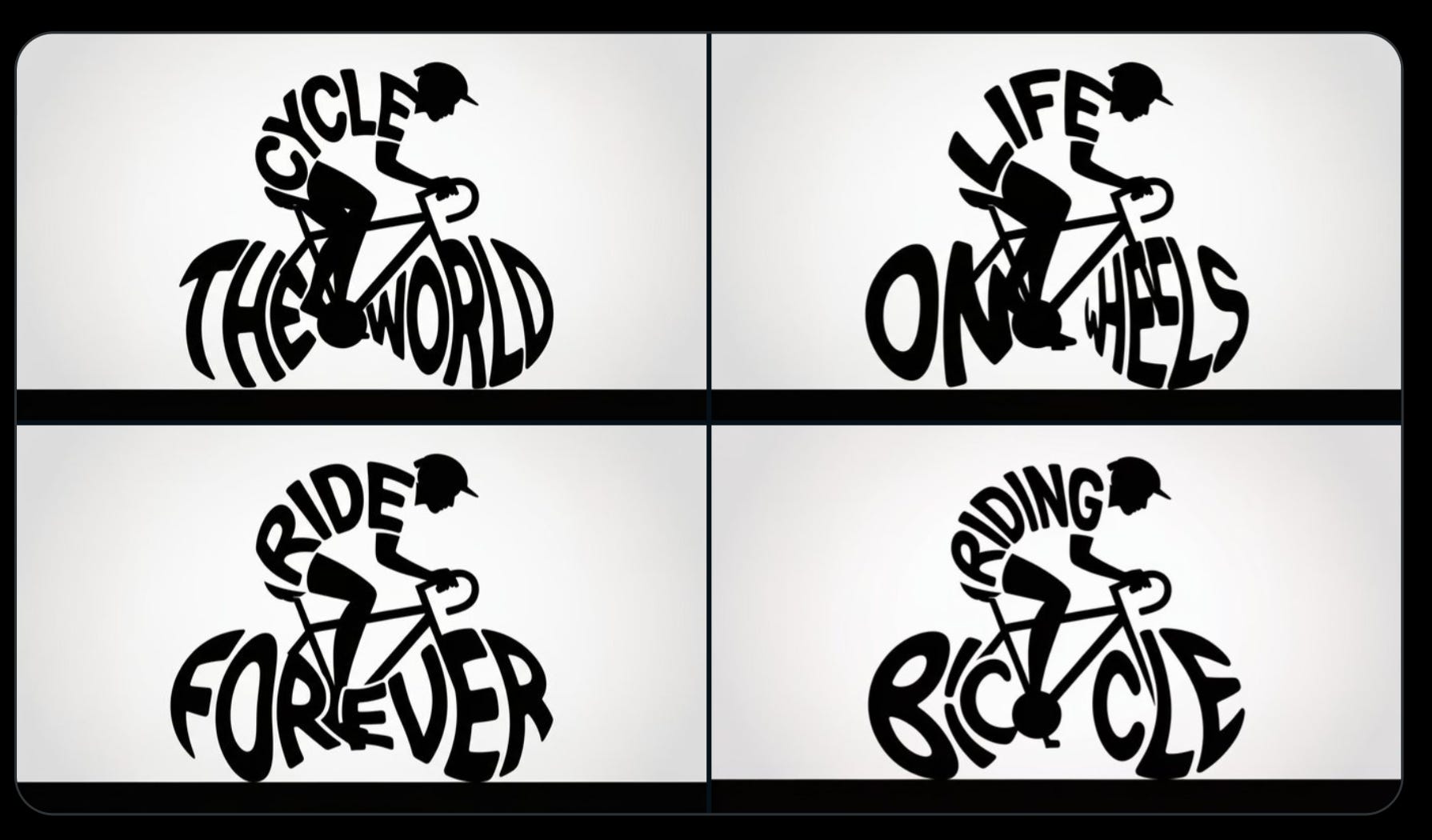
Typographic Illustration Generation by @Umesh
Product Packaging Generation by @zho_zho_zho

That’s the real shift here. Nano Banana isn’t just about making single photos cool; it’s about creating a starting point that can scale into dynamic content pipelines. From personal gifs to professional campaigns, it’s a tool that’s reshaping how we think about images, motion, and creativity itself.
After seeing Nano Banana push boundaries with images and even video, the obvious question pops up: Does this mean the end of Photoshop?
Truth be told, ever since Google unveiled Nano Banana, the internet’s been buzzing with takes and memes about “buying puts on Adobe,” and claims that Photoshop is officially dead. But the reality is a little more nuanced.
“Photoshop” is still the industry’s precision tool the scalpel for designers who need to have pixel-perfect control. It shines in detailed retouching, advanced composition, and professional workflows that demand meticulous adjustments.
Nano Banana, by contrast, is the paintbrush. It thrives on speed, imagination, and accessibility. With a single line of text, you can transform an entire scene, spin up creative drafts, or experiment with wild ideas things Photoshop can’t natively do without hours of work.
So rather than being a “Photoshop killer,” Nano Banana feels more like Photoshop’s sidekick. Photoshop polishes and perfects; Nano Banana sparks and expands. Together, they give creators the best of both worlds: a tool that can take you from rough concept to professional finish in record time.
At the end of the day, Nano Banana is far more than just a quirky name; it’s a versatile AI image generator with real creative muscle. From preserving facial features across edits to producing natural, integrated scenes, it’s built to handle both playful experiments and serious projects. Like any AI model, it has its technical drawbacks, but that only highlights how much room there is for growth as the field continues to evolve.
The best way to appreciate its potential is to dive in yourself. I encourage you as the reader to play you’re your own prompts, push the limits of your imagination, and see how quickly a few words can reshape reality.
Whether you’re designing products, crafting marketing content, or exploring new storytelling frontiers, Nano Banana strikes a rare balance of power and practicality, a promising step forward in Google’s AI image generation lineup.
Give it a go yourself to see how far image models have come
Check out other cool use cases of from this really cool repo - Awesome-Nano-Banana-images by PicoTrex
No posts
Comments
Nothing yet. Say the first thing.
Sign in to join the conversation.