
I’ve been enthralled with the night sky for as long as I can remember.
Or, in my case, so long that I can’t even remember how it got started at all.
It could have been the then hot-off-the-press pictures from Voyager 2. Maybe it was a curiosity about why the Moon looked different every night. Or it could have been the shocking discovery that the stars were all suns but very far away, and that the Sun was a star but very close.
No matter. The night sky and all it contained was my first obsession, one that was kicked into overdrive when my parents got me my first telescope as a birthday gift.
By the time I was in high school, I wanted to be a professional astronomer.
There was just one catch that would emerge over the course of the next 4 years:
I sucked at math.
This is not to say that I always struggled in math, far from it.
Through primary school, I was actually really good at it, so long as I didn’t just blow through assignments to get the drudgery done and over with, so I wouldn’t have any homework that night.
Then came high school and pre-algebra, which was to my brain the equivalent of driving head-on into a concrete wall at 100mph.
I faked my way to good grades for the next 4 years until my K-12 academic career was over.
Fake learned? Yes.
I simply leaned into my photographic memory and memorized what the answers of the practice problems looked like in the classwork, and then translated this into the tests. I got mostly ‘A’ grades while having absolutely no idea what I was doing.
By the time I finished high school, I knew that my dreams of becoming a professional astronomer would never leave the launch pad.
Still, by the time I was finished with high school, I had my first real telescope: a 120mm refractor on an equatorial mount, along with a nice wooden case I built in shop class to protect it.
If it was clear, I was out with my telescope, even on the bitter, cold winter nights.
Armed with a red flashlight and a sky atlas that highlighted all of the brighter deep sky objects as well as the easier to find binary stars, I plotted my nightly course through the cosmos.
Planets, stars, star clusters, nebulae, and galaxies: they all found themselves in my eyepiece.
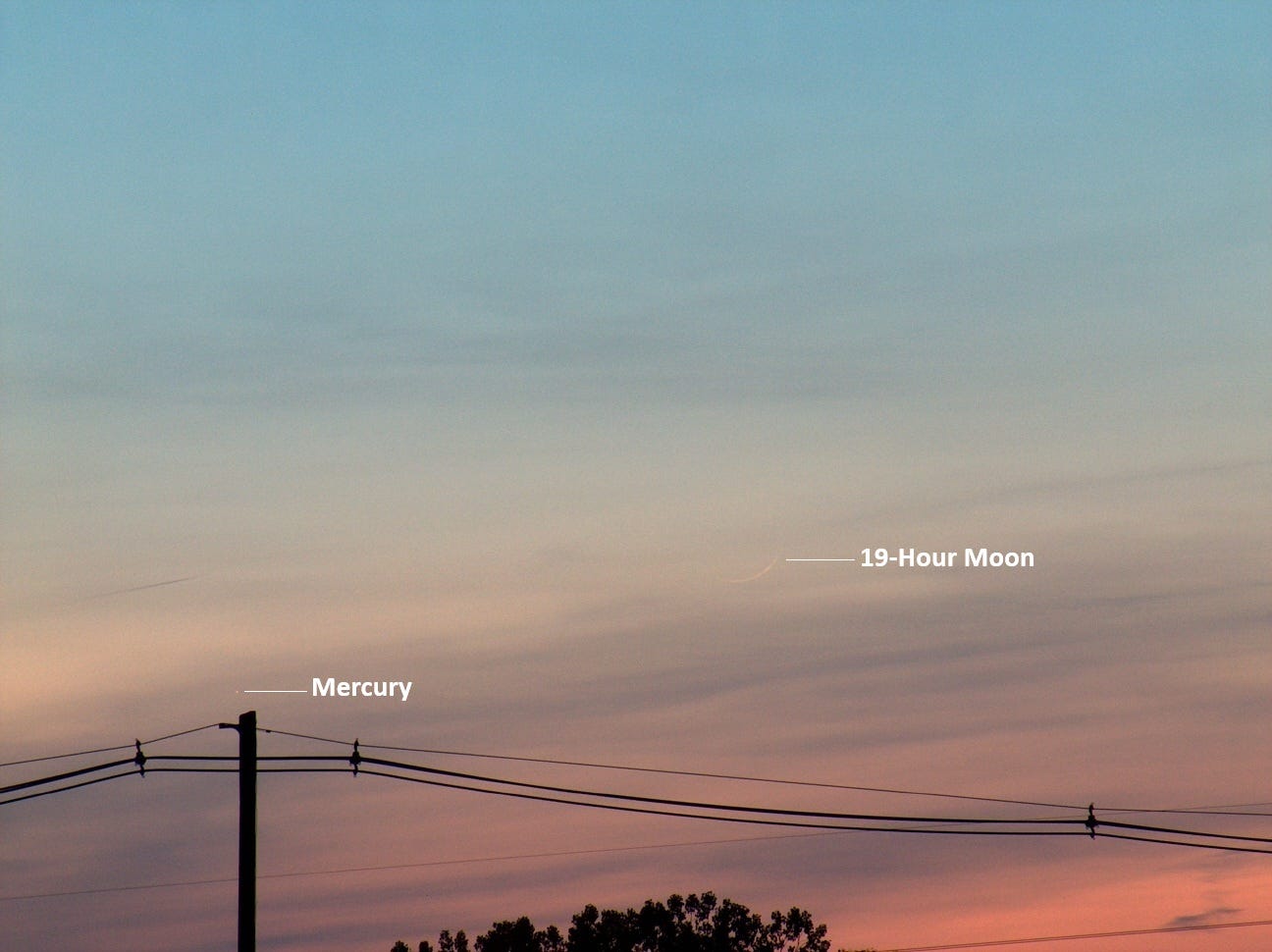
Outside of the night, I developed a particular interest in hunting Young Moons, specifically those less than 24 hours past new. A bridge over a highway, a street over from me, offered the perfect vantage.
A 19-hour Moon is my record.
The Moon was so barely lit that I didn’t even initially recognize what it was, first mistaking it for a wisp of cloud.
By the time I was in college and diligently working on a degree that would quickly reach its expiration date and is long-since no longer worth the paper it’s printed on, digital SLR cameras were no longer a rich hobbyist’s toy and, so long as one didn’t mind buying used, becoming affordable even to college students.
Through a contact in a local astronomy club I joined back in high school, I found myself the proud new owner of a used DSLR.
In no time, I was using my camera and motorized mount to capture the same kind of pictures that had inspired a sense of awe just a few years previously.
Throughout all of this playing around with technology, one can’t help but develop a deep sense of connection to the sky, both day and night, that comes by way of the human eye alone, and that returns to the roots of astronomy itself.
The sky is a series of patterns that take place both over the course of the day and the year.
The Sun rises in the East, reaches its apex in the South, and then sets in the West. Similarly, the stars do the same over the course of a single night.
Over the course of a year, things get a lot more complicated.
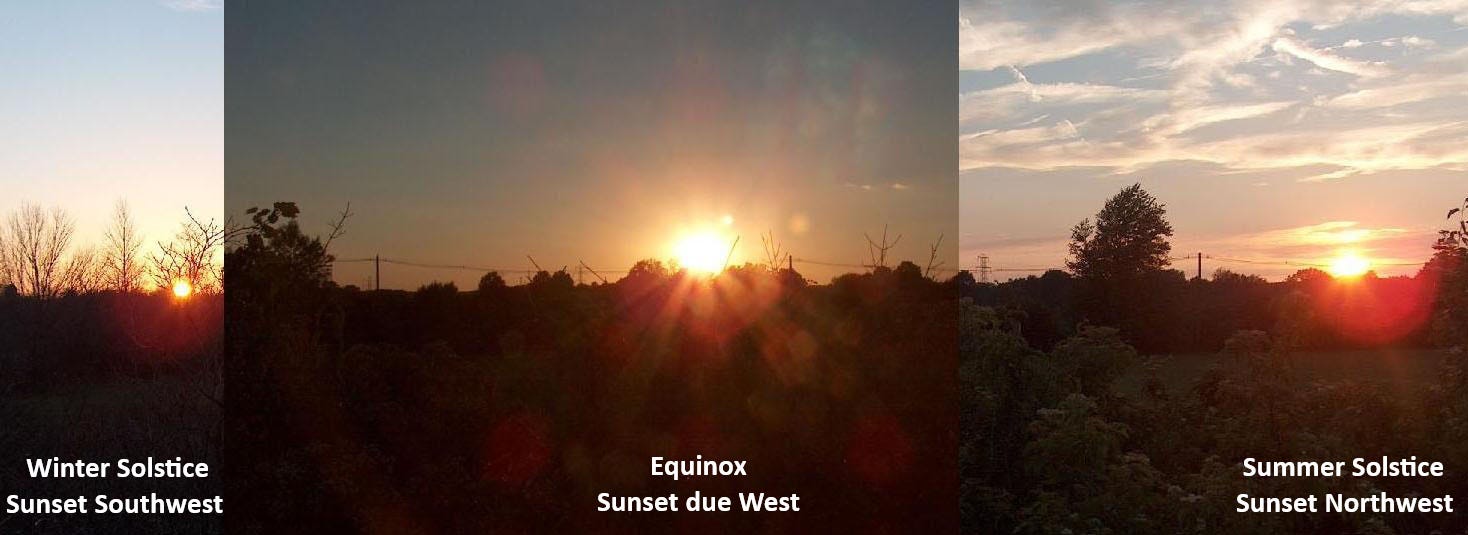
The Sun’s path through the sky changes. In winter, the Sun takes a short, low arc through the sky, rising well South of East and setting well South of West. In the Summer, the pattern in reversed as the Sun rises well North of East and takes an extremely high, long arc through the sky before setting well North of West.
At night, our ancestors noticed that some stars were visible at certain times of the year and not others. Looking at both day and night skies, they realized that the patterns overlapped and could be used for telling time.
With this knowledge, the ancients were able to determine the length of the year and, as an extension, were then able to divide the roughly 365-day year into shorter divisions, the 4 seasons we recognize today.
Our stargazing ancestors were also quick to realize that the Moon goes through a regular set of phases roughly every 30 days, which divides well into the 365-day year.
In fact, the origin of the word “month” is “moon.”
Now able to divide the year into smaller pieces, the ancients were then able to predict general weather trends by correlating them to the movements of the Sun and stars.
Agriculture itself became science rather than guesswork.
And with scientifically-guided farming and the regular surplus of food it provided, our ancestors were able to develop the state of ‘civilization’ that continues to the present day.
Speaking of the present day: maintaining a connection to the sky is still as relevant as it ever was, albeit in smaller but nonetheless important ways.
In an age where the cost of everything is on the rise, many people are looking for ways to save money wherever they can. One small way many people do this is by gardening.
Plants, whether indoors or out, need the Sun and placement is key.
The Sun moves throughout the year, from seed to final crop; the growing season can be 6 months for many plants. A sunny area of yard in late June may not be so sunny in late April, when young plants need optimal sunlight to thrive.
The inverse can be true for indoor plants. Ample light in spring can give way to limited light in summer as the Sun climbs too high in the sky to shine directly through a window.
The same is true of solar panels: what use is one if it can only create energy for a fraction of the year due to poor placement?
For anyone who enjoys the great outdoors, knowing where the Sun and stars are located at any given time of day can serve as a rough compass, the same way they did for our ancestors, should one get lost.
Moving into the night, the patterns of the sky can be just the reassurance one needs during the dark, cold times.
For anyone getting up on a bitterly cold morning in early January, the sight of bright blue Vega in the predawn Northeast sky is a reassurance that, in time, the warmth will return.
On the other end of the night, seeing Orion low in the Southwest during an unseasonably cold snap in April serves as a reminder that the cold weather is an anomaly and that winter is actually on the wane for the season.
Hate heat? Then look for blazing blue Sirius rising low in the Southeast come September as it heralds cooler weather on the way.
Through all of this, one thing should become obvious:
Astronomy is a hobby for anyone, on any budget, and living anywhere.
At its most basic level, astronomy is completely free, as the eye is the only equipment you need.
Looking up and tracking the movements of the Sun and planets while noticing the seasonal changes of the stars during the course of a year can be for anyone, even for people who live in cities.
Come 2026, the ability to capture images of the night sky is literally at one’s fingertips thanks to the modern marvel that is the smartphone.
The equipment? Sure, it’s fun, but it’s not necessary.
It turns out that you don’t have to be good at math, let alone have an accredited degree, to be an astronomer.
The sky is beckoning.
You just need to answer its call and look up.
Comments
Nothing yet. Say the first thing.
Sign in to join the conversation.