
👋 Ciao, I’m Giulia Blocal, your street art insider. This is Beyond the Walls, a monthly deep dive into street art, graffiti, off-the-beaten-path travel, and a bit of my life in between.
This month’s editorial was sparked by a transformation I have been closely involved in: the passage of CVTà Street Fest from a festival format to an artist residency program. More than a change of structure, I see it as a sign of where street art festivals may be heading: beyond the logic of the event, towards slower, deeper, and more responsible ways of working with public space, artists, and local communities.
But first, a few updates on my life and the BLocal project.
Let’s jump in!
Ciao,
how are you?
This month I’m writing to you from Civitacampomarano, the semi-abandoned village in southern Italy where I return every year to manage the social media for CVTà Street Fest, Alice Pasquini’s street art festival.
This year feels particularly special because we opened an art gallery and are transforming the festival into an artist residency. The communication around the project has become much more layered, and I’m finding myself unpacking this shift one layer at a time. The part that fascinates me most is the end of the festival as we knew it and the beginning of a new format that will allow artists to work more deeply, create more meaningful projects, and build a stronger relationship with the place. That’s what this month’s editorial is about (you’ll find it below).
Before CVTà, I spent ten days in Portugal working at WOOL | Covilhã Urban Art, Portugal’s first urban art festival, plus one rather hectic day in Lisbon running around to photograph new works for our upcoming Lisbon street art book. Some of the artists I interviewed have painted new pieces since the research trip when we photographed most of the book, and I really wanted to include them, which meant crossing the city like a spinning top, trying to capture everything in a very limited amount of time.
WOOL and CVTà were two very different experiences, yet they shared something important: the care that goes into creating art in public space. It’s one of the reasons I’ve kept working with both organizations for so many years. At this point, I only want to work with people who care.
That word has been following me around lately. I recently started reading Careless People by Sarah Wynn-Williams, Facebook’s former Director of Public Policy, and I found the title remarkably effective. It captures exactly what I've struggled with over the years, both in some of the workplaces I've been part of and with some of the clients I've encountered as a freelancer: superficiality, disrespect, arrogance, laziness, and that particular kind of carelessness that sees street art, and the artists behind it, as resources to exploit rather than people and practices to respect (and this is why, over time, I keep returning to organizations whose values I genuinely share).
Anyway, this past month I didn’t just return to two events I know well. I also discovered what has already become one of my favorite events: Assedio, a book fair that brings together independent publishers, photographers, artists, researchers, and cultural projects connected to urban and countercultural worlds.
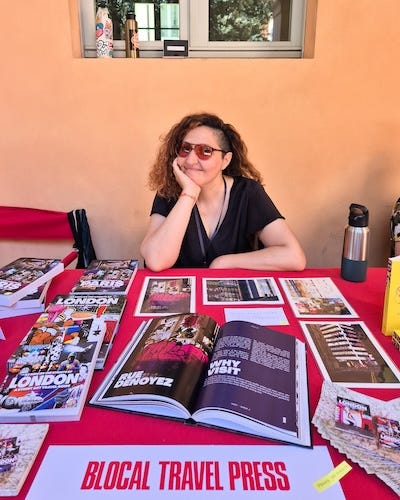
It was our very first book fair as exhibitors, and we absolutely loved it. Over two days we talked about our books, shared the stories behind them, answered countless questions, and realized that many readers are just as interested in the research, fieldwork, and long-term documentation behind our publications as they are in the finished books themselves.
One thing I especially appreciated about Assedio was its atmosphere. Despite the variety of backgrounds and projects represented, there was a real sense of exchange and mutual curiosity. It felt much less like a marketplace and much more like a temporary gathering of people who genuinely care, there it is again, about documenting, preserving, and discussing cultures that mainstream institutions often overlook.
This coming weekend we’ll be heading to another fair, Tabula Rasa Art Market in Civitanova Marche, Italy. I’m curious to see how it compares, and also quite relieved to be attending an urban art event without being involved in the production. Between festival season and the recent heatwave, the past few months have definitely taken a toll on me, both physically and mentally.
Until next month,
Giulia
P.S. It’s that time of the year again! Every June, I run a reader survey to help me improve this newsletter and make sure it continues to be worth your time.
The link is the same as always, it only takes a few minutes to complete, and you can find it here 👇
✈️ Travel with me!
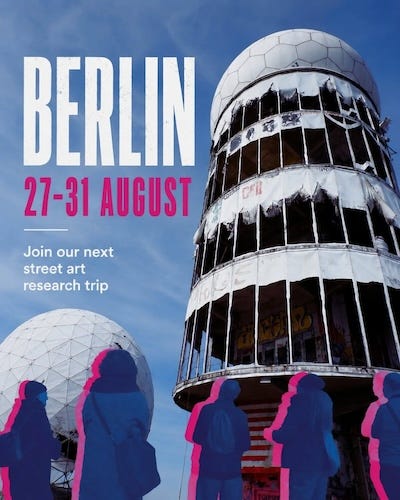
The program of our 5-day exploration of Berlin is out!
From August 27 to 31, we’ll use street art as a lens to explore the city’s many layers, from residential neighborhoods and former industrial areas to alternative cultural spaces, contemporary architecture and districts undergoing rapid transformation.
Expect long walks, surprising discoveries, unusual locations and plenty of opportunities to experience Berlin beyond its most familiar narratives. This is a journey for curious travelers who want to understand not only the artworks themselves, but also the communities, spaces and stories that surround them.
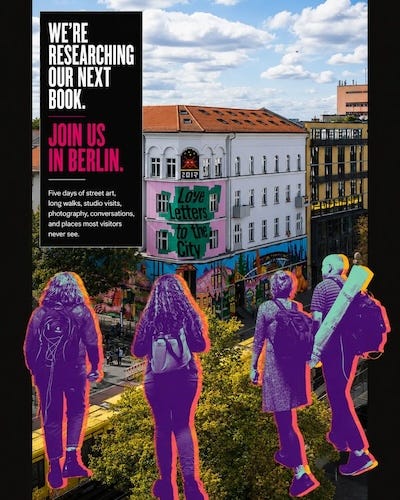
🐦 Early bird registration until July 5th!
🎥 New on Youtube!
In this video, you’ll see WOOL | Covilhã Urban Art Festival from the inside: artists painting, murals taking shape, the production team at work, and the slightly chaotic rhythm of following everything across the streets of Covilhã, Portugal, with a camera in hand.
✍️ New on the blog!
This year's edition carried particular significance, celebrating fifteen years of WOOL | Covilhã Urban Art. It was not simply an anniversary, but proof that an independent festival can grow without losing the values that made it meaningful in the first place. Context, community, curiosity, and the belief that public space can still be a place for dialogue remain at the centre of this festival, shaping an edition that once again invited artists to spend time understanding Covilhã before leaving their mark on it.
Summer is around the corner, and whether you’ve already booked your trip or are still wondering where to go next, let me ask you something: what if you planned it with a book instead of an algorithm?
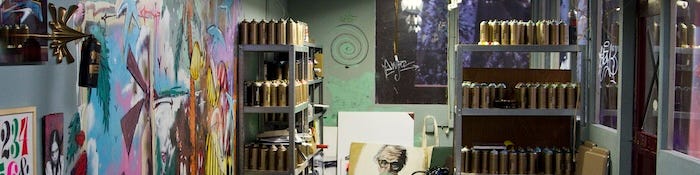
After ten years of CVTà Street Fest, this year we changed rhythm. We felt that the festival had accomplished what it was born to do: it had welcomed artists and visitors to Civitacampomarano, a village marked by depopulation, filled its empty streets with people, and transformed a place far from the usual cultural maps into one of Europe’s most unexpected street art destinations.
Precisely because of this, continuing in the same way no longer felt like the most honest choice. From this year on, CVTà will grow as an artist residency program, hosting one artist at a time and allowing each project to unfold through research, stories, daily encounters, and a slower relationship with the place and the people who inhabit it.
I believe, and honestly hope, that many street art festivals will move in a similar direction in the coming years, because the opposite drift is becoming impossible to ignore: a growing culture of Instagram-driven muralism that is producing more images in the streets, with less and less meaning attached to them.
The problem is not the festival format itself. Festivals can still create powerful moments of encounter, discussion, fun, and shared attention around street art. The problem begins when the format becomes a machine that has to produce at high speed: artists invited for a few days, walls assigned in advance, images created to be photographed from the right angle, made to exist through the endless cycle of online visibility.
Even the act of choosing the wall can disappear from the process. Yet looking for the right location, reading the street, and understanding how an image might live in relation to its surroundings have always been core elements of street art, as we explored in last month’s newsletter.
In this system, research, hesitation, listening, and context are often the first things to disappear, as the mural is conceived elsewhere and only occasionally adapted to fit a wall or a local reference. The result can still be beautiful, technically impressive, and visually effective. It works perfectly online, where context is collapsed. Yet it remains detached from the place where it appears. It could have been painted in another city, or even another country, without its meaning changing in any substantial way. Within this economy, this absence of roots is no longer perceived as a problem, because the work is primarily expected to circulate on Instagram. For me, the problem is twofold: street art becomes portable content, while public space is reduced to a surface, much like advertising billboards do.
I noticed this again earlier this month while working at WOOL in Covilhã, Portugal, a festival that is not an artist residency, although its approach often feels much closer to that of a residency than to the production rhythm of many urban art festivals. Artists are not invited simply to bring an image to Covilhã; they are invited to spend time in the city and let the work take shape from what they encounter there.
This is why I think the real question is not whether a project takes the form of a festival or a residency, but whether it gives artists enough time, space, and trust to create work that is genuinely contextual. At CVTà, we chose to make that space by becoming a residency; other festivals may find different forms, but the direction, to me, should be the same: less pressure to produce quick, easy-to-like images, and more room for artists to understand the places they are working with and create something meaningful in that specific context.
Maybe this is where many street art festivals are now being asked to mature: by questioning the idea that their value depends on producing more walls, getting more likes, or attracting more visitors. Slowing down is not stepping back; this was the conviction behind our decision at CVTà. It can be a way of investing more attention and always-scarce resources in fewer projects, of allowing artists to move beyond the ready-made image and return to the practices that should be at the centre of street art: research, sketches, studies, conversations, observation, doubt, friction, and the possibility of changing direction.
One more thing I noticed this past weekend in Civitacampomarano is that the artists who returned to celebrate this shift towards residency with us very naturally embraced the idea of creating something spontaneously in the village. They looked for their own locations, followed what caught their eye, and painted intimate works on a human scale, born where the arm can reach, at most with the help of a ladder.
I have been advocating for human-scale street art for a while now, and I feel this should probably become the topic of another newsletter. This time, though, I wanted to stay with the feeling I had after this month between WOOL and CVTà: that other directions are possible, and that they are already being tested by people who care enough to change the conditions of production rather than keep feeding the same cycle.
After so many editorials spent discussing what is going wrong, I felt I owed you some hopeful thoughts too. I do feel positive after this past month. Tired, very much so, but also convinced that the conversation does not have to remain trapped in criticism. There are festivals already working with more attention (with more care!), where artworks are allowed to grow out of a real encounter, and there are artists who want time to look, listen, sketch, and change direction.
And yes, a residency might not be a perfect solution, and not every festival needs to become one, but residencies do make one thing clear: depth needs a real relationship with the place.
If the future of street art festivals is not simply to grow through Instagram visibility, then perhaps the most urgent question is not how many images they can send into circulation, but whether the works they produce can still belong to the places where they appear.
I rely on the support of readers like you to keep creating genuine and informative content. If you value my work and would like to see more of it, please consider making a donation to support my writing and my editorial project BLocal.
You can Buy me Pizzas, Donate via Paypal, or become a Paid Subscriber.
You can also buy my books, As Seen on the Streets of London & As Seen on the Street of Paris,“like” my newsletters by tapping the ❤️, share them on Substack Notes or other social media, and forward this email to anyone you like.
Comments
Nothing yet. Say the first thing.
Sign in to join the conversation.