
👋 Ciao, I’m Giulia Blocal, your street art insider. This is Beyond the Walls, a monthly deep dive into street art, graffiti, off-the-beaten-path travel, and a bit of my life in between.
This month’s editorial looks at text-based street art, and how bringing language into the streets reshapes our relationship with public space.
But first, a few updates on my life and the BLocal project.
Let’s jump in!
Ciao,
how are you?
This month I’m writing to you from Glasgow, where I’ve just arrived, somewhere in the middle of the UK book tour. It’s my first time here, and although I’m feeling the weight of the past three weeks on the road, I’m still curious to explore the city and take the kind of notes that might end up shaping your future trips to Scotland. 🏴
These past weeks have been intense, and unexpectedly sunny. There’s a lot to unpack, so I’ll stick to a simple, chronological order, not the most exciting structure, but probably the clearest way to make sense of it.
The tour started in London, where we presented the book at an urban art gallery in Camden, together with several artists featured in it, and I’m still processing how supportive they’ve all been, from those who joined the signing to my friend Inspiring City, who moderated the talk.
(I’ve shared a few short clips from my conversation with Stuart, you can find them on Substack Notes and Instagram)
The presentation turned into a party, and the energy felt right, with people moving through the space, getting their books signed, meeting each other, and taking the time to talk, beyond the kind of quick, surface-level exchanges that define most online interactions. What stayed with me, though, was something more specific: seeing people I usually know as usernames show up, say hello, and take up space in the same room. 🥰
The next book signing is tomorrow, May 2, at Yardworks Festival in Glasgow, followed by Bristol on May 16 during Upfest.
Another moment that took us beyond the screen were the London walks I led for a small group of readers from this newsletter, off-the-grid explorations where we moved through the city together, observing, talking, and exploring side by side, spending time together around a shared interest.
Each book grows out of moments like these, since it is during the trip itself that Paolo photographs the city and gathers the material that will later shape the book, and once the book is ready, we return for a second journey, where the launch becomes a shared experience and readers can meet the artists and continue those conversations in person.
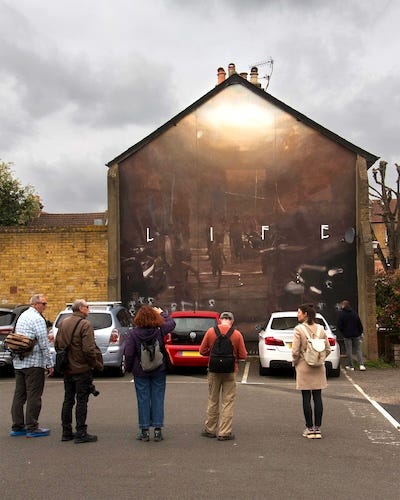
With every trip, this part of the project is starting to matter more, especially as familiar faces are coming back, alongside new ones who shift the dynamic each time, something that was particularly clear in London, where each group seemed to create its own rhythm and atmosphere.
The next trip will be in Berlin, from August 27 to 31, more details below.
From London, I flew to Aberdeen for Nuart Festival, where I’m back once again as a media partner, a festival widely regarded as the most important in the street art world, and the one I feel closest to after writing about it for over a decade.
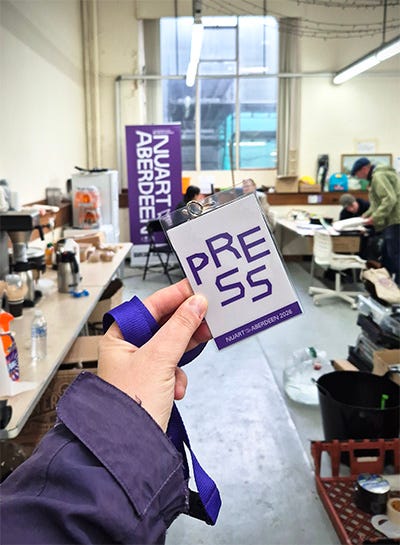
The days in Aberdeen were intense and precise, as always, shaped by conversations, talks, and ongoing exchanges around this year’s theme, Poetry is in the Streets, with a strong focus on text-based street art.
The kind of support I receive there, from both the team and the artists, comes with generous words about my work that I’m deeply grateful for, even if my mind has a habit of turning that appreciation into pressure almost immediately, the kind that can easily get in the way of the work if I’m not careful.
And so this year I made a deliberate choice to put the camera away and focus instead on interviewing the artists whose work resonated with me the most, moving away from documentation (which I still covered live on Instagram) and closer to conversation, which felt more aligned with the way I wanted to connect with the work and the artists more directly.
I’ve made several of my “crazy vlogs” about Nuart Festival in the past, both in Aberdeen and Norway, and this shift felt necessary, not as a rejection of that work, but as a way to move it forward, to find a sharper focus, and to move vertically rather than horizontally.
(I am filming a weekly vlog from Glasgow though, so you’ll still get some of the more chaotic, slightly nonsensical side of things alongside the writing.)
I’ll leave it here.
What follows, in this month’s editorial, is where those days in Aberdeen begin to settle into something more structured.
Until next month,
Giulia
✈️ Travel with me!
We’ve been planning a new street art trip, and it’s time to invite you to join us. This time, we’ll be exploring Berlin from August 27 to 31.
The trip is part of the research process for the upcoming Berlin book. I’ll guide you through the city, while Paolo captures it through his camera for the next volume of the As Seen on the Streets of… series. By joining this crowdfunding trip, you become part of that process, and you’ll receive a copy of the book once it’s published.
The programme isn’t ready yet, but since the group will be small, if you’re considering joining, just reply to this email and let me know. I’ll keep you in the loop and share all the details as soon as they’re ready.
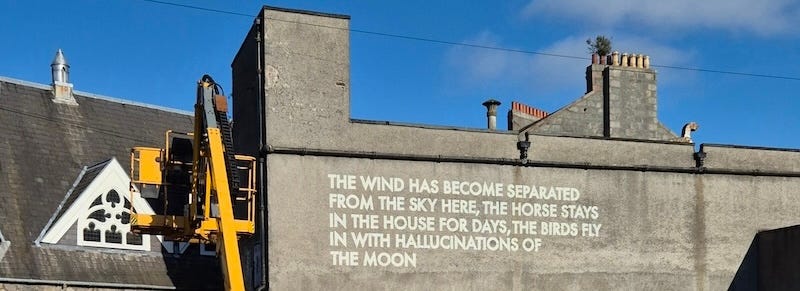
On my last day at Nuart Aberdeen, I joined a tour led by walking artist Alisa Oleva, where one of the exercises was to write down every word we encountered in the streets. As we moved through the city, it quickly became clear that, aside from a handful of tags and a couple of poems by festival artist V2K, most of what we were reading was either telling us what to do or what not to do, or trying to sell us something.
What I noticed that day reflects something broader: rarely do words in public space invite us to think about ourselves, or to engage with a place in a way that feels genuinely our own. The same dynamic extends to the other space we all inhabit, the digital one, where language is largely shaped by news and advertising, addressing us as demographics, as voters, or as customers, often with a clear agenda, if not outright propaganda.
In both cases, there is little room for language that speaks to more personal, less instrumental dimensions of experience. What we encounter instead is language designed to direct, or to sell, rarely to connect with us in a way that feels personal or lasting.
Saying shocking, offensive things may make headlines, but I believe we need more billboards and big signs that express love, kindness, and welcome.
Robert Montgomery
Poetry carries a certain opacity, a gap in meaning that resists full understanding, and it is within that gap that something else can take shape, a space for interpretation, for projection, for thought.
It is within that space that the artists of this year’s Nuart Aberdeen began to move, each responding to the theme in a different way. Some approached it directly through poetry, working with language in its most immediate form, while others explored it more broadly, engaging with the tension between text and image.
This is something I had already touched on in an essay I wrote before the festival, where I argued for a shift in focus from image to language, looking at text-based street art as a response to the growing dominance of large-scale figurative murals, works that are often technically impressive and visually pleasing, yet sometimes conceptually limited, and increasingly closer to billboard advertising than to something that invites reflection.
What interested me was the possibility of reshaping the relationship between the work and its audience. You are not observing it from below, you are reading it, and reading implies a different kind of involvement. I was drawn to a form of writing in the streets that could disrupt expectations shaped by cities accustomed to being visually enhanced, where art is expected to beautify and anything that interrupts that expectation risks feeling out of place.
Looking back at this edition, though, it became clear that text does not simply replace the image. In many cases, it generates one. Through the way letters are drawn, shaped, and distributed in space, language itself begins to operate visually, producing images in the mind as much as on the wall.
After all, this entire culture begins with writing, with kids reshaping the alphabet on trains and walls, stretching letters beyond their basic forms, sometimes to the point of abstraction. One of the artists at this year’s festival, Remi Rough, is there precisely as a reminder of that trajectory, his practice moving from letters to style, into abstraction, while retaining something inherently poetic: a sense of rhythm runs through his compositions, which he himself describes as “visual haikus.”
His work traces the path from letters to image, while the festival moves in the opposite direction, from image back to language. Things, when pushed far enough, turn into their opposite.
And so what I had initially imagined as a shift now feels more like a loop, where text and image fold into each other, each carrying traces of the other rather than standing in opposition.
After seeing how the concept unfolded in the streets, it became clear that the idea of poetry taking over the city is not only about rebalancing the dominance of large-scale figurative murals. It is also a way of freeing poetry from its usual contexts, bringing it back into daily life, allowing people to encounter it again without mediation.
During the Nuart Plus programme, festival artist the ed hicks gave a talk that began with a quote by Philip K. Dick: “The symbols of the divine initially show up at the trash stratum.” In VALIS (1981), the “trash stratum” refers to the overlooked layer of reality, where meaning emerges from what is usually ignored.
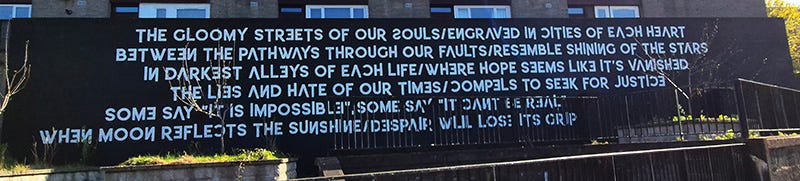
In Aberdeen, I found myself thinking about that idea in reverse, poetry moving out of its more protected contexts and into the public space we all inhabit. One afternoon, while documenting The Writing is on the Wall as he was tattooing the city with his poems, I saw an older woman stop, read one of the lines, take a moment, and then say to the artist, “you really touched my heart with that.” And the sentence sat there, right next to a seagull’s mess on the wall. Symbols of the divine showing up at the trash stratum, indeed.
What I witnessed felt less like emergence and more like a redistribution: when poetry, or even a moment of disruption like Dr.D’s altered road signs, enters the streets, it can do something, however small, for someone.
In that sense, this movement echoes the early gestures of street art itself, when images were taken out of institutional spaces and placed directly in the urban landscape.
It is no coincidence that artists working in this context, those who offer their art to the public without guarantees or expectations of return (“even after all this time, the sun never says to the earth: you owe me”), are the ones who carry that gesture forward.
I rely on the support of readers like you to keep creating genuine and informative content. If you value my work and would like to see more of it, please consider making a donation to support my writing and my editorial project BLocal.
You can Buy me Pizzas, Donate via Paypal, or become a Paid Subscriber.
You can also buy my books, As Seen on the Streets of London & As Seen on the Street of Paris,“like” my newsletters by tapping the ❤️, share them on Substack Notes or other social media, and forward this email to anyone you like.
Comments
Nothing yet. Say the first thing.
Sign in to join the conversation.