
👋 Ciao, I’m Giulia Blocal, your street art insider. This is Beyond the Walls, a monthly deep dive into street art, graffiti, off-the-beaten-path travel, and a bit of my life in between.
This month’s op-ed looks a little further back than usual, revisiting the night in 2014 when Blu erased two of his most famous murals in Berlin as Kreuzberg was undergoing rapid gentrification, a story I came across again this past month while planning the itineraries for our upcoming Berlin street art trip, when I realised I had never written about it here and decided it was time to make up for that.
But first, a few updates on my life and the BLocal project.
Let’s jump in!
Ciao,
how are you?
I’m melting in the city heat. This past month, I’ve been glued to my desk, chasing deadlines across the many editorial projects I’m juggling, while also organising my Berlin schedule around meetings with local artists and finalising the itineraries for our summer street art trip. (😁 can’t wait!)
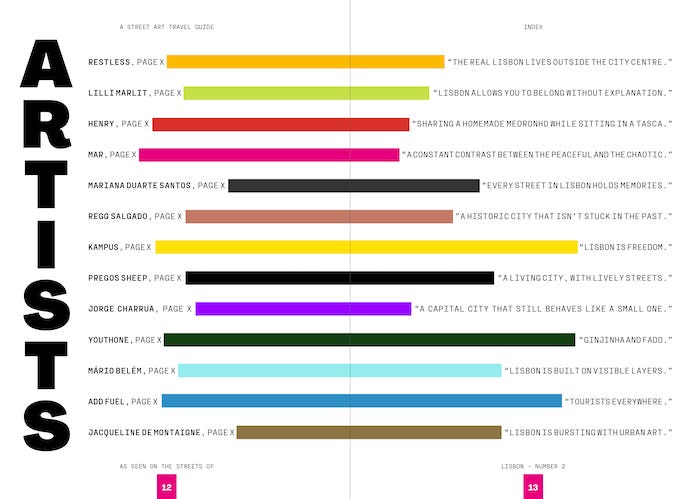
The project I’ve been most focused on is the Lisbon street art book, because this time we took on the only part of the process we had outsourced in the past: graphic design. Paolo is working hard on it, while I chip in every now and then with ideas like this artist index, inspired by a design newsletter I recently discovered called Minor Edits by Melis Ugurlu.
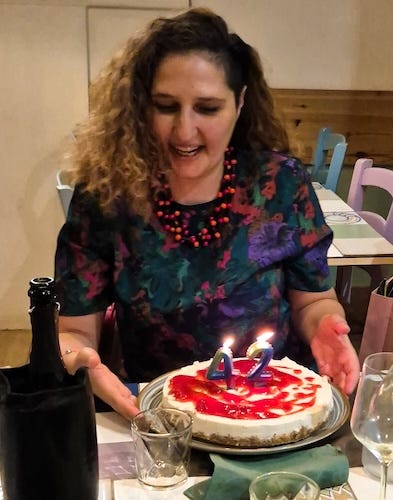
The only time I kept the laptop firmly closed was on my 42nd birthday, which I celebrated with a swim in the lake with Paolo, on what will go down in history as the first, and very likely the last, proper summer day of 2026, followed by dinner with my BFFs at the vegan restaurant in the neighbourhood. It’s simply too hot to go anywhere.
And anyway, I’ve started to appreciate these kinds of low-effort days, or rather, low-performance days, when I don’t need to prove anything to anyone and can simply go about my day with no fuss.
This is definitely one of the consequences of entering my forties. I even remember the first person who told me this would happen: the artist Aida Wilde, with whom I celebrated my 40th birthday during the summer I spent in London researching the London street art book. And wow, is it liberating!
I was thinking about this again the other day when I stumbled upon Sarah May Grunwald’s notes about proudly embracing her “caftan and crystal” era. In my case, it’s more of a “sweats and messy bun” era, with the occasional barefoot day.
Earlier this month, though, I swapped the sweats for something more presentable and headed to Civitanova Marche for the Tabula Rasa Art Market, which gave us another chance to put ourselves out there and talk about our books in person.
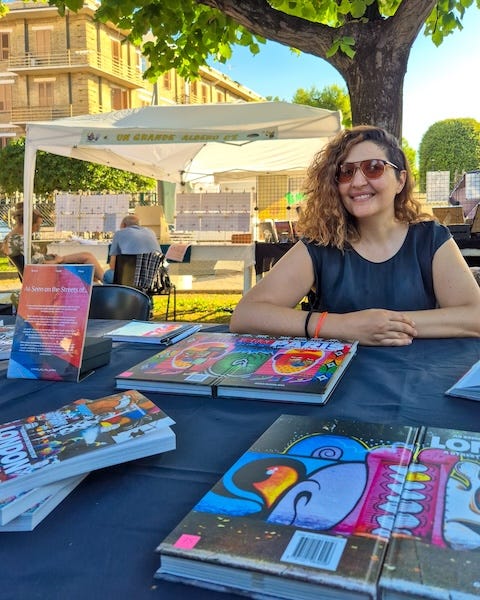
Every art book fair teaches us something about how to present the books more clearly, how people respond to them and what we can learn from their questions and feedback. These events are also a chance to meet people developing their own independent creative projects, and seeing what others are making, while discovering so much under-the-radar talent, is always inspiring.
Back home, I unpacked the boxes, changed into something cosy and started applying to several autumn art book fairs in Italy and abroad. Most have already turned us down, but I’ll try a few more open calls this weekend, so keep your fingers crossed. 🤞
I’ll let you know where the books are heading next. In the meantime, you can find our street art book series, As Seen on the Streets of..., online.
Until next month,
Giulia
P.S. Let’s share once again the reader survey! It’s anonymous, it only takes a few minutes to complete, and will help me improve this newsletter:
✈️ Travel with me!
Last chance to join our Berlin Street Art Trip, this August from 27 to 31!
Expect long walks, plenty of street art, unusual locations and a deeper experience of Berlin beyond its familiar narratives.
By joining this crowdfunding trip, you’ll help make our upcoming Berlin street art book possible and become part of the research behind it. As a heartfelt thank-you, we’ll send you a copy once the book is published! 🥰
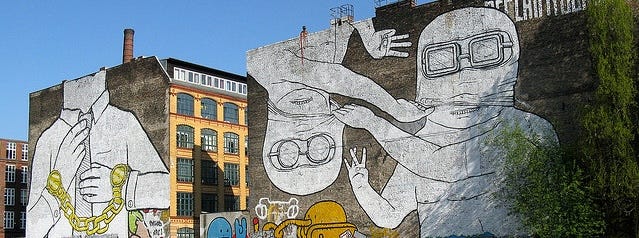
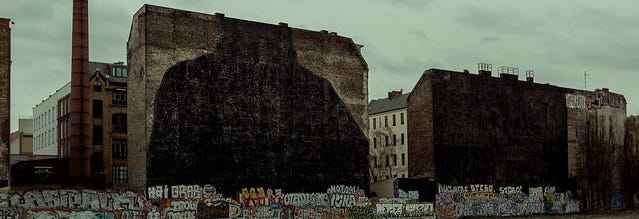
On the night of 11 December 2014, a small group of people began covering two of Berlin’s most recognisable murals with black paint while photos of the operation spread across social media and onlookers tried to figure out why these murals, which had been a part of the city for so long, were suddenly being painted over. At first, many people thought it was the developers who were behind it, since the land the murals were on was scheduled for redevelopment.
But the truth was actually more complex, because the artist, Blu, had had chosen the fate of his murals, turning what initially appeared to be censorship into a deliberate act of self-erasure whose meaning could only be understood through the transformation happening around them.
Blu created the first mural with JR back in 2007, depicting two identical figures from East and West in an image that explored Germany’s reunification and the creative possibilities that had emerged after the division of the city. The next year, he went back and painted the other wall with a man adjusting his tie while two gold watches, linked by a chain, formed a pair of handcuffs around his wrists, creating an image that became increasingly associated with money, power and the constraints of capitalism.
As time passed, the murals grew into landmarks of Kreuzberg and icons of Berlin’s street art scene, showing up in guidebooks and photos taken by tourists until they became part of the same “poor but sexy” image through which the city marketed itself.
Kreuzberg itself embodied that identity, with accessible rents that gave artists room to live and work, while the visibility generated by their creativity gradually recast the neighbourhood as a distinctive cultural destination whose reputation attracted tourism and investment. But the thing is, as property values started to rise, it got harder and harder for the very people who made Kreuzberg so special to actually stay there.
This is one of the central paradoxes of gentrification: the people who make a neighbourhood interesting often help create the appeal that eventually pushes them out, becoming their own worst enemies in the process. The Cuvrystraße murals are a great example of this, since they embodied Kreuzberg’s alternative identity while reinforcing its reputation as a desirable destination, allowing images associated with a critique of capitalism to increase the symbolic value of the neighborhood around them and become a major selling point for the area.
By 2014, this tension had become impossible to ignore, because the vacant plot in front of the murals had been the subject of years of speculative development plans, which put the future of the walls right in the middle of the area's commercial makeover. A campaign soon began calling for the murals to receive heritage protection, and the proposal appeared entirely reasonable to the thousands of people who regarded them as important works connected to Berlin’s recent history, whose preservation might protect a fragment of Kreuzberg’s cultural identity from the redevelopment taking place around it. The murals had become a big part of the area's history, and many people felt that they were worth saving.
The debate therefore came to represent two different visions of Kreuzberg: one rooted in the informal and unpredictable life of the street, and another in which that same identity could be preserved within a planned, privately managed development.
Yet from Blu’s point of view, saving the murals wasn’t entirely a good thing, because the new development could keep them even after the community that had given them meaning was gone, turning them into an attractive feature of the new buildings and watering down their rebellious message while offering future residents a carefully preserved piece of alternative Berlin after the people and informal spaces behind that identity had been replaced.
The walls might still look the same, yet those images would operate inside a new economic and social arrangement, lending cultural credibility to the transformation of the place they had once helped define. This is because a mural (and street art, in general) gets its meaning from the wall, street, and neighborhood it's in, and at the same time, it helps shape how people think about that space. So, when the social and economic life around a mural changes, its significance is bound to change too.
Blu took back control of his murals by covering them up, so they wouldn’t get swallowed up by the redevelopment plans. He was basically destroying his own work, but in a way that made a statement, turning the black paint normally associated with the removal of street art into a way of resisting the transformation of the murals into part of the new development.
City authorities usually use buffing to wipe out street art and decide what gets to stay visible in public space, but Blu flipped the whole thing around, using it to defend his artistic freedom and pull his murals out of Kreuzberg’s redevelopment story. In doing so, he brought street art back to its rebellious roots, showing that its spirit was still alive, even in one of Berlin’s most heavily gentrified areas.
The black paint became a new intervention in its own right, preserving the memory of the murals through their absence and turning their disappearance into a final political statement about the transformation of the neighbourhood around them.
In street art, preserving the physical work can also change what it means once the world around it has been transformed, while erasing it can become a way of protecting its political force before the image is absorbed into a different story. Blu chose to make the murals disappear to defend the connection between his work and the place that had shaped it, leaving the black walls to deliver the final message once the transformation of Kreuzberg had altered the meaning of the original images.
I’ve written about the connection between street art and gentrification before, so I’m leaving the link here in case you missed that post:
🔁 Updated!
👩💻 Stuff I write when I’m not here
UP Magazine - Nuart Aberdeen 2026: Reading Walls in the Age of Images
Art Mag - WOOL Celebrates 15 Years of Contextual Urban Art in Covilhã
Moreover, I was interviewed by Manolis Andriotakis about pixel street art and by pollywantsacracker about…life, I guess? 😆
I rely on the support of readers like you to keep creating genuine and informative content. If you value my work and would like to see more of it, please consider making a donation to support my writing and my editorial project BLocal.
You can Buy me Pizzas, Donate via Paypal, or become a Paid Subscriber.
You can also buy my books, As Seen on the Streets of London & As Seen on the Street of Paris,“like” my newsletters by tapping the ❤️, share them on Substack Notes or other social media, and forward this email to anyone you like.
Comments
Nothing yet. Say the first thing.
Sign in to join the conversation.