
Ravi: So far, we have discussed how to measure time, but I would like to know what exactly is time. It seems so hard to define time.
Professor: True. The subject matter of time is so rich that it is difficult to capture it in one definition. However, time does not move because of clocks; rather, clocks move because of time. Can we define time as the fundamental driver of any change?
Ravi: Interesting. Sun and planets move because of time. Electrons excite because of time. Light moves because of time. All things change because of time.
Subal: I can appreciate that time is not driven. But instead of calling time as a driver, why don’t we call it as a passive dimension to index changes?
Professor: Good point. Would anybody like to give his/her input?
Karan: I think time is not the cause of change. We can control change. I can decide how to drive my car — whether to turn left or right. So time could be just a passive index which registers my action.
Professor: I would like to bring to the table the arrow of time. Would anyone like to pick up on that?
Karan: The arrow of time means that time flows in one direction, i.e., irreversibility of time. For instance, a glass of hot milk kept at room temperature cools down with time; it never gets heated up. In other words, this process is irreversible. It is quantitatively expressed in terms of entropy, which only increases with time. The entropy of hot milk + room is less than the entropy of cooled milk + heat dispersed in the room. With time, entropy increases.
Professor: Or the changes induced by time are irreversible.
Subal: But reversible phenomena also do exist. For instance, water converting into ice is reversible, and electrons getting excited in an atom are reversible. It appears that, at a fundamental level, time is reversible.
Ravi: Certainly, reversible phenomena do exist. But the question is, why should irreversibility exist at all? When we study atoms or water molecules, we consider them isolated from the macroscopic world — and perhaps isolate them too much.
Professor: I agree that this topic is debatable. At a macroscopic level, changes are irreversible, but at a microscopic level, they could be reversible. The second law of thermodynamics is also debated. Nevertheless, irreversibility seems to be unavoidable in many observations. Hence, it is useful to model time as an inevitable factor driving the change.
Neeti: I can relate it with state space models, which are useful for analyzing dynamical systems, such as robots and cars. The system evolves because of two explicit factors - its intrinsic response and the external inputs. Even if the external input is absent, the system evolves as per its intrinsic nature. This evolution cannot be checked.
Subal: I agree. Even in non-linear dynamical systems, we characterize a system with zero input response or the system’s intrinsic response to time.
Karan: It makes sense. While driving a car, the driver is one factor, but we cannot ignore the intrinsic response of a car to time. In that way, time is an active factor whose effects cannot be ignored.
Neeti: So there are many causes for a change, and time is one of them.
Karan: Rather the foremost of them [BG 11.32]. Even the driver is affected by time.
Professor: The effect of time on humans and human civilization is inevitable. Great empires have been created and destroyed by time. I appreciate the kind of effort put in by museums to preserve items for longer times. While external factors, such as temperature, humidity, and wear and tear, can be controlled to some extent, certain items, such as papers, naturally deteriorate faster than others, such as stones.
Neeti: Even our bodies change with time, often against our liking. No doubt the cosmetic industry is ever flourishing. (Laughter)
Ravi: So, time can be seen as a destructive factor. Death is a natural consequence of time. And death is the most fearful thing for all living beings.
Professor: As we have discussed earlier, everything we experience follows its evolution in time; however, we get attached and, hence, become morose or fearful [SB 11.2.37]. But yes, ageing and death are inevitable.
Karan: Why do people say time is good or time is bad? Should time not be neutral?
Professor: Time is neutral to all, but it is my attachment that I call time good or bad. For instance, a bud blossoms into a beautiful, fragrant flower, and after a day or so, it withers away. But in the meanwhile, I get attached to the flower and later become morose to see it go. But time will act to change the state of the flower.
Karan: If we know time is separate from us, why do we become attached and morose?
Professor: Time drives things, and an experiencer has his/her preferences. Time makes my body change from babyhood to youth to old age, and everybody goes through it. But I may prefer one state over the other. I may prefer a young body to an old body. This could be my preference — I see one state as more desirable than the other. I may have my preferences in all kinds of experiences. I don’t wish to grow old or fall sick or die. But we have no control over them — these come with time.
Subal: Indeed, time is neutral. It just moves on, whether someone becomes happy or sad.

Neeti: There is a saying — time runs slower if you run faster.
Professor: Good perspective. So, we can also see time as a resource. I know I am young today, and time will make me grow old. As the decay of my ability is inevitable, I can see my ability as a limited-time asset and use it wisely.
Karan: For a student, certainly time is the prime resource. We have to complete our PhD in a fixed duration of time. If we don’t use it judiciously, we may screw up our Ph.D.
Neeti: During exams, if we are not quick and wise, we may lose marks.
Ravi: Not just studies, we have to balance everything — our health, our sleep, and our recreation activities. And we have got just 24 hours in a day.
Karan: Someone may use daytime for sleeping and nighttime for watching movies. (Laughter)
Professor: Time is a resource you have — how we use it is our choice, and consequences will follow. As you sow, so shall you reap.
Neeti: Time management is a common problem that people struggle with. Philosophers say that one cannot buy a fraction of time even with enormous wealth.
Ravi: Poets say that every rising and setting of the sun reminds us of flowing time and approaching end [SB 2.3.17]. So make the hay while the sun shines.
Neeti: There is a story of grasshopper and ants. In the summer days, the grasshopper enjoyed the good weather roaming around, but the ants worked hard to collect food in their anthills. Time turned summers into winters soon after, and the ants rested in their anthills. But the poor grasshopper was cold and hungry. It learned its lesson that time is a resource - use it, or you shall repent later.
Professor: Is time all about degradation and change? Does it have any utility also in scientific studies?
Everyone looked confused.
Professor: Let me ask what is reality? The wheels of the bus are turning. They were oriented at one angle and after a moment, the orientation has changed. It was winters sometime ago. The trees had shed their leaves. And now it is summers and trees are gaining their leaves. What is reality?
Karan: Is not reality an illusion? Even science, which is supposed to describe reality, is changing. Old laws get replaced with new ones, and the research still goes on.
Subal: I disagree. If there were no real laws of nature, do you think any scientist would invest time and effort to do research?
Professor: Agreed. Those who are after knowledge would definitely say let me find out what is reality. My current understanding of reality could be limited, but there is certainly some fundamental reality that we seek to discover as scientific laws.
Subal: If there were no reality, science research would be like trying to find patterns in strings generated by a random number generator.
Ravi: All over the world, governments are spending billions of pounds to set up and run lab facilities. For example, the large hadron collider at CERN and, similarly, many accelerators around the globe, cost a fortune. If there were no reality, it would all be futile.
Karan: I mean, the reality could be relative. For example, we may see a star in the sky, hundreds of light years far. But that star may no longer exist because what we see from Earth today is hundreds of years old.
Subal: What is different here is our perception of reality. Our perceptions are limited, but reality is reality.
Professor: Good. There are two popular notions in philosophy [Deng 2018]. Theory A says that everything in space-time in a reality. Every point in space-time is a reality - whether past, present, or future. But theory B says that only present is reality. The past is over, so does not exist anymore. And the future is yet to come, so does not exist.
Neeti: I agree more with Theory B. We cannot observe past or future, and we cannot modify them. We can only observe and modify our present. So it is safe to say that the present only exists. For example, what I spoke about two years ago was a reality at that moment when I spoke. But today, I cannot change it, nor can I observe it. Similarly, I cannot change what I will say after two years. I can only change what I speak now.
Subal: Maybe I will go with Theory A. Because the past was present some time ago, and I did or could observe it and modify it. Likewise, the future is an outcome of how I modify my present or modified my past. So everything — past, present, and future — is a reality.
Neeti: The future and past are connected if there is some memory. But if there were no memory, we cannot retrieve the past by any means, and no effect of it can be seen on the future. (Pointing to a tree outside the bus window) For example, if no one recorded the height of that tree in the meadow at this time of the last year, we cannot know it now. It is gone. I would say it is not real because it is not accessible. The present is real because the past is real.
Professor: I can see the debate is getting heated up. Let me add another perspective here. It is that what does not change with time is real [BG 2.16]. The basic premise in Physics is that the laws should be invariant to space and time. Only that which does not change with space and time is real. Everything else is a combination, a temporary combination, of that.
For example, we see this seat. Is it real? A material designer will say this is made of polyester. Polyester is real and you can give it any shape - be it a bus seat, a car seat, or a dress. All those things are malleable at the designer’s discretion and, hence, change with time. What is not changing with time is polyester. So, a material designer studies polyester and its properties, so s/he may use it for making different things. Hence, polyester serves as the building block for a material designer. It is more fundamental than the bus seat as it is less susceptible, or more invariant, to change with time.
However, a chemical engineer will see polyester as a polymer that is a combination of atoms such as carbon, hydrogen, and oxygen. S/he goes to college to study the chemistry of these atoms — how they combine and give rise to materials with different properties. So a chemical engineer sees at a deeper level where even polyester is malleable and changes with time. Hence, atoms serve as the building blocks for a chemical engineer. They are more fundamental than polyester as they are less susceptible, or more invariant, to change with time.
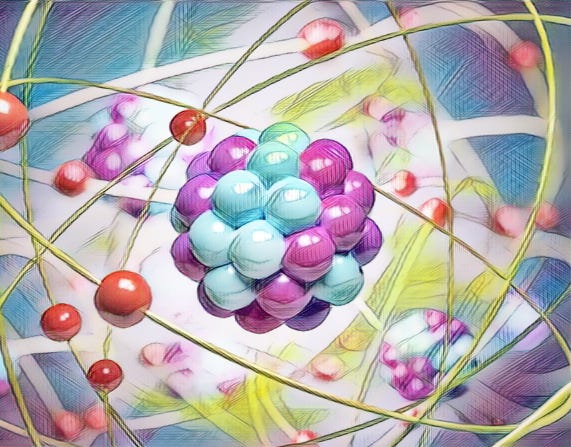
Likewise, a Physicist sees even atoms as a combination of protons, neutrons, and electrons. Nuclear reactions can change the identities and properties of atoms. So, even atoms are susceptible to change with time and, hence, not as fundamental as protons and electrons.
Further, Physicists such as the particle Physicists continue their research in finding entities and their relationships (properties) that are even more fundamental or invariant to space and time.
In the hierarchy of fundamentals, we can place
Bus-seat
Polyester
Atoms
Protons/neutrons/electrons
…
The highest level in this hierarchy is the surface form we experience with our senses. It is most gullible to space and time. The deeper we go in the hierarchy, the more invariant the entities there are to changes with space and time, and hence more fundamental. Hence, Einstein’s laws are more fundamental than Newton’s laws.
So, reality is that which is invariant to time (and space). Hence, time reveals the fundamental reality. And that is what the scientists search for.
Neeti: Are things other than the most fundamental not real? Are they an illusion?
Professor: The surface form we observe is not unreal but a transient combination of a more fundamental reality. Hence, they are also real but temporary or less fundamental.
Subal: I think the surface form has a great utility; that is, it can be used to understand the progressively fundamental levels. And time helps reveal the nature of the fundamental.
Karan: Is time also fundamental?
Professor: Very good question. If it were not, how could it interact with fundamental entities? And in that case, the fundamental entities won’t even be able to interact with each other because interaction is not possible without time.
Subal: Fascinating. At the fundamental level, time does not change the properties of the fundamental entities but does provide a ground for them to interact with each other [BS 5.56]. Does that imply that the interactions are reversible at the fundamental level?
Professor: That seems correct.
(He leaned back in his seat and started pondering on this.)
Neeti: I think we are discussing time only in relation to the observations we make but not in relation to the observers that we are.
Professor: Haha. These concepts apply equally well to the observer, too. Are we, the observers, invariant to time or not?
Neeti: My observations and perceptions change with time. Today, I consider someone as my friend; tomorrow, I may consider that person to be my enemy.
Professor: This means this perception is not invariant to time, and hence, not fundamental. Then why should I take it very seriously? Even if my perceptions have changed, I have not changed. A few decades ago, I was a high school student, and my perceptions and desires were very different; sports, marks, art, and what classmates said about me, were the things I cared about the most. After some years, I joined college, and my perceptions and desires changed; grades, student clubs, and science books occupied my thoughts. Afterward, since I became a professor, my thoughts have been about the latest research, teaching experiences, and societal issues. I hardly cared about these when I was a student.
Neeti: How about your thoughts on leniency?
(Everyone laughs)
Professor: Certainly, now I am more inclined towards strict discipline. Earlier, I wondered why the professors could not be a little lenient, at least while grading the exams. (Laughter)
Subal: It is interesting to see that I, the observer, remain the same, even if my perceptions and desires appear to change with time.
Professor: I and my properties, which do not change with time, could be fundamental. For example, an individual’s desire to be happy endures time.
Subal: What gives me happiness is always changing. A baby may find it in toys, a young boy in games, and a grown-up man in wealth.
Professor: That is why they are not fundamental. But the tendency to be happy is. Nevertheless, since there exists a fundamental tendency to be happy, there must be a fundamental object of happiness, too.
Neeti: That is interesting. What is that?
Professor: We find happiness in relationships. Gita recognizes that fundamental happiness is experienced in the relationship with another fundamental entity [BG 10.9]. The most fundamental entity is called Krishna [BG 15.18], with whom every living being has a fundamental relationship [BG 5.29]. This relationship gives one fundamental happiness, which is not affected by space and time [SB 1.2.6].
Neeti: Would that relationship exist if I was a worm?
(Laughter)
Ravi: Definitely, since it is fundamental.
Neeti: Does it not mean that we should invest our time in this relationship?
Professor: Definitely. Life is short. Gita recommends investing our time in fundamental relationships. And the surface forms, or our resources, should be used to nourish this fundamental relationship [BG 2.69].
Subal: I would like to know more about fundamental happiness.
Professor: (smiling) Sure, but some other time.
The bus was plying into the Oxford town. As it descended the Headington Hill, the dreaming spires of the colleges filled up the front view. The students were relishing recollecting and grasping what they had discussed about time. And no one even noticed how the time had passed.
[BG x.y] Bhaktivedanta, A. C. (1972). Bhagavad-Gita as it is. Bhaktivedanta Book Trust. Chapter-x, text-y.
https://vedabase.io/en/library/bg/x/y/
[SB x.y.z] Bhaktivedanta, A. C. (1974). Śrīmad Bhagavatam: with the original Sanskrit text, its Roman transliteration, synonyms, translations, and elaborate purports. Bhaktivedanta Book Trust. Canto-x, chapter-y, text-z.
https://vedabase.io/en/library/sb/x/y/z/
[BS x.y] Saraswati, Bhaktisiddhanta (1985). Sri Brahma Samhita. Bhaktivedanta Book Trust. Chapter-x, text-y.
https://vedabase.io/en/library/bs/x/y/
[Deng 2018] Deng, N.(2018). Metaphysics of Time. In The Routledge Encyclopedia of Philosophy. Taylor and Francis.
https://www.rep.routledge.com/articles/thematic/time-metaphysics-of/v-3
No posts
Comments
Nothing yet. Say the first thing.
Sign in to join the conversation.