
Text within this block will maintain its original spacing when published
All models are wrong, some, though, are useful
Knowing that beforehand could be really fruitful
-- George Box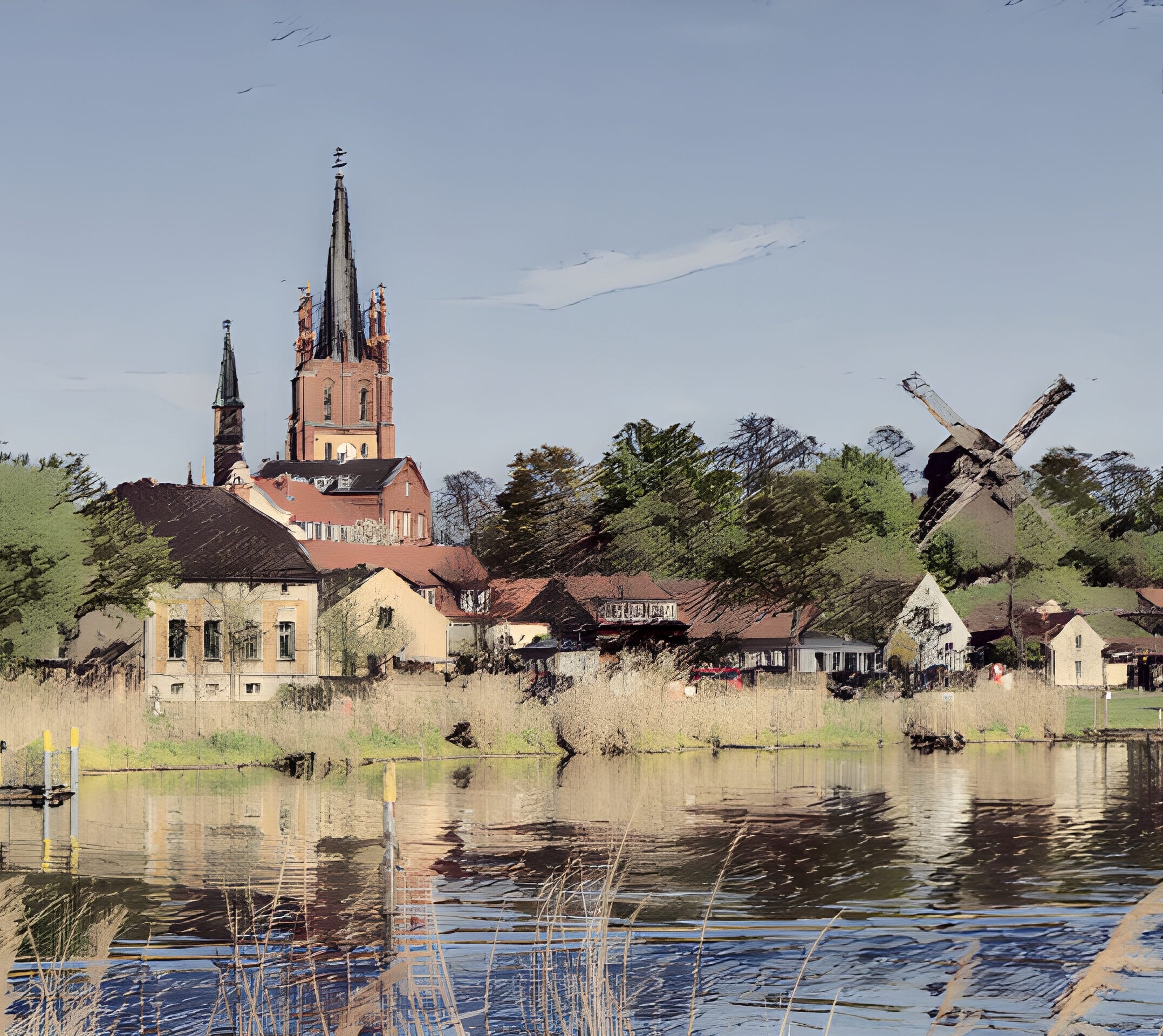
This article describes a walk around a historic island near Berlin, Germany, taken up by Professor Gopinath and some graduate students. During the walk, they discuss the conceptual models people build to understand the world around them. The discussion highlights the need to understand the uncertainties associated with every model. Shattering the common belief that science builds perfect models, this discussion underscores that understanding uncertainties indicates a better scientific temperament.
Subal is a senior graduate student in Physics.
Sia is a graduate student in computer science.
Karan is a fresh graduate student in engineering.
Professor Gopinath, a professor in computer science, has his research spanning Physics and AI. He has also been teaching the theology of the Gita at the university.

It is noon in Germany. Prof. Gopinath and a group of graduate students have come to spend the day at Werder old town, a beautiful island in the Havel lake near Berlin. They took a train from Berlin Central Station to the Werder station and then a bus to the old town. As they got off the bus, a scenic bridge over the Havel River welcomed them. The bridge connected to the island on the other side. There were yachts on both sides of the bridge, with a picturesque view of the island in the front. The old cathedral, a windmill, and many old buildings peeping out from green trees presented a bewitching scene. As they walked over the bridge, Karan, the youngest of them, spoke up.
Karan: These buildings look like magical houses from Harry Potter.
Sia: Magic catches everyone’s attention. No doubt, movies with magic pull larger crowds.
Karan: I saw a magic show last week — a bottle that magically turns upside down in a cloth pouch and a small magic box from which many cubes come out, filling up an entire table.
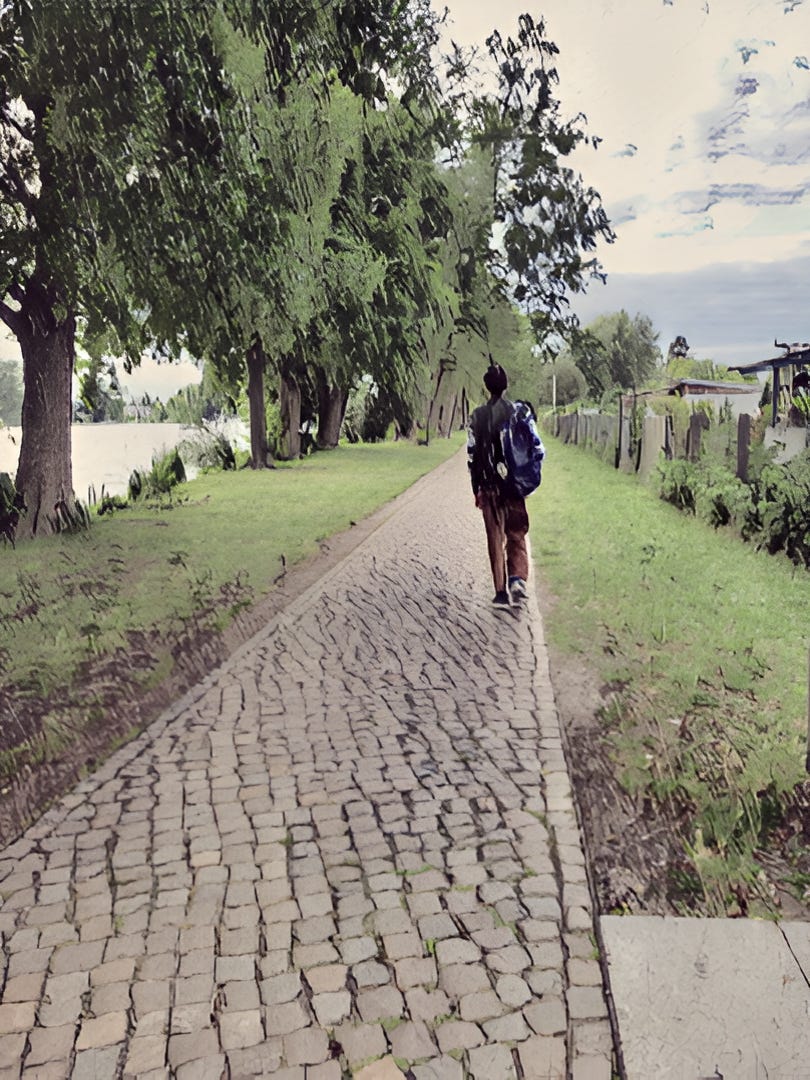
They turned left and started walking northward along the west shore. Many ducks made a quacking sound.
Professor: We have models of the world in our minds, which the magicians challenge. Many assumptions that come packaged with those mental models are silently broken by magicians to amaze us.
Karan: (amazed) Could you please elaborate? What are the models?
Professor: Models simplify our understanding by introducing some assumptions. In this case, we assume a bottle is a solid object with a fixed neck and a belly — so this is our model of a bottle. But the magician uses a bottle-like thing with two necks and a movable belly, which hides one of the necks at a time. So the bottle appears to turn upside down in the pouch. Likewise, we inadvertently assume conservation of volume, i.e., larger objects occupy larger space — this is our model of solid objects. But these cubes are only paper shells, empty inside, and can be folded to sit inside the walls of a small box.
Karan: I know these are some tricks, but relating them to models of understanding is new for me.
Subal: As soon as I say the word pencil, anyone will think of a straight, cylindrical object. That is a common model we make even as a child. But we are amazed to see it bend when placed slanted and half-dipped in water. A child certainly thinks it is broken.
Karan: Hmm. Why do we make models then? Isn’t it nice not to make models at all? Then we won’t be misled into those assumptions.
Professor: The mind makes models to simplify its work, and scientists make models to simplify theirs. (Laughter) A model of a straight pencil is made by the mind without much conscious effort, but scientists make models with a great amount of deliberation. While all models are wrong, some are useful… really useful. They simplify things a lot. For instance, simple-looking Newton's equations of motion can be used to model moving objects from a bicycle to a rocket. They allow us to predict their motion and control it when needed. In the case of a bicycle, the size of the tire, the distance of the pedals from the axle, and the design of the brake are all modeled and optimized using Newton's equations. You might remember the textbook questions asking you to find the minimum amount of fuel a rocket needs to escape away from Earth. It is so easy to solve if we use those models.
Karan: Ah, I remember; those calculations were easy. But aren’t these equations of Physics truths of life?
Subal: (shaking his head) These are just models of life, or rather, the models of physical objects in life. We know Newton's equations of motion are very limited and do not describe things properly when situations change. For example, for objects moving at very large speeds, one needs to use the special theory of relativity. Similarly, those classical models of light are unable to explain why light bends with gravity.
Sia: Essentially, these models or equations are used for either predicting the positions of objects or for controlling them, by applying appropriate force, for example. However, if prediction and control are the goals, these can be very well achieved by AI. AI models can learn to predict the motion of different objects on the street and can drive cars.
Subal: You are right. These days, AI models are being used along with Physics models to make complicated systems, from cars to satellites. Essentially, just as physicists have been constructing models by observing the data manually, AI has been constructing them with the help of learning algorithms. The amount of data that AI algorithms can observe and the complexity of models they can construct are humongous as compared to what humans can do. Hence, we see the fascinating self-driving cars, talking devices, and so on.
Karan: If all models are wrong, how can we trust an AI-driven car?
Professor: You raised an important point. While building the models is useful, more important is to understand the uncertainties associated with the models. Common people are aware of the fantastic models of the physical world that modern science has come up with, but they are less aware of the ways science deals with uncertainties. Uncertainties are studied rigorously in mathematics. They are broadly classified into three types, namely, learning limitations (epistemic), ambiguous observations (aleatoric), and unexpected rare circumstances (distribution shifts). I think education about uncertainties is very essential.
Subal: I think uncertainties matter not only for science but for any decision-making. For example, my father talks about uncertainties in the stock market.
Sia: I wonder if these concepts can apply to personal life, too. What about uncertainties in relationships, careers, and life decisions?
Professor: Certainly, these concepts are very powerful and have very broad applicability. We as individuals also learn. While learning, we construct and update our intellectual models.
Sia: You mean NI (natural intelligence) as opposed to AI (artificial intelligence)? (Laughter)
Karan: I agree it is important for us to understand these uncertainties so we can make our decisions with the right amount of confidence.
Subal: And for my father to understand when to invest and when not to. (Laughter)
Professor: It matters even more for those who make decisions for others, e.g., policymakers, and for those who mentor others, for example, parents and teachers. One's overconfidence could be a disaster for others.
As they reached the northern end of the island and turned towards south-east, they found a wooden gate. Not sure if they were trespassing on someone’s private land, they decided to enter. Soon they found themselves walking on a grass path with only private garden allotments and no houses on both sides. It seemed like a fairyland full of beautiful flowers, plantations, water fountains, and many artefacts in all directions. The sharp contrasting colors of the objects around were further accentuated by the dim sun behind the clouds.
Subal: I am really curious about the three kinds of uncertainties you mentioned. Could you please elaborate on them?
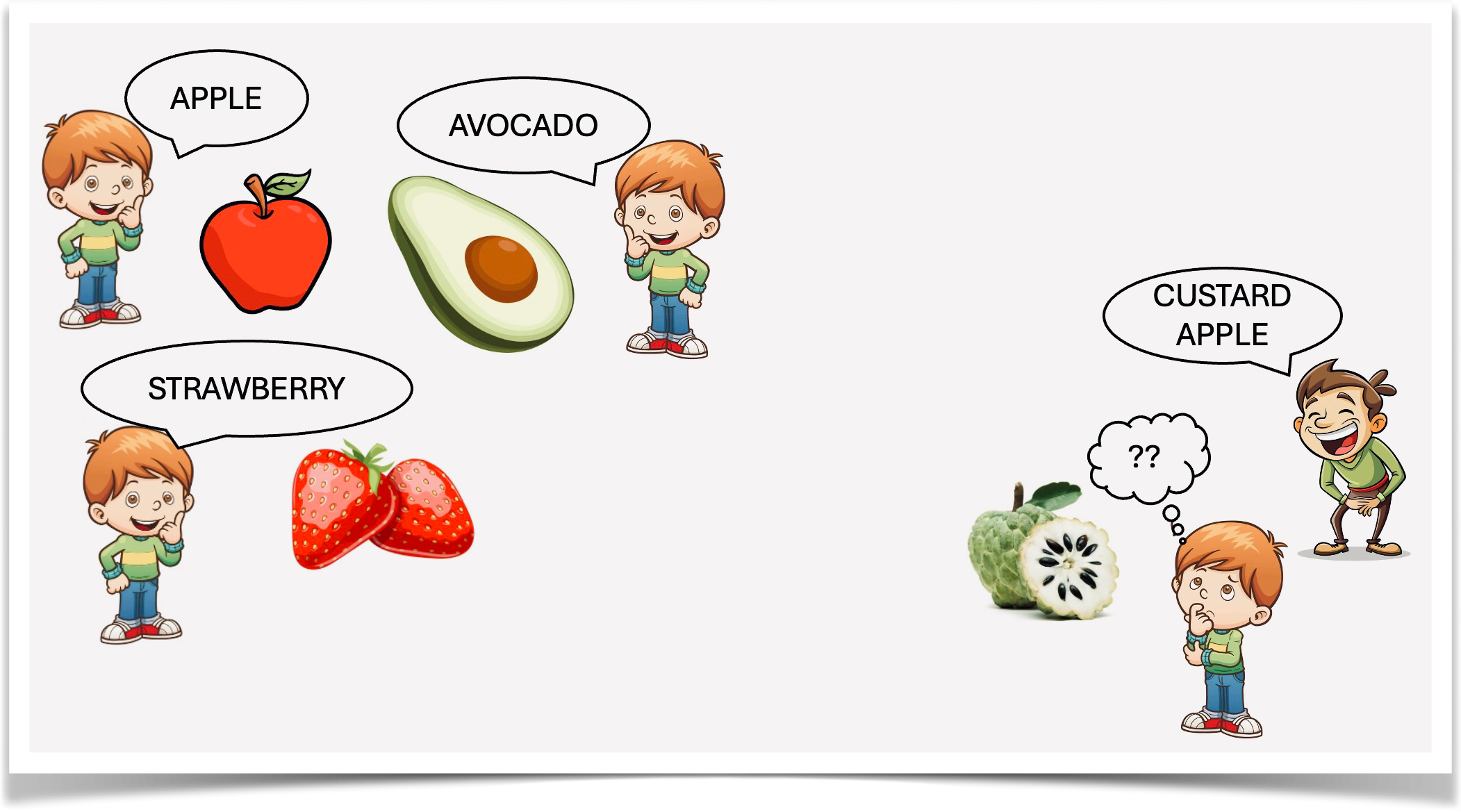
Professor: The epistemic uncertainty is due to the learning limitations of a model. A model could be uncertain due to concepts it has not learned. For example, an AI-driven car may have learnt to recognize other cars but may get confused when it sees an RV (recreational vehicle) or a bulldozer.
Sia: A German boy may easily recognize apples, strawberries, and avocados, but may not know what a custard apple is.
Professor: Hmm … (nods with approval)
Subal: You are making me feel hungry now. (Laughter)
Karan: I am confident in Algebra if I have studied it properly, but not in Geometry, simply because I did not study it well. Is this a good example?
Professor: Yes. You can attempt the Algebra questions first and secure those marks confidently. (Laughter)
Subal: It seems this kind of uncertainty can be reduced by learning.
Professor: Yes, training reduces epistemic uncertainty and makes us confident. Learning is essential, and we must seek to learn from the best.
Text within this block will maintain its original spacing when published
Approach the best in a field,
and from them you learn,
with humility and servitude,
for their company you yearn.
[BG 4.34]
Karan: And learning one field may not make you an expert in another field.
Professor: Yes, we certainly have a very large but limited learning capacity. So we should learn what is essential for us.
Sia: Only one PhD at a time, Karan … (Laughter)
Karan: Given an individual’s limited learning capacity, this uncertainty seems irreducible.
Professor: (smiling) That is why we collaborate. Many scientists, who are experts in different disciplines, come together to take up challenging projects and complement each other’s knowledge and skills.
Subal: What about the depth of learning? Animals observe with their senses, and so do humans. But animals do not have the curiosity to go beyond the surface form, to model things with concepts, and to find relations between concepts, as humans do. Physicists have the curiosity to inquire into the most fundamental building blocks of physical nature, such as quarks and leptons. I understand these are just models, but very powerful ones.
Professor: The deeper you go, the more fundamental the models are. More fundamental models can explain more things than a shallower model. For example, the theory of relativity is more fundamental than Newton’s laws, and hence, can explain things that Newton’s laws can’t.
Vedanta encourages humans to have the curiosity to inquire into the deepest level of existence. It calls this limit as brahman — the most fundamental building block of everything1.
Subal: Could truth be subjective? I mean the deepest level of reality, as brahman, seems different from that of the standard model of Physics, comprising quarks, etc.
Professor: Not subjective, but truth can be seen from different perspectives. Utility is the principle. For example, modeling a moving ball with quantum field theory is very tedious, and it has hardly any utility when the ball’s motion can be predicted and controlled with simple Newton's equations. Of course, quantum field theory2 is more fundamental and can explain the motion of a ball, but while controlling balls, one may not need that depth of understanding. Another thing is about interest. A mechanical engineer working with Newton’s equations may have no interest in knowing quantum field theory.
Likewise, Vedanta provides a more fundamental ground for understanding both matter and spirit, or my own fundamental nature3. But even as a spiritualist, while doing particle Physics, I would prefer using equations of quantum field theory over a more fundamental understanding from Vedanta. On the other hand, one may be fascinated only by matter and not by spirit, and hence, may not be interested in Vedanta.
Subal: Are the differences in models appreciated in spiritual life? I have a naive feeling that while Physics is open to discussion and uncertainties, spiritualists tend to be rigid about their views. Neither do they accept uncertainties nor differences in models.
Professor: In [SB 11.22], Krsna explains to Uddhava that there are multiple perspectives to see the same thing, all of which may have value in their own applications and may be coherent. An intelligent person appreciates them and does not get bewildered. A simple example could be the clustering of a country - it could be done on the basis of political states, languages, geographical terrain, or weather conditions. The purpose served by one model may not be served by others. The Federal Government will disburse funds to the political states, but an AI company making speech-operated devices cares more for linguistic clusters. Similarly, different understandings of the self and different understandings of the supersoul operate for different functions. One may choose to focus on an understanding depending on what one is interested in.
Subal: Just as different Physics is important at different scales of spacetime and energy.
Karan: So it is not my way or the highway.
Professor: Well, if you understand epistemic uncertainty, then no.
Sia: But some models could be completely wrong, too. There are so many charlatans who give stupid mystical theories.
Karan: Well, we already said that only some models are useful. (Laughter)
Subal: So, does the inability of Newton's equations to describe the relativistic effects fall into this type of uncertainty?
Professor: Newton's equations do not quantify their uncertainty, but yes, it is a case of epistemic uncertainty. These equations are simply not made to model relativistic effects.
Sia: How nice it would be if these equations could also quantify their uncertainty.
Professor: Well, that is where "our" role is. Otherwise, one will confidently make mistakes with these models.
Karan: Overconfidently rather … (Laughter)

… to be continued. In the next part, we will see other kinds of uncertainties.
Photo credits: online and AI tools such as goart.fotor.com
[BG x.y] Bhaktivedanta, A. C. (1972). Bhagavad-Gita as it is. Bhaktivedanta Book Trust. Chapter-x, text-y. https://vedabase.io/en/library/bg/x/y/
[SB x.y.z] Bhaktivedanta, A. C. (1974). Śrīmad Bhagavatam: with the original Sanskrit text, its Roman transliteration, synonyms, translations, and elaborate purports. Bhaktivedanta Book Trust. Canto-x, chapter-y, text-z. https://vedabase.io/en/library/sb/x/y/z/
athāto brahma jijñāsā (BS1), janmādyasya yatah (SB 1.1.1)
Quantum field theory deals with the fundamental particles and fields that constitute matter.
The indestructible, transcendental living entity is called Brahman, and her eternal nature is called adhyātma. [BG 8.3]
No posts
Comments
Nothing yet. Say the first thing.
Sign in to join the conversation.