
Over the Edge
In 1946, Devil’s Slide was a graveyard of twisted metal, dense fog, and secrets. And Franklin Hogmire was trying to make a living out of it.
Franklin moved along the steep incline of the slide, stepping carefully even as his feet slid in the loose shale and sliding dirt. He made his way around the sagebrush while hundreds of feet below the Pacific Ocean crashed against the shore.
Like many veterans, Franklin had returned from World War II determined to make a living for himself in the post-war era. And for Franklin, that meant salvaging materials as a junk collector.
The work was difficult: hunting down abandoned cars, appliances, and other discarded materials and taking anything of value he could from them. The work could be lucrative, certainly enough to provide a living for Franklin and his wife Lorene, but it could also be dangerous depending on the location.
There were few more dangerous places than Devil’s Slide. In the 1930s, Highway 1 had opened up along California’s coast including a stretch along the steep cliffs known as Devil’s Slide. That section of highway had been plagued with accidents from the start with little protection to keep drivers from plummeting hundreds of feet down the cliffs.
It also provided ample opportunity for junk collecting. Treasures could be found down the cliffs if you were daring enough to look. And Franklin was. Using a rope tied to the bumper of his car, he’d lower himself over the edge and look for items he could bring back.
But that April, he found something he never expected: a body.

The Discovery
The woman Franklin found that day was 23-year-old Dorothy Rose Woods (who also went by the last names of Burleson and Jones). Dorothy had been living in a hotel on San Francisco’s Howard Street when she suddenly disappeared the October before.
Both her landlady and her friend, Vanie, had seen her with a man the night she disappeared. If either looked for her, they did so privately. Which is why there was no missing person’s report on record for Dorothy when a man named Thomas McMonigle confessed to kidnapping and killing a Black woman from San Francisco.
McMonigle didn’t know her name, but when he confessed in early 1946, he said it had happened in October.
During late 1945 into 1946, McMonigle’s name and picture seemed to be in every California newspaper on a daily basis. McMonigle stood accused of kidnapping and killing a 14 year old girl named Thora Chamberlain (we talk about Thora’s case on this week’s episode of She Goes by Jane).
McMonigle would confess to Thora’s kidnapping multiple times, each time changing the story of how she died and where he left her body. One of those confessions led investigators to Devil’s Slide where McMonigle had claimed to have thrown Thora’s body over the edge. They never found Thora, but they did locate her bobbysocks down the cliffs. Thora’s mother identified them as her daughter’s by the darning she’d done to repair them.
Investigators spent months with McMonigle, driving him hundreds of miles across several counties in their search for Thora’s body. With each new story and each failure, they began to believe McMonigle was telling tall tales.
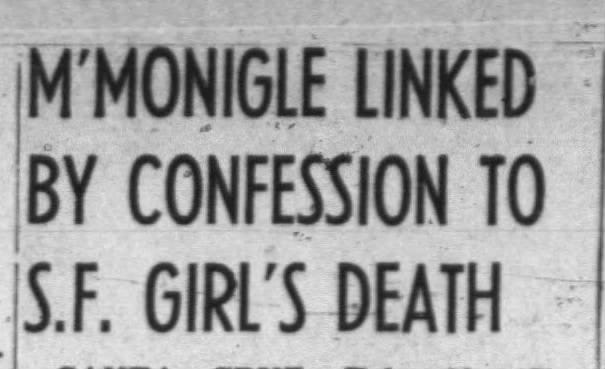
So when he said he’d killed a Black woman in October and thrown her body over Devil’s Slide in the same place he’d left Thora, they didn’t believe him, particularly when there hadn’t been a matching missing person’s report.
But that February, as word of his confession reached the papers, Dorothy’s landlady, her mother, and her friend came forward to make an official missing persons report.
The discovery of Dorothy’s body a few months later provided them the confirmation they needed: Thomas McMonigle had likely killed Dorothy Rose Woods.
But the discovery also led them back to something else: maybe McMonigle hadn’t been all talk. Maybe he’d actually left Thora down Devil’s Slide.
They were determined to launch another search, and they knew just the person to do it: Franklin Hogmire.
The Search for Thora
Over the course of the next few mornings, at the behest of San Mateo County’s Sheriff John McGrath, Franklin Hogmire lowered himself down Devil’s Slide over and over hoping to find Thora. By this point, McMonigle had been convicted of her murder, but it had been a rare murder conviction without a body case. The prosecution was nervous it could be overturned unless Thora was located.
But every afternoon, Franklin would haul himself back up to Highway 1 without having succeeded in locating the teenager.
After days of searching, Franklin Hogmire gave up the hunt. But the unsuccessful attempts and the story of Thora Chamberlain must have haunted him, because on April 24th, he decided to try once again.
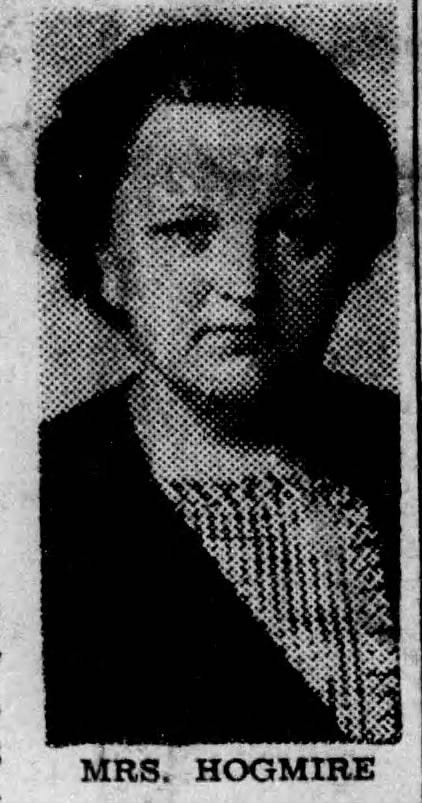
This time he went without notifying Sheriff McGrath of his attempt. With Franklin that day was his wife Lorene. The two had only been married for a year and a half, but Lorene had accompanied Franklin from Texas to California where they’d been living in a hotel in San Francisco. This was their primary form of income since her job as a waitress wasn’t enough to keep them afloat.
At around 7:30am, Franklin attached his rope to the bumper of his car and lowered himself down once again.
Lorene was supposed to stay with the car, whiling away the hours while her husband searched. Lorene hadn’t wanted to be there that day. In fact, she’d begged Franklin to give up the search entirely. She was worried about the danger he’d been placing himself in during the searches, but he hadn’t listened to her.
That day, Lorene had been reluctant to go with him. For safety reasons it would be best to have someone there, but Lorene was recovering from an illness and likely didn’t look forward to spending an entire day waiting by the car.
At around lunchtime, Franklin pulled himself back up to the top. He’d expected to eat with his wife, but Lorene wasn’t there.
Suspecting that she had gone for a walk, Franklin finished his lunch and then went back down. But when Franklin returned later, Lorene wasn’t there.
”When I came back up again at 4:30 and found her still gone, I knew something was wrong,” Franklin said.
Worried, Franklin checked the car. Inside the vehicle was her handbag. And he didn’t see any footprints in the soft gravel by the car either. Where could Lorene have gone?
Lorene, seemingly, had vanished into thin air.
That evening, Franklin reported his wife missing and while investigators searched, Franklin and his landlady did the same, driving everywhere they could think of hoping to catch sight of Lorene.
Both of them worried about Lorene. She’d had a child by a previous marriage and didn’t have custody of her. The nine-year-old girl lived in Texas and Lorene had talked about wanting to see her. There was a possibility that Lorene could have been trying to get back to Texas, but Franklin knew she didn’t have the funds for a bus ticket. Plus, he pointed out, she’d left her purse behind.
And there was one more clue, members of the highway department had seen the car at 8am that morning. It was just half an hour after Franklin had made his descent. The workers reported that when they’d stopped Lorene hadn’t been there.
She’d been missing almost the entire time Franklin was gone.
The Search for Lorene
The search for Lorene made for lurid headlines in the daily papers. A woman goes missing while her husband is searching for a missing teen after having found a completely different missing person sounded so far-fetched it could have been the plot of a pulp novel.
Many hinted that the search for Thora and the case against McMonigle was cursed. And while Franklin had wondered if Lorene left voluntarily, the eeriness of the situation began to overwhelm him. Franklin made public his new suspicions: that someone had come across Lorene while she waited and harmed her.
But others suspected that Lorene had been a victim herself, shoved over the edge of Devil’s Slide.
Soon, a search team followed Franklin’s path down Devil’s Slide on their own hunt for a body, this time Lorene’s.
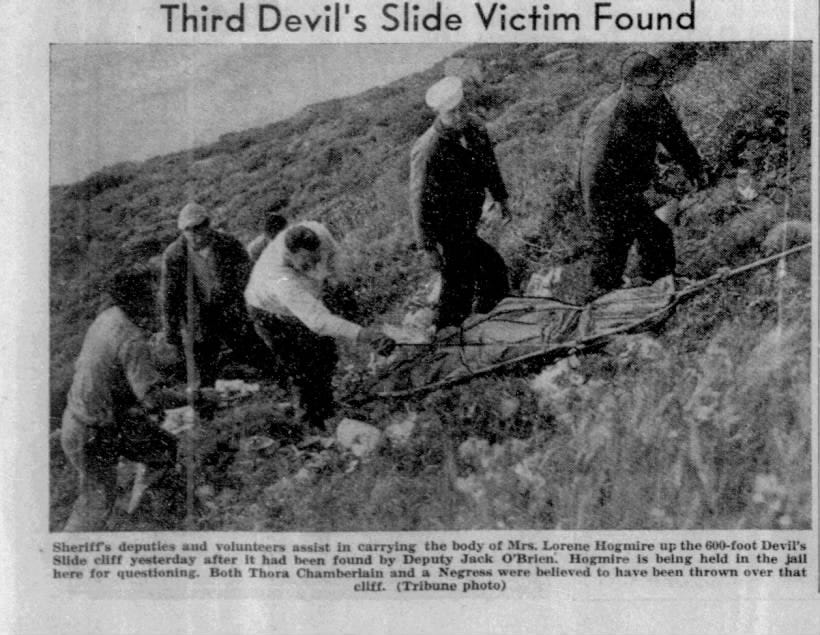
On May 2nd, they discovered her body in an inaccessible location 300’ down a cliff, about 200’ below the area where Franklin had found Dorothy’s body. A call went out to local ranches to see if any one had a rope long enough that searchers could reach her.
Meanwhile, the sheriff’s office was making its own plans. They picked Franklin up from the hotel he’d been living in and drove him to Devil’s Slide under the pretense there would be a new search for Lorene. Franklin went along, hoping to help.
Instead, he arrived to find his wife deceased. Her bruised and broken body hauled up the cliffs by volunteers. The intent had seemed to be to shock Franklin into a confession—that he had killed his wife.
The Questioning
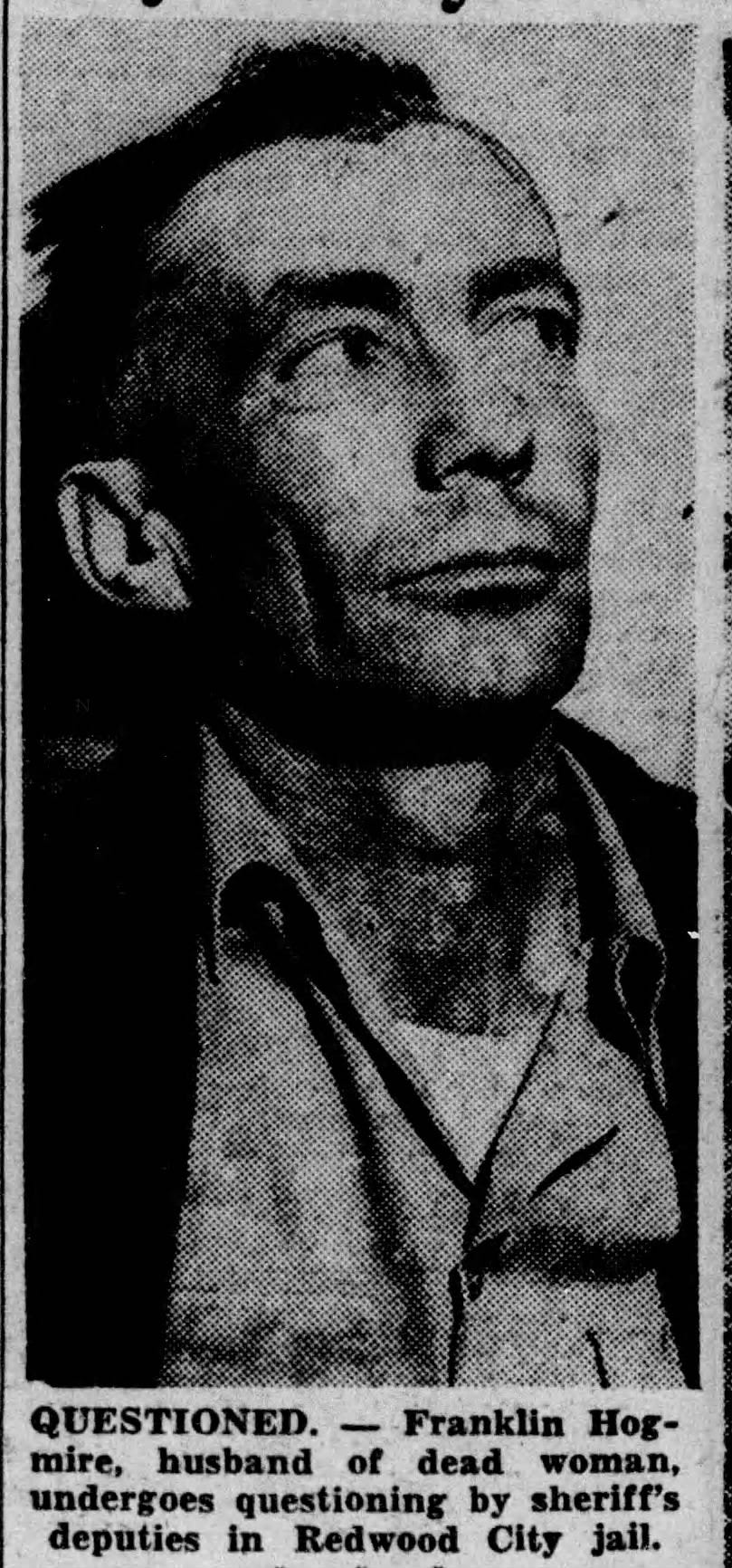
While Lorene’s body was taken away to be autopsied, Franklin was taken into custody. Even though he wasn’t charged with a crime, he was held for days and questioned repeatedly about his involvement in his wife’s death.
Franklin remained adamant that he had not harmed Lorene.
Meanwhile, two autopsies were done on Lorene’s body. She’d been found face up down the cliff and had a significant amount of bruising. That matched up with the autopsy findings that catalogued these injuries. They also noted that she had two broken ribs, a scalp wound, and two deep lacerations just below her knees.
Despite Lorene’s injuries, none seemed to be the direct cause of her death. They sent some of her organs to a toxicologist in San Francisco and though results might take weeks, they hoped it would help them ascertain what led to Lorene’s death.
But it was the knee injuries in specific left the examiners wondering if they had been caused by a blow from the bumper of a car.
Had Franklin struck Lorene and tried to hide her body in an area he knew was difficult to access?
Investigators thought so. To increase the pressure on him, they subjected him to a lie detector test. Over the course of 45 minutes, they peppered him with questions and then awaited the results.
But the results of the lie detector left them shocked: his answers showed no signs of deception.
Even with this, they wanted to continue to detain Franklin while they waited for the results from the toxicologist. They weren’t ready to charge him, but they also weren’t ready to let him out of their sights.
Finally the results came in: Lorene had been drunk at the time of her death.
Franklin was set free.
Interest in Lorene’s case quickly faded. She wasn’t part of an unsettling story about a series of missing women along Devil’s Slide. She wasn’t murdered by her husband in a twisted plot. She was just a woman who fell to her death while intoxicated they decided.
Franklin would make clear that he never thought Lorene would have committed suicide, but as to what led to her death, he remained uncertain. “I didn’t know what happened to her,” he said, “and I still don’t.”
The Devil’s Slide
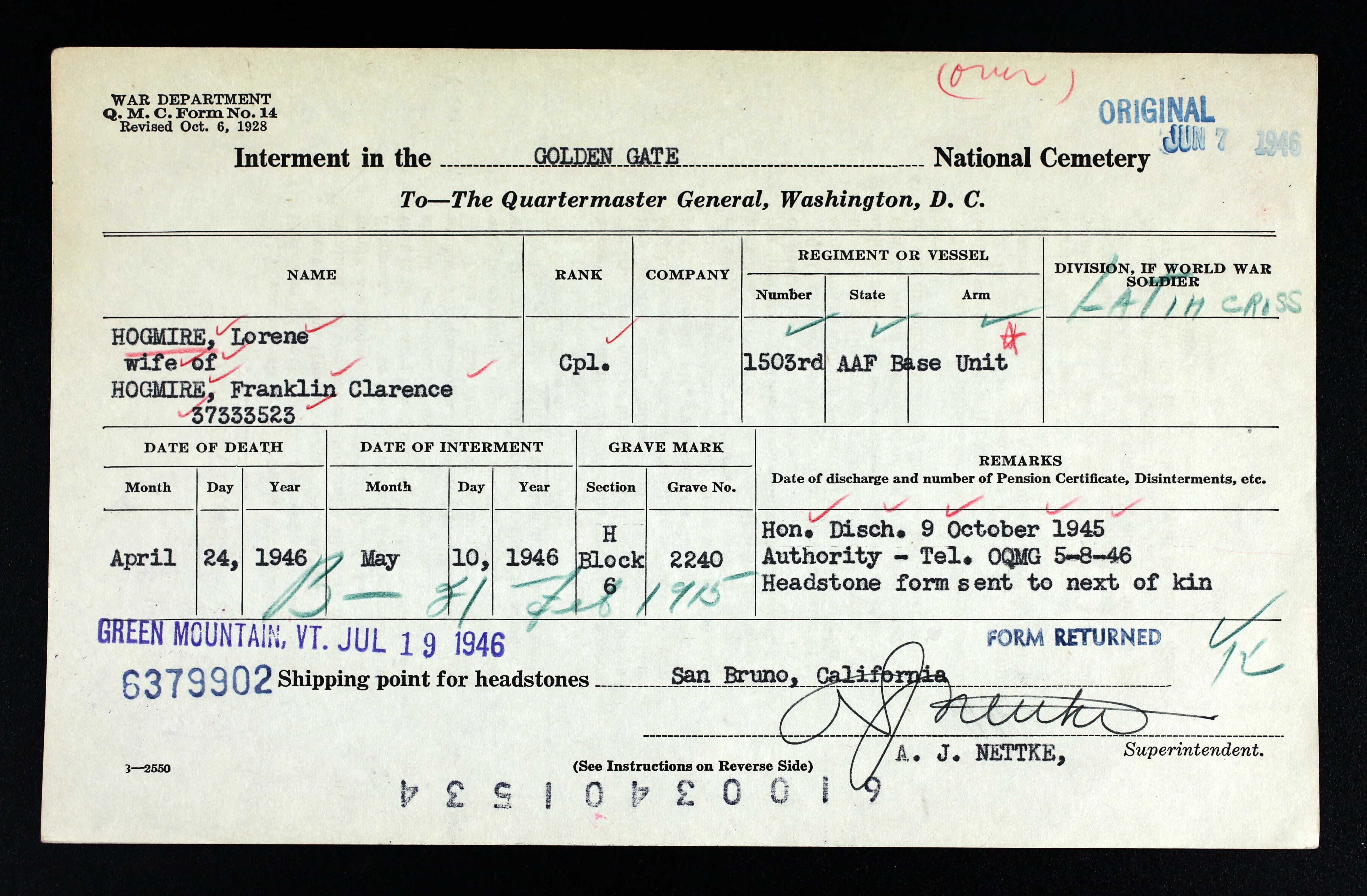
Lorene was laid to rest in San Francisco. Soon after, Franklin left the state, finding employment elsewhere. Today, her story is found only by digging through the thousands of articles that had been generated focusing on Thora Chamberlain’s disappearance. For Dorothy, there are even fewer. Just a few articles about her disappearance, discovery, and murder reported in relation to McMonigle and Thora’s disappearance. McMonigle didn’t even face charges in Dorothy’s murder.
Eighty years later, I find myself thinking about all three—Dorothy, Thora, and Lorene—and what we can do better in telling women’s stories both then and now.
It’s why I created this space here at GIRLHUNT. It’s a place where we remember from the small pieces that are left behind.
A Note From the Author:Girlhunt is a newsletter about women and crime — sometimes as victims, sometimes as perpetrators, sometimes as the people who solve it. My focus is on the women history overlooked, misread, or forgot to be angry about.
I’m also the host of She Goes by Jane, a podcast devoted to missing and unidentified women. This piece grew out of last week’s episode on Thora Chamberlain—if you found your way here from the podcast, welcome. If you found your way here first, the podcast is linked above.
If this resonates with you, subscribe. Tell someone. The stories I cover don’t get found without readers who go looking. —Aimee
No posts
Comments
Nothing yet. Say the first thing.
Sign in to join the conversation.