
“The standard of care is a legal term used to determine whether a provider has taken acceptable and reasonably prudent care of a patient’s needs. If the standard of care is not met, you can file for medical malpractice to seek damages.” - Very Well Health
Since the passage of the 2006 Combating Autism Act and its subsequent iterations over the last 20 years, Federal agencies have been given $3.08 billion to provide for federal efforts to understand, diagnose, treat, and prevent autism spectrum disorders.
The current law directs the creation of programs to provide, “evidence-based interventions to meet the needs of individuals with autism spectrum disorder or other developmental disabilities across their lifespan and the needs of their families through Federal programs.” Autism Families are explicitly recognized as the direct beneficiaries of these programs.
So do the outcomes of National Institutes of Health (NIH) research grants , “meet the needs of individuals with autism spectrum disorders and their families”?
Year / Period: 2000
Legislation / Bill: Children’s Health Act (P.L. 106-310)
Funding Authorized: No specific dollar figure; established programs
Focus: Created NIH Autism Centers of Excellence (ACE), started federal autism research coordination
Year / Period: 2006–2011
Legislation / Bill: Combating Autism Act (P.L. 109-416)
Funding Authorized: $950 million over 5 years (~$190M/year)
Focus: Research, early diagnosis, intervention, and CDC surveillance; created Interagency Autism Coordinating Committee (IACC)
Year / Period: 2011–2014
Legislation / Bill: Combating Autism Reauthorization Act (P.L. 112-32)
Funding Authorized: Continued $190M/year ($570M total)
Focus: Extended prior funding; maintained IACC and research programs
Year / Period: 2014–2019
Legislation / Bill: Autism CARES Act (P.L. 113-157)
Funding Authorized: $1.3 billion over 5 years (~$260M/year)
Focus: Expanded NIH ACE research, Health Resources and Services Administration
(HRSA) services, CDC epidemiology; coordinated federal autism programs
Year / Period: 2019–2024
Legislation / Bill: Autism CARES Act Reauthorization (P.L. 116-60)
Funding Authorized: $260M/year ($1.3B over 5 years)
Focus: Continued research, expanded focus on adults, lifelong support, and services; strengthened coordination by IACC
Coordination of Federal refunded autism research in the 21st century has been guided by the IACC, created in 2006 and maintained in all reauthorizations. NIH has received the largest share of funding, primarily for research, longitudinal studies, and the Autism Centers of Excellence. CDC funding steadily increased to improve epidemiology and prevalence tracking. HRSA’s share grew under CARES, reflecting more investment in direct services, family support, and training for healthcare providers. Overall, total annual funding increased from ~$190 million/year under the 2006 Combating Autism Act to ~$260 million/year under CARES.
Yet a the vast amount of research funding has not been used to further the stated goal of meeting “the needs of individuals with autism spectrum disorders and their families,” used to justify the expenditure of these taxpayer dollars.
This piece will discuss our advances in knowledge on ASD before, during, and after the early 21st century federal funding era.
PART 1
OUR UNDERSTANDING, DIAGNOSIS, TREATMENT, AND PREVENTION OF AUTISM SPECTRUM DISORDERS,
1943-2005
Kanner
Autism is defined by Leo Kanner in his 1943 paper, Autistic Disturbances of Affective Contact
written during his tenure at Johns Hopkins University. The disorder defining paper begins, “Since 1938, There have come to our attention a number of children whose condition differs so markedly and uniquely from anything reported so far that each case contains merits – and, I hope, will eventually receive a detailed consideration of its fascinating peculiarities.”
The paper assessed eleven patients from The Henry Phipps Psychiatric Clinic and The Harriet Lane Home for Invalid Children at Johns Hopkins Hospital, and the Child Study Center of Maryland . The first person reported to be diagnosed with autism was “Donald T.” born in 1931. Had Donald received the “detailed consideration” of his condition, the world may have learned that Donald recovered from Autism at age 12 via cheation, as a side effect of medical treatment for juvenile arthritis.
Instead the world learned of this dramatic turn of events in 2005, a full 68 years later, when a reporter, trying to learn about the history of autism, tracked down Donald Triplett, “Donald T.” in his home town of Forest, Mississippi.
Olmsted
Dan Olmsted, reporting for the Associated Press, after meeting Donald’s brother, retold his brother’s account of Donald’s recovery:
“At age 12 Donald had been living with a nearby farm couple. “One February day, I think it was, they came to (town) with Don. He had a bad fever and was obviously sick.” His joints were swollen and stiff, his brother said.
“My father and mother took him to all various places for examination — they went to Mayo Clinic, brought him back. He lost his appetite and was terribly emaciated. But anyway, my father was talking to a doctor (in a nearby town) he happened to run into and said, ‘It looks like Don is getting ready to die.’”
The doctor said, “What you’re describing sounds like a rare case of juvenile arthritis.” Diagnosis in hand, his parents took Donald to the eminent Campbell Clinic in Memphis, where he was treated with the then-standard remedy, gold salts. “He just had a miraculous response to the medicine,” Donald’s brother said. “The pain in his joints went away.”
And here’s the kicker: “When he was finally released the nervous condition he was formerly afflicted with was gone. The proclivity toward excitability and extreme nervousness had all but cleared up.” He also became “more social.”
In other words, Donald got a lot better. He went on to college, joined a fraternity, worked at a bank, owns a house, drives a car, belongs to the Kiwanis and the Presbyterian Church and plays a good game of golf despite one fused knuckle left over from the arthritis attack.
And now, in retirement, he travels the world. That explained why he wasn’t in town — he was off having a good time. Last stop: Italy. Favorite city: Istanbul.”
Donald was successfully treated for arthritis in 1947 during which he was also successfully treated for his “Autism.” Although Kanner reported Triplett’s recovery from autism he, did not report the fact that it followed a treatment with gold salts which address both mercury toxicity and autoimmunity, but rather Kanner reported but he believed that it was due to Triplett’s living circumstance with the family in the country.
In this first episode of the first recorded autism case we see the gestalt that is repeated over the last 8 decades. Families reporting successful autism treatments after treating the medical symptoms of the person with autism and the failure of the medical community to learn from the families and further the research on those successful medical interventions.
Olmsted continued, “Donald’s brother told us Johns Hopkins researchers have been in touch every decade to check on Donald, but we’re not aware of any published accounts of Donald’s improvement following the gold-salts treatment — something his brother volunteered to us in a half hour of conversation.”
Because of the misattribution of Donald’s recovery to his change in circumstance rather than medical intervention for a toxic/autoimmune disorder, two paths were set. The path of the medical community’s approach to autism became one of change in external circumstance rather than recognition of autoimmune and toxicological impacts and medical treatment for them. Here begins the split between the medical community and autism families in their approach to autism treatment.
The same disconnect between families and medical providers existed on autism causation is evident in Kanner’s reporting on the initial 11 cases. Ms. Miller, the mother of the third case, reported autistic regression and gastrointestinal symptoms following a smallpox vaccine.
“Case 3. Richard M. was referred to the Johns Hopkins Hospital on February 5, 1941, at 3 years, 3 months of age, with the complaint of deafness because he did not talk and did not respond to questions.”
“Following smallpox vaccination at 12 months, he had an attack of diarrhea and fever, from which he recovered in somewhat less than a week.”
“In September, 1940, the mother, in commenting on Richard’s failure to talk, remarked in her notes: I can’t be sure just when he stopped the imitation of words sounds. It seems that he has gone backward mentally gradually for the last two years.”
The timeline for William Richard Miller’s, “Richard M” regression as reported by his mother, is:
November 1937 – Born
November 1938 – Vaccinated with Smallpox vaccine
September 1940 – Mother reports developmental regression beginning approximately two years previously, in 1938
February 1941 – Referred to Hopkins for evaluation
So within the first 11 cases diagnosed with “Autism” we have parental reports of regression following vaccination, gastrointestinal distress, autoimmunity, and successful autism recovery via a mercury chelator. All were observed by families beginning in the 1930s, before autism had a name, and those same reports are still being made today by the tens of thousands, 82 years later.
Subsequent to Kanner’s reporting on the disorder, Bruno Bettelheim set the treatment standard for autism for the next decade teaching that autism was caused buy so-called refrigerator mothers who hated their children. Bettelheim believed that children with autism knew that their mothers hated them and as a response turned inward away from all social connection. Treatment then became removal from the parents and placement in a facility run by Bettelheim. Mothers were then placed in Freudian Psychoanalysis to help them understand why they hated their children. This is one of the most abusive and disturbing episodes in the evolution of mental health interventions in the 20th century.
Rimland
Bettelheim’s pernicious reign over autism treatment did not end until the 1960s when a Navy psychologist by the name of Bernard Rimland issued a publication announcing that his son’s autism was not a mental disorder caused by his parents lack of love for him but rather a medical condition. Rimland’s 1964 book Infantile Autism: The Syndrome and Its Implication for a Neural Theory of Behavior, lead to the opening of Rimland’s Autism Research Institute in 1967. Shortly thereafter mothers of children with autism began writing to Rimland to report that when their children were given B vitamins, their behavioral symptoms improved. Initially Rimland did not take the maternal reports seriously until he had received many letters over several years, when he then decided to undertake a research project on the effect of B vitamins on those with autism in 1974 . Rimland found health and behavioral improvements in with autism who had been given vitamin B6 (pyridoxine), and subsequently set out on a lifelong journey to find medical interventions that improved the lives of those with an autism diagnosis which lasted until his death in 2006.
Eggers
Contained within Leo Kanner’s first 11 cases was the groundwork for both the causes and potential treatments for autism . Although Case number 3 , William Ritchey Miller, was reportedly a regressive case of autism onset following vaccination, and accompanied by gastrointestinal symptoms, no research on whether or not vaccines were causative in autism would be published until in 1976 German paper by G. Eggers who would report that vaccines have a triggering effect on autism cases.
“Autistiches Syndrom (Kanner) und Pockenschutzimpfung.” Translation: Autistic Syndrome (Kanner) and Vaccination against Smallpox, when translated into Engish, reads, “3-4 weeks following an otherwise uncomplicated first vaccination against smallpox a boy, then aged 15 months … gradually developed a complete Kanner syndrome. The question whether vaccination and early infantile autism might be connected is being discussed. A causal relationship is considered extremely unlikely. But vaccination is recognized as having a starter function for the onset of autism.”
The 1986 National Childhood Vaccine Injury Act
By 1986 the questions on whether or not vaccines can cause autism were so widely discussed that Congress included in the act the directive that, “the Secretary of Health and Human Services shall complete a review of all relevant medical and scientific information (including information obtained from the studies required under subsection (e)) on the nature, circumstances, and extent of the relationship, if any, between vaccines containing pertussis and... Autism.” - an excerpt from Section 312 of the National Childhood Vaccine Injury Act of 1986 (Public Law 99-660), codified in the Public Health Service Act (42 U.S.C. § 300aa-1 et seq.)
The Autism Research Institute
Bernard Rimland’s work at the Autism Research Institute evaluated autism treatments already being independently implemented by parents who had long since abandoned the wait for the medical community to give them solutions to their struggling children’s conditions. Since 1967, the Autism Research Institute has been collecting feedback about the usefulness of a variety of interventions.
Ratings of Behavioral Effects of Biomedical Interventions Survey
“Data have been collected from the more than 26,000 individuals and family members who have completed our questionnaires designed to collect such information. ARI’s ratings report responses on a six-point scale combined into three categories: “made worse” (ratings 1 and 2), “no effect” (ratings 3 and 4), and “made better” (ratings 5 and 6). The “Better:Worse” column gives the number of children who “Got Better” for each one who “Got Worse.”
ARI began publishing evaluations by parents scoring the still experimental interventions that they were trying. A 2009 report listed the effectiveness of interventions as follows.
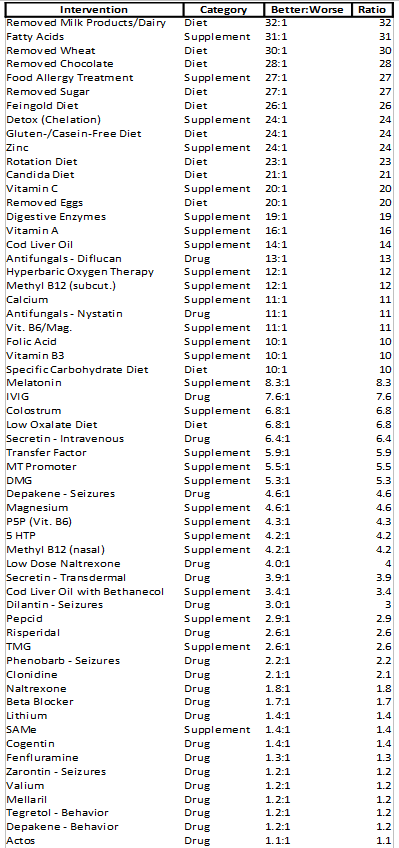
Parent ratings 2009
83.2KB ∙ PDF file
Download PART 2
OUR UNDERSTANDING, DIAGNOSIS, TREATMENT, AND PREVENTION OF AUTISM SPECTRUM DISORDERS,
2006 – 2025
In 2006, finally convinced that autism represented an urgent health crisis in American children, Congress passed the 2006 Combating Autism Act , and 3 subsequent laws authorizing approximately $3.08 billion for autism research and related programs. The last of which expired at the end of FY 2024, September 30, 2024.
Of the medical interventions that parents reported as having beneficial effects between 1967 and 2008, no advancement on our understanding of these interventions took place via the research funded by the NIH. Of the nutritional interventions that have showed dramatic improvements in the medical conditions and behaviors of children diagnosed with autism, none of them were studied by NIH.
Although parents reported dietary intervention for autism as the highest rated and most effective intervention medical intervention at the beginning of the 21st century funding cycle, the current AAP recommendations In their baseline recommendations for the treatment of autism, after $300 million worth of research by NIH …
AAP has not advanced in their medical understanding of autism since the dawn of the 21st century.
“Many interventions, including many nutritional interventions, do not have evidence to support their use at this time.”
Even as it acknowledges that ...
“Examples of common co-occurring conditions are disorders of sleep, feeding problems, gastrointestinal symptoms, obesity, seizures, attention-deficit/hyperactivity disorder, anxiety, wandering or elopement, and others.”
This was the position held by the AAP before the NIH funded research.
Their clinical care guidelines do not reflect the experiences of parents of the late 20th century but rather like the early medical paradigms, focus on the care and support of the child in the family and community. While such wrap around support is vital for the development and care of the person with autism, It reflects the bias from the beginning of the autism era the medical interventions should be ignored by the medical community, it seems to reject any medical evaluations, interventions, or research that could further the notion that autism is iatrogenic. The same way Kanner credited community support For Donald T’s miraculous recovery while ignoring medical interventions going back to late 1940s , The AAP in 2025 teaches physicians to emphasize community support and discourages medical interventions.
AAP and NIH has not advanced in their understanding of Autism since NIH Funding began in 2006.
NIH has failed to provide, “evidence-based interventions to meet the needs of individuals with autism spectrum disorder or other developmental disabilities and their families.”
And AAP is fine with that, even recommending against Leucovorin.
Please go read Katie Wright's piece, The Medical Neglect of Children and Adults with Autism, about the medical neglect of AAP and NIH, and her attempts to discuss vaccine research with NIH. Long story short they won't even tell the mother of the child whose vaccine regression resulted in the founding of Autism Speaks, the names of the people that are supposed to be working on these federally funded projects.
No posts
Comments
Nothing yet. Say the first thing.
Sign in to join the conversation.