
On the night of 1 November 2023, storm Ciarán crossed the southern North Sea. Every wind farm in the Belgian offshore zone stopped producing. This was not a fault, not a cable failure, and not a protection misoperation. The turbines did exactly what they were designed to do: when the wind exceeds the speed at which a machine can safely extract energy from it, the machine stops.
What makes Ciarán worth revisiting is not the shutdown itself but what happened inside the forecasting system that was supposed to see it coming. Belgium’s operational storm forecast chain — the one that has been running since November 2018 — predicted the cut-out reasonably well, with some error in timing. In parallel, researchers had been testing a machine-learning replacement that beat the operational chain comfortably on average accuracy across the whole of 2023. During Ciarán, that better model kept forecasting output close to maximum while the fleet sat at zero.
The reason is instructive. The neural network had been trained to minimise mean absolute error. Storms are rare, they are penalised twice when you get the timing wrong — once for the drop you predicted that did not happen, once for the drop that happened when you did not predict it — and a model rewarded for average accuracy learns to smooth them away. The metric that made the model good made it blind to the only events the transmission system operator actually needed it for.
That is the theme of this article. Storm management in an offshore-heavy power system is not primarily a hardware problem. It is a problem of correlated behaviour, of measuring the right thing, and of the gap between what is statistically normal and what is operationally dangerous.
A single turbine shutting down is a rounding error. A fleet shutting down together is a contingency. What determines which one you get is correlation, and correlation is largely a matter of geometry.
The Belgian offshore zone is among the most extreme cases in Europe. When its first phase was completed in 2020, roughly 2.3 GW sat across about 225 square kilometres — an installation density near 10 MW per square kilometre against a North Sea average closer to 6.6, which at the time ranked it the densest such zone in Europe. All the farms sit in a narrow band, close enough that they shade one another aerodynamically and close enough that a single weather front reaches all of them within a short window. The adjacent Dutch Borssele zone, fully operational since 2021, adds to the interaction from the other side of the border.
Two consequences follow. The first is that wake losses between farms are material, which is a yield question. The second is that the fleet behaves less like a portfolio and more like a single machine, which is a stability question. When plants are far apart, their shutdowns are smeared across hours and the aggregate ramp is gentle. When they are packed into one band, the smearing collapses.
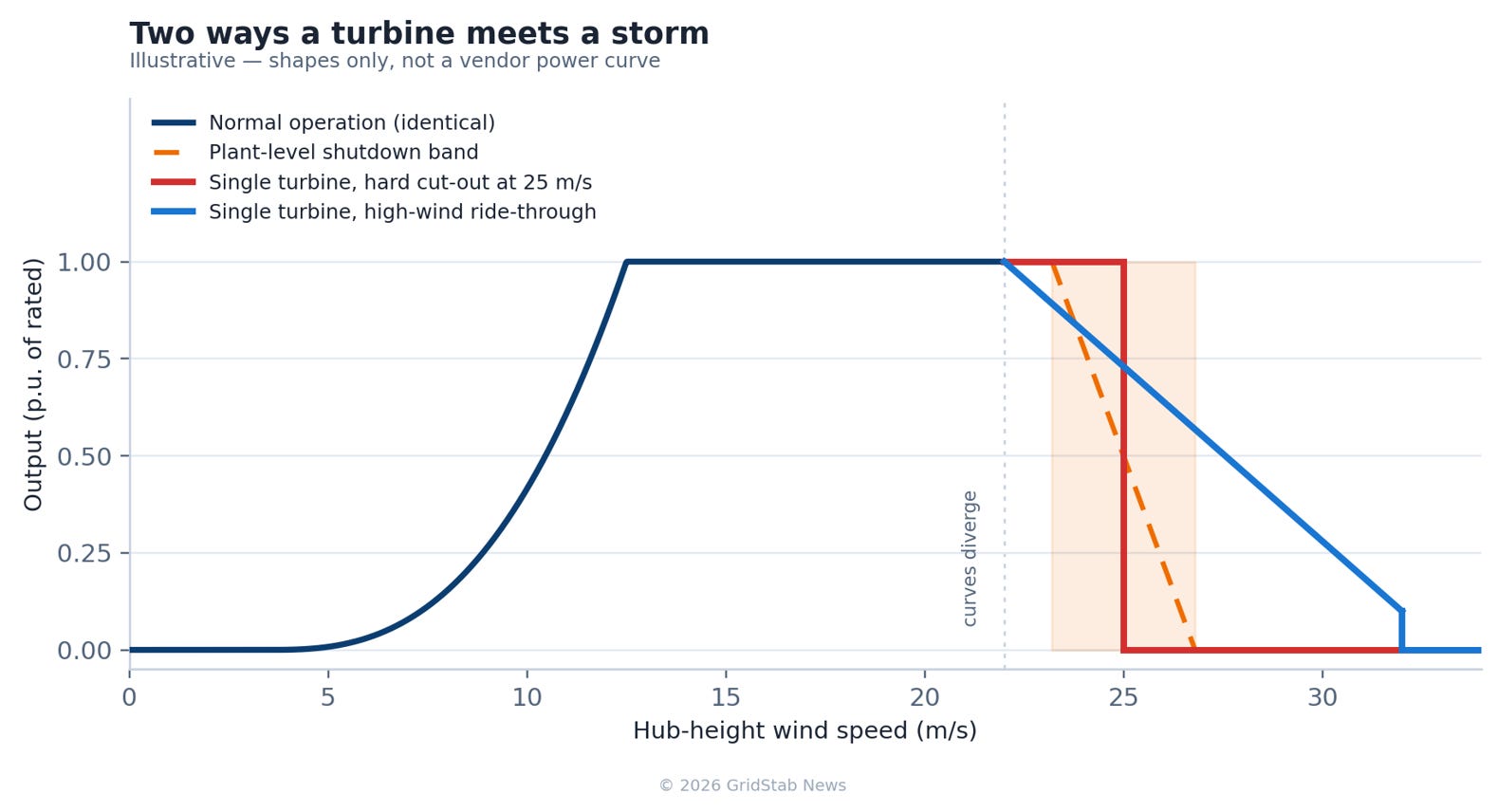
Figure 1. Two shutdown philosophies. A hard cut-out removes full output at a threshold; high-wind ride-through trades output progressively for continued operation. At plant level, turbine-to-turbine variation smears the transition into a staircase rather than a cliff.
Figure 1 shows the mechanism at the level of a single machine. The traditional design cuts out abruptly at around 25 m/s: below the threshold, full output; above it, nothing. Modern high-wind operation replaces the cliff with a ramp, reducing output progressively to keep the structural loads on blades and tower within limits, while keeping the turbine connected and generating into wind speeds where an older machine would already have stopped.
A wind farm never reproduces the single-turbine curve exactly. Turbulence means each machine sees a slightly different wind speed at any instant, and shutdown logic typically evaluates several averaging windows at once — a ten-minute mean, a thirty-second mean, and a one-second peak — so machines trip at different moments. Restart is governed by a separate and lower threshold, which creates hysteresis: a fleet that has shut down does not come back the instant the wind dips below the trip point.
—YOU ARE 30% INTO THIS ARTICLE —
What follows behind the paywall
So far you have seen why a densely packed offshore fleet behaves like one machine, and how shutdown philosophy shapes the edge of a storm. The remaining 70% of this article covers:
The number that reframes the problem — what 37 years of simulated five-minute generation, validated against measured fleet data, says about the worst credible ramp a packed offshore zone can produce (Section 3, with the storm anatomy diagram).
Why the restart is worse than the shutdown — the counterintuitive finding that modern ride-through hardware fixes the ramp-down and leaves the ramp-up as the binding constraint, and what that implies for connection terms (Section 4).
Inside the forecast chain — how a probabilistic storm alert is actually assembled, why cut-out probability is a different product from a power forecast, and the verification trap that catches machine-learning approaches (Section 5, with the forecast-to-action diagram).
Sizing reserves against storms — how ramping statistics translate into balancing volumes, why the seasonality matters, and what happens to reserve adequacy as installed capacity grows (Section 6).
The full mitigation toolbox — four intervention points across turbine control, fleet layout, market design and control-room practice, and which ones actually move the extremes (Section 7, with the toolbox diagram).
What changes with the next zone — why geographic spreading helps, why it does not help enough, and the questions every TSO with a growing offshore pipeline should be asking now (Sections 8 and 9).
Subscribe to GridStab News to unlock the full article and all future technical deep dives.
Comments
Nothing yet. Say the first thing.
Sign in to join the conversation.