
I am, by any reasonable measure, a digital person. I have spent a career in software and technology. I reach for my iPhone before anything else, and more often than not, it is the camera on that phone I am reaching for, chasing a doorway or a bit of light on my way somewhere. For years, whenever I wanted to capture a thought rather than a photograph, I did what people like me do. I went looking for the right app.
You will know the routine if you have ever tried it. You find something promising. You spend a happy weekend setting it up, tagging things, colour-coding, building the perfect system. It works beautifully for a fortnight. Then a better app appears, or the one you have starts to niggle, and you begin the great migration. Exporting, importing, reformatting, losing half your notes in the process. I did this more times than I care to admit. The perfect system was always one app away.
This time last year, I gave up.
Not on capturing my thoughts, but on the idea that there was a system worth chasing. Instead, I did something that would have appalled my younger, tidier self. I bought a notebook. Then another. I let them scatter around the house and settle into the bottom of my bags, each at a different stage, none of them synced to anything. No search. No backup. No order at all. I decided to embrace the mess and see what happened.
What happened is the reason I am writing this.
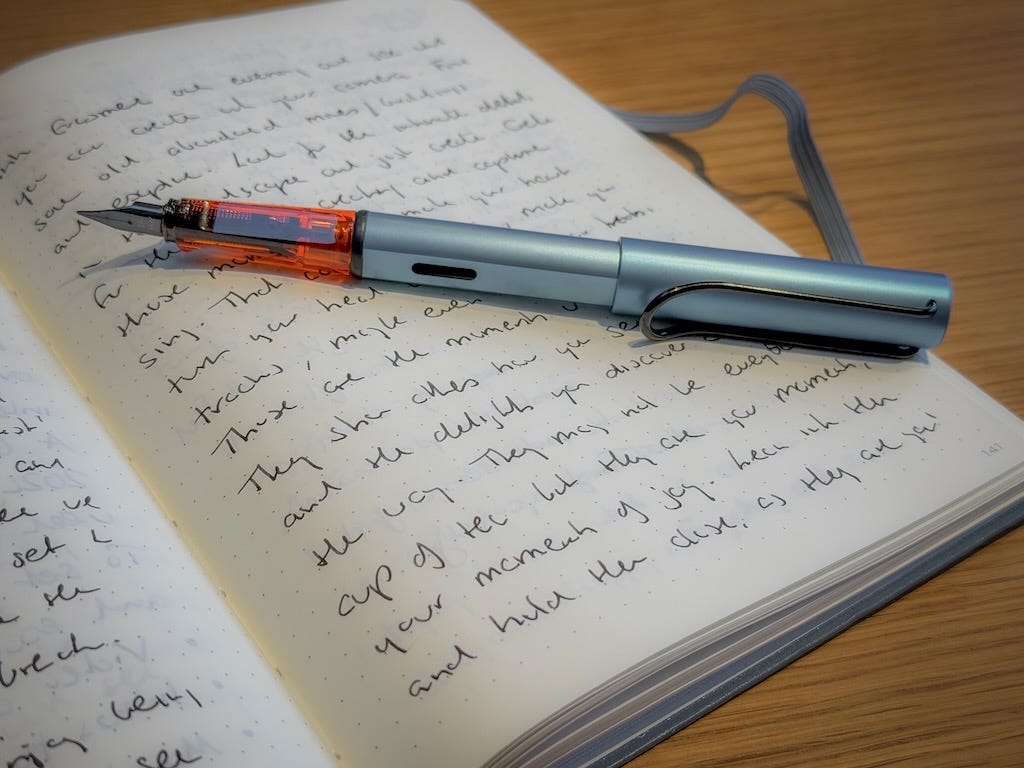
Here is the thing I had spent years trying to engineer away. Paper is slow. You cannot search it. You cannot copy and paste. If you lose the notebook, the words are gone. Every instinct I have built over a career in technology says these are problems to be solved.
They are not problems. They are the whole point.
The slowness forces me to think. The lack of search means I have to sit with a thought rather than file it and move on. And the fact that it will only ever be read by me changes what I am willing to write down. There is no client at the other end. No colleague. No audience. Just me and the page.
I did not expect a technologist’s peace to arrive in the one system he cannot back up. But it did.
I noticed it most clearly at a conference recently. In my old life, I would have sat there with my phone, tapping out notes, snapping photos of the slides, feeling productive. And I would have been lying to myself. Because the phone that takes the notes is the same phone that buzzes with email, that flashes up a headline, that quietly begs to be checked. However good my intentions at the start of an hour-long talk, my attention would drift. I would end up half in the room and half in my inbox. Present in body, absent in every way that counts.
This time I brought a notebook. Nothing else. The phone went flat on the chair beside me, face down, then into my bag entirely.
The difference was startling. With nowhere to escape to, I actually listened. I was in the talks, following the argument, catching the aside the speaker threw away, rather than surfacing every few minutes to see what I had missed elsewhere. The notebook did not just record the conference. It let me attend it. It gave me back the room.
That is the quiet trick of paper. It does not compete for your attention with a thousand other things. It only ever asks you to do the one thing in front of you.
I want to show you what this actually looks like, rather than just telling you it is good. So here is a page from an actual morning, more or less as I wrote it.
I’ve neglected my morning routine, and I’ve forgotten how much I enjoy the feel and sound of my fountain pen rolling across the page. The way it gives me focus and tries, at least, to slow my mind. Words flow from my mind through my fingertips and across the page, a series of curls and lines that are barely legible even to me but represent the physical manifestation of my thoughts. A deep breath, maybe even a sigh. I feel grounded.
That is not writing meant for anyone. It is barely legible, even to me. But something happens in the act of it. The contact between hand and paper draws the pent-up energy out, mixing with the ink as it soaks and dries into the page. Bleeding thoughts, in a good way. Cleansing the soul and making space in the mind.
It is like a morning wash for your brain. A splash of cold water to rinse away the sleep and give you a clean slate for the day ahead. Some mornings I write about dreams. Some mornings about whatever is sitting on my mind. And some mornings it is just the feel of the writing itself, the loops and lines and dots, all interconnected to communicate meaning if you can decipher them.
I have tried meditation, and I struggle with it. You are meant to keep returning the mind to the breath. This is the opposite. Here I give my mind free rein to wander and seek out what it can, like a puppy weaving from here to there, sniffing and rustling through the grass. It lingers on the interesting patches for a while, then moves on.
And some mornings I don’t write a word. No pressure. No expectation. If I don’t feel up to it, then I let it slide without judgement, knowing it will be there when I am ready to return.
The longer I have kept this up, the more I have realised what the notebook actually is.
A good journal is a bit like a good friend. One who just sits, listens, and gives you space to talk. No judgement. No advice you did not ask for. Just room to let it all come tumbling out in a rambling mess so that you can start to make sense of it, thinking aloud with a pen.
It is somewhere to celebrate a success without being seen to brag. Somewhere to work through an injustice without being seen as a victim. Somewhere to untangle a complicated situation before you have to say anything sensible about it to anyone. It is your own personal playground, and you make the rules.
That last part matters more than I first understood. You choose everything. The pen, the paper, fat or thin, large or small. Longhand, shorthand, lists, mind maps, doodles, a proper bullet journal or a glorious mess. There is no right way, only the way that works for you. And because nobody is ever going to see it, you cannot get it wrong.
I still have notebooks in different states dotted around the house. One lives in the kitchen within easy reach of my morning coffee. One is in a bag I have not opened in a fortnight. I could not tell you what is in most of them, and I cannot search any of them.
For the man who wanted everything tagged, synced and backed up, that should be unbearable. Instead, it is the first system ever to stick. Not because it is efficient, but because it never asked to be. I stopped trying to optimise the thing and simply started using it.
And somewhere along the way I realised the notebook was not really a departure at all. It is the same instinct that makes me raise a camera. Both are slow. Both ask me to pay proper attention to the thing in front of me, whether that is a doorway catching the morning light or a thought I am trying to untangle before breakfast. One trained my eye on the world. The other, it turns out, trained it on myself. Same photographer, same quiet act, just pointed inward instead of out.
The perfect app was never one app away. It was a notebook I could not sync, and a pen I have to slow down to read.
Are you a digital-first person who has found something unexpectedly grounding in going analogue? I would love to hear what pulled you back to paper, or what has kept you firmly on the screen.
Comments
Nothing yet. Say the first thing.
Sign in to join the conversation.