
I'm just back from holiday. I spent a lot of it reading about robots. Autonomous robots with max power cognitive AI onboard, able to move on their own, make decisions, and learn new things. These are not big arms in a car factory moving a sheet of metal into the right place.
The story that started my dive into the rabbit hole was about a Tesla factory. On 9 May 2026, the final Model S and the final Model X came off their assembly line in Fremont1. That is the factory that made Tesla the company it is. The line is not being shut down. It is being retooled to build Optimus, Tesla's humanoid robot.
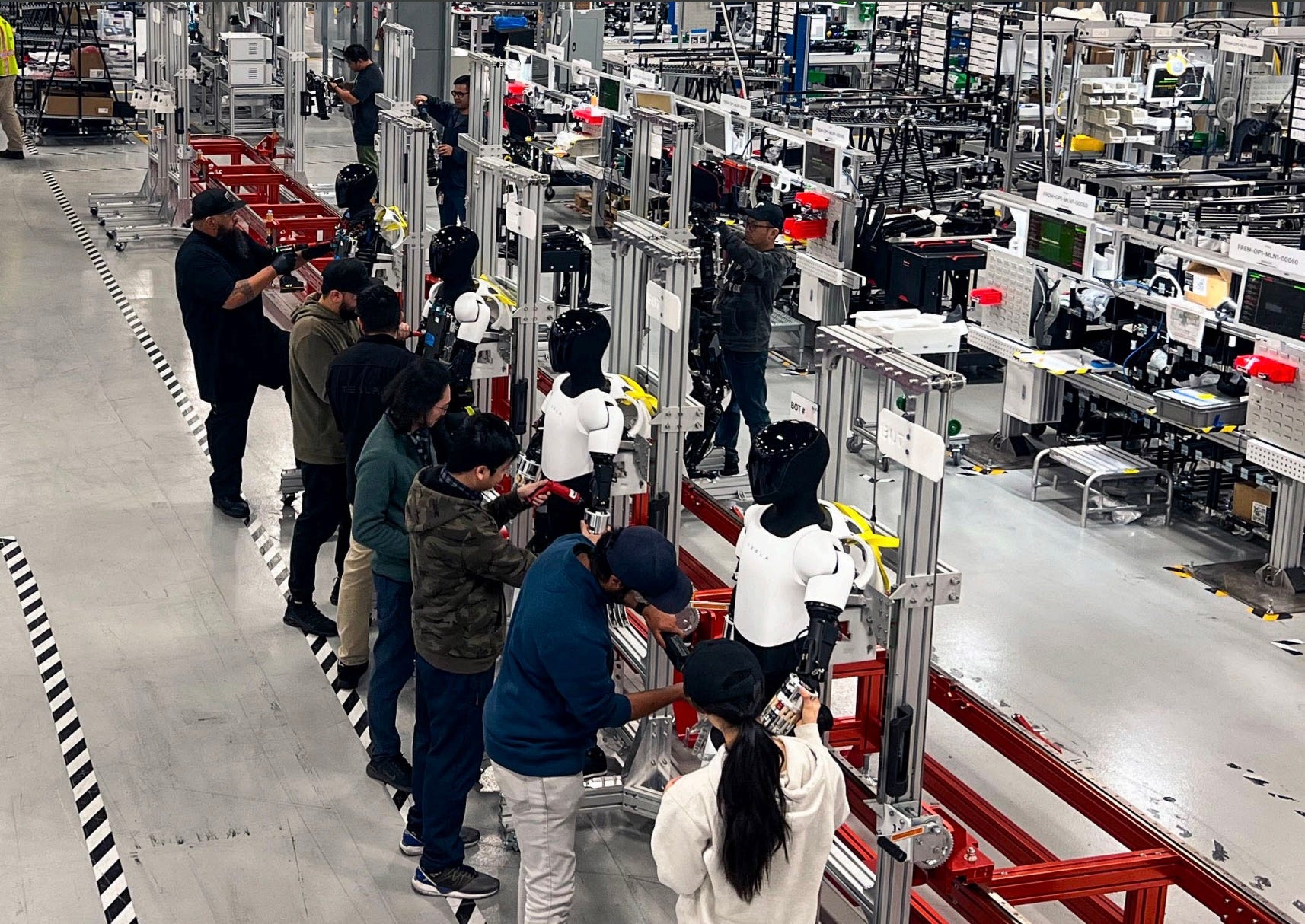
What a moment. Historically significant and worth noticing. A fourteen-year-old car line, the one that built the company, now repurposed to make humanoid robots that are themselves designed to build Teslas, with a stated target of a million units a year.
I am not naïve about the gap between a target and a fact. The Tesla Optimus robot has not shipped at scale, and many of us (some with glee) watched a demo unit topple over backwards while it was handing out drinks at an event last December. The program manager who oversaw the first production run apparently left one day after it rolled off the line. So we can file the timeline under 'ambitious'. But the direction is not in doubt, and that direction is the whole point. I agree with KraneShares: "We believe that when the world's highest-profile EV manufacturer reallocates factory space from vehicles to humanoid production, it signals the sector's trajectory regardless of exact delivery dates."2
The forecasters certainly think so, even if they cannot agree on which decade. Bank of America projects three billion humanoid robots in operation by 2060, most of them in homes, eventually outnumbering cars on a per-capita basis3. Citi has the humanoid market reaching seven trillion dollars by 20504. Morgan Stanley lands on roughly a billion humanoids by the same year5. Set against the perhaps sixteen thousand humanoid units actually installed in the world today, by Counterpoint Research's count6, every one of these is essentially an act of faith. But notice what the disagreement is about. It is about which the decade this comes true, and how many billions of robots it is. Not if. Nobody serious is arguing about whether autonomous robots go mainstream any more.
Tesla is not alone. BMW is piloting Figure's robots in the body shop at its Spartanburg plant. In May, a two-year-old London startup called Humanoid signed a deal with the German industrial group Schaeffler to put up to two thousand robots on factory floors by 2032, one of the largest such deals disclosed to date7. Schaeffler is not only buying the robots, it is supplying their joints, the actuators, which are among the hardest and costliest parts of the machine. It is the buyer and the maker of the moving parts at once. The supply chain of robots already runs partly through a robot supplier.
So what? It would be easy to file all of this under Science Project, and my guess is that most of us will do exactly that. We have been watching videos of Boston Dynamics dogs do backflips for a decade, and the world didn’t change, even when we saw robot dogs with machine guns mounted on them. The thing that has actually changed in that time is not the hardware. It is the cognition: self-learning AI on board; and the self-improving design and build process: the iteration, the long loop of trying something, breaking it, learning, improving. That loop was always the real bottleneck, not the machinery. And that loop is exactly the part now being automated. You still have to build and break real prototypes in the physical world, but everything around that act, the thinking that used to take months, is compressing faster than we can comprehend. Improvement no longer relies on humans.
Many of us have spent years now arguing about the impact of AI arriving in cognitive work. We have all had a go with Claude and Chat: the emails, the LinkedIn posts, the memo, the draft deck, the business plan, the slop. That argument seems over, and everyone I know appears to be bored of the statistics or the projected societal change discussion. What I do not hear much discussion of is the next chapter, which is physical. The logic is identical. Massive abundance where there used to be scarcity, the marginal price of the work arcs to zero, except this time it is moving autonomously on robotic feet, straight onto the factory floor, with working hands and opposable thumbs. A car line becoming a robot line is not just an interesting milestone. It means the supply curve of physical labour is starting to bend the same way we are watching the cognitive one already bend. As a society, we seem to generally agree that AI is moving too fast for us to keep up, so I can’t wait to see how people react to the three billion robots arriving.
The robots being built now are designed to build more robots. Once that gets going, you can presume that the humanoid you are looking at was itself assembled by an earlier one. The chain of making loses a human link, really fast. That email thread you're looking at now, where you know your AI is talking to other people's AIs? That, but robot-made physical stuff. A table. A ready meal. A polo shirt. An iPad. A tailored pill. A replacement heart. Maybe not the design. Hopefully not the decision. But definitely the making.
That poses a genuinely awkward question for anyone who sells physical things, which includes me. What happens when an object stops being well made? If we follow the current trajectory to its end, everything becomes well made. And when everything is well made, 'well made' has no meaning. It literally means 'made'. It is no longer a differentiator. It is a baseline: free, available, universal, assumed.
The value does not vanish, though. As we are seeing at mind-bending pace in cognitive work, it migrates. It moves to the things a robot cannot author:
- Who decided this should exist?
- What is the history behind it?
- Where did it genuinely come from?
- Whose name is on it?
The same migration we are watching in knowledge work, from output to judgement to taste, is about to happen to objects. Provenance stops being a nice-to-have. It becomes the product itself.
I can hear the objection, because I used to make it myself, and I still hear it from friends every day. That is all completely fine for knowledge work, but the physical world is different. Robots are clumsy and awkward. Factories are messy. You cannot prompt your way to a folded shirt, let alone a beautifully tooled leather handbag. I simply do not believe anyone will be saying that in two years from now. The marginal cost of physical labour is heading for zero, exactly as it has for a draft email, and the skill ceiling is heading north to somewhere we cannot yet imagine.
So what? Well, so far we have been arguing about whether the machine takes on the work. That is the wrong frame. The machine takes the middle. The making, the executing, the part we used to call being good at your job, all of that will hollow out, we're just not seeing it yet. What the machine cannot take is the two ends: the decision that this thing should exist at all, and the name that answers for it once it does. Taste at the front, accountability at the back, and a great hollowing-out in between.
My assumption was that the surviving human premium would be about craft: the soul, the hand, the beautiful imperfection. The art. I see now that's a misplaced romantic notion. It's weak. The robot will out-craft us inside two years. The premium that actually survives is not the hand. It is accountability. A machine can make anything. It cannot decide the thing is worth making, and it cannot be answerable for it. A brand, stripped right back, is simply a promise that somebody will stand behind the object. They thought about it, and this is the outcome. That is the one input that cannot be manufactured, no matter how cheap the manufacturing gets. The product becomes the commodity. The romance is the vision, and the act of standing behind it. It is someone able to point at the thing they made and say: we were right, this is the one.
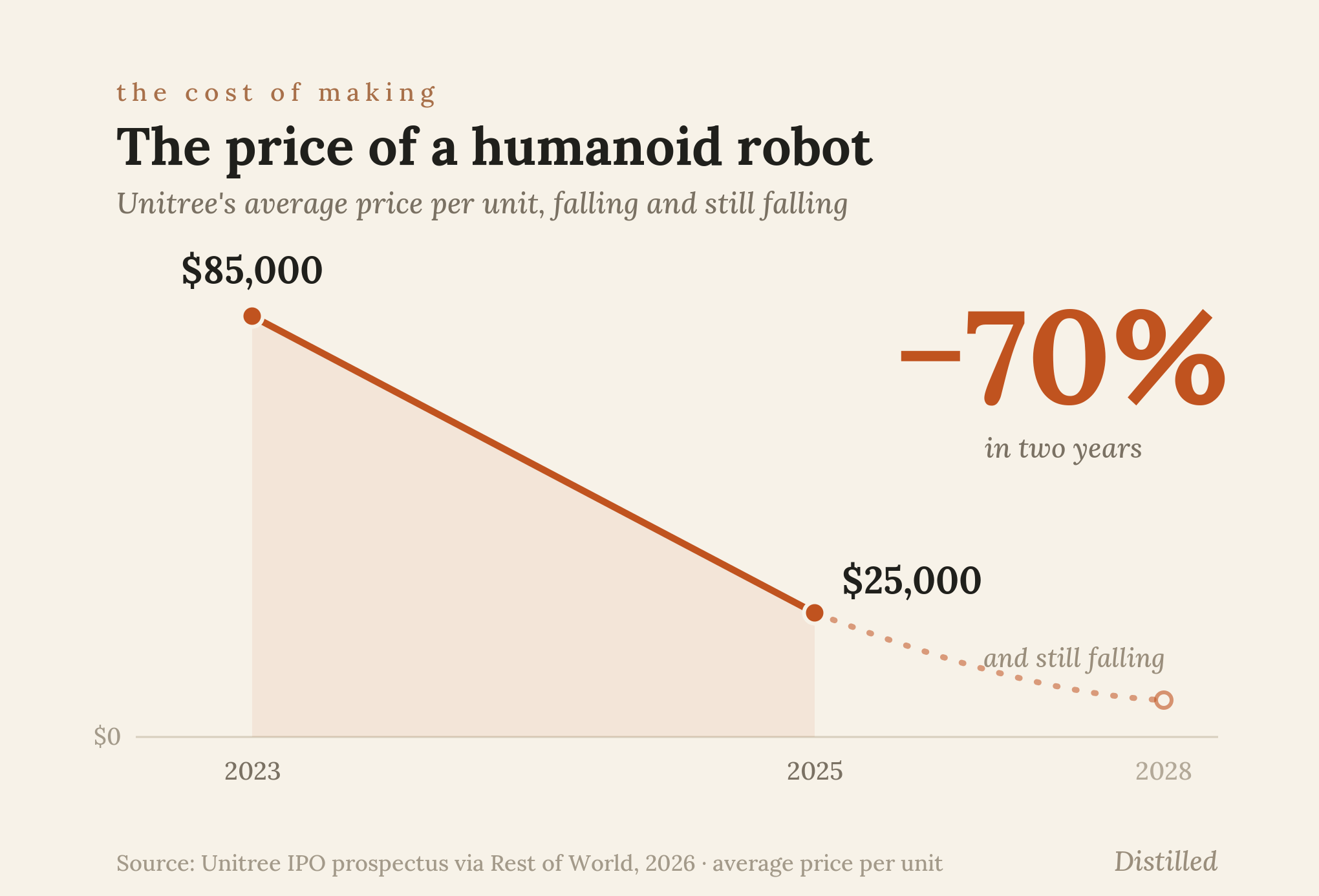
If you make or sell anything physical, the question worth considering now is a challenge. In two years, when well made is free and everyone has it, what is your honest answer to 'why mine?' If the answer is because we make it really, really well, either that answer now has an expiry date on it, or the market you are in is tiny. Look at the trajectory. The average price of a Unitree humanoid fell from about $85,000 in 2023 to about $25,000 in 2025, a drop of around 70% in two years, and the margins improved rather than collapsed, because Unitree builds its own components8. You can only imagine where that number lands in five years, even for a dev machine. That is the proof. When the making costs almost nothing, the margin cannot live in the making. It has to come from somewhere a robot cannot reach.
If the answer to 'why mine?' is a decision someone took and a person who will stand behind it, evidence that can actually be checked, then you have something the robots cannot assemble.
We go through the looking glass and the world comes out inverted. The thing that was scarce, the making, becomes abundant. The thing we always took for granted, that a person decided this and a person stood behind it, becomes the rare and valuable part.
That is the part worth preparing for now. Not the robots. The answer.
Tesla retires the Model S and Model X at Fremont and converts the line to Optimus; the December demo stumble and the program manager’s departure. EVXL, May 2026. https://evxl.co/2026/05/10/tesla-last-model-s-x-fremont-optimus/
“We believe that when the world’s highest-profile EV manufacturer reallocates factory space...” KraneShares, “Humanoid Robotics In 2026: The Race From Pilot To Platform,” May 2026. https://kraneshares.com/humanoid-robotics-in-2026-the-race-from-pilot-to-platform/
Bank of America Global Research: three billion humanoids by 2060, eventually outnumbering cars per capita. Reported in Fortune, March 2026. https://fortune.com/2026/03/13/bank-of-america-humanoid-robot-forecast-3-billion-2060
Citi GPS, *The Rise of AI Robots*: a seven-trillion-dollar humanoid market by 2050. https://www.citigroup.com/global/insights/the-rise-of-ai-robots-humanoids-are-coming-for-you
Morgan Stanley: roughly a billion humanoids and a five-trillion-dollar market by 2050. https://www.morganstanley.com/insights/articles/humanoid-robot-market-5-trillion-by-2050
https://counterpointresearch.com/en/insights/Global-Humanoid-Robot-Installations-Reach-16%2C000-Units-in-2025-as-Mass-Production-Picks-Pace
Humanoid and Schaeffler deployment and actuator-supply agreement, up to two thousand robots by 2032. Reuters, May 2026. https://www.globalbankingandfinance.com/humanoid-deploy-up-2-000-robots-schaeffler-plants/
Unitree humanoid average price fell from about $85,000 (2023) to about $25,000 (2025) with gross margins near 60%, from its STAR Market IPO prospectus. Rest of World, March 2026. https://restofworld.org/2026/unitree-china-humanoid-robot-shanghai-ipo/
Comments
Nothing yet. Say the first thing.
Sign in to join the conversation.