
I went to Shenzhen to see China and to see robots at CITE, one of the biggest consumer electronics conferences in the world. I’ve wanted to go to Shenzhen on a field trip for a long time. In 1980, Shenzhen had 300,000 inhabitants, and was mostly known for oysters. Today it has 18 million.
Since the early 2000s it has become the world’s key electronics hardware hub. It now has:
Huawei: (founded 1987): from telecom reseller to the world’s largest telecom equipment maker; revenue exceeded USD 100 billion by 2018.
Tencent (founded 1998): grew through WeChat and gaming to a market capitalization exceeding USD 500 billion at peak.
BYD (founded 1995): evolved from battery manufacturer to the world’s leading EV company.
DJI (founded 2006): captured ~70%+ of the global consumer drone market.
And robots of course. So I went in part to see robots. This note below has been top of mind during this trip, but has been more or less my approach to AI as well. So I am writing a field report.
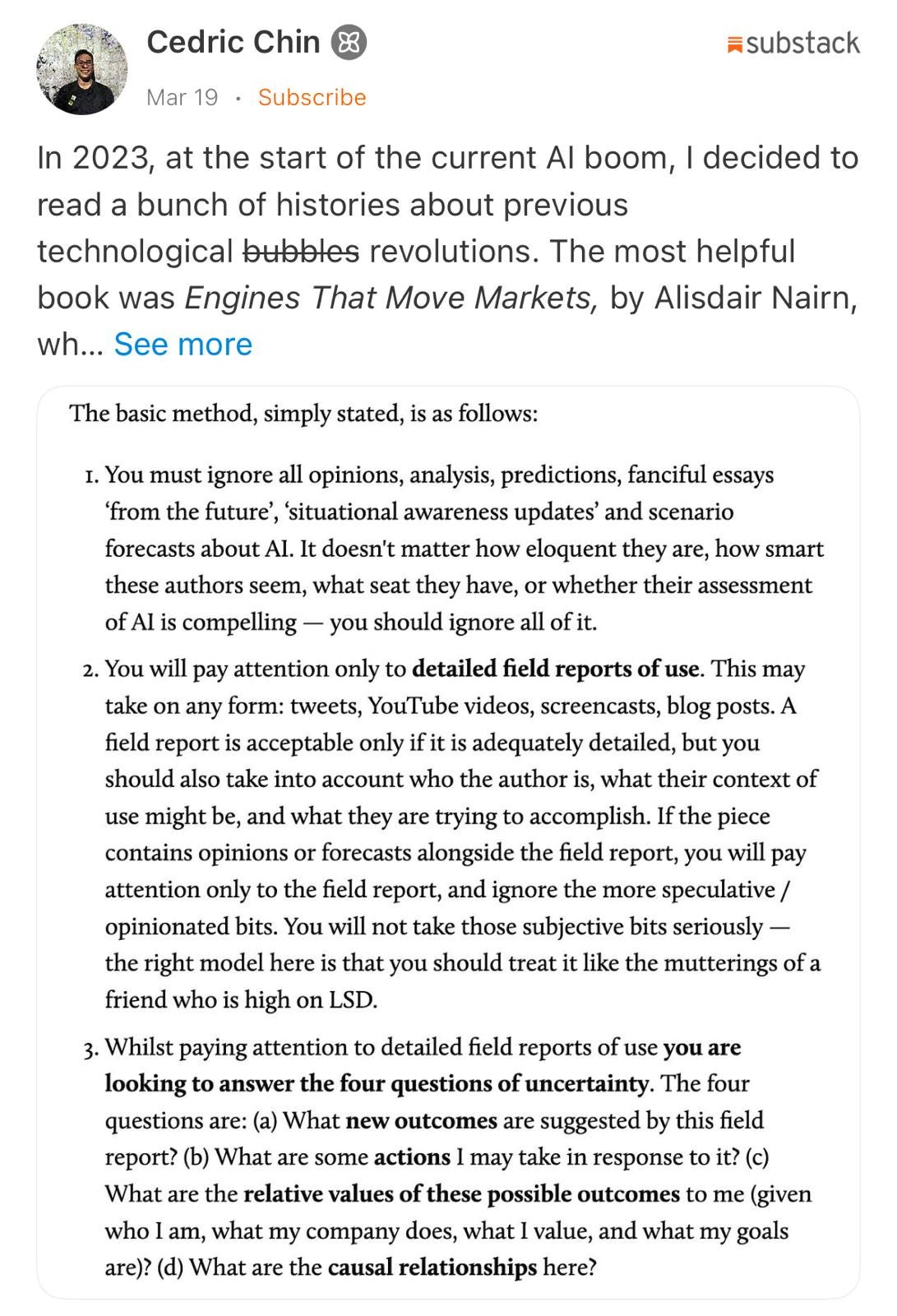
Some people told me how going to China is like traveling into the future. Some short notes on that.
The UI of the customs entry form you need to complete at the border is great. The best I’ve seen. From a photo of your passport it prepopulates all your personal details. All of the fields that require you to select from a list have a good mobile friendly way to choose your option. My only complaint is that I had to input the address of my hotel. Assuming the Chinese has the ability to track anyone down if they need, this seemed a bit pointless.
AliPay is the app to order items from a QR at restaurants, and the app you use to pay everywhere. That integration is nice. The integration between AliPay and Didi (the ride hailing app) is also excellent. I liked AliPay as a core ‘buying things in the real world’ app. However, I will also say that the Western infrastructure of cards + ApplePay seems just as good. The big missing link in the Western system is that there is no QR based solution readily built-in. As a result, the QR based payment flows are a mess, with most countries having their own system.
Location service did not seem to work so well in China. It uses BDS, instead of GPS, but I’m not sure if that’s the issue. Apparently there are some other nuances about the coordinate system, and obviously the map apps. However, I also noticed it with Didi (ride hailing in China). It might also be because of using a foreign sim card.
Most of the robots I saw were being controlled by a human with a game controller. A few were walking around by themselves doing little dances. My main takeaway about the robots is simply: It’s still early. Earlier than I thought. People constantly say that it’s hard to see humanoids really work without much more powerful AI, and I understand that now.
But the hardware is also still early stage. Hands are a big problem, and the most advanced hand I saw was $14,000 (per hand!). It was shown playing piano. For a robotics person who knows the incredibly hard engineering work that went into that demo, I can imagine it was impressive. For a human who has only seen robots on TikTok, not so much. The various four legged form factors seemed more mature. There were many dog like robots with wheels or legs that were being sold for use in surveillance, and to go into dangerous places. Still, the demos of the real thing, in person, were nowhere near as impressive as the ones in the videos. In the flesh, the robots mostly did nothing unless their humans were actively controlling them to demonstrate abilities. Hence, the autonomy, which should be enabled by good robot AI, is not there yet.
That’s what someone told us who was selling Blackwell powered desktop computers, like the Nvidia Spark. We were asking who was buying these computers, and for what. He did not really have an answer. Even though these Blackwell computers were from different brands, it took me a lot of time to understand the reason for their existence. There are people who want to run AI models locally: for privacy, but mainly just for research on AI models. There isn’t really a commercial use case for these things yet, or at all.
There was also a huge number of AI powered pets in all shapes and forms. Cat shaped, dog shaped, furry, big ones, small ones. Every possible iteration is available. You can talk to them like you talk to ChatGPT. Sometimes there’s a game element. Some are meant as educational companions for kids (a bit dystopian). And smartglasses, lots of different ones (I’ll talk about them in a minute). The busiest booth by far was the one selling mechanical keyboards.
In the same consumer gadget area, I played chess against a cute robot.
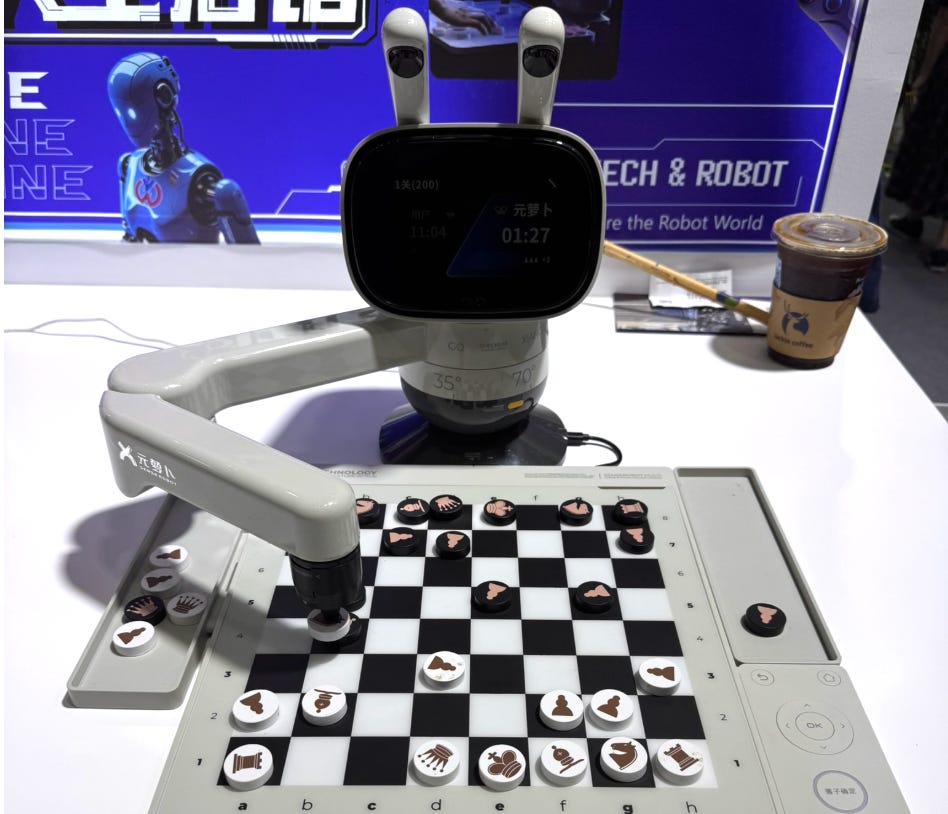
The reason the quote from the computer seller struck a chord is that it seems like in Shenzhen, products are built just because they can. It’s a technological inevitability that a physical chess robot will exist. But why? Who could possibly want a physical chess robot? If I wanted to play chess against a computer, I can do that on my phone.
I think this is more a Shenzhen thing than a China thing, in that this is the electronics manufacturing hub of the world. They will manufacture all the things.
It is kind of remarkable that Google Glass came out 13 years ago. Current smart glasses, for example from Rokid are much more affordable. They also are significantly better thank to AI. From live translation, to messaging, to guidance (“ok Rokid, I’ve cut the blue wire, the bomb is still counting down, what should I do next?”), there are some cool use cases here. I still think it is quite creepy to imagine people walking around with cameras on their head who can take photos and videos without any kind of disclosure to the people around them. But I guess this is probably also a technological inevitability and future trend.
The key challenge with smart glasses is still battery life, and the continued stupidity and latency of LLMs.
Big passenger drone. Very cool to see up close. Passenger drones are apparently called the ‘Low Altitude Economy’ now. (低空经济 / dī kōng jīng jì). I was not aware of that term.
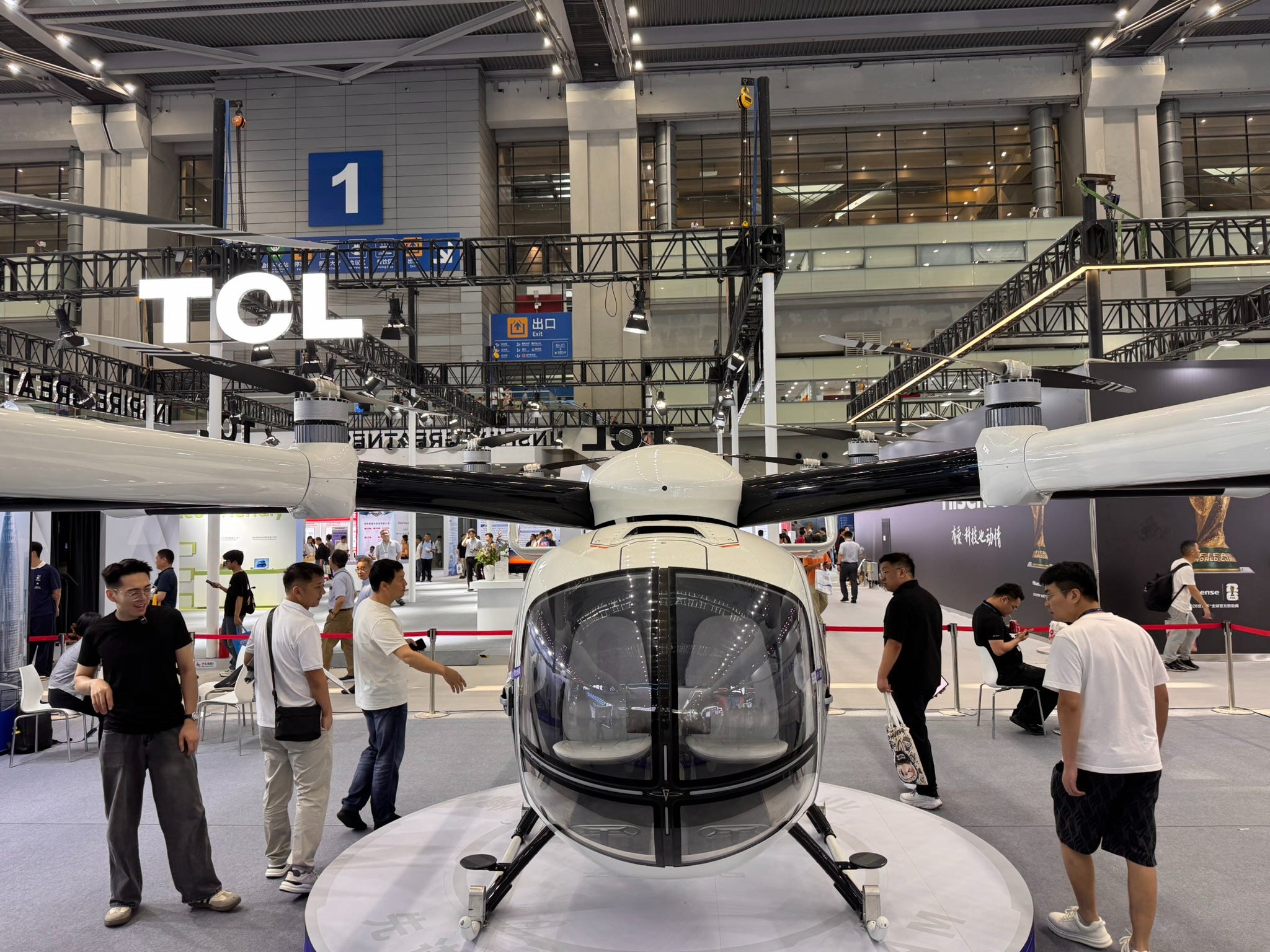
Sightseeing trips with real passengers have still not commenced, three years after Ehang’s certification of the aircraft. But they are said to become available any moment now. Again, this is going to take a lot more time.
Screens and other gadgets
Every kind of screen was for sale at CITE. From massive, super high fidelity ones down to screens in every conceivable size and shape. If you want to create any kind of hardware, with any kind of screen, that is no problem at all. There were also see through holographic screens that displayed an avatar that you could talk to. The intended use case was as a guide at a museum or in-store clerk.
The only gadget I was tempted to actually buy was a really cool hardware translator with a small screen. It worked offline and with almost zero latency, using an on-device LLM. It was $160. It’s true that you can just use your phone for this, but I’ve never found the UX to be super convenient. And if you’re using your phone to translate, you can no longer use it to show things to the person you’re speaking with. Thinking back to the days I did user interviews or even sales in Myanmar and Bangladesh, this device would have been amazing.
More than anything, I’d like to go back to China with my family and explore the more rural areas. I would also love to visit some of the other cities, Shanghai obviously, but also Chongqing. Traveling is always a great way to get more appreciation for your home country. And seeing Shenzhen made me realize more than anything else how futuristic and high-tech Singapore is. There was nothing I saw in Shenzhen that was not familiar to me from Singapore. We’re even getting self-driving cars in Singapore this year, and I did not actually find any in Shenzhen! Singapore is also constantly building. Building building building. Some of it is ambitious new stuff, like ‘Long Island’. But a lot of it is refreshing. Tearing down old buildings to replace them. Singapore is lucky to have build housing significantly larger back in the day, which means it is now still often possible to tear down an aging housing block and replace it with a higher one with smaller units, for a big increase in homes per area.
One of the most interesting elements of this trip was spending time in Hong Kong before and after my trip to Shenzhen. Hong Kong looks old in many places. It’s an awkward city partially carved into a stone hill. The MTR (subway) is overflowing with people during rush hour. A project to, say, double capacity of all the busiest stations would be monstrously expensive. And that’s just one of the countless things that could use an update. Its dated housing blocks already contain sometimes shockingly small apartment units. The only place to go is up, which is expensive.
But to my surprise, also in Shenzhen, Infrastructure is already older than I expected. Taxis are electric but aging BYDs. Some parts of the city already look dated, with buildings clearly not made to last. China has famously staked a large part of its economy on building real estate, resulting in awesomely fast growing cities like Shenzhen, but also full-scale ghost towns. All of that stuff will need to be maintained. The maintenance cost of anything you built goes up over time. That’s both because of inflation and because more things break as something gets older. At some point, things need to be replaced, which is what the USA is also ‘discovering’ about their highway network, bridges, and trains. Infrastructure aging is real and is going to hit China like a sledgehammer at some point. While I’m in favor of building, some degree of restraint seems smart1.
As almost always, I end up finding myself in the middle somewhere. Partially while I was in China and partially back home I read Breakneck, by Dan Wang. Definitely a book recommendation with eye opening passages, especially in the first half.
Comments
Nothing yet. Say the first thing.
Sign in to join the conversation.