
Even though I’m getting to middle-age, I still remember being in my twenties and trying to figure out what I wanted to do with my life. Studying in the Netherlands, especially back then, allowed for lots of slacking around and figuring things out. I studied law for a year, then did my Bachelors (slowly) in Biomedical Engineering, before switching to Finance and starting work in Private Equity. I decided I wanted to get involved with startups and become a VC, but VCs wanted people with ‘operator experience’, so I joined Rocket Internet and moved to Bangladesh to get some operator experience. After that, I decided that operating was more fun than investing, but I also took a two year sabbatical on Bali before starting my own company. Now, in the last two years I have completely reinvented myself as an ‘AI expert’ (it sounds super silly, but it’s plainly true, and I’ve heard my name has started appearing on other people’s lists of AI experts).
Where I’m going with this, is that given this weird path, I still find myself quite unqualified to give career advice to young people. There is no way anyone can or should try to mimic a path that is this random. So I usually limit myself to asking some questions and a couple of basic tips: try to work with people you admire, work on a subject that interests you, but also… try to be interested in many things. That’s basically what my life so far has boiled down to. Just being open to getting interested in something, then following that interest. AI is changing things, but some of these pieces of wisdom are timeless. So I enjoyed reading this post from Jasmine Sun, which hits on similar points. It offers some great and timeless advice.
What I also agree with, is that she points at some of the things about the ‘old world’ that a lot of people hated anyway, like credentialism and I guess more broadly “the rat race”. One thing I have never done myself is join the rat race, and I wholeheartedly recommend young people to also look for the side doors and fake walls to get out and try to play life in 4D.
The making of El Mariachi, exhibit A: not joining the rat race
How to walk through walls / Hacker Mindset, by Escaping Flatland
Nine months later, having finished El Mariachi, the first part of his planned trilogy, Rodriguez found himself in the office of Robert Newman, a Hollywood agent. Watching the trailer Rodriguez had cut, Newman, who would go on to sell the movie to Columbia in a deal worth $1.8 million, asked:
“How much did it cost [to make] again?”
“$7,000.”
“Really? That’s pretty good . . . most trailers usually cost between $20,000 and $30,000.”
“No,” Rodriguez said, “the whole movie cost $7,000.”
The story goes on:
Rodriguez bought 250-watt bulbs that he screwed into the existing lamps on the sets, and that was that for lighting.
At film school, they had also been taught to shoot several takes from multiple angles so the editor could shape the scene, but since Rodriguez was the editor, he could visualize exactly what the scenes would be, shooting only precisely what was needed, a single take per scene, which minimized the cost of film stock and editing time.
A thousand small optimizations like this meant he could shoot the film in ten days while staying with the lead actor’s mom in Ciudad Acuña during summer break.
Everyone who knew anything about making films thought Rodriguez was crazy and had zero chance of success. Of course, El Mariachi and the sequels “Desperado” and “Once upon a time in Mexico” are…well… classics now.
On the one hand, it is important to realize that this is a generational outlier. It is not easy to do what Rodriguez did. Throwing conventional best practices out of the window is probably more likely to go wrong than well. But on the other hand, lots of things in the world have fake, constructed rules. AI certainly enables these Rodriguez like hackers to just go and make movies. When I started Ox Street, I spent close to 100k on engineers and designers to get the first fully functional version of our platform out (not the MVP, that was Shopify and some plugins). Recently found myself wondering how much time and money it would take to rebuild it with AI. I think it would take about one month instead of three, and that it could be done by one engineer and a designer. Some gatekeepers have disappeared.
Dolphins enjoy a great reputation, despite extensive documentation that many of them are assholes. They regularly rape and murder other dolphins, including babies, and also other animals for fun. Dolphins are clearly intelligent, and have huge brains, about the same size as a human brain, and relative to the size of their bodies, they have the second highest brain/body size quotient of all animals after humans.
Since dolphins are probably the second most intelligent species on earth, just behind mice humans, I guess it is no wonder that humans are curious about Dolphin language. It was therefore about time that Google Deep Mind released a Dolphin LLM, and it’s called DolphinGemma.
A large language model that uses dolphin audio to help scientists study how dolphins communicate — and hopefully find out what they’re saying, too.
Obviously this is one of those things that you just can’t make up, something that might as well be from a Silicon Valley TV Show episode. But this also reminded me of an outrageous dolphin story I read once, about a woman who tried to teach a dolphin English in the 60s. Here is that story.
This post is awesome, and I have two quite separate things I want to highlight about it. First, the topic itself. DVDs were such a big part of my life for 15 years or so, and me being a teenager and student back then, those were also obviously my ripping days. But the other fascinating aspect of this post is the way it is written. The post is clearly underpinned by the writer’s human life experience and expertise. It is a rich tapestry of human memories and physical world happenings that no AI could come up with. But the prose has ChatGPT’s fingerprints all over it. Just one small example:
Layer Two: PCFriendly, The Bonus App That Time Forgot
To be clear, I’m fine with that. It is repetitive towards the end, but the post overall does not suffer from it. But it did get me thinking:
Would this post not have been written without AI? Or it wouldn’t have gotten finished? That would have been a shame, because I really enjoyed reading it.
What was the process like? What were the prompts? For the first time in history we are reading words that were not written by the author. What did the author mean? What words would he have chosen? No more shall we be able to ‘read between the lines’ of a follow-up email from a recruiter or negotiation partner.
In Dutch culture, honesty and authenticity are valued. I find myself wishing people would just give me the prompt for the email or document they send me, instead of the AI’s output.
Now, on to the content itself. The post is partly a trip down memory lane for millennials, but also a very interesting tour of a technological museum. I do remember that this is roughly what was on a DVD.
E:\
├── AUDIO_TS\        (empty, legacy)
├── VIDEO_TS\        (the actual movie)
├── COMMON\          (cross-platform bonus assets)
├── MAC\             (Mac-specific bonus runtime)
├── WIN\             (Windows-specific bonus runtime)
├── drmworks\        (DRM library files)
├── PCFriendly       (the bonus app binary, no extension)
├── PCFriendly_Read_Me
├── install.exe      (the installer)
├── autorun.inf      (Windows autoplay launcher)
├── disc.id          (small token identifying the disc)
└── readme.txt
The post goes:
Open any DVD on any operating system and you will see the same two folders at the top level:
VIDEO_TSandAUDIO_TS. The second one is always empty (it is the legacy DVD-Audio format that nobody adopted). The first one holds the actual movie. (emphasis mine)
Never have I used a DVD for audio, so I had to look this up. Welcome to the first room of the museum. It turns out there were ideas to use DVD’s higher capacity vs CDs to create a music medium with higher quality music. But CDs at 44.1 kHz (uncompressed audio sampled 44k per second) already sound great and nearly losless, so there was very little demand for higher quality audio. In fact, just 5-10 years later, consumers would accept a massive drop in audio quality for the portability (and pirateability) of MP3s1. Another decade later, Tidal also never really took off in the mainstream. High Fidelity is niche. Let’s move on.
In the second section of the museum, we have “PCFriendly, also branded as InterActual Player, a Windows application that early-2000s DVD studios bundled on every disc.”
The pitch was: you put the disc into your PC, Windows would auto-launch
install.exevia theautorun.inffile, and you would be prompted to install the InterActual Player runtime. Once installed, the player would do things a normal DVD player could not. It would pull “web-enhanced” bonus content over your dialup connection. It would link out to studio websites with deleted scenes and trivia trackers. It would offer real-time text overlays of director commentary. It would let you download movie posters as desktop wallpaper.
Now, I can tell you that I don’t remember using this ever. I can totally picture the Powerpoint decks, meetings, and Excel files about this idea though. But not only did nobody in their right mind ever put a DVD movie into their computer in the first place, the project also had some naive assumptions about computer technology. Within a matter of a few years, the online content was no longer available and the software no longer compatible with newer PCs. Let’s quickly move on.
To enter the last room, take a shot of rum and grab an eye patch, because here be pirates. Piracy was of course rampant in the 00s. Who didn’t have a spindle of burned DVDs? Some friends of mine had entire folders full of movies. Music too, obviously. This is what happened with global recorded music revenue over that period of time. The one for movies probably starts going down later, but the overall shape must be quite similar.
The media industry did everything they could to fight piracy. They were suing 12 year olds for downloading music. It was a lost cause obviously in retrospect, but a lot of effort was spent.
In 1999, a Norwegian fifteen year old named Jon Lech Johansen reverse-engineered the CSS encryption used to protect every commercial DVD. He published the resulting decryption code, called DeCSS, online. Within months the DVD Copy Control Association sued him. Within a year the United States DMCA had been weaponized to threaten anyone hosting the source code. The MPAA argued that DeCSS distribution was a federal crime. The Electronic Frontier Foundation defended the case. A New York federal court ruled in 2000 that even linking to DeCSS source code was illegal under the DMCA’s anti-circumvention provisions. The case went to the Second Circuit. The Second Circuit affirmed. People got subpoenaed. T-shirts with the seven line DeCSS source printed on the front were briefly considered legally dangerous.
Every generation gets a unique technology landscape they grew up with. For millennials it was PCs, MSN, Napster, burned discs that would sometimes skip when the car went over a bump, and piracy warnings. What a time to be young.
My whole family had Influenza A. My son got it first, and I was his primary caretaker, even spending a night at the hospital with him. The night I got home, my partner got it, and then a few days later my daughter. With every person and surface around me being covered with virus, it was a matter of time that I would get it. Coincidentally I had bought a whole bunch of craft beer online with our groceries (to hit the minimum value for free delivery of course). So every night, convinced that I’d be sick the next day, I’d have one or two IPAs to enjoy my last night. Except I didn’t get it. Nobody else drank as much IPA as I did. Obviously, it’s the IPA. A year ago I was at an oyster place and I ate an oyster that was very obviously bad. But I only noticed when I had already swallowed it. So I chased it with two shots of tequila. Got away with that one too.
A few quotes
"You never know what worse luck your bad luck has saved you from." (Cormac McCarthy)
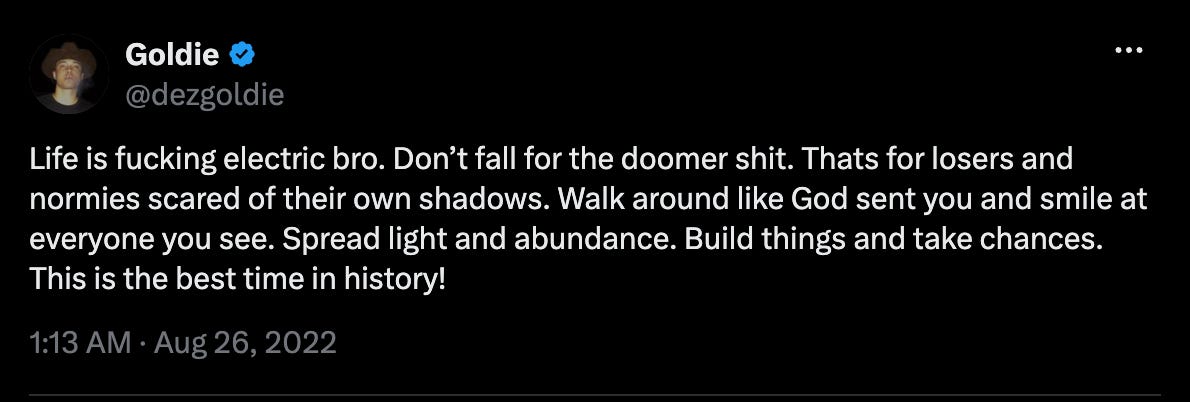
Remarkable timing, three months before ChatGPT. Kind of random, but I dig it:
Natural fabric sports clothes
I started getting into cotton and merino wool workout wear. Bought two pairs of shorts from Ryker Clothing Co, and loving them so far. Might try a shirt next. Now that I have bought something, I’m also on the online marketing targeting train for natural fabric sports clothes, and it turns out there is a lot of it!
Dumb phones
Every once in a while I fantasize about ditching some technology. Sometimes I succeed in using new technology to ditch some other technology. For example, thanks to my Apple Watch, I feel comfortable going out the door without my phone. I can pay for stuff with my watch, listen to music, and in case of an emergency I can call and I can be reached. The idea of ditching the smart phone sings around in my head from time to time. Maybe, if I can use Telegram to let my Clawdbot handle productivity stuff, I can do it thanks to AI. Maybe, with better voice control, my watch can soon do everything. I don’t think I would mind getting rid of the screen. Although I do like reading newsletters on my phone. Tethering/hotspot mode which I use all the time is a must-have for me though. So I’d want 5G. And then there is maps, taxis, ordering food and groceries, wiring people money. Hmm, ok maybe not. This looks interesting though!
So, CDs at 16 bit x 44.1Khz come down to about 1,411 kbps. DVD Audio would take this up to over 9,000 kbps. Early MP3s were often 128 kbps, and even now Spotify streams at 320 kbps. 320 is good enough to DJ with and can only be distinguished from lossless audio on super high-end sound systems.
Comments
Nothing yet. Say the first thing.
Sign in to join the conversation.