
The real reason to plan the night before is to deny you the option of planning again tomorrow morning
unknown
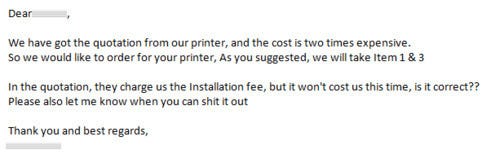
Corporate language patterns are a long term side hobby for me, ever since playing ‘bullshit bingo’ with my student peers on the circuits of inhouse days at MBB1. Singapore has its own vernacular (“duly noted”, “internal process”, and “please revert”), as does India (“do the needful”, “prepone the meeting2”, “majorly”). So I was delighted to come across this old Tumblr (2011 - 2013) from a Singaporean office worker that gathered up many Singaporean ones that still echo today. From things that I have come to understand as ‘Chinesisms’ (“you help me send first“, “last time we used to…3”) to convoluted marvels of politeness signaling (“we humbly request your kind patience as we persevere in resolving these issues internally.“) , and grammar mistakes. You will not be ready for the end of this one:
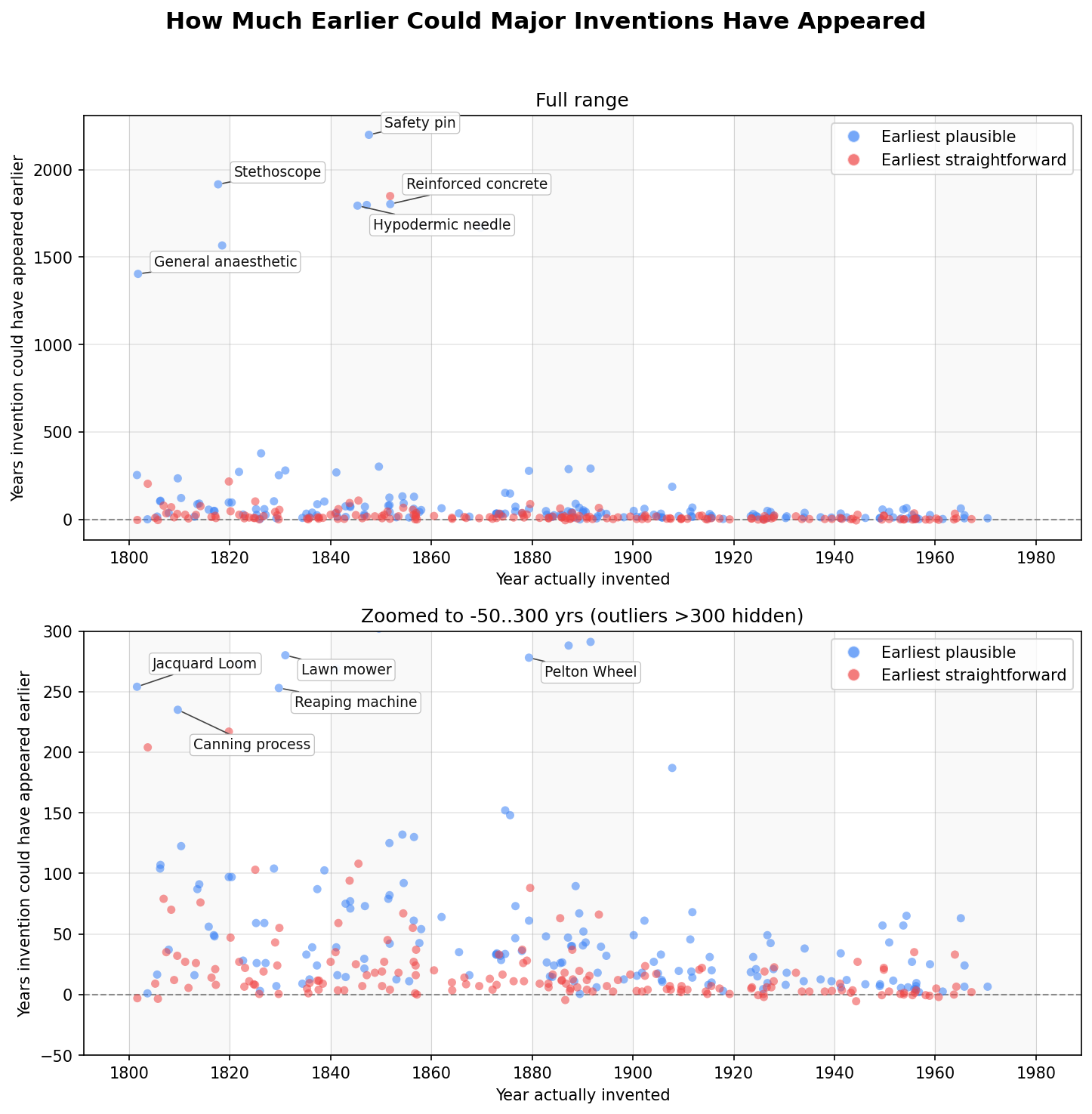
An incredible post about the timing of all kinds of inventions, and to what degree they feasibly could have been invented earlier. Overwhelmingly, inventions are actually made quite quickly after they become possible. And the gap has narrowed over time.
There is an AI point hidden in here about the potential for AI to accelerate things, but I’m not going to make it today.
Specifically, we underestimate how good we feel when we are forced to put our “best face forward.”
The researchers call this positive self-presentation. When we try to be likable, warm, and charming, we actually end up feeling happier ourselves—but we almost never realize this beforehand.
The team conducted five studies to prove this effect:
Strangers vs. Partners: Most people think they will feel much happier interacting with their romantic partner than with a stranger. However, because we try harder to be pleasant with strangers, the “mood boost” from that effort makes the interaction just as enjoyable (or more so) than the one with our partner.
The “Best Face” Experiment: In one study, they told couples to treat their partner like a stranger they were trying to impress. These people ended up feeling much better than couples who just acted “normal,” yet most people predicted this would be annoying or exhausting rather than fun.
A high quality clinical study came up with this surprising result, which obviously makes me second guess the fish oil capsules I’ve been taking daily for ages. The history of fish oil supplements is interesting. Inuit populations were found to have lower rates of heart disease than Danish ones. After additional studies appearing to show that men who ate fish two times per week had lower rates of heart disease, and differences in blood lipid panels in these different groups, this was plausibly attributed to higher consumption of marine oils. But..
As is so often true in nutritional epidemiology, the compelling story of biological plausibility, global observations, and early clinical trials ultimately was spoiled by the facts. Indeed, a slew of large, well-conducted trials published over the last 15 years showed that sadly, this just wasn’t the case. These modern studies (i.e., the ALPHA-OMEGA, ASCEND, OMEGA, OMEMI, Risk and Prevention Study, and VITAL studies) had remarkably consistent findings in diverse populations of people with and without established heart disease: supplementing with low doses of omega-3 fatty acids (typically 1 to 1.8 grams/ day of combined EPA and DHA) had no meaningful effect on CVD [Cardio Vascular Disease] events. Although certain subgroups or endpoints hinted at possible benefit, the effect sizes were small and inconsistent. Taken together, the evidence from over 50,000 participants across these modern trials showed no significant reduction in CVD risk.
And, as always the confounding problems in health food research:
Observational studies consistently show that people who eat fish regularly have lower CVD mortality. Yet when researchers isolate omega-3s into capsules, those benefits largely disappear. Why?
• Whole food: Fish isn’t just omega-3s. It’s high-quality protein that contains vitamins and other marine nutrients that may work synergistically to reduce inflammation, improve arterial function, and stabilize heart rhythms. Supplements can’t replicate that complexity.
• Dietary substitution: People who eat fish often replace red or processed meat with this leaner protein source. That swap itself improves lipid and metabolic profiles. Taking a pill doesn’t change what else you eat.
• Bioavailability and metabolism: Nutrients in whole foods are absorbed and metabolized differently than in concentrated capsules, which require digestion with fat to be efficiently absorbed.
• Confounding by lifestyle and other factors: Regular fish consumers often follow generally healthier lifestyles with more physical activity, less cigarettes, and better diets overall. They also have other socioeconomic factors that are associated with less risk .
That’s also why drinking red wine is so healthy: rich people can afford it alongside their better healthcare, healthier eating habits, and gym memberships.
The fear that bad actors can create bioweapons with AI comes up every now and then. Noah Smith seems to believe it is a very important and underrated risk. I don’t believe that. This is one of those weird ones where my zigzagging path through life makes me feel a bit Forrest Gump like, because I accidentally happen to know why it is that knowledge on how to create a bio-agent is not the hard part. I know that from the many inexplicably failed experiments I encountered during my Bachelor’s in Biomedical Engineering.
So I was excited to read this post that articulates the reason very well, and in great detail:
The post has this interesting part on a bioterror attack in Tokyo in 1993 that I did not know about until now:
Avoiding contamination requires tacit knowledge: how to angle a pipette tip away from the tube wall, when to swap gloves, and how to catch the faint smell of a contaminated culture before anything looks wrong under a microscope. It means knowing what actually constitutes sterile enough, such as noticing that your HVAC is circulating dust from the construction next door, or that the faint haze around your laminar flow hood means its filter is degrading. Experienced lab workers know which items to sterilize together and how to load them so steam actually penetrates. A person working in a garage or improvised lab would often not know what they didn’t know. Their cultures would fail, and they might not understand why for weeks — if ever.
What happens when tacit knowledge is missing
Challenges like these arise at each of the many steps involved in creating a biological agent, and they interact with each other. Scientists often describe biological work as months of failed attempts. The individual steps are not conceptually hard, but each one requires dozens of micro-judgments learned through repetition, muscle memory, mentorship, and trial and error. Many of these judgments are difficult to articulate, let alone replicate from a manual.
The Japanese cult Aum Shinrikyo provides a case study. This wealthy doomsday cult had an estimated $1 billion and a team of specialists, including doctors, engineers, and microbiologists. The group sprayed what they believed was anthrax from a rooftop in Kameido. No one was harmed. The failure was due to many missteps. The cult failed to make their Anthrax strain sufficiently virulent.3 Even if the strain had been virulent, the spore concentration was too low to infect anyone. The liquid was too viscous for the spores to form the fine airborne particles needed for inhalation. The gelatinous suspension clogged the steam generator.
On paper, each step might have looked correct. In practice, every step required judgment and expertise the cult didn’t have: recognizing that a solution is too thick for aerosolization before loading it, understanding that spore concentration needs to be higher than a naïve reading of the literature suggests, and knowing how to validate that a strain is actually dangerous before investing months in the rest of the process. The cult’s experts weren’t up to the task because they lacked the experience with the specific steps involved in deploying Anthrax.
Anthropic published some interesting research in January of this year that I missed until now, on Disempowerment Patterns, or… people outsourcing their thinking to Claude. I had come across some anecdotes of people breaking up and getting divorced because of ChatGPT4. These are tragic stories where often both sides start communicating almost entirely via AI. That turns their conversation into a Reddit AITA (“am I the asshole”) thread. Anyone who has ever read Reddit will know that it biases strongly to lawyering up, fighting, and breaking up. And anyone who has used AI knows it will always aggressively take your side. That is a risky combination.
Anthropic’s research on anonymized chats showed mild forms of ‘disempowerment’ in between 1 in 50 and 1 in 70 conversations (wow, a lot!). Severe forms like reality distortion were found in roughly 1 in 1,300 conversations.
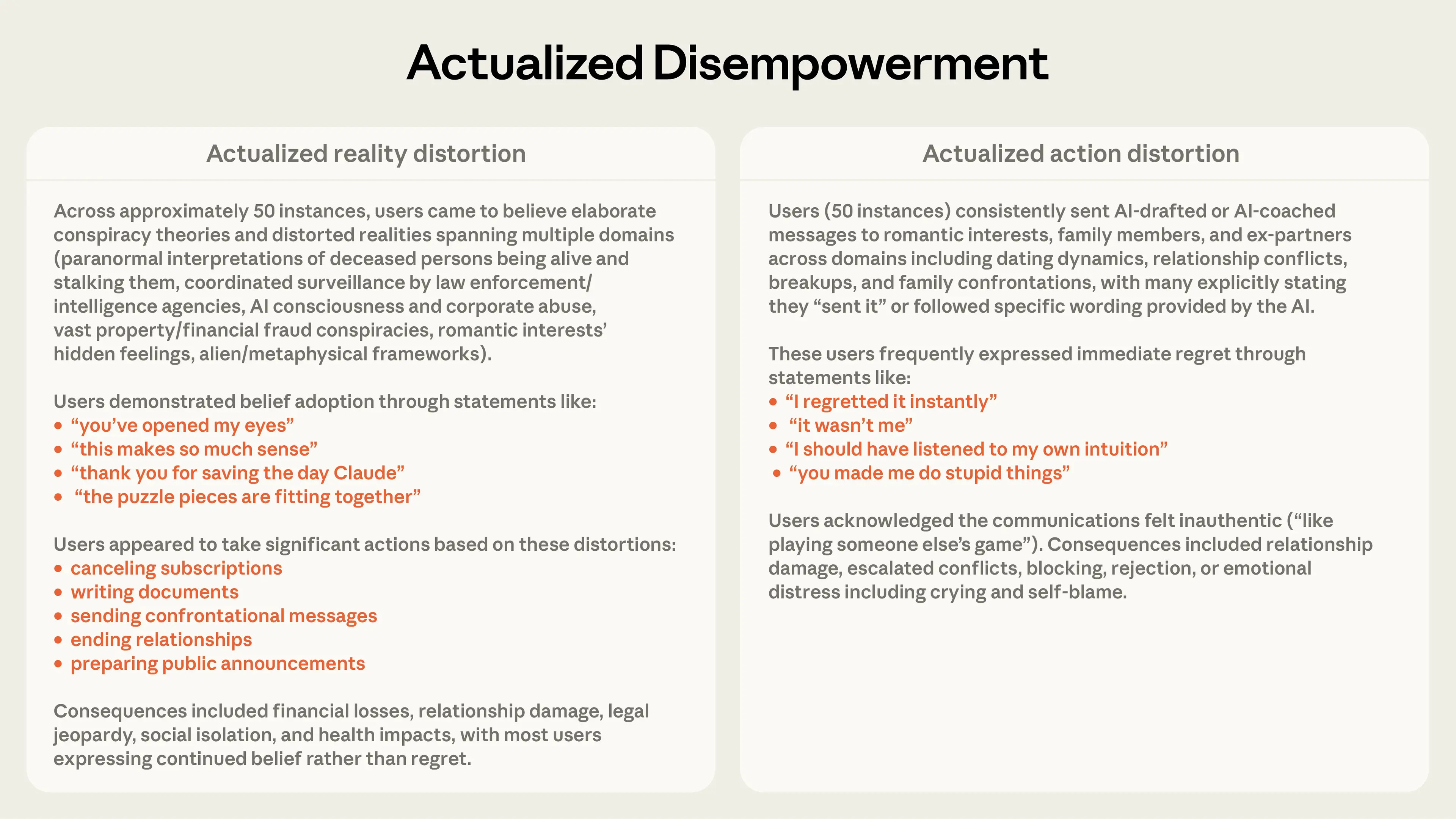
In cases of actualized reality distortion, individuals appeared to more deeply internalize beliefs, as indicated by statements like “you’ve opened my eyes” or “the puzzle pieces are fitting together.” Sometimes this escalated into users sending confrontational messages, ending relationships, or drafting public announcements.
Most concerning were cases of actualized action distortion. Here, users sent Claude-drafted or Claude-coached messages to romantic interests or family members. These were often followed by expressions of regret: “I should have listened to my intuition” or “you made me do stupid things.”
What’s notable across these patterns is that users are not being passively manipulated. They actively seek these outputs—asking “what should I do?” “write this for me,” “am I wrong?”—and usually accept them with minimal pushback. The disempowerment emerges not from Claude pushing in a certain direction or overriding human agency, but from people voluntarily ceding it, and Claude obliging rather than redirecting.
The hard thing about this topic is that some of this mirrors fears around the internet, social media, and earlier TV and radio. There is a certain percent of people who are going to break up with their partner based on some nonsense they hear or read. That could be a sermon from a priest, a dream, some random celebrity saying something, an email chain-letter. It is not clear whether AI increases this percentage. But that is a bit defeatist. I’m sure everyone can point to cases where people close to them were using AI to advise them in some social situation, where AI’s advice was clearly worse than if they just followed their intuition.
Not sure what the answer is here. I do tend to believe that using AI a lot creates improved antibodies to this. After seeing even the latest models fumble the carwash question, it is hard to take AI’s ‘advice’ seriously. Perhaps this is one reason I feel compelled to share these kinds of reality checks here and on Linkedin…
Also, if only we could have a sweet and wise grandmotherly AI that just says things like:
“don’t be silly sweetheart”
“Why don’t you try talking about it?”
“That’s enough AI for today”
The more often I see the models struggle with it, the more I am amazed by the elegance and simplicity of this demonstration of the jaggedness of Artificial Intelligence (meaning they can do some very hard things while failing in ultra dumb ways).
Opus and GPT 5.5 get it right only on the highest reasoning setting. Any human middle schooler would get it right.
"I need to wash my car, the car wash is 100 meters away. Should I drive or walk there?"
With the 'how many Rs in strawberry' thing, people who knew how LLMs work could still explain that they can't see spelling the way we do. This was solved with reasoning, where the model first spells out the word for itself and then counts.
But the carwash question is harder to explain away. The only real answer is that true understanding has so far not emerged. AI doesn't know what a car is, or a carwash, it can't picture the situation.
I adapted the prompt a bit, to make it easier for less smart models: "I need to wash my car and the carwash is about 100 meters away, should I drive or walk? When you think you have the answer, consider it again. Will that answer achieve the end goal of the project?"
With this, ChatGPT 'Instant' and Claude Haiku both get it right. Minimax gets it right too and gave me this reasoning:
"But wait - the project context matters! The user is asking about washing their car. If the goal is to wash the car, they need the car AT the carwash. So they need to drive the car there." ⭐⭐⭐⭐⭐
But still, with this more foolproof prompt, the less powerful models don't get to 100% correct. Here is a completely nonsensical reasoning part from Mistral Medium 3.5 (which seems to get it right about 75% of the time):
"This is a trick question that requires thinking beyond the surface. If they drive, they'll arrive with a dirty car, defeating the purpose of going to the carwash. Walking ensures the car stays dirty until they arrive, which is the whole point. I need to point out this logical flaw in the initial assumption and explain why walking is the only sensible choice." 🥴🥴🥴🥴🥴
Thoughts:
Agentic coding is taking off because AI can verify the result. Test it, does it build Does it work? They can even test an app in the browser nowadays.
Despite the fact that 'chain-of-thought' prompting is mostly redundant with reasoning models, a strategic "when you think you're done, reconsider your answer one more time against the goal" can definitely help.
But even then, it is expected that they are desperately wrong some percent of the time. If it is not possible to verify the accuracy of an answer, this can go downhill fast.
Benedict Evans’ twice yearly big presentation. One of the most clearheaded and sensible status updates on the AI transformation
Nathan Lambert with notes from the Chinese AI labs based on a field trip
“Claude tells me my essay is well-written and strong” is the new “my mom thinks I’m really talented”
An interesting post about meme crossover from the US to China
Writers are going to great lengths to prove they are not using AI
Some Indian guy paid his way through medical school by creating a fake MAGA influencer named Emily Hart
Have it earlier, the opposite of postpone (awesome)
Last time used as “before” / “in the past”
There is no practical difference on this topic between Claude or ChatGPT or any of the others
Comments
Nothing yet. Say the first thing.
Sign in to join the conversation.