
Special thanks to GigaClimate Advisor and our A&R Series author, Chris Mangieri
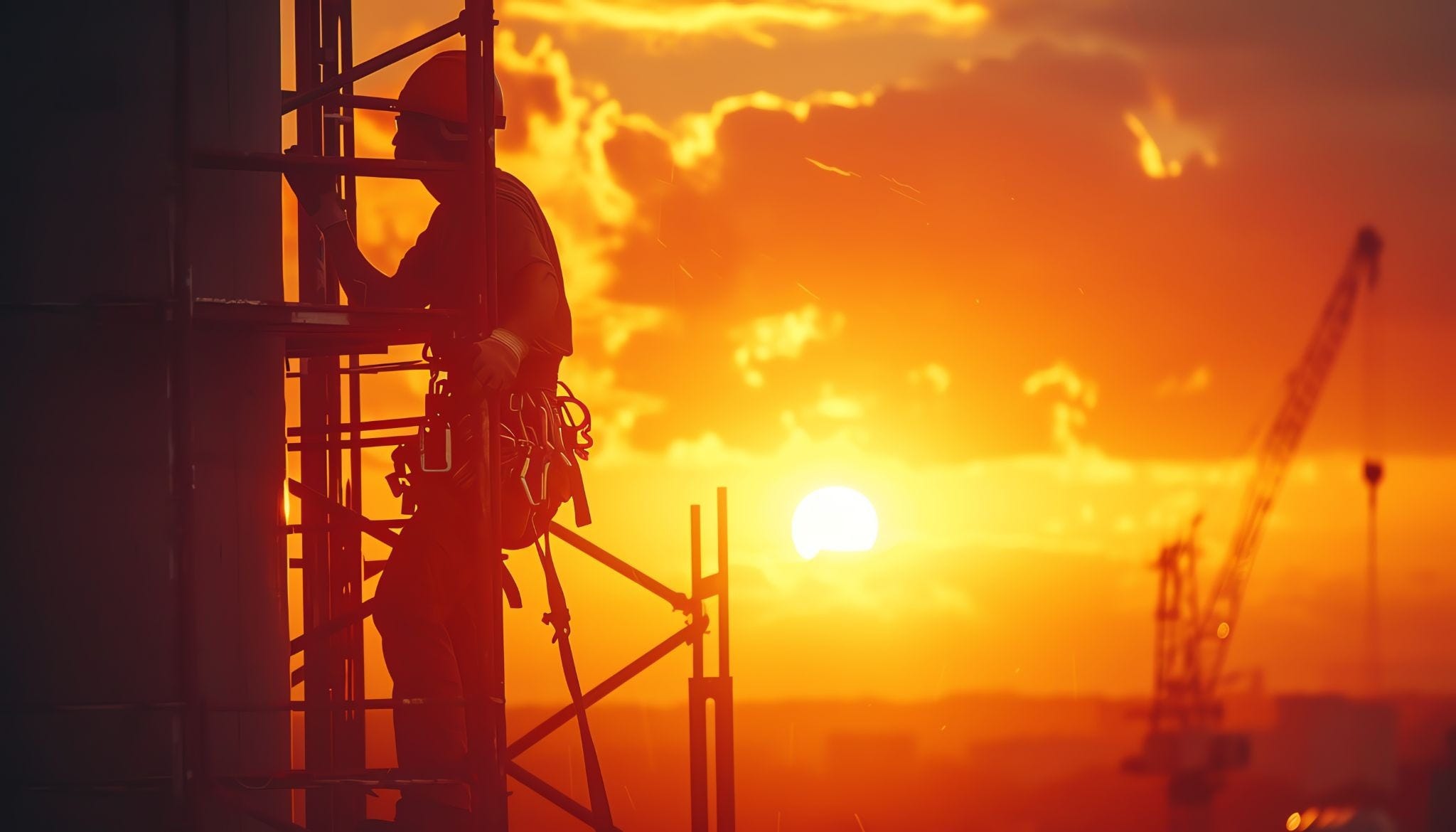
In 2024, heat cost the global workforce 640 billion labor hours and $1.09 trillion in lost output. It also killed an estimated 546,000 people worldwide, roughly one per minute.
In 2023, 2,325 Americans died from heat, the highest official toll on record. Texas A&M researchers put the real US total at 11,000, and the gap between those figures is built into the system. A medical examiner certifies a heat-related death when someone arrives at the ER with a core temperature of 106°F. When someone dies of a heart attack at 85°F, the certificate says cardiac arrest, with little indication of what caused it. In Texas alone, official records capture only about one-sixth of statistically estimated heat deaths, and the state’s official 2023 count was 563. The regulatory architecture is built on the number medicine can certify, not the one the statistics reveal.
But the deaths are the extreme end of a curve that starts much earlier. In field studies of outdoor crews, worker productivity falls by roughly 0.5 to 2% for each additional degree of wet-bulb temperature, depending on how strenuous the work is. That scale, the combined measure of heat, humidity, and sun exposure, is what the Occupational Safety and Health Administration (OSHA) uses to set its heat thresholds. That’s not a catastrophic event; it’s a Tuesday in Phoenix in August. A warehouse operator whose pickers are running at below 50% capacity because it’s July and the facility doesn’t have mechanical cooling; the throughput loss posts to the P&L, not to an incident report. A project running two hours over because the crew hit the 90°F threshold and the foreman called a mandatory rest.
Aggregate that loss across the US workforce and the math lands at nearly $100 billion per year in reduced output. Without intervention, that reaches $200 billion by 2030 and $500 billion by 2050. The same logic lands on an employer’s books: a documented heat program can cut a six-figure sum off its annual workers’ comp premium, the concrete return a CFO acts on.
This productivity drag is a clear market signal. The acute losses are the visible layer; repeated heat exposure also compounds into cardiovascular disease, kidney damage, and cognitive effects that don’t yet show up in workers’ comp pricing but will. A growing number of states now mandate heat protections (water, shade or cool-down areas, rest breaks, a written prevention plan, etc.), with two more advancing standards in 2026. Together, these forces are creating one of the fastest-moving procurement categories in climate adaptation and resilience. If 10% of the 36 million workers covered under OSHA’s proposed rule (the federal version of those protections) are employed by firms that actively procure compliance tooling in the next three years, at a hypothetical $300 per worker per year, that puts a $1B+ software market into view before hardware (wearables, cooling systems, and sensors) even enters the equation.
This is Article 2 of GigaClimate’s four-part Health A&R series. Under the Skin mapped the health A&R landscape broadly. This post goes deep on one pathway: the acute thermal exposure market, the compliance stack forming around it, and what the four-layer solution stack looks like when it’s built to survive procurement. It’s written for founders, operators, and the investors behind them.
OSHA’s proposed federal rule is frozen, and its National Emphasis Program was set to lapse in April 2026 without announced renewal, but the compliance market isn’t waiting on Washington. Seven states enforce occupational heat standards today. California’s indoor standard, effective July 23, 2024, requires written prevention plans, cool-down areas, water, and training starting at 82°F, and Cal/OSHA is enforcing it with willful citations. Oregon, Washington, Maryland, Minnesota, Nevada, and Colorado all have active requirements. 18 states proposed heat safety legislation in 2025, double the prior year. Virginia’s Governor Spanberger signed HB 1092 into law on April 13, 2026, requiring comprehensive heat illness prevention standards by May 2028; Colorado’s HB26-1272 passed the House 43–22 in May 2026. OSHA’s General Duty Clause continues to expose employers federally, regardless of the stalled rulemaking. The beachhead market for compliance tooling is California, Oregon, Washington, Maryland, and Virginia, and all five are already enforcing.
Outside the US, regulators have already moved past proposals. Japan enacted criminal liability for employer heat negligence on June 1, 2025, with fines up to ¥500,000 (approximately $3,300) and imprisonment for cases of serious injury or death from employer negligence. The EU Advisory Committee on Health and Safety at Work issued an opinion on heat at work in December 2024. Heat-related workplace deaths in the EU have increased 42% since 2000: in the three prior summers alone, a combined 181,000 people died from heat across Europe, where only 20% of households have air conditioning. A binding directive is forming. The companies building employer-facing heat platforms aren’t building for a US regulatory moment. They’re building for a global economic reality. The US federal rule is paused. The global direction of travel is not.
That direction is already landing in specific industries. Heat safety isn't one market. It's four buyer types with different products, different sales motions, and fundamentally different willingness to pay. What they share is exposure: construction, agriculture, logistics and warehousing, heavy manufacturing, the military, and energy and infrastructure all operate where heat is direct, prolonged, and unmediated by building systems. Heat is hitting all of their P&Ls through workers' comp premiums, lost throughput, and downtime. But the primary motivation to write a check is different. The labels below mark each sector's dominant motivator, not its only one; in reality, every sector faces compliance, liability, and productivity loss, with readiness being unique to the armed forces.
Construction is a compliance-driven buy. It accounts for the largest share of heat-related fatalities and hospitalizations in OSHA's enforcement data. From 2017 to 2022, OSHA investigated over 1,000 heat-related injuries, illnesses, and fatalities, with hospitalizations concentrated in construction, manufacturing, and postal and delivery services. Outdoor construction work in summer combines direct solar load, heavy physical exertion, and limited shade: the three conditions that compress the timeline from thermal discomfort to heat illness fastest.
Agriculture is a liability and reputational buy. It has the most acute exposure of any sector. A heat death on the farm becomes the food brand’s headline, so retailers screen growers on labor conditions to stay clear of it. Crop workers die from heat at 20 times the rate of the average US civilian worker, a figure from CDC mortality data that holds across decades. A NIOSH analysis of occupational heat deaths from 2000 to 2010 found agriculture, forestry, fishing, and hunting combined carried more than 35 times the heat fatality risk of all other industries. California growers have been buying heat safety compliance products longer than any other industry in the country; the state’s outdoor agricultural heat standard dates to 2005, and Cal/OSHA issued a $276,425 willful citation in 2024 against a firm that had been previously cited and failed to correct.
Logistics and warehousing are a throughput buy. The problem is different but equally acute. Fulfillment centers, distribution hubs, and cold-chain loading docks are often partially conditioned or not conditioned at all. Workers operating pickers and forklifts in facilities running at 85°F face less acute medical risk than field crews, but not zero; as seen with heat deaths at Amazon and Kroger warehouses. But the dominant exposure is performance risk. Throughput drops, error rates rise, and worker retention deteriorates. The business case for investment isn’t survival; it’s throughput per labor hour.
Heavy manufacturing is a downtime buy. It’s the most complex exposure environment. Workers near furnaces, casting equipment, and heavy machinery operate in ambient conditions that regularly exceed 90°F before accounting for radiant heat from equipment. Heat-related workers’ comp claims in the Southwestern US have doubled over the past decade.
The US military is a readiness buy. The US Armed Forces recorded 1,453 Army heat illness cases in 2024, with heat stroke incidence across all branches up 16.5% year-over-year, measuring mission degradation rather than compliance exposure. The Army SBIR program has awarded 24 Phase 1 contracts for wearable physiological monitoring; for monitoring platform founders, the defense pathway to initial revenue is open today, before the commercial compliance market fully forms.
Energy production, grid operations, and public transit share the military’s framing: heat forces operational downtime before it forces an incident report. That lost time has two causes. The equipment derating in the heat and the crews hitting their own exposure limits. A heat-safety product only touches the second, not the hardware. When a turbine crew or a depot floor reaches its limit, output drops, and the cost of sitting idle dwarfs anything they’d save on workers’ comp. That makes the ROI case straightforward once there’s a proven deployment elsewhere. These buyers don’t need a compliance trigger, just a reference they trust.
What these industries share: the people making procurement decisions aren’t buying worker safety as a standalone value proposition. They’re buying reduced workers’ comp exposure, OSHA compliance, and throughput protection. A single heat exhaustion incident runs employers $37,658 in direct costs and $41,424 in indirect costs, before litigation. Worse, California workers’ comp data shows 3–6 times more heat cases than BLS SOII data. Most employers are flying blind on their actual exposure. The preventive spend doesn’t require a moral argument, but the ROI is genuinely hard to prove; you’re counting injuries that never happened. That measurement gap is part of what makes the compliance and monitoring stack worth building. It creates the before-and-after record.
When Amazon upgraded cooling systems at a New Jersey fulfillment center under OSHA scrutiny, it wasn’t a values decision. It was a liability calculation. When the Teamsters secured mandatory air conditioning in new UPS delivery vehicles in their 2023 contract, heat became a contractual obligation. The compliance platform market forms when the mid-market follows.
Key Buyer Insight: The EHS (Environmental, Health, and Safety) director at a multi-site construction or logistics firm isn’t making a values-based purchase. They’re making a risk calculation. A recordable heat incident costs ~$79,000 in direct and indirect costs, creates workers’ comp exposure they’re already undercounting, and opens the door to an OSHA General Duty Clause citation: fines up to $16,550 per violation and a negligence record that compounds liability in any subsequent litigation. The product that eliminates that risk will clear procurement.
Most heat safety products were built for individuals: cooling vests, mist fans, UV garments. That's not how an EHS director buys. When they open a procurement process, they're buying four things, and the winners will be the founders who start with one layer and build toward all four, a de facto EHS operating system: physiological monitoring, cooling infrastructure, compliance documentation, and heat risk insurance. Heat compliance is building the same tooling stack carbon accounting built once mandatory disclosure requirements arrived. Watershed raised $100 million, building almost entirely on the audit trail layer for Scope 3 reporting. The heat documentation stack hasn't been built yet. The first three layers sell to the same EHS buyer on different timelines; insurance runs parallel, pricing the data the other three generate.
A supervisor watching a crew can see who looks tired. They can’t see who’s 15 minutes from heat exhaustion.
SlateSafety, founded out of Georgia Tech in 2016 with a $1.7M Seed in 2022, monitors heart rate, exertion, and core temperature via an arm-worn wearable, pushing rest-break alerts to a supervisor dashboard. It’s 2023 heat season data logged 7,000+ alerts with an 88% intervention rate; Perrigo, a pharma manufacturer, went from 4-5 heat hospitalizations per year to zero after deployment. VigiLife, founded in 2020 as a DOD research spinout with a $2.1M Seed in 2022, launched its Shield platform in May 2025: a 65-gram wearable measuring core body temperature, heart rate, and heat flux with environmental sensors feeding a supervisor dashboard. Rogers-O’Brien Construction piloted Shield across all sites, reporting zero heat-related illnesses and over $200,000 in documented cost savings.
None of the three has locked the category. SlateSafety is chasing Class 1 Division 1 certification, which would make it the only cellular-connected wearable legally permitted in oil, gas, and mining. VigiLife is pursuing the defense and federal channel first, using its DOD lineage to build reference deployments before moving into commercial construction and logistics. The white space is the integration layer: a platform aggregating data across sites, tying heat alerts to compliance documentation, and feeding incident data into workers’ comp reporting. That product hasn’t been built. The business model is hardware plus dashboard subscription; start in warehousing and standard construction, where Class 1 Division 1 certification isn’t required. The constraint: a wearable not certified for the site’s hazard classification won’t clear procurement regardless of its data.
Founder Takeaway: Don’t sell just wearables. Sell the elimination of the supervisor’s blind spot, and design for the worker who has to wear it. Workers wear it when the device gives them something: early warning before symptoms appear, a rest break they called, a record that protects their comp claim. They pull it off when it feels like a performance monitor. That’s a design problem before it’s a sales problem.
Cooling tech is real. Most of it is mispositioned: products sold to individual workers out of discretionary safety budgets, with no compliance record attached. That doesn’t survive the EHS procurement conversation.
The global market has already validated personal cooling at scale. In Japan, battery-powered air-conditioned jackets worn by construction workers, delivery drivers, and outdoor laborers are a ¥20 billion (~$130M) industry that has been growing for years. Similar products are standard-issue across outdoor workforces in the Middle East and Southeast Asia. The US isn’t discovering wearable cooling, it’s catching up.
In the US, the market is just emerging. Vendors are at an early stage and sub-scale, and only a thin slice of the exposed workforce runs any structured heat solution today. Ergodyne’s Chill-Its, a Klein Tools subsidiary since 2018, has moved furthest toward positioning cooling as compliance. Phase-change vests start at $96/unit; the 6672 Heat Stress Station Kit bundles a vest, shade, fan, and cooler as a single OSHA rest-and-recovery station. Ergodyne markets explicitly to employers using OSHA General Duty Clause language and distributes through Grainger and 50,000+ industrial safety distributors. Qore Performance, founded in Knoxville in 2014 and bootstrapped, sells to legal and risk departments rather than safety managers. Its IceVest HiVis system has been deployed at approximately $250/employee based on a large-fleet case study; Boeing, FedEx, and Chick-fil-A are named customers, and the company claims zero heat incidents across 4.5 million hours worked.
Ergodyne bets on distribution: Klein Tools ownership means shelf presence at every major industrial safety distributor; no startup can replicate that reach without a corporate partnership. Qore bets on enterprise validation: named deployments at recognizable brands, sold on liability math rather than product features. Neither has built the documentation layer. A vest without an issuance log, replacement tracking, and worker acknowledgment record is a cost; with that record, it’s an audit asset.
The business model is direct sale or outcomes-based (guaranteed throughput improvement tied to cooling investment). The latter creates the stickiest customer relationship. Expect the longest procurement cycle of the three compliance layers; the capital expenditure case requires an ROI model, not a safety pitch.
Founder Takeaway: Don’t sell cooling equipment. Sell documented PPE. The white space isn’t a better vest; it’s the issuance and tracking layer that makes a commodity vest an audit asset rather than a cost that’s sold to the EHS buyer instead of the worker.
Compliance documentation is the most underdeveloped layer in the stack. No purpose-built product exists yet. State standards require written prevention plans covering acclimatization, training, and emergency response, along with supporting documentation that must be available for inspection. None of that exists as a purpose-built product.
EHS platform incumbents (Cority, Intelex, VelocityEHS, SafetyCulture) haven’t prioritized heat-specific workflows. The big ones are too costly and complex for a 150-person construction firm, and the cheaper, simpler ones like SafetyCulture, already on job sites, still don’t offer one. SafetyCulture starts at $29/user/month: $5,800/month for a 200-person firm with no heat-specific workflows. A purpose-built compliance tool at $200–500/month per site costs less than a single heat prostration incident. The bigger return is on the premium line. Documented safety programs reduce workers’ comp costs by an average of 26%; a firm carrying $300K in annual premiums saves roughly $78K in the first renewal cycle. Carriers benefit from the same math, which makes them a natural referral channel for any compliance platform.
The product is a heat-specific workflow for 50–500 workers: prevention plan builder, training tracking, incident reporting with OSHA-formatted output, and documentation export for audit response, integrated with Workday and ADP. Build for California first, direct to the EHS director using the state deadline as an urgency trigger. Expect 3-6 month cycles. The hard constraint: 18 more states are advancing legislation; a standards-monitoring function built into the product isn’t optional. The regulatory surface is widening beyond OSHA, too. Heat is surfacing in corporate sustainability due diligence directives (CSDDDs) and forced-labor due diligence reporting, pulling the same records into a second, buyer-facing regime.
Founder Takeaway: Don’t just sell software. Sell the document that survives an OSHA inspection. The law mandates a written prevention plan and supporting records, and no 200-worker employer keeps those reliably on paper. The trap is building it state-by-state, which turns the product into an unscalable services business; the defensible version encodes each jurisdiction’s rules as configurable logic, so the nineteenth state is a config change, not a consulting engagement.
The three layers above are employer-facing compliance products. This one is where the data those products generate gets priced by the insurance market, a structurally different build opportunity that runs parallel to the compliance stack rather than inside it.
The US workers’ comp market is $41.6 billion in premiums. Heat is one of its fastest-growing loss categories: Workers Compensation Research Institute (WCRI) data shows 210 heat-related claims per 100,000 total claims; workers above 100°F are 18 times more likely to file. Carriers are repricing on regional weather averages rather than employer program quality, which means a firm with a documented monitoring program pays the same premium as one running paper logs. Two products close that gap.
The first is underwriting analytics: heat risk models from real-world physiological data that let Managing General Agents (MGAs) and specialty carriers price employer books by program maturity, not just geography. The Experience Modification Rate (EMR) mechanism already exists for this; a construction firm dropping its EMR from 1.2 to 0.85 on a $500K base premium saves $175K annually, but today that calculation uses lagging incident data rather than real-time exposure records. The second is parametric coverage triggered on verified wet-bulb globe temperature thresholds: the global parametric insurance market was $19.4 billion in 2025, growing to an estimated $63.8 billion by 2035; employer-facing heat coverage is almost entirely absent from it. What little exists is built on physiological guidance that’s still crude, so today’s parametric triggers tend to both over- and under-pay until the underlying thresholds improve. Both products require verified data from monitoring and compliance platforms, which creates a natural partnership lane between monitoring founders and specialty carriers.
Founder Takeaway: Don’t build the insurance product. Build the data layer that makes heat risk priceable. A monitoring platform that feeds employer-level heat stress and incident data into actuarial models is worth more to a workers’ comp carrier than any individual employer contract. If you’re building in the monitoring or documentation layer, the insurer channel belongs in your GTM from day one: carriers already have the budget authority, actuarial appetite, and annual repricing cycle to move fast once the data exists.
The instinct in this market is to treat heat as a crisis response problem: something bad happens, employers react. The founders who build on that instinct build response products. The market they’re missing is larger and stickier.
Heat is infrastructure now: a predictable seasonal condition, recurring, measurable, and increasingly regulated. The employers who outlast a warming world aren’t the ones who respond to incidents fastest. They’re the ones who’ve built the systems to prevent them and use the data to reduce their next premium cycle.
That’s the company worth building: not a safety equipment vendor, but an EHS operating system built from cooling gear, monitoring hardware, and a compliance workflow that renews every year because the regulation doesn’t go away. At GigaClimate, we’re actively building in the cooling layer. If you’re a founder, technologist, or investor working in this space, we want to talk.
California, Oregon, and Virginia employers are buying today. The Midwest and South will follow when their legislatures arrive at where Japan already is. When the federal rule returns, the companies with 36 million workers to reach will go looking for reference vendors. Build before that moment, not after it.
Next in the Health A&R series: Infectious & Vector-Borne Disease, where climate-driven expansion of disease vectors is creating new surveillance, diagnostics, and prediction markets.
Comments
Nothing yet. Say the first thing.
Sign in to join the conversation.