
Special thanks to GigaClimate Advisor and our A&R Series author, Chris Mangieri
Water is the most overlooked market in climate technology. It underpins food, energy, cities, and industry, yet it’s still managed and priced as if it were infinite. That assumption no longer holds.
The global water consumption economy is estimated at $7.5 trillion annually, or about 6.7% of global GDP. Indirectly, freshwater ecosystems add an additional $50 trillion annually to the global economy through water purification, enhancing soil health, carbon storage, flood protection, and more. $6.7 trillion in water-related infrastructure is needed by 2030 to achieve the UN’s Sustainable Development Goal 6, yet water receives only 1-2% of annual global climate-tech investment. The gap between economic importance and capital allocation is one of the largest mispricings in climate markets today.
Climate volatility is further exposing the brittleness of our water systems. In 2021, floods alone caused $82 billion in global economic losses, representing nearly a third of all natural catastrophe losses in that year. In the US alone, average annual losses from droughts are between $10-$14 billion (in 2018 dollars). Moreover, 90% of natural disasters are water-related, highlighting how key water is to climate risk. If Arizona chip fabricators were to halt production or London’s stormwater systems were to fail, those aren’t environmental problems; they’re operational and financial ones.
Water has long been seen as the realm of slow, capital-heavy infrastructure, too regulated and asset-intensive for venture capital. But that’s changing fast as modular systems, digital twins, and service-based models open paths for founders to build faster. Shorter industry and commercial sales cycles with clear margins enable builders to scale technologies where utilities and governments can’t move quickly enough.
At GigaClimate, we see water as the frontline of adaptation and resilience, where physical climate risk becomes tangible business risk, and often, an opportunity to rebuild. Founders who treat water not as a utility, but as an input, asset, and performance driver, will define the future of adaptation and resilience companies.
The most investable and buildable opportunities live at the intersection of:
Water Intelligence & System Visibility: Using sensing, analytics, and AI to expose and price hidden losses; non-revenue water costs US utilities $6.4 billion annually, and that number is only growing.
Modernizing Legacy Systems: Upgrading existing systems to be more resilient and flexible in a more volatile climate; corrosion-resistant pipe coatings, energy-efficient retrofits, and digital twin systems.
Point of Use Production: Generating water for customers at the point of consumption, targeting industrial, commercial, and remote applications with a high willingness to pay for high uptime needs.
Wastewater Recovery & Treatment: Technologies that turn wastewater into recoverable water, energy, and/or feedstock – from nutrient recovery to PFAS destruction.
This is where climate adaptation and resilience become a business advantage. The next decade’s builders won’t sell sustainability; they’ll sell reliability, efficiency, and continuity. Which is exactly what the water economy demands.
Water systems in developed economies were built for a climate that no longer exists. They were designed for predictability – steady rainfall, consistent recharge, centralized delivery – and are now failing under volatility and extremes. The result is a dual crisis: too little in some regions, too much in others.
Too Little
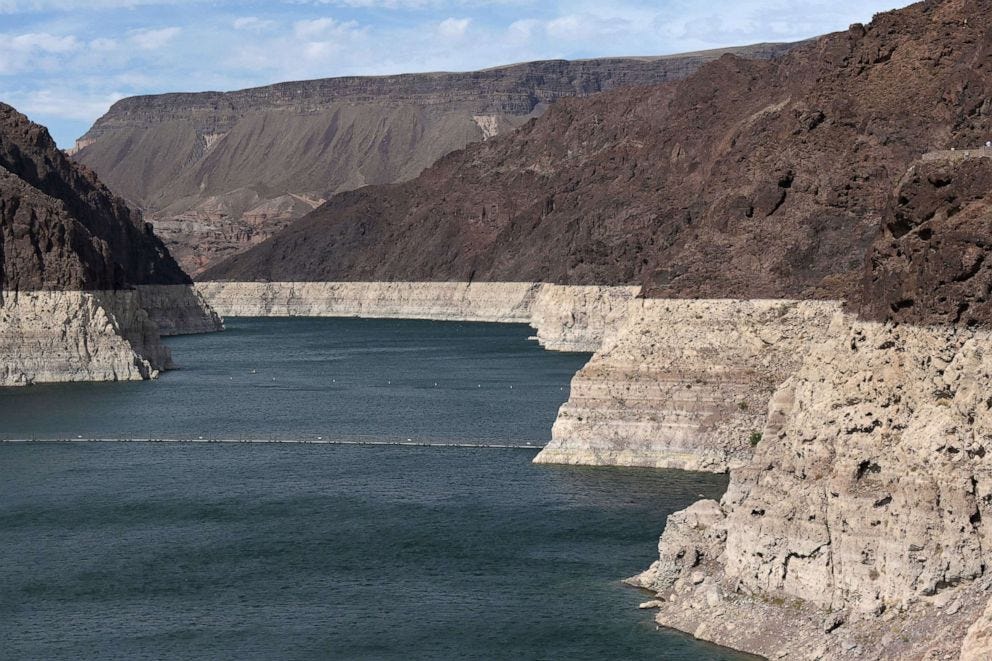
The US Southwest has experienced its worst drought in 1,200 years, with reservoirs like Lake Mead and Lake Powell sitting at only 30% capacity, forcing water rationing for agriculture and power generation. Across Europe, annual drought losses are intensifying, costing an estimated €11.2 billion annually. Globally, 30% of global freshwater is stored as groundwater, and 21 of the 37 largest aquifers are being depleted faster than they can recharge. In the US, of almost 85,000 wells, nearly 50% have had significant water-level decline over the past 40 years; 4 out of 10 sites have hit all-time lows. In California’s San Joaquin Valley, decades of groundwater overpumping have caused parts of the region to sink by as much as 30 feet, one of the largest human-induced surface changes on Earth. These figures reveal a pattern of chronic overuse and structural imbalance, where demand keeps rising even as the natural reservoirs that sustain our economy are running dry.
Too Much
At the same time, excess water is creating its own crisis. Between 1980 and 2022, flooding events in Europe claimed over 5,500 lives, and today, one in every eight Europeans lives in areas prone to river flooding. In the US, flooding is the most common and expensive disaster, having caused $8.8 billion in damages in 2024 to homes and businesses nationwide. Urban systems built for predictable precipitation are now buckling under the weight of new extremes. NYC’s Central Park just saw its highest rainfall total in more than 100 years; urban drainage systems designed for 10-year storms are now routinely facing 50- or 100-year events. What used to be a rare shock is fast becoming the baseline operating condition for cities and utilities.
Too Old
Aging, inefficient infrastructure is compounding the problem. Most water infrastructure in the US was built in the 1930s under the New Deal and expanded under the Clean Water Act and Safe Drinking Water Act in the 1970s. Pipes, pumps, and treatment facilities have long exceeded their intended lifespan and are struggling to meet modern performance standards. The American Society of Civil Engineers gives US drinking water, stormwater, and wastewater infrastructure scores of C-, D, and D+, respectively –– barely passing grades for critical infrastructure. Non-revenue water (water lost to leaks) in the US is estimated at 2 trillion gallons annually, wasting not just water but also embedded energy and treatment chemicals. Replacing and upgrading these systems, including treatment and stormwater infrastructure, will require $1.2 trillion over the next 20 years. Funding levels that public budgets cannot meet alone.
And yet, water remains drastically underpriced. Municipal residential and commercial users can pay around $5-$7 per 1,000 gallons of water. This chronic undervaluation has discouraged investment, masking the real price of scarcity and the growing cost of failure. Some industrial users already pay market rates and are the ones increasingly seeking private-sector solutions that guarantee resilience and operational continuity. Prices are also starting to rise across the board, with global water, wastewater, and stormwater bills rising by 10.7% last year.
The bottom line: the old model of centralized, underpriced, publicly funded water no longer works. The system’s failure is opening a massive gap for private innovation: decentralized systems, data-driven management, and performance-based water infrastructure. For founders, that gap isn’t a crisis — it’s an entry point.
The failure points in global water systems have become open market signals. Aging infrastructure, less predictable supply, and new regulations are creating a sector where founders can build real businesses now, with paying customers, visible ROI, and billion-dollar scale potential.
Infrastructure Rehabilitation & Modernization
Much of the world’s buried water infrastructure is beyond its designed life; in the US alone, 240,000 water main breaks occur each year. Replacing US water infrastructure would cost more than $1 trillion over the next 20 years, a gap no public budget can fill. The opportunity for builders lies in technologies that repair, reinforce, and extend legacy systems at a fraction of replacement cost. From smart coatings that self-seal micro-cracks to in-pipe robotics and predictive maintenance software, founders can modernize aging systems from the inside out.
Water Intelligence & Automation
Most utilities still run blind; 20% of treated water disappears before use in the US. Real-time sensing, analytics, and AI can turn that loss into savings. Think leak detection, predictive maintenance, and digital twins for networks or facilities. Start where data already has value — industry, data centers, food and beverage — then expand to utilities once performance is proven.
Decentralized Treatment & Reuse
Centralized systems can’t keep up with urban growth or drought. Modular, on-site reuse units let factories, campuses, and developments recycle water locally. Founders should focus on containerized systems and leasing or treatment-as-a-service models that remove CapEx friction. Reliability, not chemistry, can be the moat.
Flood & Stormwater Management
Extreme rain is now the costliest weather risk; flooding in the US costs between $180 billion to almost $500 billion annually. Smart stormwater controls, adaptive drainage, and predictive modeling are the new infrastructure layer. Pair tech with insurance or finance partners so resilience becomes a service, not just hardware.
Water-Market FinTech
Scarcity is turning water into an investable asset. Trading in Australia’s water markets has historically exceeded AUS 6 billion ($3.9 billion) annually. Founders can digitize these markets, such as rights exchanges, credit verification, and parametric insurance, by building around existing offline transactions.
Treatment & Compliance Tech
PFAS and nutrient rules (nitrogen and phosphorus) are forcing utilities and industry to upgrade their treatment processes. The EPA estimates new PFAS limits will cost $1.5 billion annually, while the American Water Works Association puts the cost at $5.2 billion for PFOA and PFOS and $5.7 billion for long-chain PFAS. In addition, concerns about the health impacts of microplastics and pharmaceuticals in water supplies are growing. The market will need compact and at-scale destruction units to meet the 4 parts per trillion requirement (set to go into effect in 2029 or 2031). Focus on selling compliance as savings: lower hauling, lower energy, less downtime.
Find the Expensive Incremental Gallon: Focus on customers already feeling the squeeze, where water costs, scarcity, and downtime are highest; municipalities and utilities have long sales cycles, so tread carefully. The ‘marginal cost of water’ (cost of energy and infrastructure to pump from greater depths and distances when freshwater is no longer available) in some regions, including the US Southwest, is already 5x the average cost of commercial water.
Follow Real Budgets: Industrial, municipal, and insurance buyers already pay for reliability and certainty; this isn’t going away.
Stay CapEx-Efficient: Recurring service and monitoring models scale faster than large hardware sales, but don’t be afraid of larger CapEx business models with the right offtakers and partners.
Leverage Incumbents: OEMs, EPCs, and operators are the fastest route to distribution, particularly through joint venture-type collaborations.
Sell Outcomes: Adaptation and resilience that translate into bottom-line cost savings and pay for themselves. But being cheaper isn’t enough to be commercially viable within the next 2-3 years; seamless integration with today’s systems and procurement cycles is also key.
The next generation of water companies will prove that resilience isn’t a cost center, it’s a competitive edge.
Water has become the frontline of adaptation and resilience, the largest system where climate volatility directly translates into economic and human loss. Droughts shut down crop production and power plants, floods erase municipal budgets in days, and outdated infrastructure turns both into recurring business and community risks. For founders, this isn’t a policy problem; it’s a market opportunity.
The next decade’s winners will turn resilience into a monetizable service: tools and systems that keep cities, industries, and supply chains running when environmental conditions are at their worst. The opportunity is no longer about just doing good; it’s about building what’s needed to keep the global economy functional under severe climate stresses.
At GigaClimate, we focus on opportunities that blend:
Strong near-term unit economics with clear payback, measurable savings, and/or risk reduction from day one.
Modular deployments that scale, such as systems that install fast, replicate easily, and don’t depend on billion-dollar infrastructure cycles.
Regulatory and industry pull where markets are being created by compliance, scarcity pricing, mandates, and a high willingness to pay.
This is where founders can move fastest, solving pain points that utilities, insurers, and industries can’t afford to ignore. The next wave of water startups will enable municipalities and industry, not compete with them.
This piece anchors our month on Water Management, which fits into our broader exploration of adaptation and resilience as an investable frontier. Over the coming weeks, we’ll go deeper into where the opportunity lies:
New Water Markets: Who’s buying, selling, and trading resilience.
Water Intelligence & Infrastructure: Where data and physical systems converge to make water networks smarter, faster to repair, and more resilient.
Wastewater to Wealth: How closing the loop creates both profit and protection.
Water isn’t just the frontier of adaptation and resilience; it’s the proving ground. The founders who learn to monetize here will help shape how every other sector adapts next.
Follow along and join the conversation on our deep dive into water - next up we’ll explore where builders can find paying customers for climate-resilient water systems today.
Comments
Nothing yet. Say the first thing.
Sign in to join the conversation.