
Hi Substack,
It’s been a while. Sorry about that.
The longer I go without writing, the harder it is to start again. What should I tell you about? Should I tell you about the food? Should I tell you about my students and their crazy lives? Should I tell you how it feels to stand in the ruins of an ancient Buddhist city, staring across the Amu Daryo river into Afghanistan? Should I tell you about the time my neighbors slaughtered and skinned a goat right outside my bedroom window? Should I tell you about work? So many big and little stories keep piling up, and I don’t know where to start. I also don’t feel comfortable articulating any single story, for fear of it all sounding like the ramblings of a self-obsessed 19th-century anthropologist. As much as my American friends and I complain and commiserate about the little absurdities of life in Uzbekistan, to put it down in writing feels wrong sometimes. I don’t want to exoticise this place more than I already do, but it is precisely this place’s otherness that makes it so hard to write about. Anything I put here feels like an overcommitment, since I have to choose what to leave out and confront the fact that I simply can’t give you anything remotely well-rounded. For now, then, I’ll just tell you about how I feel.
I feel like garbage. I have COVID.
I went to Tashkent on December 24, and stayed with some of the Tashkent ETAs through Christmas and New Years. As the week went on, more of the fulbrighters joined us, coming from their respective cities and vacation destinations. On New Year’s Eve, we all gathered in Tashkent. We had a great time, although our celebrations didn’t go completely unhindered by Uzbekistan’s enduring weirdness.
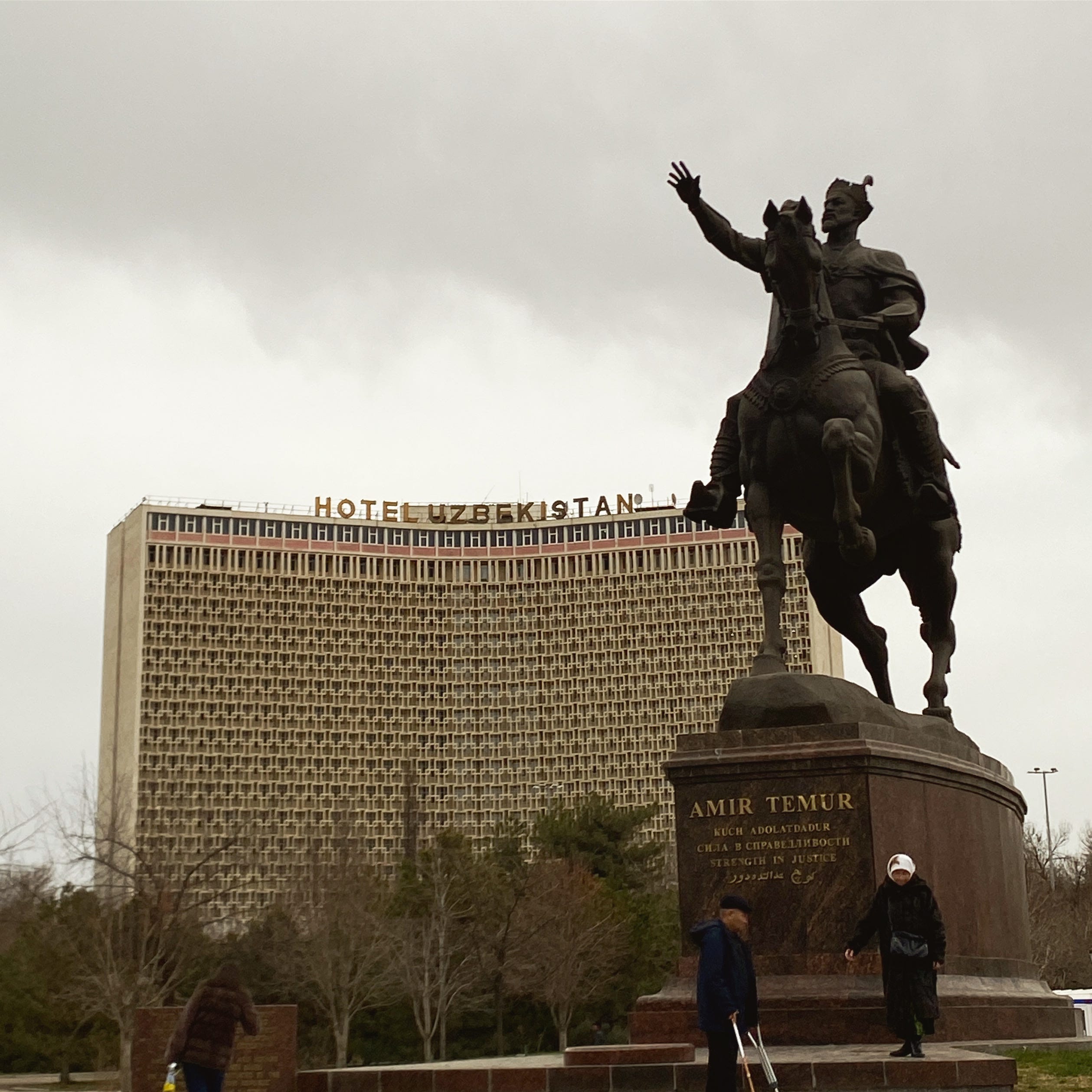
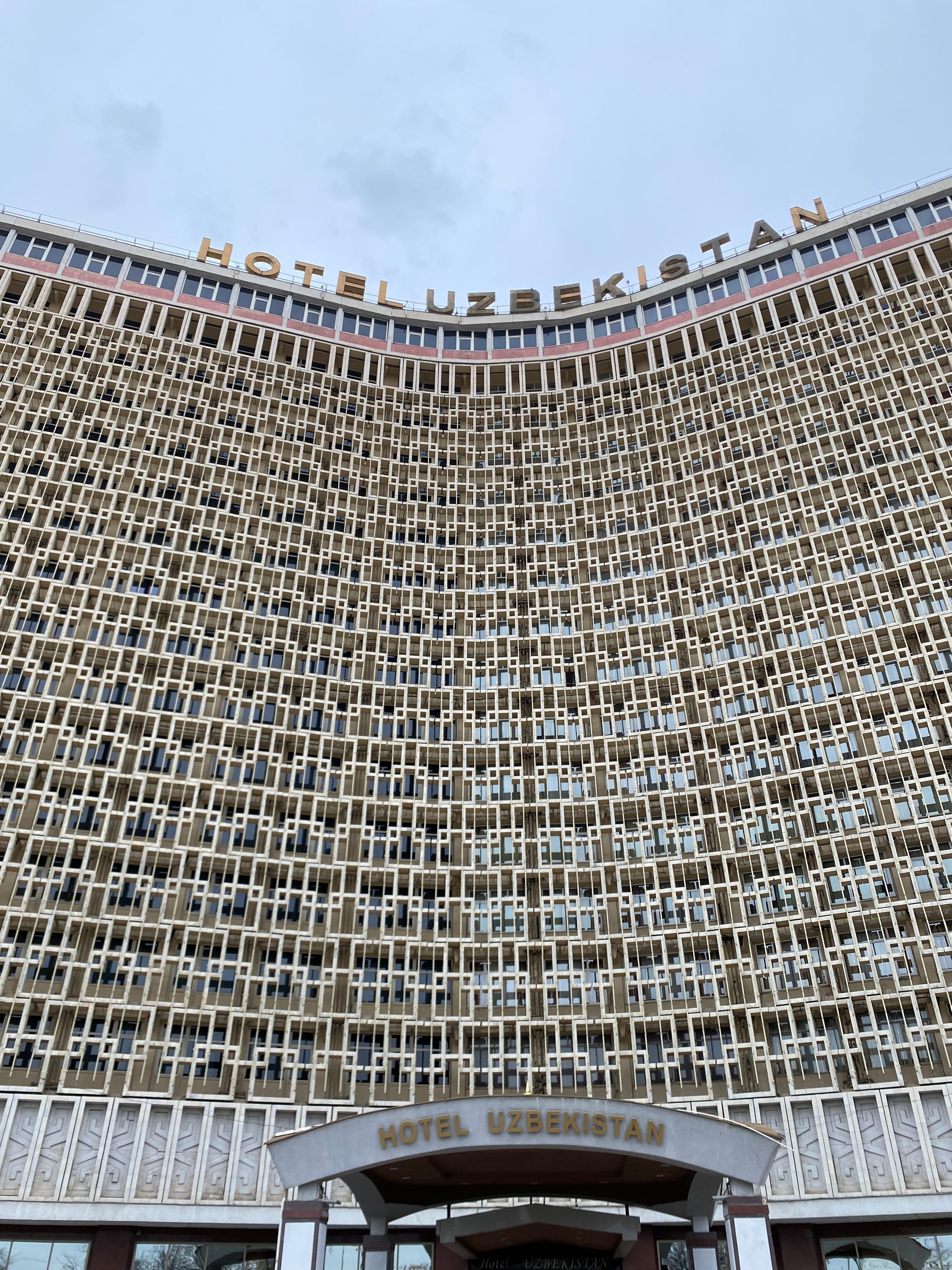
You see, those of us who don’t live in Tashkent decided to rent rooms for the night in the Hotel Uzbekistan—a towering monument to Soviet Brutalism in the center of the city. The building’s hulking stature and unique concrete latticework facade make it one of the city’s most notable buildings, and remains one of Uzbekistan’s most recognizable buildings from the Soviet era. We had heard that the actual hotel had become a bit more grungy than it was in its glory days, but we were just excited to see the place and have somewhere interesting to meet the new year.
The rooms were, even beyond what we had expected, pretty disgusting. I had cockroaches in my room, another friend didn’t have heat in hers, and another friend didn’t have hot water in his. All the rooms reek of stale cigarettes.
More strangely, however (although this is even more on-brand for Uzbekistan), we weren’t actually allowed into the hotel to celebrate. After checking in, we tried to enter the hotel with our whole group, but were stopped by a group of men in the lobby who physically stopped us from accessing the elevator. Apparently, it is forbidden on New Year’s Eve to have any guests in the hotel rooms at all, except for those who have rooms and are registered in the hotel. This is, of course, in the interest of “safety".” Even for those of us with room keys and registration documents, we had to go to the reception desk to prove that we had actually booked rooms for the night before they let us up. While we stood outside waiting for a taxi to take us back to the Tashkent ETAs’ apartment, our safety-minded friends took to shooting industrial fireworks off at a 45-degree angle across the parking lot.
Anyway, back to COVID.
After New Years, I took a train back to Kokand with Daniel, a fellow ETA based in Nukus, the capital of the autonomous region of Karakalpakstan, in the Western part of Uzbekistan. He hadn’t been to the Fergana Valley before, so we were excited to explore together. Unfortunately, the next day, I started feeling awful. More than anything else, my body ached like crazy. I felt like my bones were made of lead, and I became utterly and completely exhausted. On the second day, the aches were replaced by what felt like essentially a nasty head cold, with a runny nose and all that.
I was ready to write it off as a passing cold—something I would never do in the USA, but which, in a country where no one believes in or cares about COVID, is very easy to do—until another one of the ETAs told us that she had tested positive. Daniel and I got tested within the hour, and both our results came back positive. Neither of us were surprised.
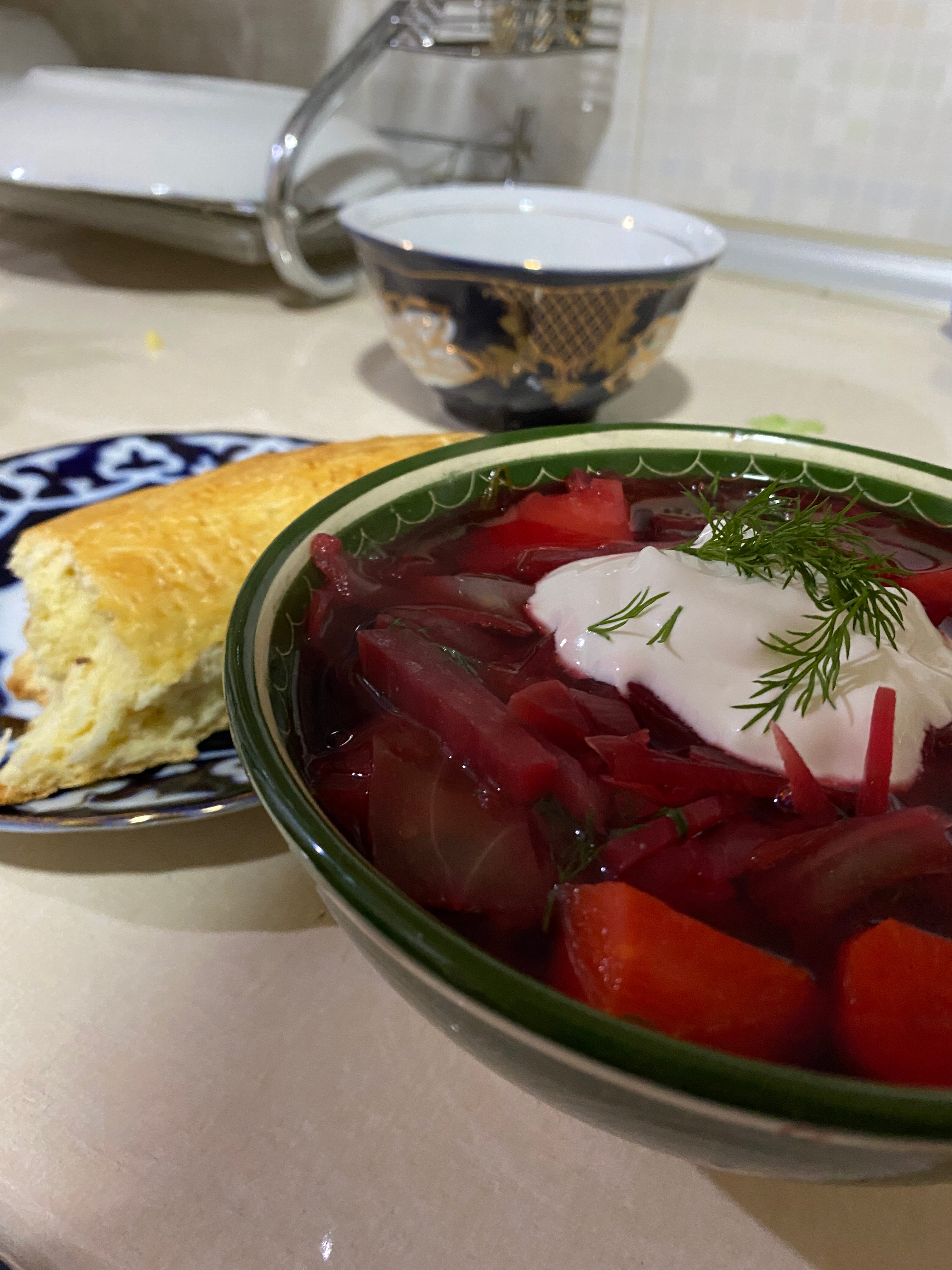
So what does this mean for us? It means I’m stuck in my Kokand apartment for the next 10 days, and that Daniel is stuck here with me, on the other side of the country from his city. I’m still pretty sick—stuffy, exhausted, and sore. I’m lucky to have my little support system here, because I certainly need them now. My co-teacher Zulayho brought some extra mats and pillows for Daniel to sleep on, and my friend Fakhriddin did a big grocery shopping for us. We made Borsch a few nights ago, and we’ve slowly been working our way through it. Tonight, I think Pelmeni (Russian meat dumpling) soup is on the menu. With any luck, we’ll both be feeling fine well before our 10-day quarantine period is up. Hopefully we’ll also be able to avoid the flood of Uzbek medical advice coming our way, urging for mystery injections, unnecessary hospitalizations, and the absolutely terrifying overprescription of antibiotics for anything and everything.
I also hope that this quarantine will give me the chance to get back into writing here. It’s important for me, and I know some people are upset that I haven’t posted for so long. It’s flattering to be missed, and I hope I can keep producing interesting and entertaining content for you all. As always, please do reach out with any questions, feedback, or suggestions on what you’d like to hear me write about!
Until next time, Salomat bo’ling
Patrick
All views expressed above are mine alone, and do not reflect the position or opinion of the U.S. Fulbright Program, the U.S. Embassy in Uzbekistan, or any affiliate organizations of the U.S. Department of State.
No posts
Comments
Nothing yet. Say the first thing.
Sign in to join the conversation.