

Nearly every day I walk our Welsh Terrier. Her name is Gemma—but I like to call her Miss Gemma. She is named after the English actor Gemma Jones—one of my wife’s favorite actors. As you may know, terriers are a handful. They are smart, curious, tenacious and full of ready-to-release energy. Gemma just turned eight years old but acts, at times, like she is one. Without these walks she can be a handful at home in our condominium or at our beach house.
We live in a condominium in Portland and on the Pacific Coast in a house I designed. The routes we take vary based on the location. In Portland, we try to alternate between hill/forest walking and city block walking. After about four miles, the walks become counterproductive—since when Miss Gemma gets tired she can be even more rowdy. So three to four miles is a good walking length window. Each walk has some very predicable elements: lots of sniffing, searching for dropped food on the sidewalks, digging under tree roots and “doing her business” —a euphemism for peeing and pooping.
The walks are primarily geared to exercise. I intentionally vary our destinations to all corners of the city. By doing so, I can see first hand what things are changing, staying the same or getting worse. I have a visual map of the city and its ups-and-downs.
Portland has an odd national reputation. On the one hand, it is proudly “weird.” The TV series Portlandia had a profound effect on how people around the world perceived Portland. Premiering in 2011 and running for eight seasons, it both celebrated and gently mocked aspects of the city's culture. Over time, many viewers came to equate the show's exaggerated version of Portland with the city itself. The show ended just before the COVID pandemic. Many of the conditions that inspired it have changed:
Housing costs rose dramatically.
Homelessness became far more prevalent.
Downtown businesses struggled after the pandemic.
Political tensions increased.
Drug use increased.
The city became less affordable for many artists and young creatives.
As a result, many residents now see Portlandia as documenting the optimistic, quirky Portland of the early 2010s rather than the city as it exists today.
Online, one pundit (who, it turns out after some sleuthing, had not been to our city) recently referred to the city as a “shit hole.” Even the President was quick to “trash talk” our city without stepping a foot here. It is true that the city has major issues to deal with—the most serious being drug use and homelessness—and the attendant security and violence risks associated with the drug culture. These two issues cause the most friction politically.
I’ve been walking the city since we relocated here in 2018. During the pandemic—and then during the George Floyd protests—things were indeed bad. But “shit hole” is not a moniker I would use—it is the name we used when we had to go to the bathroom in the outhouse at my grandfather’s house.
We do have to navigate around a few tents now and then—but considerably less than even a year ago. We know where the likely drug-use spots are—so those can avoided. Things have improved considerably over the past few years and I am optimistic for our city. The biggest challenge, in my opinion, is getting the city and the county to be effective and cooperating on the best way to utilize the funds already appropriated through state and local taxes for services, housing and security.
When walking a dog in the city, the view of a city is distinctly different. One has to pay close attention to the “dog’s view.” This means looking at the sidewalk and watching for hazards and things the dog might love to eat. In Gemma’s case, for example, she loves “goose poop caviar.” But the experience is pleasant—and especially since many folks want to say hi to the “the cutest dog.” We have even had folks pull over in their car and ask about “that cute dog.” Most people think of her as a miniature Airedale—not realizing that the Welsh Terrier is the Airedale’s ancestor. Gemma puts a smile on nearly everyone’s face. Sometimes, a person who is living on the street will even start reminiscing about the dog they had during their childhood. The momentary flashback brings a smile to their face—and perhaps Gemma, for a brief moment, is a Good Samaritan. There is a coursing of goodwill up the person’s arm when they pet Gemma. Miss Gemma generates smiles.
Living in the center of Portland has other advantages. We are 10 minutes by foot from Washington Park and the Hoyt Arboretum. The city itself has a 32% tree canopy coverage rate—which the city is working to increase to 45% by 2050. There are an estimated 1.2 million trees in the parks and natural areas; 330,000 street trees and 2.9 million trees on private property. 35% of the city’s canopy is on public land; 15% on streets and right-of-way; and 50% on private property. One of the most interesting, yet not surprising, findings from Portland's Urban Forest Plan is that tree canopy closely tracks income and historical development patterns. Wealthier, older neighborhoods—especially in southwest Portland—generally have much denser canopy, while many lower-income neighborhoods in east Portland have substantially less, contributing to higher summer temperatures and fewer of the environmental benefits that mature trees provide. At 16,000+ acres, Forest Park is 6.1% of the land area of the city. Central Park in NYC at 843 acres is 0.5%. Walking the city with Miss Gemma is pleasant and uplifting. Forest Park is a dense, temperate rainforest immediately adjacent to downtown Portland, extending nearly eight miles along the West Hills. It is one of the largest urban forests in the United States contained entirely within city limits.
For perspective:
Portland: ~6.6 trees per resident (total of 4.2 Million trees or 77 trees per acre of city land area.
New York City: roughly 5.2 million trees for about 8.5 million residents, or ~0.6 trees per resident
Washington, D.C.: roughly 2 million trees for about 700,000 residents, or ~2.9 trees per resident
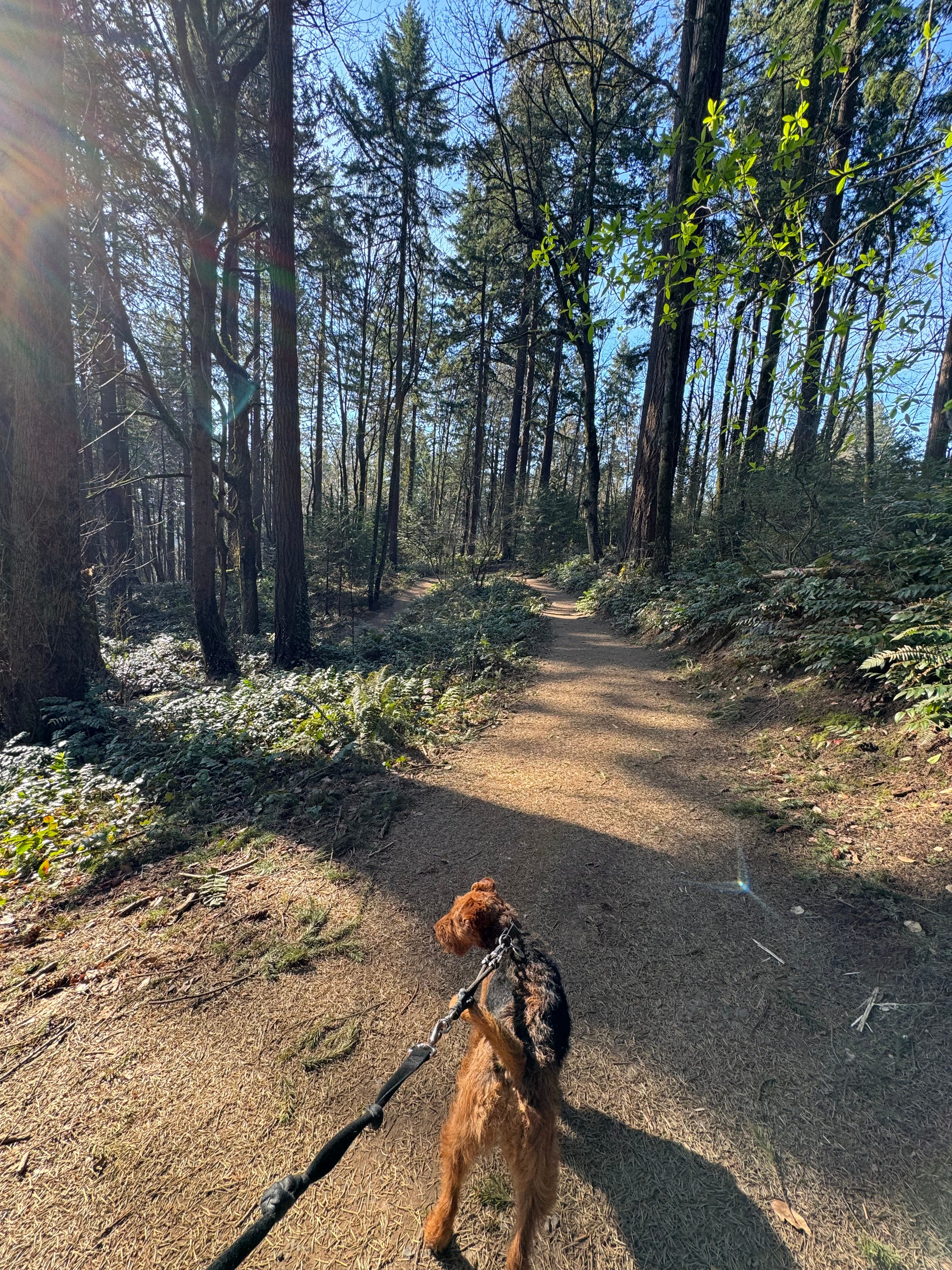
Thanks to Miss Gemma, I am walking 3–4 miles daily. According to most scientific studies, it is among the best-supported habits for maintaining independence, cardiovascular health, and cognitive function well into the eighth and ninth decades of life. At eight years old, I am hopeful Miss Gemma and her dad can age gracefully together on the streets of Portland and in the forests of Oregon.
In a forest, notes John Fowles, we sense that “we stand among older, larger and infinitely other beings,” which he deems “very like the only form universal god could conceivably take.” Psychological studies have shown that looking at big trees naturally produces feelings of wonder, gratitude, and compassion.1
When I look into Gemma’s eye I see that wonder too.
Page 90, In Trees by Robert Moor © 2026 by Robert Moor | Simon & Shuster
No posts
Comments
Nothing yet. Say the first thing.
Sign in to join the conversation.