
CW: Non-graphic discussion of pedophilia, underage sexual assault, emotional abuse.
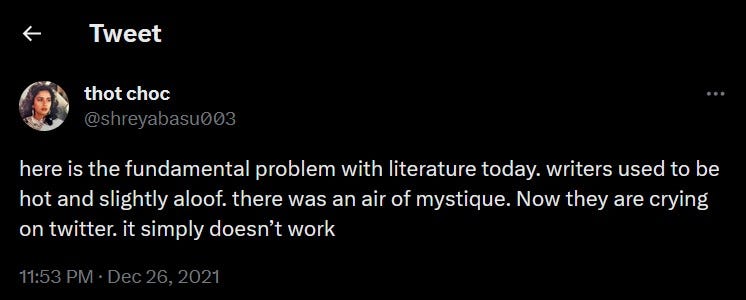
As a teen, I dreamed of publishing a literary bombshell and then immediately vanishing from the public eye, like Harper Lee or J.D. Salinger. For those who don’t obsess over the private lives of canonical greats as a guiding blueprint, they were hermits—the old-fashioned kind. My high school copies of To Kill a Mockingbird and Catcher in the Rye didn’t feature author photos on the back covers. The “About the Author” sections were scant on details, limited to birth dates and locations, and while my English teacher filled in context for the eras in which they lived, he left the personal portraits alluringly hazy.
To be honest, I can’t remember what prompted my prescient yearning for obscurity. Facebook and Twitter were still in their infancy. TikTok and Instagram didn’t even exist. (Oh, take me back…) I couldn’t have dreamed of the social media hustle demanded of authors today.
Perhaps I was beguiled by the persona of Lemony Snicket, the name which appears on the covers of A Series of Unfortunate Events, just as fictitious as any other character penned by author Daniel Handler. There is no pain like growing up to find out a favorite writer’s real name and discovering that their Wikipedia page has a controversy section.
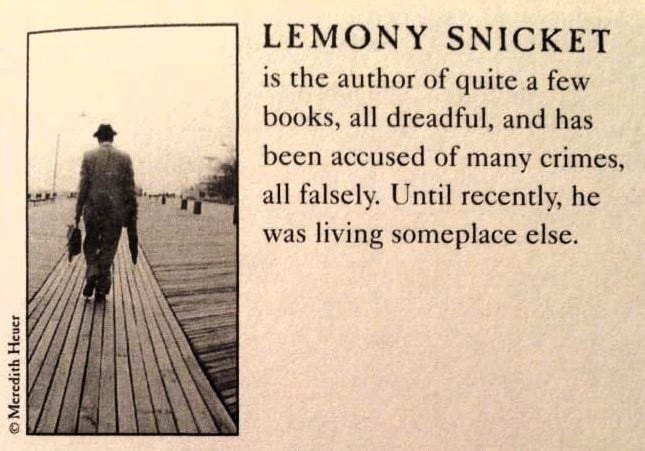
In any case, at that tender age, I didn’t make the connection between Handler’s parody of the shadowy author and the persona of the literary recluse spun by publishers. Of course, the public hungered for interviews from Salinger and Lee, and their editors were no doubt annoyed when each author denied them—but the next best thing had to be leaning into this mystique.
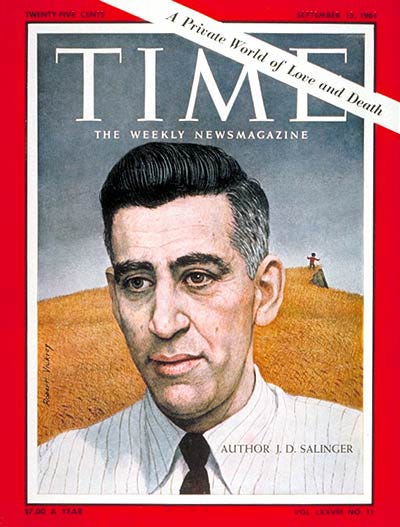
Salinger once said, “It is my rather subversive opinion that a writer’s feelings of anonymity-obscurity are the second most valuable property on loan to him during his working years.”
While looking him up to find that pithy quote for this essay, though, I stumbled across an ulterior motive for privacy. The author of my beloved Franny and Zooey was a groomer.
I don’t use the word lightly. It feels threadbare, stretched out of shape, makes the nose wrinkle with the horrid conjecture of, “Who knows where it’s been?” Except we know exactly where it’s been: the mouths of unhinged bigots. Wrestled from actual advocates for children’s safety to leverage against gay men and trans women and drag queens. Story as old as print.
Maybe it’s useless to play tug of war, but I’m not letting go, not when the word perfectly encapsulates the routine so many old straight cis men insist on performing time and again to victimize underage girls. It’s a tired sleight of hand, but for the young who’ve never seen it, you can’t fault them for believing with childlike wonder that it must be magic. So, sadly, we must review the cautionary tale once more. Run the fucking tape.
Salinger, 53, wrote a letter to Joyce Maynard, 18, following the success of a piece she wrote for The New York Times. He took the lonely fledgling writer under his “mentorship,” stroking her ego via long-distance correspondence, which led to extended stays in his remote New Hampshire homestead, for which she quit her New York Times internship and eventually dropped out of Yale. He continued to isolate her from family, friends, and even the publishing world, to the point of urging her not to publicize her upcoming book whatsoever. Excerpted from her memoir, At Home in the World:
“‘A writer's face should never be known,’ he says.
‘If you hadn't seen my face, would you have written to me?’ I ask him. He doesn't answer.”
Ultimately, when it became clear that due to a medical issue, he couldn’t fuck her, he finally discarded her.
In light of this information, I’m rather inclined to ignore the man’s advice. Besides, it’s all too easy for an established icon to snub publicity when his legacy is already secured. And even if there’s a grain of truth, can we separate advice on art from the artist? Should we?
Even Nelle Harper Lee, rest her soul, didn’t escape the dredging machine of the digital age unscathed. Much has been written and debated about the 2015 novel released under her name, Go Set a Watchman: I’m inclined to agree that that timing was suspicious.
But it wasn’t always fashionable for writers to hoard their opinions either for subtle incorporation into long-form works or til death. I’m sure Oscar Wilde would’ve had a ball on Twitter (at least, before it became X—I’d like to imagine he’d get himself banned by the current CEO in a glorious online equivalent of a gentlemanly slap with a glove.)
Though, would we still revere him as we do now, if he’d possessed the capacity to blast thoughts instantaneously across the digital world, as opposed to waiting for listeners-in at salons to pick and choose his best witticisms to publish in the quarterlies? Would we admire Jane Austen as much if we knew the contents of the letters her family chose to burn posthumously? Not that I think those letters contained any “cancellable” offenses—though I’m sure their absence titillates the imagination far more than their presence could ever inspire.
“Well, it’s better to be silent than to be a fool.”
– Harper Lee
We do gain insight on reclusive authors eventually, upon their deaths. Salinger, the bastard, even admitted that obscurity is “on loan”—biographers wait to devour every diary entry and letter, cross-examine family and friends and lovers. Still, I suspect even biographies barely scrape the surface of life compared to what contemporary authors currently volunteer on social media.
Nevertheless, I think I prefer the old days, having a lifetime of distance between works and the inner landscape of the minds behind them. Hence my teenage fantasy of hermitage. After all, I don’t enjoy posting pictures of myself, not even on private accounts. I prefer far over two-hundred and fifty words to chew on when speaking (or posting) in public.
But where’s the line between mystery and obscurity? Too much mystery won’t do my debut novel or any of my future books any favors.
To write at all is to hinge on the conceit that anyone cares what you have to say. It necessitates no small amount of ego.
Over the last decade, I managed enough ego to write over four hundred pages of prose, spend years querying the manuscript to literary agents, then one last year waiting to hear back while on submission to fiction editors, before I finally received a book deal. The ultimate validation for hundreds of days, thousands of hours writing, re-writing, and breaking down in quiet, existential tears in the dead of night: my publisher was willing to gamble that readers will care what I have to say.
You’d think posting an essay now and then would be considerably easier.
How dreary – to be – Somebody!
How public – like a Frog –
To tell one’s name – the livelong June –
To an admiring Bog!
— Emily Dickinson
I don’t want fame. That’s not false modesty—I’ll admit that what I envied about the great literary recluses as a teen, and what I still yearn after even now, is awe. It’s my work I want under the spotlight, bright enough to hide my face as I watch from the shadows of the wings.
Deep down, I’m still just a lonely kid making up imaginary friends to keep me company in my head. Somewhere along the way, I plucked up the courage to think these stories I daydream deserve to find a home in hearts aside from my own. Perhaps that is in fact conceited, attention-seeking, embarrassing behavior, and I need to get over myself and lean into it. Maybe the currency of the modern world is shaving off slivers of my dignity one confessional essay at a time, in exchange for the privilege of a little attention—worth its weight in gold given the algorithm-driven deficit. Is this vulnerability enough to equate at least one TikTok dance?
Then again, sometimes when I’m at a social outing, I’ll mutter a joke under my breath, and my partner will decide it deserves a wider audience, repeating my punchline: “Nadi says…”
I love them for it. But maybe it’s a sign that I ought to speak up more often, loud enough to be heard the first time.
Even the meek yearn, now and then, for a good void in which to scream. I suppose I’ll let you listen in. You might want to muffle your ears.
— N
Comments
Nothing yet. Say the first thing.
Sign in to join the conversation.