
2 months ago I read about how Intercom Fin gave Claude Code to everyone:
My first thought was hmm, we should do that too. That turned into Wozhub. This is its story.
I started by asking Claude to read Intercom’s post and write a spec for an app based on the Intercom post. The idea was that everyone would get access to a Claude Code instance with MCP servers pre-configured, and they’d also get access to a website (hence the “hub”) where they could push the files, reports, or artefacts that they generated to. The website would do all the data loading in a safe way and would ensure access controls were respected.
This design came with a lot of complexity that I didn’t have easy answers on how to handle. For example, it wasn’t obvious how to sync MCP credentials from the Claude client to the website, how (or if) they should be shared across users, how to map these to team-level access controls that matched our org structure, and a long list of other questions. It also didn’t sound fun to have to host another app. We’re a very monolithic company and this just felt like hard mode.
So I cut the scope in half. Wozhub became a Claude Code instance with MCP servers pre-configured. This turns out to be extremely useful.
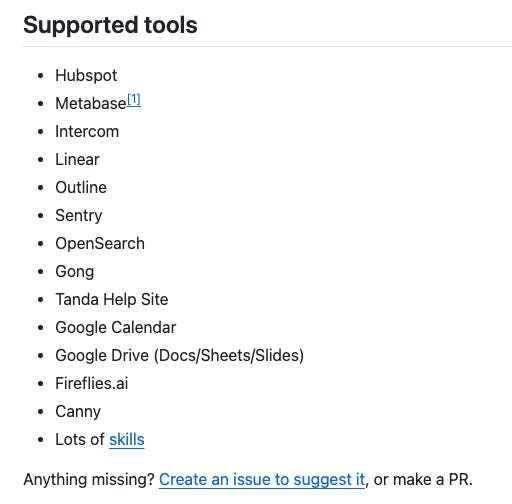
Wozhub is distributed as a Github repo. All the repo contains is a MCP server configurations, Claude skills, and an install script. The install script installs node, AWS CLI, Claude Code, and some of the more complicated MCP servers.1
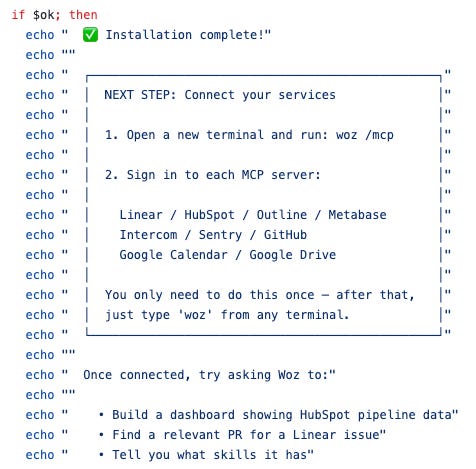
Then, there’s a one-liner terminal command in the README that installs Homebrew, installs gh, logs in to gh, clones the repo, and runs the install script. Once that’s done users are prompted to open Wozhub (using the system wide alias woz (which just calls claude)) and log in to any MCP servers they want to use.
We found that once they had access to the repo, most people were able to get up and running by themselves, or with a colleague looking over their shoulder.
When I first read the Fin post I was a bit bemused. I was skeptical that there was so much value to be unlocked just in making it easier to connect to MCP servers. After all, I’d been using MCP servers in Claude Code for a year now, and it’s not that hard to set up, right?
I was dead wrong.
It turns out getting connected to all your tools is still the biggest roadblock in AI. Any friction you can remove in that process has a huge impact. Many SaaS companies are trying to add chatbots inside their product so you can use AI to interact with data inside it, but for a lot of products, what users actually want is a way to use AI from outside of it. Wozhub delivered that.
Fast forward a month, in our next company all hands, of the 5 company priorities we set for the next cycle, 2 directly referenced Wozhub.2
Every week we get messages from people in the company - sometimes people I’ve never talked to before - who’ve used Wozhub to make some part of their job easier.3
As a company we don’t push very hard on training, we prefer to hire people who like to figure things out themselves. When we did any Wozhub training, it focused on 1) here’s how to install it, 2) if you do something cool with it, consider making a skill so other people can use it too.
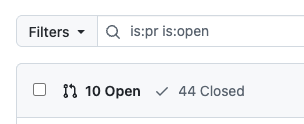
The training worked! Most days there’s new Wozhub PRs as people contribute skills that can be shared with others.
Reflecting back, there were two really big wins that I didn’t forsee:
Giving everyone access to query Metabase in natural language. So many questions across the company boil down to “who’s using this feature” or “which customers have set this up correctly”. Now everyone has access to a complete product analytics suite in their terminal, so they can spend less time doing admin work to then speak to customers, and more time just speaking to customers.
A much simpler version of the original “hub” idea. Rather than the website with all the access control challenges I originally considered, we added a skill that just knows how to write HTML reports to a private S3 bucket with a strict access & expiry policy. Every other skill knows that it should use this skill to generate output. So anytime you ask Wozhub to do something you get a nicely formatted report with a shareable link that’ll work for a few days. This was just the right level of detail to let people share their work without creating a whole new system to maintain and manage.
Wozhub has been a big success and I’m excited to see all the good stuff people keep building with it. If you’re reading this you should consider building your own version.
Special shout outs go to Austin, who did a lot of the day to day work of getting people ramped up on Wozhub, and to Paul Vickers from Intercom, who wrote a lot of great posts (particularly this one) that helped give us a roadmap. We took Paul’s “every piece of friction we found, we removed” to heart and I think it was very good advice.
I dunno what they’re smoking over at Hubspot.
Both were basically “take this current process that we don’t do very well, and rebuild it on top of Wozhub so that it’s automated and exceptional”.
Don’t set up your own Wozhub if you don't want to get messages like this:


No posts
Comments
Nothing yet. Say the first thing.
Sign in to join the conversation.