
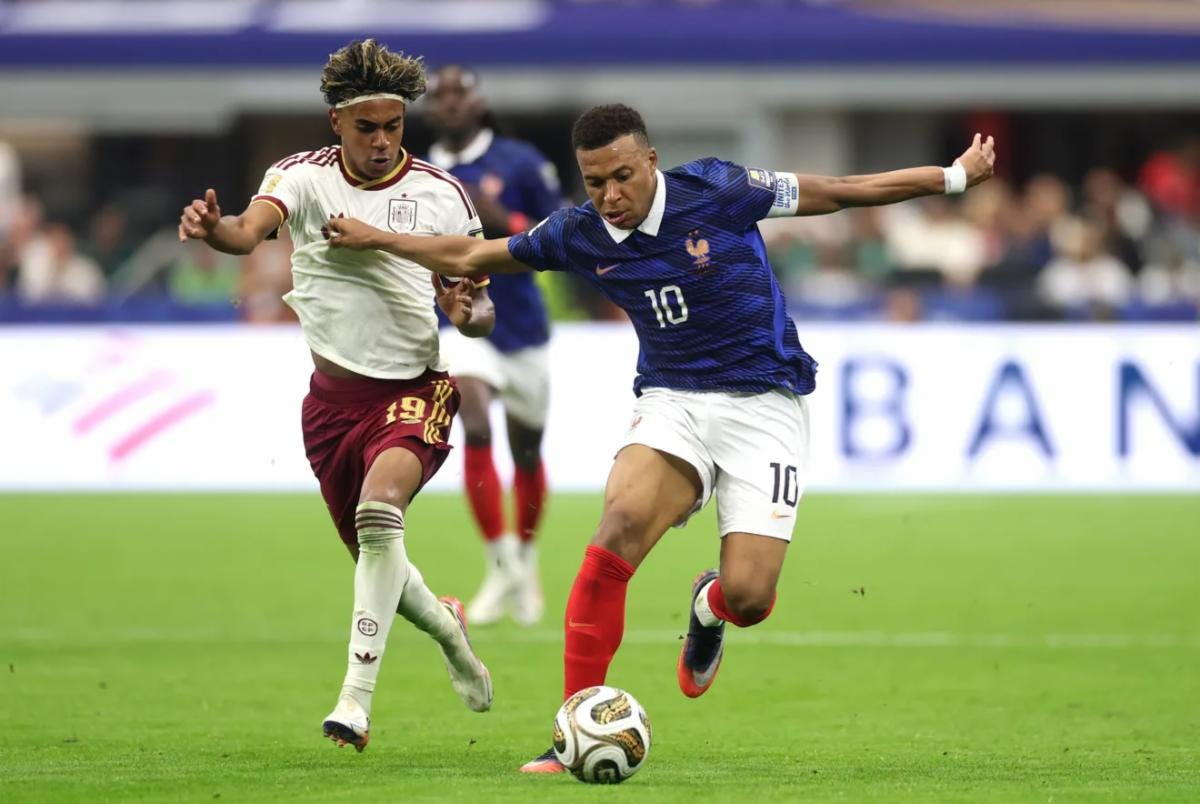
A clinical and highly disciplined Spain advanced to their first FIFA World Cup final in 16 years after brushing aside neighbors France 2-0 in a high-octane semifinal clash at Dallas Stadium on Tuesday. A first-half penalty from Mikel Oyarzabal and a brilliant second-half strike by right-back Pedro Porro sealed a memorable victory for La Roja, crushing French dreams of reaching a third consecutive global final.
The victory marks the third consecutive summer that Spain has eliminated France in the final stages of a major tournament, following their triumphs in the Euro 2024 semifinals and last year’s UEFA Nations League.
Teen prodigy Lamine Yamal, who celebrated his 19th birthday just a day prior, proved to be the architect of destruction once again. In the 22nd minute, Yamal’s trademark anticipation caught the French defense off guard. French defender Lucas Digne misjudged a looping header in his own box, allowing a sprinting Yamal to steal the ball from behind. In a desperate attempt to recover, Digne clipped the teenager, prompting the referee to point straight to the penalty spot.
Mikel Oyarzabal stepped up calmly and sent French goalkeeper Mike Maignan the wrong way to net his fifth goal of the tournament, handing Spain a vital 1-0 lead.
France, the top-ranked team in the world, struggled to find their usual attacking rhythm. High-flying talisman Kylian Mbappé, who currently leads the Golden Boot race with eight goals, was kept entirely quiet by a relentless and organized Spanish backline. Spain’s pressing system restricted France’s midfield supply lines, isolating the French forward line for long stretches of the game.
Any hopes of a French comeback were emphatically dashed in the 58th minute. Pedro Porro initiated a beautiful give-and-go passing sequence with Dani Olmo on the edge of the area before driving a powerful shot past Maignan to make it 2-0.

England vs Argentina
The historic, fiercely contested soccer rivalry between Argentina 🇦🇷 and England 🏴 has written a brand-new chapter on the grandest stage of them all. Meeting in the 2026 FIFA World Cup Semifinals in Atlanta, Georgia, the match delivered all the high-stakes drama that fans have come to expect from this legendary matchup.
In their sixth World Cup encounter, Thomas Tuchel’s England took a 1-0 lead early in the second half through a 55th-minute strike by Anthony Gordon. Holding firm for much of the game, England seemed poised to reach their first final since 1966.
However, Lionel Scaloni’s defending champions showcased the championship grit that has defined their modern era. Led by captain Lionel Messi, who orchestrated the attack with two late assists, Argentina mounted a furious comeback in the final ten minutes. Enzo Fernández found the equalizer in the 85th minute, before Lautaro Martínez sent Argentine fans into ecstasy with a dramatic winner in stoppage time (90+2’) to seal a 2-1 victory and secure a spot in the World Cup Final.
This latest fixture adds to a long list of legendary World Cup moments between the two nations, evening their head-to-head World Cup record at 3 wins apiece.
1966 Quarter-finals (England 1-0 Argentina): A fiercely physical match marked by the controversial sending-off of Argentine captain Antonio Rattín. The aftermath birthed a decades-long sporting grudge.
1986 Quarter-finals (Argentina 2-1 England): Diego Maradona’s defining game. He scored the infamous “Hand of God” goal before weaving through the entire English defense to score the “Goal of the Century” just four minutes later.
1998 Round of 16 (Argentina 2-2 England - ARG wins on pens): A thrilling match featuring a wonder-goal by a teenage Michael Owen, a red card for David Beckham, and ultimate heartbreak for England in the penalty shootout.
2002 Group Stage (England 1-0 Argentina): Beckham earned his ultimate redemption, burying a first-half penalty to send England through and contribute to an early tournament exit for Argentina.
With their triumph in Atlanta, La Albiceleste have once again proven to be England’s ultimate World Cup kryptonite, booking their ticket to another global final on the back of pure late-game magic.
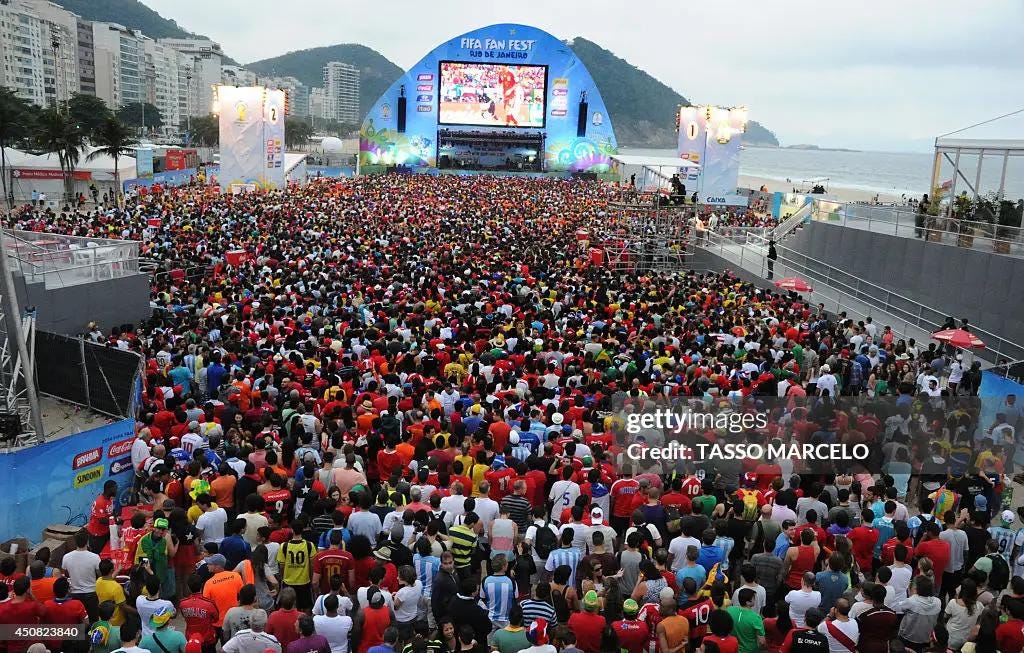

The 2026 FIFA World Cup has shattered expectations, proving that an expanded 48-team field generates intense drama rather than lopsided mismatches. As the tournament enters the semifinal stage in North America, several historic milestones and stunning storylines have defined this edition.
When FIFA expanded the tournament, critics feared the group stage would lose its edge. Instead, the addition of new nations injected unprecedented chaos. Cabo Verde 🇨🇻 emerged as the ultimate underdog story of the summer, shocking the world by holding European giants Spain to a 0-0 draw and fighting back to secure a 2-2 draw against Uruguay. Emerging nations across the board have closed the gap, turning the group stages into a highly competitive battleground.
At 38 years old, Lionel Messi 🇦🇷 has rewritten soccer history once again. By netting a brace in a 2-0 victory over Austria during the group stage, Messi broke Miroslav Klose’s long-standing men’s record of 16 World Cup goals. He now stands alone at the absolute top of the sport’s historic scoring charts with 18 career World Cup goals, also surpassing Marta’s international tournament record.
While Messi looks to cement his legacy, Kylian Mbappé 🇫🇷 is hunting down a modern dynasty. Leading the race for the Golden Boot with 8 goals in the tournament, Mbappé has carried France to their third consecutive World Cup semifinal appearance. Right on Messi’s heels historically, the French superstar already sits at 16 career tournament goals at just 27 years old.
The tournament has now narrowed down to a high-stakes heavyweight final. With the final set for July 19 at New York/New Jersey Stadium, the 2026 World Cup is rapidly heading toward a legendary conclusion.
A summer of controversy
While the action on the pitch has delivered historic performances, the 2026 FIFA World Cup in North America has been equally defined by major off-pitch controversies. As the tournament heads into the semifinals, the massive expansion and logistical friction have sparked furious debates across the footballing world.
Here are the biggest scandals and flashpoints that have dominated the headlines:
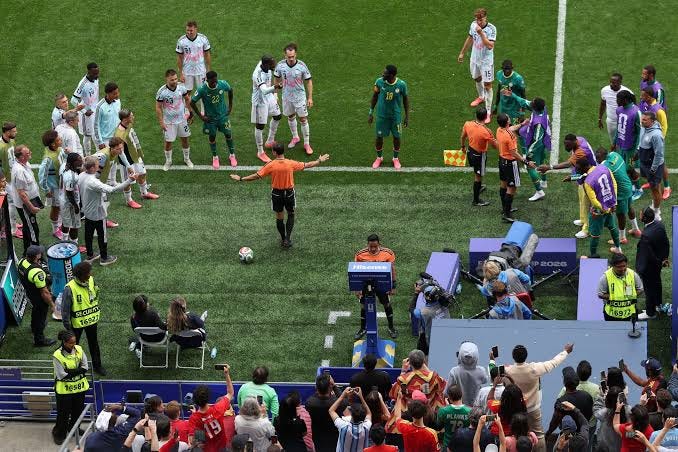
No issue has caused more outrage than refereeing consistency, highlighted by a chaotic Round of 16 clash between Argentina and Egypt. After Argentina escaped with a dramatic 3-2 victory, the Egyptian Football Association lodged an official complaint with FIFA. The flashpoint included a disallowed Egyptian goal via a controversial VAR check, a denied late penalty appeal, and a stoppage-time winner for Argentina.
The controversy took a political turn when Egypt’s coach, Hossam Hassan, publicly claimed his side was “cheated” and suggested marketing forces were actively trying to keep Lionel Messi and Argentina in the tournament.
A repulsive off-pitch incident cast a shadow over the knockout stages after France’s Round of 16 win over Paraguay. Following Kylian Mbappé’s match-winning goal, Paraguayan Senator Celeste Amarilla targeted the French captain’s Cameroonian heritage, appearance, and identity in a series of highly abusive social media posts.
Mbappé condemned the remarks as “despicable,” prompting a formal apology from the Paraguayan government to France and a criminal investigation by prosecutors in Paris. The United Nations also stepped in to issue a formal warning regarding systemic racism in modern football.
FIFA’s deployment of a demand-based dynamic pricing model sparked unprecedented backlash from fans, players, and United States politicians. Ticket prices for the final at MetLife Stadium soared up to $11,000, forcing attorneys general from New York, New Jersey, Texas, and California to launch consumer price-gouging inquiries.
Even players like USMNT midfielder Timothy Weah publicly voiced frustration that ordinary fans were being priced out. The pricing strategy seemingly backfired, as thousands of empty hospitality seats were visible during several group-stage matches—prompting embarrassing scenes where FIFA volunteers were instructed to occupy empty prime seating.
Playing summer football matches across North America brought intense weather challenges. Dozens of players signed a coordinated letter demanding stronger environmental protections as afternoon kickoff temperatures skyrocketed.
While FIFA implemented mandatory cooling breaks to protect player safety, the solution triggered its own corporate controversy. Broadcasters immediately used the medical stoppages to cut away to commercials, angering fans who accused networks and FIFA of turning player health risks into a new advertising stream.
FIFA found itself in hot water with UEFA and European federations over arbitrary disciplinary rulings. After USMNT forward Folarin Balogun received a straight red card against Bosnia and Herzegovina, FIFA controversially intervened to suspend his automatic one-match ban. The decision provoked a furious reaction from UEFA, who accused FIFA of crossing a regulatory red line, while teams like Belgium demanded an official explanation regarding the perceived favoritism.
Which of these off-pitch issues do you think will leave the most lasting impact on how future World Cups are run?
Women’s College Soccer in AL
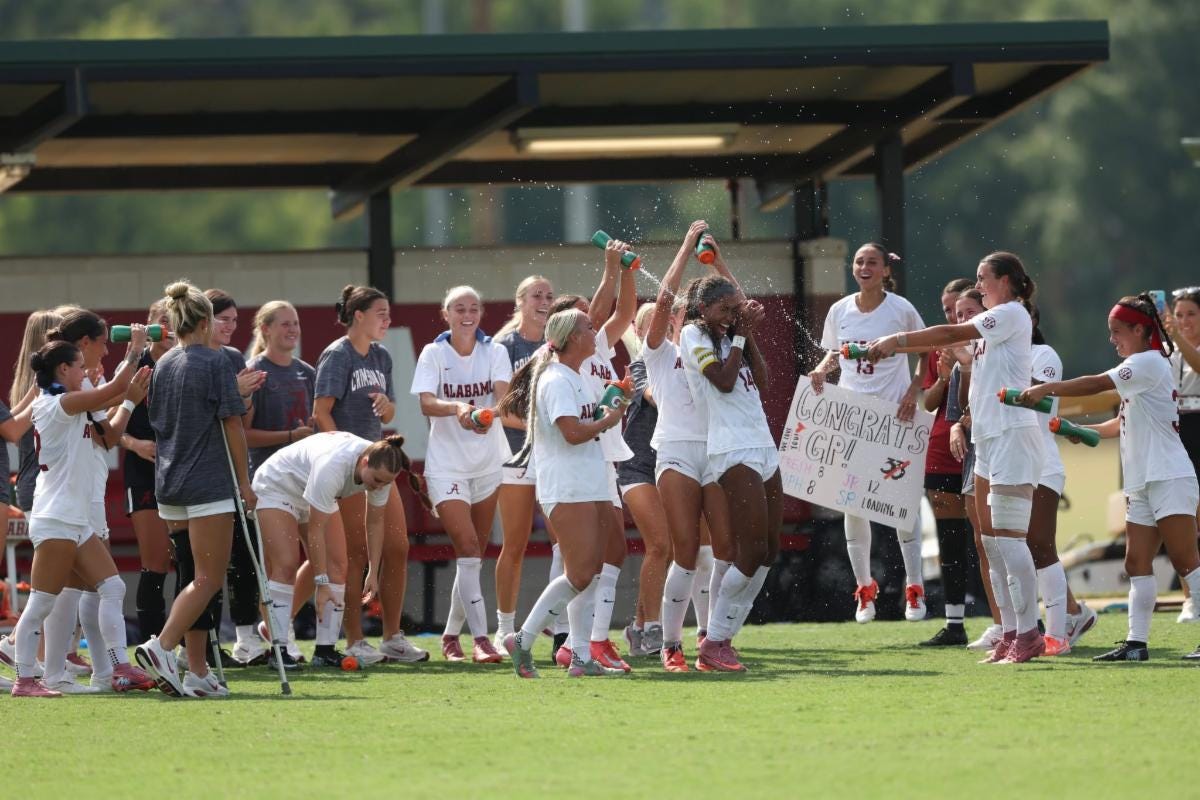
As mid-summer blazing heat settles over the state, the countdown to the 2026 collegiate soccer season has officially begun. Programs across Alabama are finalizing their summer preparations, welcoming dynamic transfer additions, and locking in their tactical approaches ahead of an action-packed August kickoff.
From grueling SEC rivalries to mid-major powerhouses looking to make a deep postseason run, the upcoming campaign promises to deliver premier soccer right in our backyard.
The biggest news heading into the fall is the highly anticipated battle for the state, which takes center stage earlier than usual.
The Alabama Crimson Tide, fresh off head coach Wes Hart signing a massive contract extension through 2031, dropped their official 2026 schedule with an immediate marquee circle on the calendar. The Crimson Tide will open their SEC conference schedule on the road in Auburn for a massive Iron Bowl showdown on Friday, September 11. With five highly competitive SEC home matches scheduled at Alabama Soccer Stadium—including dates against powerhouse programs like Arkansas (Sept. 18) and Tennessee (Oct. 23)—Tuscaloosa will be an absolute fortress this fall.
Meanwhile on the Plains, the Auburn Tigers are quietly building a roster geared toward upending the conference hierarchy. Auburn’s home crowd at the basic brick-and-grass complex will play a massive factor as they look to defend their turf in the early-season rivalry game before navigating a brutal gauntlet of SEC road trips.
Beyond the SEC spotlight, the state’s mid-major programs are shaping up to be exceptionally dangerous, setting up fantastic non-conference drama:
South Alabama Jaguars: Always a powerhouse in the Sun Belt, the Jaguars have scheduled a massive target on August 30, when they host the Crimson Tide in Mobile. It represents a premier opportunity for the coastal squad to pick up a resume-defining win early on.
Samford Bulldogs: The perennially dominant force in the Southern Conference (SoCon) is reloading for another championship run. They will travel to Tuscaloosa on September 3, a fixture that always provides top-tier tactical execution and local bragging rights.
Troy Trojans: The Trojans round out the intense inter-state scheduling matrix, traveling for an away fixture against Alabama on August 27 to test their revamped defensive structures against elite SEC attacking speed.
Mark your calendars for the defining milestones of the 2026 calendar:
August 12: Regular season official kick-off.
August 30: Alabama at South Alabama (Mobile, AL).
September 11: The Iron Bowl of Soccer — Alabama at Auburn (Auburn, AL).
November 8–15: The SEC Tournament returns home to the coast, hosted once again in Orange Beach, AL.
Whether you are heading down to Mobile, packin’ the stands in Tuscaloosa, or chanting on the Plains, the depth of coaching talent and elite player pools across the state means this fall is going to be something special.
What is new in the Women’s Game
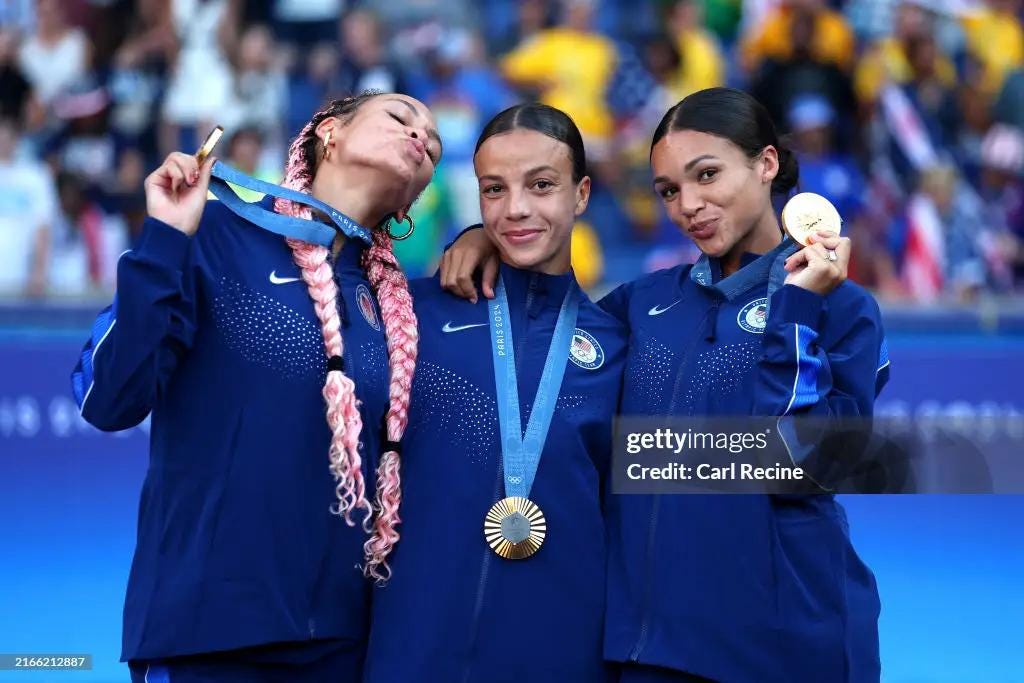
The world of women’s soccer is moving at a breakneck pace, driven by unprecedented financial investment, skyrocketing attendance, and major tournament structural changes. As professional leagues and international federations push for global expansion, the landscape looks fundamentally different today.
Here is what is new and shaping the sport.
The biggest structural shift in the women’s game arrived with the inaugural edition of the FIFA Women’s Champions Cup. Gathering the elite club champions from all six continental confederations in a single-elimination bracket, the event crowned Arsenal as the first-ever global club champions following a thrilling 3-2 extra-time victory over Corinthians at Emirates Stadium.
Crucially, the tournament injected massive resources directly into the club ecosystem, offering a $2.3 million prize for the winners—the largest single payout in women’s club football history.
North America’s premier domestic league is demonstrating exponential growth at its mid-year mark. The NWSL reached one million fans in attendance faster than any season in its history, currently pacing at an all-time high league average of over 11,000 fans per match.
The absolute highlight came earlier this year when a massive crowd of 63,004 fans filled Empower Field at Mile High for a match between Denver Summit FC and the Washington Spirit, setting a new NWSL record and cementing the largest turnout ever for a U.S. professional women’s sporting event. This fan energy is translating straight to the ledger, with league retail sales rocketing up 72% year-over-year.
International calendars are intensifying as the road to the 2027 FIFA Women’s World Cup in Brazil begins to take shape. Heavyweights like defending world champions Spain have already locked in direct qualification through a dominant UEFA campaign.
Stateside, the focus shifts toward the end of the year when the U.S. will host the 2026 CONCACAF W Championship across Texas. The tournament, featuring an eight-team bracket including Canada, Mexico, Jamaica, and the USWNT, will serve as the final crucible for North and Central American teams trying to secure their plane tickets to Brazil.
To prepare for the rigorous qualification window, national teams are scheduling blockbuster friendlies. Head coach Emma Hayes and the reigning Olympic champion USWNT have booked a highly anticipated East Coast double-header against World No. 1 Spain for this October. The fixture at Audi Field on October 10 will pull double-duty as a top-tier tactical test and a formal pre-game retirement celebration for legendary U.S. defender Crystal Dunn.
Which of these milestones—the new global club tournament, surging domestic league numbers, or upcoming international qualifiers—do you think is having the biggest impact on the sport?
No posts
Comments
Nothing yet. Say the first thing.
Sign in to join the conversation.