
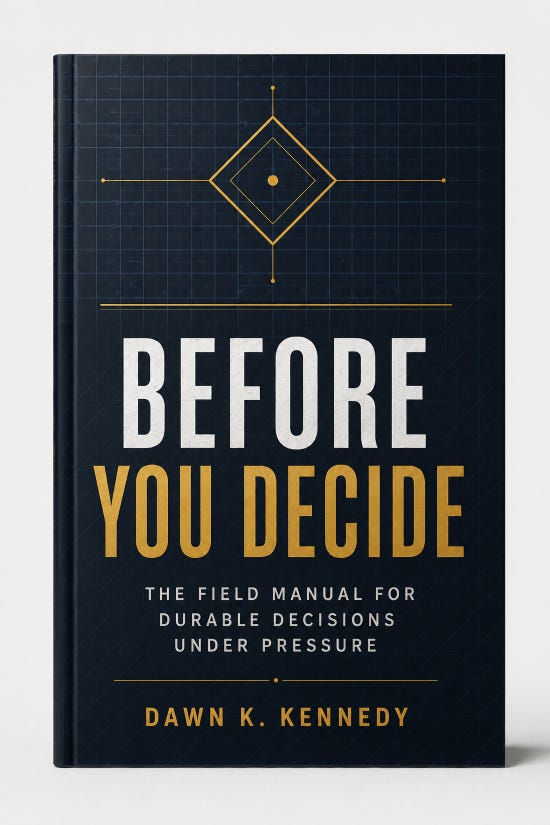
Before You Decide releases today.
And the question I keep coming back to is not, “What is this book about?”
The better question is:
Why now?
Why this book, now, when business owners already have more frameworks, tools, consultants, templates, dashboards, courses, coaches, operating systems, financial methods, productivity systems, marketing plans, and strategy advice than they could ever possibly use?
Why write a book about decision-making when the business world is already drowning in answers?
Because answers are not the same thing as judgment.
And frameworks are only helpful when we understand the condition they are entering.
That is the part I could not stop writing toward.
For a while, I thought I was publishing my framework. Dawn’s Strategic Intelligence Framework.
A way to help business owners gather better information, identify the real problem, examine tradeoffs, evaluate timing, understand capacity, and make decisions that could hold under pressure.
And yes, there is architecture in my own work. There are patterns, questions, ways of seeing, and disciplines.
But the more I worked with business owners, founders, operators, legal clients, coffee decisions, family business decisions, and my own history of business loss and rebuilding, the more I realized something important:
You do not need my framework to run your business.
You can use EOS. You can use Profit First.
You can use a coach’s model, a lender’s template, a strategic planning worksheet, a fractional CFO’s dashboard, a whiteboard, a legal pad, a spreadsheet, or a system your grandfather made up in 1987 that somehow still works better than half the software on the market.
The issue is not whether you have a framework.
The issue is whether you know what the decision is really asking before you step into one.
Because if you do not, any framework can become theater.
A planning session can become theater.
A dashboard can become theater.
A quarterly review can become theater.
A cash management system can become theater.
A business plan can become theater.
Even a beautiful operating system can become theater if no one in the room is willing to ask what the decision will actually require the business, the people, the cash, the owner, and the system to carry.
You have seen pieces of my own work here before.
You have seen the Breakthrough Number here on Substack. My ADFP market research architecture was published more than five years ago in my first book.
I have built tools. I believe in tools. I use tools.
But one of the most dangerous things we can do with any business framework, mine included, is to collapse a whole decision into “use this.”
Use this worksheet.
Use this system.
Use this dashboard.
Use this operating model.
Use this financial method.
Use this marketing plan.
Sometimes that helps. Sometimes it is bringing a Band-Aid to a gaping wound.
And sure, maybe the bleeding slows down for a minute.
But the better question was never, “Which Band-Aid should we use?”
The better question is:
Does this need stitches? Does it need pressure? Does it need more support?
Less movement? A different specialist? More time?
Or maybe (and this is where business gets uncomfortable) do we need to stop putting the same body part into the same machine and acting surprised when it keeps getting injured?
That is the difference between a tool and decision discipline.
A tool helps you do something.
Decision discipline helps you understand what the situation is actually asking before you decide what to do.
It is a correction to how we enter them.
Use EOS. Use Profit First. Use your planning system. Use your advisory board.
Use your scorecard, budget, intuition, experience, whatever actually helps you operate.
But before you decide, learn to ask what the decision is really asking.
Not just:
Can we do this?
But:
What will this require?
What does this assume?
Who carries the consequence?
What happens if the timing is wrong?
What tradeoff are we pretending is not a tradeoff?
What pressure is making this feel urgent?
What capacity will this consume?
What part of the system has to absorb the load?
What changes on Monday?
That is the missing discipline.
Not because business owners are careless. Most are not.
Not because they are unmotivated. Good grief, most are carrying more than anyone sees.
Not because they need one more expert to tell them they are doing it wrong. They do not.
This book exists because good operators can still make fragile decisions when the framework in front of them does not account for the real conditions underneath them.
And because sometimes the most dangerous advice is the advice that sounds responsible while failing to ask the right question.
That is one of the most human truths in this book.
Sometimes the problem is not the strategy, the dream, the effort, the intelligence, or the willingness to work.
Sometimes it is your socks.
And yes, I know, wet socks do not sound strategic.
No one puts “sock condition” on a quarterly planning agenda.
No one opens a board meeting with, “Before we discuss revenue, can we confirm everyone’s feet are dry?”
But wet socks still change the walk.
They change your patience, your pace, and how long you can keep going before everything feels harder than it should.
And business is full of wet socks.
The tiny irritation no one names.
The capacity issue everyone keeps stepping around. The employee who is “fine” but not fine. The owner who is exhausted but calling it focus. The customer promise that seemed reasonable in the sales conversation but is now making operations limp. The cash gap hiding underneath revenue growth. The family tension sitting quietly under the staffing decision.
The thing that does not sound strategic enough to put on the whiteboard but is absolutely changing how the business moves.
Wet socks matter.
Not because they are the whole problem.
Because pretending they are not part of the condition is how people make bad decisions with very serious faces.
It is for the operator who has outgrown motivational business advice.
It is for the founder who has tools but still feels the decision underneath the tool is unresolved.
It is for the small business leader who is tired of being told to work on the business when no one is helping them understand what the business is asking them to carry.
It is for the family business owner navigating history, money, loyalty, resentment, love, and payroll in the same decision.
It is for the chamber member, the Main Street owner, the consultant, the attorney, the accountant, the lender, the coach, the SBDC advisor, the professor, the student, the manager, and the person sitting quietly in the room thinking:
“This plan sounds good, but something about it does not hold.”
It is for the people who use frameworks and want them to work.
It is for the people who have been failed by frameworks and are not ready to give up on disciplined thinking.
It is for the person who does not need a guru.
They need a way to see.
That is why now. Because we are in an economy where the cost of fragile decisions is getting higher.
Money is tighter.
Labor is harder.
Customers are more cautious.
Technology is louder.
Advice is everywhere.
Certainty is being sold by the truckload.
And Main Street operators are still being asked to make decisions with enterprise-level consequences and Main Street-level support.
That gap is the work.
That is what I could not stop writing.
Not a framework to replace every other framework.
A field manual for the judgment underneath them.
Before You Decide is not asking you to abandon the tools you already use.
It is asking you to stop handing your judgment over to them.
Use the tools.
But bring the whole decision.
The data, the pressure, the wet socks, the tradeoffs, the human beings.
Bring the part you are afraid to say out loud because it does not sound professional enough.
Bring the thing the spreadsheet does not know, the thing the room keeps stepping around, the question underneath the question.
That is where the real work begins.
That is why I could not stop writing this book.
Because before a framework can help you, you have to be willing to tell the truth about the conditions it is entering.
And before you decide, you have to know what the decision is really asking.
Before You Decide is available today.
For the operators carrying decisions that have to hold.
If this piece made you think of a business owner, founder, advisor, chamber leader, family business, operator, or local leader carrying decisions under pressure, please share it with them.
Not because they need one more framework.
Because they may need a better way to see the decision before they answer it.
And If This is For YOU:
Before You Decide: The Field Manual for Durable Decisions Under Pressure is available now:
Amazon Kindle: Here
Amazon Paperback: Here
For bulk, bookstore, chamber, or organizational orders, please visit: https://dawnkkennedy.com/byd/
No posts
Comments
Nothing yet. Say the first thing.
Sign in to join the conversation.